Steam Systems
Basics, Challenges and
Troubleshooting
John Cilyo
Senior Account Executive
Spirax Sarco Inc.
For
Steve Jalowiec, PE, CHFM
Steam Systems & Chaos
Theory
In mathematics, chaos theory describes the
behavior of certain dynamic systems – that is, systems
whose states evolve with time – that may exhibit
dynamics that are highly sensitive to initial conditions
(popularly referred to as the butterfly effect). As a result
of this sensitivity, which manifests itself as an
exponential growth of perturbations in the initial
conditions, the behavior of chaotic systems appears to
be random. This happens even though these systems
are deterministic, meaning that their future dynamics are
fully defined by their initial conditions with no random
elements involved. This behavior is known as
deterministic chaos, or simply chaos .
Steam Systems & the 2 nd Law
Second Law of Thermodynamics
• The entropy of an isolated system not in equilibrium will
tend to increase over time , approaching a maximum value at
equilibrium.
• In a simple manner, the second law states "energy systems have a
tendency to increase their entropy rather than decrease it." This can
also be stated as "heat can spontaneously flow from a highertemperature region to a lower-temperature region, but not the other
way around." (Heat can flow from cold to hot, but not spontaneously
—- for example, when a refrigerator expends electrical power.)
• A way of thinking about the second law for non-scientists
is to consider entropy as a measure of disorder . So, for
example, a broken cup has less order (more entropy) than an intact
one, and it is more difficult to repair a broken cup (reducing its
entropy) than to break an intact one (increasing its entropy).
Likewise, solid crystals, the most organized form of matter, have
very low entropy values; and gases, which are very disorganized,
have high entropy values.
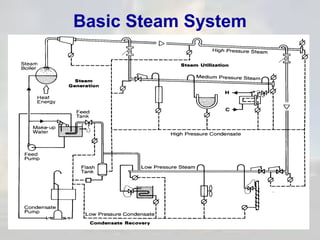
Basic Steam System
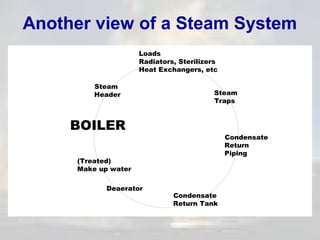
Another view of a Steam System
Loads
Radiators, Sterilizers
Heat Exchangers, etc
Steam
Header

Steam
Traps

BOILER

Condensate
Return
Piping

(Treated)
Make up water
Deaerator

Condensate
Return Tank
Steam System Basics
• Boiler Design
• Water Tube, smaller steam space, need to be run closer to

•

•

design pressure
• Fire Tube, large steam chest, can be run a lower than design
pressure.
Definitions
• "Carryover" means that you have a problem with the TDS (total
dissolved solids). You need to properly define the PPM values
needed. Fire tube boilers have a normal TDS of 3000 ppm, while
water tube designs need 2000 ppm. Everyone uses the 3000
ppm value regardless of boiler type and that is their first mistake.
• "Priming" is a mechanical condition caused by too great of a
takeoff velocity (50 to 100fpm).This is corrected mechanically.
Testing
• With the boiler running, take a condensate sample from a drip pocket on
the main header. If you see a high TDS value (say 2000 PPM), you
have a carryover issue. If your value is 5 ppm or is immeasurable, you
have priming. Remember, steam has no TDS!
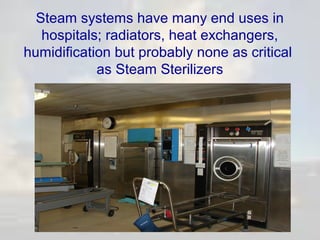
Steam systems have many end uses in
hospitals; radiators, heat exchangers,
humidification but probably none as critical
as Steam Sterilizers
Your Objectives
(Challenges)

• Deliver good quality steam to heating,

humidification and process equipment.
• Operate the system safely.
• Get maximum efficiency from heating
equipment - energy $$$
• Maintain the system at a reasonable cost.
Steam Has Another Objective In
Mind!
(Challenges)

• Condenses anywhere and everywhere it

can.
• Happily fills the system with air, in the
worst possible locations.
• Carries entrained water, gases, chemicals
and dirt into every nook and cranny.
• Will slow down and stop flowing as soon
as differential pressure is lost.
Your Mission Is To Stay Ahead of
Potential Problems
(Challenges)

•
•
•
•
•
•
•

Test/maintain steam traps routinely.
Clean strainers!
Clean and maintain regulators/control valves
Routine maintenance of condensate pumps.
Keep an ear open for excess pipe-line waterhammer & correct the root-cause.
Watch for repeat instances of valve wire-draw &
correct root-cause (wet steam, valve sizing)
Recognize that water hammer in heat
exchangers and heating coils is correctable.
Challenges
No problem – right?
All it takes is money and manpower!
Anyone here have enough of both?
But there is help:

• Boiler Water Treatment Company
• Steam Specialty Companies
• Steam Consultants
• Some of these can help for free, some will
cost.
Steam System Challenges
• Remember Steam Systems are dynamic systems
• Never Steady State
• Loads coming on and off

•
•
•
•

Sterilizers
Heating coils
Steam Absorption Chillers
Manual Building Heat (Old fashion radiators)

• System Sizing

• Sized for steady state or instantaneous loads (sterilizers)
Steam System Troubleshooting
Myths
• My boilers never carry over, prime, etc.
• The water level is always steady in the gauge
glass.
• I don’t need trap maintenance, failed traps will
become apparent on their own. (The water
hammer will tell me about a bad trap.)
• Boiler water treatment is a scam.
• Boiler blow-down wastes energy and water.
Steam System Troubleshooting
Steam System Chemistry
• Feed Water Quality

• Softener
• Deaerator

– Dissolved O2 and non-condensable gases

• Chemical Treatment
• Totaled Dissolved Solids (TDS)
• Blow down
• Continuous Surface
• Bottom Blow Down
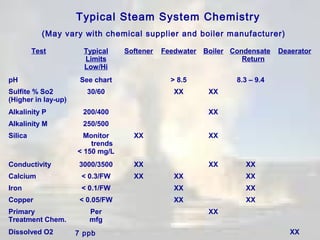
Typical Steam System Chemistry
(May vary with chemical supplier and boiler manufacturer)
Test

pH
Sulfite % So2
(Higher in lay-up)

Typical
Limits
Low/Hi

Softener

Feedwater Boiler Condensate
Return

See chart

> 8.5

30/60

XX

Alkalinity P

200/400

Alkalinity M

Deaerator

8.3 – 9.4
XX
XX

250/500

Silica

Monitor
trends
< 150 mg/L

XX

XX

Conductivity

3000/3500

XX

XX

Calcium

< 0.3/FW

XX

Iron
Copper
Primary
Treatment Chem.
Dissolved O2

XX

XX

XX

< 0.1/FW

XX

XX

< 0.05/FW

XX

XX

Per
mfg
7 ppb

XX
XX
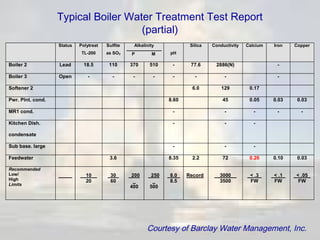
Typical Boiler Water Treatment Test Report
(partial)
Status

Polytreat

Sulfite

Alkalinity

Silica

TL-200

as SO3

P

M

Conductivity

Calcium

Iron

Copper

pH

Boiler 2

Lead

18.5

110

370

510

-

77.6

2886(N)

-

Boiler 3

Open

-

-

-

-

-

-

-

-

6.0

129

0.17

8.60

45

0.05

0.03

0.03

MR1 cond.

-

-

-

-

-

Kitchen Dish.

-

-

-

-

-

-

Softener 2
Pwr. Plnt. cond.

condensate
Sub base. large
Feedwater
Recommended
Low/
High
Limits

3.6
__10__
20

_30_
60

8.35
_200
_
400

_250
_
500

2.2

72

0.26

0.10

0.03

_8.0_
8.5

Record

__3000__
3500

_< .3_
FW

_< .1_
FW

_< .05_
FW

Courtesy of Barclay Water Management, Inc.
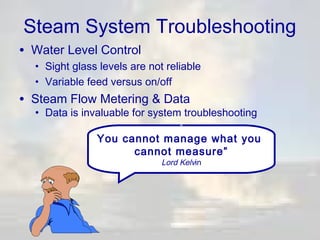
Steam System Troubleshooting
• Water Level Control

• Sight glass levels are not reliable
• Variable feed versus on/off

• Steam Flow Metering & Data

• Data is invaluable for system troubleshooting
“

You cannot manage what you
cannot measure”
Lord Kelvin
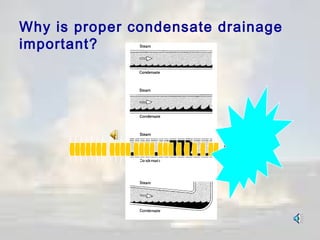
Why is proper condensate drainage
important?
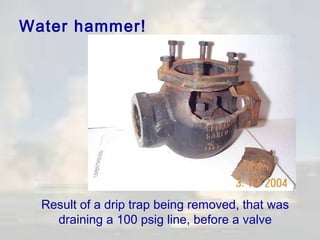
Water hammer!

Result of a drip trap being removed, that was
draining a 100 psig line, before a valve
Steam System Troubleshooting

• Steam Traps

• Properly located
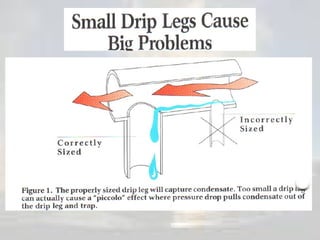
• Drip Legs properly sized
• Trap Selection and sizing
• Steam Trap Testing &
Steam System Troubleshooting
•
•
•
•
•
•
•
•

Steam Traps

Main Header Main header drip legs are full size
Other drip legs are properly sized
Drips located 300’ or less and any change of
elevation
Drip stations located ahead of automatic valves
Steam traps are properly sized
Steam traps are working and maintained
Missing insulation
• heat goes to cold
•

another consequence of the 2nd law thermodynamics!
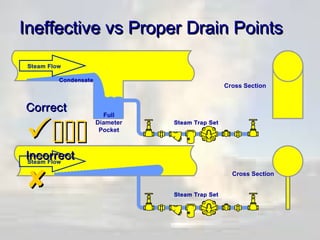
Ineffective vs Proper Drain Points
Steam Flow
Condensate

Correct




Cross Section

Full
Diameter
Pocket

Steam Trap Set

Incorrect
Steam Flow

Cross Section
Steam Trap Set
Steam System
Troubleshooting
Steam Trap Testing

•
•
•
•

Visual *
Temperature **
Ultrasonic ***
Continuous monitoring systems ****
• conductivity
Steam System Troubleshooting
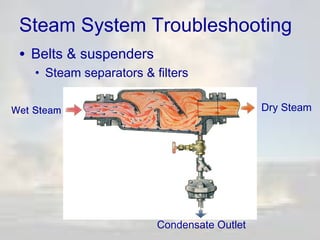
• Belts & suspenders

• Steam separators & filters
Dry Steam

Wet Steam

Condensate Outlet
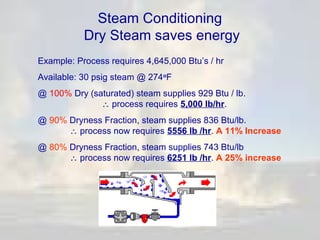
Steam Conditioning
Dry Steam saves energy
Example: Process requires 4,645,000 Btu’s / hr
Available: 30 psig steam @ 274oF
@ 100% Dry (saturated) steam supplies 929 Btu / lb.
∴ process requires 5,000 lb/hr.
@ 90% Dryness Fraction, steam supplies 836 Btu/lb.
∴ process now requires 5556 lb /hr. A 11% Increase
@ 80% Dryness Fraction, steam supplies 743 Btu/lb
∴ process now requires 6251 lb /hr. A 25% increase
Steam System
Troubleshooting
• Condensate equipment operating properly
• Pumps
• Flash tanks

• Loads

• Varying loads
• Instantaneous loads - Sterilizers
Steam System Troubleshooting
Now what do I do
If you suddenly have problems
• What has changed?
• Go back to basics
• Start at the boiler plant and work your way out into

•

the system
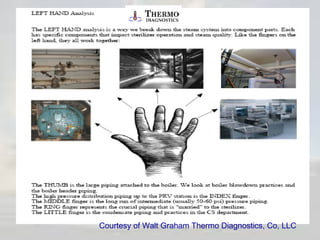
Left Hand Analysis
Courtesy of Walt Graham Thermo Diagnostics, Co, LLC
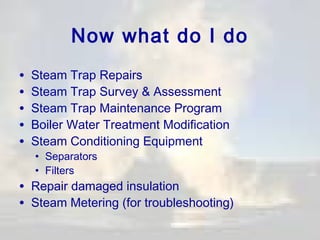
Now what do I do
•
•
•
•
•

Steam Trap Repairs
Steam Trap Survey & Assessment
Steam Trap Maintenance Program
Boiler Water Treatment Modification
Steam Conditioning Equipment
• Separators
• Filters

• Repair damaged insulation
• Steam Metering (for troubleshooting)
Thank you!
• Questions or Comments
• Special Thanks to

– John Cilyo, Spirax Sarco
– William Wethey, Barclay Water Management

• Contact Information
–
–
–
–

Steve Jalowiec, PE, CHFM
Waterbury Hospital, 64 Robbins Street, Waterbury CT
Work 203-573-7197
Cell 203-228-3480

Fall2011 jalowiec

  • 1.
    Steam Systems Basics, Challengesand Troubleshooting John Cilyo Senior Account Executive Spirax Sarco Inc. For Steve Jalowiec, PE, CHFM
  • 2.
    Steam Systems &Chaos Theory In mathematics, chaos theory describes the behavior of certain dynamic systems – that is, systems whose states evolve with time – that may exhibit dynamics that are highly sensitive to initial conditions (popularly referred to as the butterfly effect). As a result of this sensitivity, which manifests itself as an exponential growth of perturbations in the initial conditions, the behavior of chaotic systems appears to be random. This happens even though these systems are deterministic, meaning that their future dynamics are fully defined by their initial conditions with no random elements involved. This behavior is known as deterministic chaos, or simply chaos .
  • 3.
    Steam Systems &the 2 nd Law Second Law of Thermodynamics • The entropy of an isolated system not in equilibrium will tend to increase over time , approaching a maximum value at equilibrium. • In a simple manner, the second law states "energy systems have a tendency to increase their entropy rather than decrease it." This can also be stated as "heat can spontaneously flow from a highertemperature region to a lower-temperature region, but not the other way around." (Heat can flow from cold to hot, but not spontaneously —- for example, when a refrigerator expends electrical power.) • A way of thinking about the second law for non-scientists is to consider entropy as a measure of disorder . So, for example, a broken cup has less order (more entropy) than an intact one, and it is more difficult to repair a broken cup (reducing its entropy) than to break an intact one (increasing its entropy). Likewise, solid crystals, the most organized form of matter, have very low entropy values; and gases, which are very disorganized, have high entropy values.
  • 4.
  • 5.
    Another view ofa Steam System Loads Radiators, Sterilizers Heat Exchangers, etc Steam Header Steam Traps BOILER Condensate Return Piping (Treated) Make up water Deaerator Condensate Return Tank
  • 6.
    Steam System Basics •Boiler Design • Water Tube, smaller steam space, need to be run closer to • • design pressure • Fire Tube, large steam chest, can be run a lower than design pressure. Definitions • "Carryover" means that you have a problem with the TDS (total dissolved solids). You need to properly define the PPM values needed. Fire tube boilers have a normal TDS of 3000 ppm, while water tube designs need 2000 ppm. Everyone uses the 3000 ppm value regardless of boiler type and that is their first mistake. • "Priming" is a mechanical condition caused by too great of a takeoff velocity (50 to 100fpm).This is corrected mechanically. Testing • With the boiler running, take a condensate sample from a drip pocket on the main header. If you see a high TDS value (say 2000 PPM), you have a carryover issue. If your value is 5 ppm or is immeasurable, you have priming. Remember, steam has no TDS!
  • 7.
    Steam systems havemany end uses in hospitals; radiators, heat exchangers, humidification but probably none as critical as Steam Sterilizers
  • 8.
    Your Objectives (Challenges) • Delivergood quality steam to heating, humidification and process equipment. • Operate the system safely. • Get maximum efficiency from heating equipment - energy $$$ • Maintain the system at a reasonable cost.
  • 9.
    Steam Has AnotherObjective In Mind! (Challenges) • Condenses anywhere and everywhere it can. • Happily fills the system with air, in the worst possible locations. • Carries entrained water, gases, chemicals and dirt into every nook and cranny. • Will slow down and stop flowing as soon as differential pressure is lost.
  • 10.
    Your Mission IsTo Stay Ahead of Potential Problems (Challenges) • • • • • • • Test/maintain steam traps routinely. Clean strainers! Clean and maintain regulators/control valves Routine maintenance of condensate pumps. Keep an ear open for excess pipe-line waterhammer & correct the root-cause. Watch for repeat instances of valve wire-draw & correct root-cause (wet steam, valve sizing) Recognize that water hammer in heat exchangers and heating coils is correctable.
  • 11.
    Challenges No problem –right? All it takes is money and manpower! Anyone here have enough of both? But there is help: • Boiler Water Treatment Company • Steam Specialty Companies • Steam Consultants • Some of these can help for free, some will cost.
  • 12.
    Steam System Challenges •Remember Steam Systems are dynamic systems • Never Steady State • Loads coming on and off • • • • Sterilizers Heating coils Steam Absorption Chillers Manual Building Heat (Old fashion radiators) • System Sizing • Sized for steady state or instantaneous loads (sterilizers)
  • 13.
    Steam System Troubleshooting Myths •My boilers never carry over, prime, etc. • The water level is always steady in the gauge glass. • I don’t need trap maintenance, failed traps will become apparent on their own. (The water hammer will tell me about a bad trap.) • Boiler water treatment is a scam. • Boiler blow-down wastes energy and water.
  • 14.
    Steam System Troubleshooting SteamSystem Chemistry • Feed Water Quality • Softener • Deaerator – Dissolved O2 and non-condensable gases • Chemical Treatment • Totaled Dissolved Solids (TDS) • Blow down • Continuous Surface • Bottom Blow Down
  • 15.
    Typical Steam SystemChemistry (May vary with chemical supplier and boiler manufacturer) Test pH Sulfite % So2 (Higher in lay-up) Typical Limits Low/Hi Softener Feedwater Boiler Condensate Return See chart > 8.5 30/60 XX Alkalinity P 200/400 Alkalinity M Deaerator 8.3 – 9.4 XX XX 250/500 Silica Monitor trends < 150 mg/L XX XX Conductivity 3000/3500 XX XX Calcium < 0.3/FW XX Iron Copper Primary Treatment Chem. Dissolved O2 XX XX XX < 0.1/FW XX XX < 0.05/FW XX XX Per mfg 7 ppb XX XX
  • 16.
    Typical Boiler WaterTreatment Test Report (partial) Status Polytreat Sulfite Alkalinity Silica TL-200 as SO3 P M Conductivity Calcium Iron Copper pH Boiler 2 Lead 18.5 110 370 510 - 77.6 2886(N) - Boiler 3 Open - - - - - - - - 6.0 129 0.17 8.60 45 0.05 0.03 0.03 MR1 cond. - - - - - Kitchen Dish. - - - - - - Softener 2 Pwr. Plnt. cond. condensate Sub base. large Feedwater Recommended Low/ High Limits 3.6 __10__ 20 _30_ 60 8.35 _200 _ 400 _250 _ 500 2.2 72 0.26 0.10 0.03 _8.0_ 8.5 Record __3000__ 3500 _< .3_ FW _< .1_ FW _< .05_ FW Courtesy of Barclay Water Management, Inc.
  • 17.
    Steam System Troubleshooting •Water Level Control • Sight glass levels are not reliable • Variable feed versus on/off • Steam Flow Metering & Data • Data is invaluable for system troubleshooting “ You cannot manage what you cannot measure” Lord Kelvin
  • 18.
    Why is propercondensate drainage important?
  • 19.
    Water hammer! Result ofa drip trap being removed, that was draining a 100 psig line, before a valve
  • 20.
    Steam System Troubleshooting •Steam Traps • Properly located • Drip Legs properly sized • Trap Selection and sizing • Steam Trap Testing &
  • 21.
    Steam System Troubleshooting • • • • • • • • SteamTraps Main Header Main header drip legs are full size Other drip legs are properly sized Drips located 300’ or less and any change of elevation Drip stations located ahead of automatic valves Steam traps are properly sized Steam traps are working and maintained Missing insulation • heat goes to cold • another consequence of the 2nd law thermodynamics!
  • 23.
    Ineffective vs ProperDrain Points Steam Flow Condensate Correct   Cross Section Full Diameter Pocket Steam Trap Set Incorrect Steam Flow Cross Section Steam Trap Set
  • 24.
    Steam System Troubleshooting Steam TrapTesting • • • • Visual * Temperature ** Ultrasonic *** Continuous monitoring systems **** • conductivity
  • 25.
    Steam System Troubleshooting •Belts & suspenders • Steam separators & filters Dry Steam Wet Steam Condensate Outlet
  • 26.
    Steam Conditioning Dry Steamsaves energy Example: Process requires 4,645,000 Btu’s / hr Available: 30 psig steam @ 274oF @ 100% Dry (saturated) steam supplies 929 Btu / lb. ∴ process requires 5,000 lb/hr. @ 90% Dryness Fraction, steam supplies 836 Btu/lb. ∴ process now requires 5556 lb /hr. A 11% Increase @ 80% Dryness Fraction, steam supplies 743 Btu/lb ∴ process now requires 6251 lb /hr. A 25% increase
  • 27.
    Steam System Troubleshooting • Condensateequipment operating properly • Pumps • Flash tanks • Loads • Varying loads • Instantaneous loads - Sterilizers
  • 28.
    Steam System Troubleshooting Nowwhat do I do If you suddenly have problems • What has changed? • Go back to basics • Start at the boiler plant and work your way out into • the system Left Hand Analysis
  • 29.
    Courtesy of WaltGraham Thermo Diagnostics, Co, LLC
  • 30.
    Now what doI do • • • • • Steam Trap Repairs Steam Trap Survey & Assessment Steam Trap Maintenance Program Boiler Water Treatment Modification Steam Conditioning Equipment • Separators • Filters • Repair damaged insulation • Steam Metering (for troubleshooting)
  • 31.
    Thank you! • Questionsor Comments • Special Thanks to – John Cilyo, Spirax Sarco – William Wethey, Barclay Water Management • Contact Information – – – – Steve Jalowiec, PE, CHFM Waterbury Hospital, 64 Robbins Street, Waterbury CT Work 203-573-7197 Cell 203-228-3480