W.O. Balogun
Endocrinology Unit
Dept. Of Medicine, UCH
About anatomy
 Paired glands located supra renal
 Divided anatomically and functionally into 2 parts:
adrenal cortex and adrenal medulla
 Adrenal cortex:
 -zona glomerulosa
 zona fascilculata, and
 zona reticularis
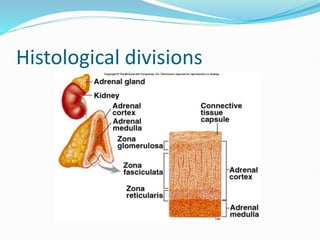
Histological divisions
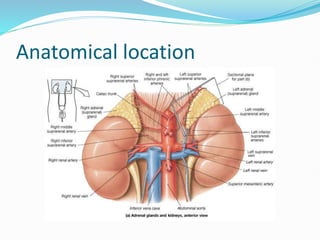
Anatomical location
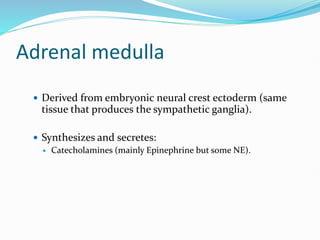
Adrenal medulla
 Derived from embryonic neural crest ectoderm (same
tissue that produces the sympathetic ganglia).
 Synthesizes and secretes:
 Catecholamines (mainly Epinephrine but some NE).
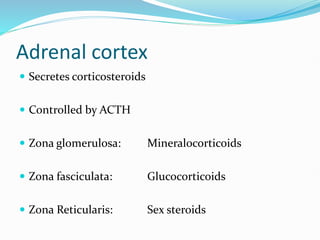
Adrenal cortex
 Secretes corticosteroids
 Controlled by ACTH
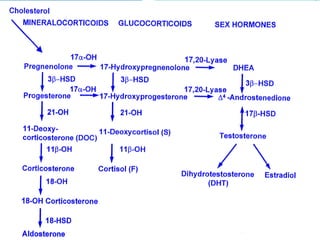
 Zona glomerulosa: Mineralocorticoids
 Zona fasciculata: Glucocorticoids
 Zona Reticularis: Sex steroids
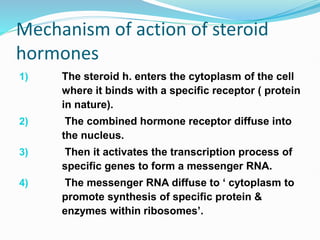
Mechanism of action of steroid
hormones
1) The steroid h. enters the cytoplasm of the cell
where it binds with a specific receptor ( protein
in nature).
2) The combined hormone receptor diffuse into
the nucleus.
3) Then it activates the transcription process of
specific genes to form a messenger RNA.
4) The messenger RNA diffuse to ‘ cytoplasm to
promote synthesis of specific protein &
enzymes within ribosomes’.
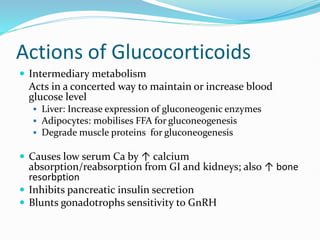
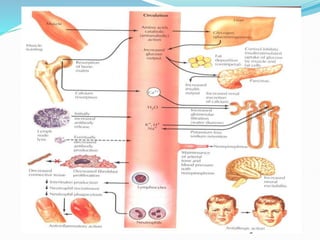
Actions of Glucocorticoids
 Intermediary metabolism
Acts in a concerted way to maintain or increase blood
glucose level
 Liver: Increase expression of gluconeogenic enzymes
 Adipocytes: mobilises FFA for gluconeogenesis
 Degrade muscle proteins for gluconeogenesis
 Causes low serum Ca by ↑ calcium
absorption/reabsorption from GI and kidneys; also ↑ bone
resorbption
 Inhibits pancreatic insulin secretion
 Blunts gonadotrophs sensitivity to GnRH
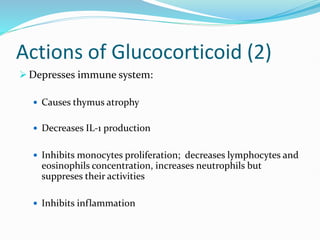
Actions of Glucocorticoid (2)
 Depresses immune system:
 Causes thymus atrophy
 Decreases IL-1 production
 Inhibits monocytes proliferation; decreases lymphocytes and
eosinophils concentration, increases neutrophils but
suppreses their activities
 Inhibits inflammation
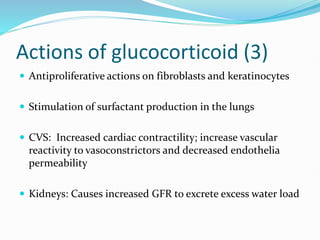
Actions of glucocorticoid (3)
 Antiproliferative actions on fibroblasts and keratinocytes
 Stimulation of surfactant production in the lungs
 CVS: Increased cardiac contractility; increase vascular
reactivity to vasoconstrictors and decreased endothelia
permeability
 Kidneys: Causes increased GFR to excrete excess water load
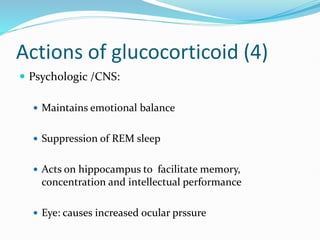
Actions of glucocorticoid (4)
 Psychologic /CNS:
 Maintains emotional balance
 Suppression of REM sleep
 Acts on hippocampus to facilitate memory,
concentration and intellectual performance
 Eye: causes increased ocular prssure
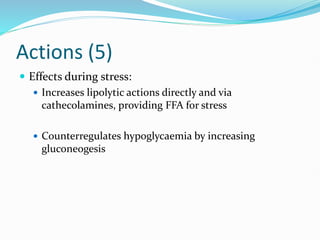
Actions (5)
 Effects during stress:
 Increases lipolytic actions directly and via
cathecolamines, providing FFA for stress
 Counterregulates hypoglycaemia by increasing
gluconeogesis
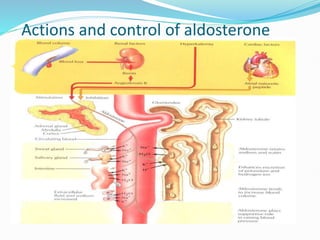
MINERALOCORTICOIDS
ALDOSTERONE
 ELECTROLYTE BALANCE
 BLOOD PRESSURE
 RENIN-ANGIOTENSIN-ALDOSTERONE SYSTEM
Actions and control of aldosterone
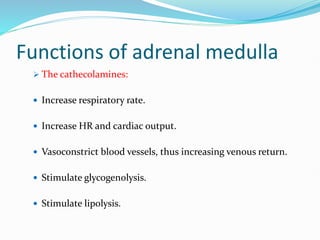
Functions of adrenal medulla
 The cathecolamines:
 Increase respiratory rate.
 Increase HR and cardiac output.
 Vasoconstrict blood vessels, thus increasing venous return.
 Stimulate glycogenolysis.
 Stimulate lipolysis.
SEX HOMONES
 ANDROGENS (TESTOSTERONE)
 ESTROGENS
LESS THAN GONADS
Function tests
Disorders of function
 Excess: Hypercotisolism; hyperaldosteronism;
 Deficiency: Hypoadrenalism
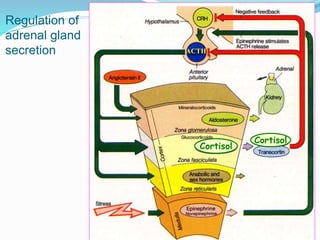
Regulation of
adrenal gland
secretion ACTH
Cortisol
Cortisol
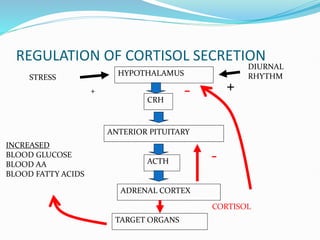
REGULATION OF CORTISOL SECRETION
HYPOTHALAMUS
CRH
ANTERIOR PITUITARY
ACTH
ADRENAL CORTEX
TARGET ORGANS
CORTISOL
STRESS
DIURNAL
RHYTHM
+ +
-
-
INCREASED
BLOOD GLUCOSE
BLOOD AA
BLOOD FATTY ACIDS
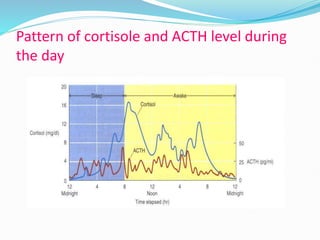
Concept of circadian rhythm
Group of hormones with pulsatile patterns of secretion
and well-defined amplitude, frequency and rhytmicity
within the circadian
Pattern of cortisole and ACTH level during
the day
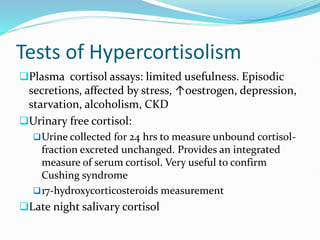
Tests of Hypercortisolism
Plasma cortisol assays: limited usefulness. Episodic
secretions, affected by stress, ↑oestrogen, depression,
starvation, alcoholism, CKD
Urinary free cortisol:
Urine collected for 24 hrs to measure unbound cortisol-
fraction excreted unchanged. Provides an integrated
measure of serum cortisol. Very useful to confirm
Cushing syndrome
17-hydroxycorticosteroids measurement
Late night salivary cortisol
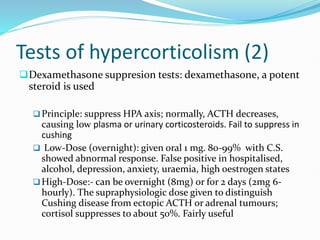
Tests of hypercorticolism (2)
Dexamethasone suppresion tests: dexamethasone, a potent
steroid is used
Principle: suppress HPA axis; normally, ACTH decreases,
causing low plasma or urinary corticosteroids. Fail to suppress in
cushing
 Low-Dose (overnight): given oral 1 mg. 80-99% with C.S.
showed abnormal response. False positive in hospitalised,
alcohol, depression, anxiety, uraemia, high oestrogen states
High-Dose:- can be overnight (8mg) or for 2 days (2mg 6-
hourly). The supraphysiologic dose given to distinguish
Cushing disease from ectopic ACTH or adrenal tumours;
cortisol suppresses to about 50%. Fairly useful
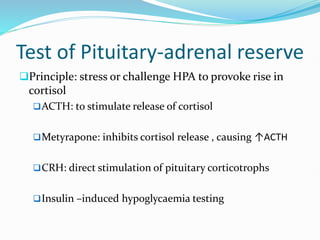
Test of Pituitary-adrenal reserve
Principle: stress or challenge HPA to provoke rise in
cortisol
ACTH: to stimulate release of cortisol
Metyrapone: inhibits cortisol release , causing ↑ACTH
CRH: direct stimulation of pituitary corticotrophs
Insulin –induced hypoglycaemia testing
Androgens: Tests
 Direct measurement better than dynamic testing
 Measure assays of hormones directly, e.g DHEA,
DHEA sulphate, androstenedione, testrosrone
Tests for Hypoadrenalism
ACTH stimulation test/Synacthen test
250µg of tetracosactrin administered; plasma
cortisol>550nm/l after 30 min normally
Subnormal responses in hypoadrenalism
Plasma ACTH level. Helps distinguish primary from
secondary hypoadrenalism
Insulin-induced hypoglycaemia stress test
Others:
Electrolytes
Low Na and high potassium in hypoadrenalism
Hypokalemia in Heprcorticolism
FBC: anaemia; leukocytosis
Radiodiagnosis for localisation
Inferior petrosal sinus sampling of ACTH to
distinguish Cushing disease from ectopic
Hyperaldosteronism
Serum K: Hypokalemia
Confirmation is by demonstrating subnormal supine and
erect plasma renin activity and elevated plasma
aldosterone
NB: Patient not on diuretic therapy for ≥3 weeks
 Aldosterone: Renin >30 in Primary aldosteronism
24-hour urinary aldosterone (especially when plasma
aldosterone not elevated but suppressed renin)
Saline infusion test: aldosterone fails to suppress with
expansion of ECF
Oral salt loading test for 3 days: aldosterone fails to
suppress
Adrenal medulla function tests
In phaeochromocytoma:
Screening by 24 hr urine metabolites e.g VMA or
metanephrines of cathecolamines. Useful.
NB: VMA less subject to drug interference but less
sensitive to metanephrines
Plasma or urinary free cathecolamines. More
specialised
THANK YOU

Update.Adrenal Functionand Tests.pptx

  • 1.
  • 2.
    About anatomy  Pairedglands located supra renal  Divided anatomically and functionally into 2 parts: adrenal cortex and adrenal medulla  Adrenal cortex:  -zona glomerulosa  zona fascilculata, and  zona reticularis
  • 3.
  • 4.
  • 5.
    Adrenal medulla  Derivedfrom embryonic neural crest ectoderm (same tissue that produces the sympathetic ganglia).  Synthesizes and secretes:  Catecholamines (mainly Epinephrine but some NE).
  • 6.
    Adrenal cortex  Secretescorticosteroids  Controlled by ACTH  Zona glomerulosa: Mineralocorticoids  Zona fasciculata: Glucocorticoids  Zona Reticularis: Sex steroids
  • 8.
    Mechanism of actionof steroid hormones 1) The steroid h. enters the cytoplasm of the cell where it binds with a specific receptor ( protein in nature). 2) The combined hormone receptor diffuse into the nucleus. 3) Then it activates the transcription process of specific genes to form a messenger RNA. 4) The messenger RNA diffuse to ‘ cytoplasm to promote synthesis of specific protein & enzymes within ribosomes’.
  • 9.
    Actions of Glucocorticoids Intermediary metabolism Acts in a concerted way to maintain or increase blood glucose level  Liver: Increase expression of gluconeogenic enzymes  Adipocytes: mobilises FFA for gluconeogenesis  Degrade muscle proteins for gluconeogenesis  Causes low serum Ca by ↑ calcium absorption/reabsorption from GI and kidneys; also ↑ bone resorbption  Inhibits pancreatic insulin secretion  Blunts gonadotrophs sensitivity to GnRH
  • 10.
    Actions of Glucocorticoid(2)  Depresses immune system:  Causes thymus atrophy  Decreases IL-1 production  Inhibits monocytes proliferation; decreases lymphocytes and eosinophils concentration, increases neutrophils but suppreses their activities  Inhibits inflammation
  • 11.
    Actions of glucocorticoid(3)  Antiproliferative actions on fibroblasts and keratinocytes  Stimulation of surfactant production in the lungs  CVS: Increased cardiac contractility; increase vascular reactivity to vasoconstrictors and decreased endothelia permeability  Kidneys: Causes increased GFR to excrete excess water load
  • 12.
    Actions of glucocorticoid(4)  Psychologic /CNS:  Maintains emotional balance  Suppression of REM sleep  Acts on hippocampus to facilitate memory, concentration and intellectual performance  Eye: causes increased ocular prssure
  • 13.
    Actions (5)  Effectsduring stress:  Increases lipolytic actions directly and via cathecolamines, providing FFA for stress  Counterregulates hypoglycaemia by increasing gluconeogesis
  • 15.
    MINERALOCORTICOIDS ALDOSTERONE  ELECTROLYTE BALANCE BLOOD PRESSURE  RENIN-ANGIOTENSIN-ALDOSTERONE SYSTEM
  • 16.
    Actions and controlof aldosterone
  • 17.
    Functions of adrenalmedulla  The cathecolamines:  Increase respiratory rate.  Increase HR and cardiac output.  Vasoconstrict blood vessels, thus increasing venous return.  Stimulate glycogenolysis.  Stimulate lipolysis.
  • 18.
    SEX HOMONES  ANDROGENS(TESTOSTERONE)  ESTROGENS LESS THAN GONADS
  • 19.
  • 20.
    Disorders of function Excess: Hypercotisolism; hyperaldosteronism;  Deficiency: Hypoadrenalism
  • 21.
  • 22.
    REGULATION OF CORTISOLSECRETION HYPOTHALAMUS CRH ANTERIOR PITUITARY ACTH ADRENAL CORTEX TARGET ORGANS CORTISOL STRESS DIURNAL RHYTHM + + - - INCREASED BLOOD GLUCOSE BLOOD AA BLOOD FATTY ACIDS
  • 23.
    Concept of circadianrhythm Group of hormones with pulsatile patterns of secretion and well-defined amplitude, frequency and rhytmicity within the circadian
  • 24.
    Pattern of cortisoleand ACTH level during the day
  • 25.
    Tests of Hypercortisolism Plasmacortisol assays: limited usefulness. Episodic secretions, affected by stress, ↑oestrogen, depression, starvation, alcoholism, CKD Urinary free cortisol: Urine collected for 24 hrs to measure unbound cortisol- fraction excreted unchanged. Provides an integrated measure of serum cortisol. Very useful to confirm Cushing syndrome 17-hydroxycorticosteroids measurement Late night salivary cortisol
  • 26.
    Tests of hypercorticolism(2) Dexamethasone suppresion tests: dexamethasone, a potent steroid is used Principle: suppress HPA axis; normally, ACTH decreases, causing low plasma or urinary corticosteroids. Fail to suppress in cushing  Low-Dose (overnight): given oral 1 mg. 80-99% with C.S. showed abnormal response. False positive in hospitalised, alcohol, depression, anxiety, uraemia, high oestrogen states High-Dose:- can be overnight (8mg) or for 2 days (2mg 6- hourly). The supraphysiologic dose given to distinguish Cushing disease from ectopic ACTH or adrenal tumours; cortisol suppresses to about 50%. Fairly useful
  • 27.
    Test of Pituitary-adrenalreserve Principle: stress or challenge HPA to provoke rise in cortisol ACTH: to stimulate release of cortisol Metyrapone: inhibits cortisol release , causing ↑ACTH CRH: direct stimulation of pituitary corticotrophs Insulin –induced hypoglycaemia testing
  • 28.
    Androgens: Tests  Directmeasurement better than dynamic testing  Measure assays of hormones directly, e.g DHEA, DHEA sulphate, androstenedione, testrosrone
  • 29.
    Tests for Hypoadrenalism ACTHstimulation test/Synacthen test 250µg of tetracosactrin administered; plasma cortisol>550nm/l after 30 min normally Subnormal responses in hypoadrenalism Plasma ACTH level. Helps distinguish primary from secondary hypoadrenalism Insulin-induced hypoglycaemia stress test
  • 30.
    Others: Electrolytes Low Na andhigh potassium in hypoadrenalism Hypokalemia in Heprcorticolism FBC: anaemia; leukocytosis Radiodiagnosis for localisation Inferior petrosal sinus sampling of ACTH to distinguish Cushing disease from ectopic
  • 31.
    Hyperaldosteronism Serum K: Hypokalemia Confirmationis by demonstrating subnormal supine and erect plasma renin activity and elevated plasma aldosterone NB: Patient not on diuretic therapy for ≥3 weeks  Aldosterone: Renin >30 in Primary aldosteronism 24-hour urinary aldosterone (especially when plasma aldosterone not elevated but suppressed renin) Saline infusion test: aldosterone fails to suppress with expansion of ECF Oral salt loading test for 3 days: aldosterone fails to suppress
  • 32.
    Adrenal medulla functiontests In phaeochromocytoma: Screening by 24 hr urine metabolites e.g VMA or metanephrines of cathecolamines. Useful. NB: VMA less subject to drug interference but less sensitive to metanephrines Plasma or urinary free cathecolamines. More specialised
  • 33.