Teacher Ethics in Summative
Assessment
Survey of teachers’ views of methods of
maximising results
• Conducted 2014
• Designed by Ofqual but conducted by Pye Tait
• 548 responses (out of 200K+ secondary school teachers)
• 92% actively teaching
• 44% teachers, 34% Heads of Department
They were asked
• Whether they had first-hand experience of a range activities
within the last academic year (including student activities,
teacher activities and school activities)
• How acceptable they considered each of those to be from
1 ‘not at all acceptable’ to 10 ‘completely acceptable’
• E.g.
• Becoming markers to gain insight into the examination system
• Focusing efforts on borderline ‘C’ students
• Providing wording of sections of coursework to students
UNREPRESENTATIVE SAMPLE WARNING
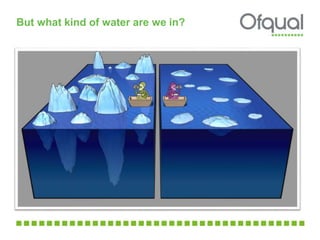
But what kind of water are we in?
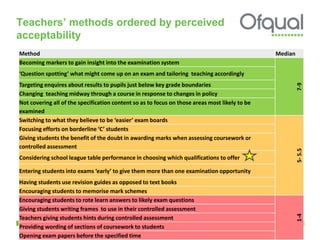
Teachers’ methods ordered by perceived
acceptability
Method Median
Becoming markers to gain insight into the examination system
7-9
‘Question spotting’ what might come up on an exam and tailoring teaching accordingly
Targeting enquires about results to pupils just below key grade boundaries
Changing teaching midway through a course in response to changes in policy
Not covering all of the specification content so as to focus on those areas most likely to be
examined
Switching to what they believe to be ‘easier’ exam boards
5-5.5
Focusing efforts on borderline ‘C’ students
Giving students the benefit of the doubt in awarding marks when assessing coursework or
controlled assessment
Considering school league table performance in choosing which qualifications to offer
Entering students into exams ‘early’ to give them more than one examination opportunity
Having students use revision guides as opposed to text books
Encouraging students to memorise mark schemes
Encouraging students to rote learn answers to likely exam questions
1-4
Giving students writing frames to use in their controlled assessment
Teachers giving students hints during controlled assessment
Providing wording of sections of coursework to students
Opening exam papers before the specified time
Method %
Focusing efforts on borderline ‘C’ students
80
‘Question spotting’ what might come up on an exam and tailoring their teaching accordingly
Targeting enquires about results to those pupils just below key grade boundaries
70
Becoming markers to gain insight into the examination system
Giving students the benefit of the doubt in awarding marks when assessing coursework or controlled
assessment
60
Considering school league table performance in choosing which qualifications to offer
Changing their teaching midway through a course in response to changes in policy
Giving students writing frames to use in their controlled assessment
Switching to what they believe to be ‘easier’ exam boards
Entering students into exams ‘early’ to give them more than one examination opportunity
Teachers giving students hints during controlled assessment
50
Encouraging students to rote learn answers to likely exam questions
Having students use revision guides as opposed to text books
Not covering all of the specification content so as to focus on those areas most likely to be examined
40
Encouraging students to memorise mark schemes
Providing wording of sections of coursework to students
Opening exam papers before the specified time
<10
Teachers’ methods ordered by experience
Method Median
Schools working together to share and understand performance data
7-9
Borderline students being ‘hot housed’ with additional classes/support
Students being double entered for key qualifications e.g. for more than one exam board’s GCSE
specification or for GCSE and IGCSE
1-4
Student qualification choices being steered to those they will perform well in, rather than those they
enjoy or those that would aid future employment
Students being removed from the school roll so as to avoid their results contributing to measures of
school performance
Schools finding ways to pick and choose the pupils they take in
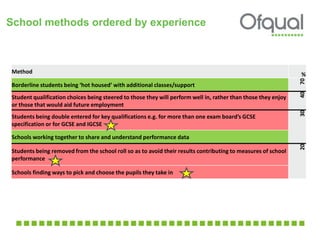
School methods ordered by perceived
acceptability
Method %
Borderline students being ‘hot housed’ with additional classes/support
70
Student qualification choices being steered to those they will perform well in, rather than those they enjoy
or those that would aid future employment
40
Students being double entered for key qualifications e.g. for more than one exam board’s GCSE
specification or for GCSE and IGCSE
30
Schools working together to share and understand performance data
Students being removed from the school roll so as to avoid their results contributing to measures of school
performance
20
Schools finding ways to pick and choose the pupils they take in
School methods ordered by experience
Controlled assessments
40% described experience of at least one additional method of
maximising controlled assessment results
Teachers providing
marks, corrections,
feedback and guidance
to enable students to
draft and re-draft
Teachers (required to
document feedback)
doing so verbally or
using post it notes
Teachers providing
sentence starters,
quotes, detailed writing
frames, essay structures
and help sheets
Teachers focusing
help on less able
– but crediting the
student in full
Teachers repeating
controlled assessment
tasks with the class or
using an almost identical
task before the real
thing
“I can get a very weak student an A grade by breaking the rules, as I
do, yet the poor Head of Department down the road doing
controlled assessments in near exam conditions is lucky to get
any work out of the student for an E grade.”
“The current system works very well for us as long as we ignore
any rules for limited, medium and high control in controlled
assessments. We ensure that every student always meets their
target grade, whatever it takes.”
Controlled assessments
“This year, we made much more use of writing frames and doing a
'similar' assignment to the one students had to do by way of
preparation. This followed from discussions with other Head of
Departments at LEA meetings last year on how to get through
these controlled assessments as fast as possible with the
minimum amount of stress and time for teachers.”
“Students can look at past years' A / A* controlled assessments for
the same task at any time as we have them in the classroom.
(The tasks remain 'live' for years).”
Controlled assessments
Coursework
21% described experience of at least one additional method of
maximising coursework results
Teachers re-drafting,
completing and writing
the coursework
themselves
Teachers
dictating or typing
coursework on the
computer for students
Teachers providing
students with previous
years’ stock of highly
graded coursework
Teachers writing
sections for the
students, and/or
providing them
with detailed
writing frames,
sentence starters
and detailed
guides
Teachers providing
extensive guidance,
coaching, corrections
and enabling re-drafts
with detailed feedback
given to students
“A teacher having difficulties with the level of students’ ability to do
coursework was told she would have to do it herself.”
“Students have their IGCSE coursework written for them by their
teacher. The expectation from the school is that 'all students' will
have A/B grade coursework folders, despite only a sixth of
students in the school being A/B grade students. Staff are
expected to 'intervene' with each student until their coursework
is of this grade.”
Coursework
“Students are given too much support during the completion of
coursework. This is a massive issue that I have experienced in 4-
5 of the schools/colleges I have worked in. This ranges from
providing them with specific examples of good work, letting
them copy others work, allowing students to work together to
plan work and when it gets to the end of the year students being
stood over by the teacher and told what to write.”
“Teachers send marks off for coursework in A level Health and
Social Care when the students haven't even given the
coursework in by the deadline – then making sure the
coursework, when it has been given in, is adapted to fit the mark
awarded.”
Coursework
Exams and orals
13% described experience of at least one additional method of
maximising exam or oral results
Teachers
giving pointers to
questions,
reading questions
out for students,
answering
questions about
exam tasks,
providing students
with hints about the
right solution
Teachers offering
strategic advice on
timing and which
questions to focus on
first
Teachers invigilating
their own subjects or
being in the hall for
exams
Teachers giving
students oral
questions, rote
learning
answers, or
giving them
more time to
prepare than
allowed by the
exam boards
“A teacher was told to go into the exam hall to help students even
though the teacher did not want to go in. Most teachers for that
subject were in the hall whilst other teachers were used to cover
their lessons.”
“I was told to target only things that would definitely come up on an
exam paper and teaching was focused solely on how many
marks each area was given. This meant lack of cohesive
teaching and students were taught only what was required on
the test not what would move their knowledge of the subject on.”
Exams and orals
“On the day before the actual speaking exam my Head of Faculty
unexpectedly appeared in my classroom to provide my pupils
with a final list of unexpected questions for them to prepare. The
pupils were asked to choose a question out of the list provided…
I was supposed to ask the chosen question to my pupils.”
Exams and orals
Conclusions?

Teacher Ethics in Summative Assessment: Ofqual ethics symposium

  • 1.
    Teacher Ethics inSummative Assessment
  • 2.
    Survey of teachers’views of methods of maximising results • Conducted 2014 • Designed by Ofqual but conducted by Pye Tait • 548 responses (out of 200K+ secondary school teachers) • 92% actively teaching • 44% teachers, 34% Heads of Department
  • 3.
    They were asked •Whether they had first-hand experience of a range activities within the last academic year (including student activities, teacher activities and school activities) • How acceptable they considered each of those to be from 1 ‘not at all acceptable’ to 10 ‘completely acceptable’ • E.g. • Becoming markers to gain insight into the examination system • Focusing efforts on borderline ‘C’ students • Providing wording of sections of coursework to students
  • 4.
  • 6.
    But what kindof water are we in?
  • 7.
    Teachers’ methods orderedby perceived acceptability Method Median Becoming markers to gain insight into the examination system 7-9 ‘Question spotting’ what might come up on an exam and tailoring teaching accordingly Targeting enquires about results to pupils just below key grade boundaries Changing teaching midway through a course in response to changes in policy Not covering all of the specification content so as to focus on those areas most likely to be examined Switching to what they believe to be ‘easier’ exam boards 5-5.5 Focusing efforts on borderline ‘C’ students Giving students the benefit of the doubt in awarding marks when assessing coursework or controlled assessment Considering school league table performance in choosing which qualifications to offer Entering students into exams ‘early’ to give them more than one examination opportunity Having students use revision guides as opposed to text books Encouraging students to memorise mark schemes Encouraging students to rote learn answers to likely exam questions 1-4 Giving students writing frames to use in their controlled assessment Teachers giving students hints during controlled assessment Providing wording of sections of coursework to students Opening exam papers before the specified time
  • 8.
    Method % Focusing effortson borderline ‘C’ students 80 ‘Question spotting’ what might come up on an exam and tailoring their teaching accordingly Targeting enquires about results to those pupils just below key grade boundaries 70 Becoming markers to gain insight into the examination system Giving students the benefit of the doubt in awarding marks when assessing coursework or controlled assessment 60 Considering school league table performance in choosing which qualifications to offer Changing their teaching midway through a course in response to changes in policy Giving students writing frames to use in their controlled assessment Switching to what they believe to be ‘easier’ exam boards Entering students into exams ‘early’ to give them more than one examination opportunity Teachers giving students hints during controlled assessment 50 Encouraging students to rote learn answers to likely exam questions Having students use revision guides as opposed to text books Not covering all of the specification content so as to focus on those areas most likely to be examined 40 Encouraging students to memorise mark schemes Providing wording of sections of coursework to students Opening exam papers before the specified time <10 Teachers’ methods ordered by experience
  • 9.
    Method Median Schools workingtogether to share and understand performance data 7-9 Borderline students being ‘hot housed’ with additional classes/support Students being double entered for key qualifications e.g. for more than one exam board’s GCSE specification or for GCSE and IGCSE 1-4 Student qualification choices being steered to those they will perform well in, rather than those they enjoy or those that would aid future employment Students being removed from the school roll so as to avoid their results contributing to measures of school performance Schools finding ways to pick and choose the pupils they take in School methods ordered by perceived acceptability
  • 10.
    Method % Borderline studentsbeing ‘hot housed’ with additional classes/support 70 Student qualification choices being steered to those they will perform well in, rather than those they enjoy or those that would aid future employment 40 Students being double entered for key qualifications e.g. for more than one exam board’s GCSE specification or for GCSE and IGCSE 30 Schools working together to share and understand performance data Students being removed from the school roll so as to avoid their results contributing to measures of school performance 20 Schools finding ways to pick and choose the pupils they take in School methods ordered by experience
  • 11.
    Controlled assessments 40% describedexperience of at least one additional method of maximising controlled assessment results Teachers providing marks, corrections, feedback and guidance to enable students to draft and re-draft Teachers (required to document feedback) doing so verbally or using post it notes Teachers providing sentence starters, quotes, detailed writing frames, essay structures and help sheets Teachers focusing help on less able – but crediting the student in full Teachers repeating controlled assessment tasks with the class or using an almost identical task before the real thing
  • 12.
    “I can geta very weak student an A grade by breaking the rules, as I do, yet the poor Head of Department down the road doing controlled assessments in near exam conditions is lucky to get any work out of the student for an E grade.” “The current system works very well for us as long as we ignore any rules for limited, medium and high control in controlled assessments. We ensure that every student always meets their target grade, whatever it takes.” Controlled assessments
  • 13.
    “This year, wemade much more use of writing frames and doing a 'similar' assignment to the one students had to do by way of preparation. This followed from discussions with other Head of Departments at LEA meetings last year on how to get through these controlled assessments as fast as possible with the minimum amount of stress and time for teachers.” “Students can look at past years' A / A* controlled assessments for the same task at any time as we have them in the classroom. (The tasks remain 'live' for years).” Controlled assessments
  • 14.
    Coursework 21% described experienceof at least one additional method of maximising coursework results Teachers re-drafting, completing and writing the coursework themselves Teachers dictating or typing coursework on the computer for students Teachers providing students with previous years’ stock of highly graded coursework Teachers writing sections for the students, and/or providing them with detailed writing frames, sentence starters and detailed guides Teachers providing extensive guidance, coaching, corrections and enabling re-drafts with detailed feedback given to students
  • 15.
    “A teacher havingdifficulties with the level of students’ ability to do coursework was told she would have to do it herself.” “Students have their IGCSE coursework written for them by their teacher. The expectation from the school is that 'all students' will have A/B grade coursework folders, despite only a sixth of students in the school being A/B grade students. Staff are expected to 'intervene' with each student until their coursework is of this grade.” Coursework
  • 16.
    “Students are giventoo much support during the completion of coursework. This is a massive issue that I have experienced in 4- 5 of the schools/colleges I have worked in. This ranges from providing them with specific examples of good work, letting them copy others work, allowing students to work together to plan work and when it gets to the end of the year students being stood over by the teacher and told what to write.” “Teachers send marks off for coursework in A level Health and Social Care when the students haven't even given the coursework in by the deadline – then making sure the coursework, when it has been given in, is adapted to fit the mark awarded.” Coursework
  • 17.
    Exams and orals 13%described experience of at least one additional method of maximising exam or oral results Teachers giving pointers to questions, reading questions out for students, answering questions about exam tasks, providing students with hints about the right solution Teachers offering strategic advice on timing and which questions to focus on first Teachers invigilating their own subjects or being in the hall for exams Teachers giving students oral questions, rote learning answers, or giving them more time to prepare than allowed by the exam boards
  • 18.
    “A teacher wastold to go into the exam hall to help students even though the teacher did not want to go in. Most teachers for that subject were in the hall whilst other teachers were used to cover their lessons.” “I was told to target only things that would definitely come up on an exam paper and teaching was focused solely on how many marks each area was given. This meant lack of cohesive teaching and students were taught only what was required on the test not what would move their knowledge of the subject on.” Exams and orals
  • 19.
    “On the daybefore the actual speaking exam my Head of Faculty unexpectedly appeared in my classroom to provide my pupils with a final list of unexpected questions for them to prepare. The pupils were asked to choose a question out of the list provided… I was supposed to ask the chosen question to my pupils.” Exams and orals
  • 20.

Editor's Notes

  • #2 This morning I would like to talk to you through the results of a volunteer survey of teachers in which we asked them about a range of activities to maximise exam results. I’m going to argue that while surveys such as this must be treated with caution as they are not necessarily representative of the teaching population as a whole, they can provide a valuable window on what some teachers are doing and what they believe. And that in the absence of robust evidence, evidence such as this is an improvement on anecdote.
  • #4 They were asked about a range of activities to maximise exam results broadly grouped into three areas, those undertaken by students, those by teachers and school level activities. Today I am going to focus on teacher and school activities. Some of the activities we asked about were likely to be deemed ethical by the vast majority of teachers, some of which were perhaps more questionable, some of which were likely to be considered ethically dubious by most teachers. We quite deliberately asked about a range of tactics in this way because we wanted to understand teachers beliefs about the spectrum of methods, to gather evidence as to acceptability and whether there was a consensus regarding acceptability. At the time though this did cause a ripple of disquiet amongst some teachers who thought that Ofqual might be labelling all of the methods as unethical – which was never our intention.
  • #5 There is no sense in which we can evaluate the extent to which the sample is representative of the teaching population (548 out of 2000K!). Indeed there is good reason to imagine it may not be representative. We have to treat these findings with great caution. To some extent this is the nature of the beast. Attempts to measure practices, some of which may be ethically acceptable and some which might not, are notoriously tricky.
  • #6  But there is little evidence regarding the extent to which such methods are employed, what there is tends to be highly qualitative, interviews for example, and is equally open to the issue of representativeness. If we have anecdote on the one hand, and robust research evidence on the other, this kind of volunteer survey falls somewhere in the middle. Better than mere anecdote but lets not over interpret the findings… or we’ll end up in deep water. For this reason I have chosen not to include precise figures in my slides, as you will see.
  • #7 Measuring the level of malpractice among teachers is a bit like measuring crime. You never know for sure the actual level of crime (or malpractice) – so one never knows whether what lies below the water is a large problem. And sometimes the fear of crime can be more a problem than the actual crime itself. Equally here, potentially the threat to public confidence of not knowing the size of the ice berg below the water may be more of a problem than the size of the ice berg itself. So for me it is crucial that we gather better evidence about what is actually happening. Otherwise we are overly reliant on anecdote and the fear that the anecdote represents reality. So the work of researchers such as Ardeshir and Rachel Taylor who has conducted interviews with teachers about their exam strategies is immensely valuable.
  • #8 Remember the scale is from 1 to 10 – so any activity scoring 6 or above is on the acceptable side. Anything scoring 5 or below is on the unacceptable side. And I have grouped the activities into these three categories – red, amber and green according to their ratings. The red, relatively unacceptable activities had average scores in the 1-4 range, amber covers activities in the middle of the scale, and green are activities that fell on average between 7 and 9 and so are considered acceptable. Of course, one of the difficulties with this kind of survey is that so much ‘depends’ on how an activity is undertaken. There may be particular contexts in which that might be considered ethically dubious but equally there may be contexts where it might seem the right thing to do – one cannot get over the variety of possible contexts in a survey of this kind. In general there wasn’t high consensus as to the acceptability of the activities. The middle 50% of respondents were often spread across 5 out of 10 of the scale. Exceptions were the three least acceptable activities (at the bottom of the scale) on which there was more consensus. One item which stood out in terms of less consensus as to acceptability was: considering school league table performance in choosing which qualifications to offer.
  • #9 While respondents considered giving students writing frames to use in their controlled assessment unacceptable, more than 60% said they had first hand experience of it happening. There was a statistically significant relationship between having had direct experience of a method and thinking that the method was acceptable. There was only two items for which this wasn’t the case. Teachers giving students hints during controlled assessment Teachers opening exam papers before the specified time These were the items which were judged as the least acceptable for all. So there was a floor effect.
  • #10 You’ll notice that there are no ‘amber’ school level activities. Two activities were considered acceptable, the rest unacceptable. In general the level of consensus as to the acceptability of these items was higher, with the middle 50% of respondents being spread across 3 to 4 of the ten point scale. There was greatest consensus about the two least acceptable items. One item which stood out in terms of less consensus as to acceptability was: student qualification choices being steered to those they will perform well in, rather than those they enjoy or those that would aid future employment Which is very similar to “considering school league table performance in choosing which qualifications to offer”.
  • #11 For these items there was more of a mixed relationship between having had direct experience of a method and thinking that the method was acceptable. For consistency I’ve starred the items for which there was no relationship. Again these were items with very low acceptability ratings. Students being double entered for key qualifications e.g. for more than one exam board’s GCSE specification or for GCSE and IGCSE Students being removed from the school roll so as to avoid their results contributing to measures of school performance Schools finding ways to pick and choose the pupils they take in
  • #12 We also gave respondents the opportunity to tell us about common tactics that they had come across which we hadn't listed. One area they wrote about, unsurprisingly, was controlled assessments. 40% respondents described at least one example of activities they have experienced relating to controlled assessment.
  • #13  The most commonly mentioned activities are that teachers provide marks, corrections, feedback and guidance to students to enable them to draft and re-draft their controlled assessment work. In these cases, students are reportedly given several attempts to make changes and improvements. As teachers are required to document feedback provided to students, some teachers mentioned that they only give feedback which cannot be traced, such as verbal feedback or through the use of post-it notes that can then be removed from the file.
  • #14 The next most commonly mentioned practice is that teachers provide students with sentence starters, quotes, detailed writing frames, essay structures and/or help sheets to help them prepare controlled assessment work. Six respondents used the terms “extensive” or “excessive” to describe the support and guidance offered in this context. Teachers also reported that they use such help with less able students in particular, but credit the student in full for the work that is produced. Teachers also quite commonly provide examples to students, write parts of the assessment for them, dictate the answers to the class or actively assist them in some other way. Some teachers also repeat the controlled assessment task with the class or facilitate a practice assessment with an almost identical task before undertaking the main controlled assessment. A small group of teachers re-draft and complete the controlled assessment for their students. They also make available examples of previous years’ high-graded controlled assessments or provide their own answer for students to copy in class.
  • #16 They also wrote a lot about coursework.
  • #21 I enjoyed the danger signs so much I thought I’d carry on amusing myself. That’s me drowning in this deep water. So what ought we to conclude from this survey? I’d be very interested to hear your views as to the face validity / likely authenticity of the findings. Do the teachers among us recognise that for some teachers, possibly a small proportion, this is their experience? If that is so, it makes the focus on ethical frameworks to help teachers come to a common view as to what is and isn’t ethical especially important. Not least of course because so many of these activities are not clearly malpractice, but they are activities that may distort the playing field for teachers and students – in some circumstances. Hence the need for this conversation that we are having today.