When charting a course in unknown
territory, we need a compass
not a road map
The Rational Teacher
Geraldine Davies
Principal
The UCL Academy
• Professor Robert Coe warns that teachers are falling into ‘bad
behaviour’
• He claims it is because they believe other schools were also
bending the rules
• This comes amid claims that teachers are 'telling learners what
to write' to boost grades
By Laura Clark for the Daily Mail
Published: 18:35, 13 June 2014 | Updated: 01:42, 14 June 2014
Read more: http://www.dailymail.co.uk/news/article-
2657341/Teachers-lost-morality-cheating-exams-boost-pupils-
exam-grades-claims-expert.html#ixzz3UY7JiJro
'Cheating Teachers Have Lost Morality':
Dirty Tricks on the Rise to Boost Exam Grades
Malpractice for GCSE and A level:
Summer 2014 Exam Series
Report published by Ofqual 2014
School or College Staff Malpractice
• Exam boards impose penalties for malpractice committed by an individual member of staff
at a school or college, for example a teacher or an invigilator.
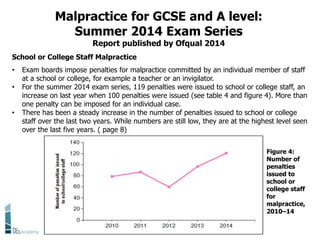
• For the summer 2014 exam series, 119 penalties were issued to school or college staff, an
increase on last year when 100 penalties were issued (see table 4 and figure 4). More than
one penalty can be imposed for an individual case.
• There has been a steady increase in the number of penalties issued to school or college
staff over the last two years. While numbers are still low, they are at the highest level seen
over the last five years. ( page 8)
Figure 4:
Number of
penalties
issued to
school or
college staff
for
malpractice,
2010–14
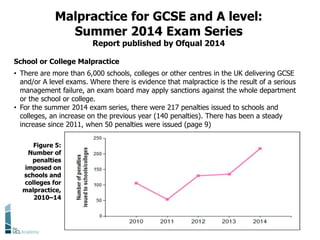
Figure 5:
Number of
penalties
imposed on
schools and
colleges for
malpractice,
2010–14
School or College Malpractice
• There are more than 6,000 schools, colleges or other centres in the UK delivering GCSE
and/or A level exams. Where there is evidence that malpractice is the result of a serious
management failure, an exam board may apply sanctions against the whole department
or the school or college.
• For the summer 2014 exam series, there were 217 penalties issued to schools and
colleges, an increase on the previous year (140 penalties). There has been a steady
increase since 2011, when 50 penalties were issued (page 9)
Malpractice for GCSE and A level:
Summer 2014 Exam Series
Report published by Ofqual 2014
Is this a New Phenomena?
1974
Cheating in ‘O’ level Geology
Does it Only Happen in England?
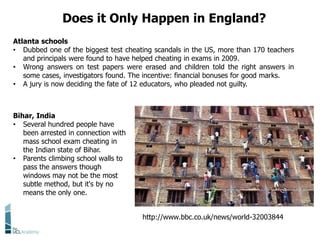
http://www.bbc.co.uk/news/world-32003844
Bihar, India
• Several hundred people have
been arrested in connection with
mass school exam cheating in
the Indian state of Bihar.
• Parents climbing school walls to
pass the answers though
windows may not be the most
subtle method, but it's by no
means the only one.
Atlanta schools
• Dubbed one of the biggest test cheating scandals in the US, more than 170 teachers
and principals were found to have helped cheating in exams in 2009.
• Wrong answers on test papers were erased and children told the right answers in
some cases, investigators found. The incentive: financial bonuses for good marks.
• A jury is now deciding the fate of 12 educators, who pleaded not guilty.
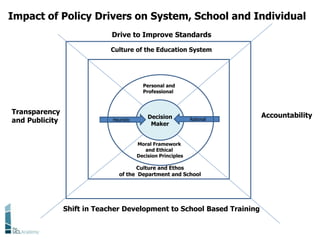
Decision
Maker
Heuristic Rational
Personal and
Professional
Moral Framework
and Ethical
Decision Principles
Culture and Ethos
of the Department and School
Culture of the Education System
Drive to Improve Standards
AccountabilityTransparency
and Publicity
Impact of Policy Drivers on System, School and Individual
Shift in Teacher Development to School Based Training
How Does the Teacher Make
Rational Decisions?
• Morality - The idea that we know what is right and wrong
– But in the context of assessment do we have a professional
consensus on right and wrong?
• Morals inform our ethical code and principles
• Principles that help individuals to exercise professional judgment in
complex moral settings
– How are teachers prepared to face these challenging moral and
ethical dilemmas?
Do the Right Thing?
Weighing up what is right for:
• The student to get the best life chance
• The subject and the school to do well in league tables and with
Ofsted
• My standing in the school
• My performance management and pay progression
• The integrity of the profession to be able to be judged as
honourable and trustworthy
What Guidance Do We Give Teachers and
Leaders to Help Them With These Dilemmas?
What do teachers need?
• Clarity
– What is expected of them as professionals?
• Preparation
– For the dilemmas they may face and how to explore and
exercise professional judgement
• Culture
– That sets and models high expectations and standards as
professionals
Rational Decision into Rational Action
Knowing what is the right thing to do and then have the
courage to do it, despite the personal consequences.
What are the incentives and sanctions to help
teachers make the right decisions?
Clarity - Look at the standards
for teachers in England
• https://www.gov.uk/government/publications/teachers-
standards
The Ethical Standards for the Teaching Profession
Represent a Vision of Professional Practice
At the heart of a strong and effective teaching profession is a commitment to students and their learning.
Members of the Ontario College of Teachers, in their position of trust, demonstrate responsibility in their relationships
with students, parents, guardians, colleagues, educational partners, other professionals, the environment and the public.
The Purposes of the Ethical Standards for the Teaching Profession are:
• to inspire members to reflect and uphold the honour and dignity of the teaching profession
• to identify the ethical responsibilities and commitments in the teaching profession
• to guide ethical decisions and actions in the teaching profession
• to promote public trust and confidence in the teaching profession.
The Ethical Standards for the Teaching Profession are:
Care
The ethical standard of Care includes compassion, acceptance, interest and insight for developing students' potential.
Members express their commitment to students' well-being and learning through positive influence, professional
judgment and empathy in practice.
Respect
Intrinsic to the ethical standard of Respect are trust and fair-mindedness. Members honour human dignity, emotional
wellness and cognitive development. In their professional practice, they model respect for spiritual and cultural values,
social justice, confidentiality, freedom, democracy and the environment.
Trust
The ethical standard of Trust embodies fairness, openness and honesty. Members' professional relationships with
students, colleagues, parents, guardians and the public are based on trust.
Integrity
Honesty, reliability and moral action are embodied in the ethical standard of Integrity. Continual reflection assists
members in exercising integrity in their professional commitments and responsibilities.
http://www.oct.ca/public/professional-standards/ethical-standards

The Rational Teacher: Ofqual ethics symposium

  • 1.
    When charting acourse in unknown territory, we need a compass not a road map The Rational Teacher Geraldine Davies Principal The UCL Academy
  • 2.
    • Professor RobertCoe warns that teachers are falling into ‘bad behaviour’ • He claims it is because they believe other schools were also bending the rules • This comes amid claims that teachers are 'telling learners what to write' to boost grades By Laura Clark for the Daily Mail Published: 18:35, 13 June 2014 | Updated: 01:42, 14 June 2014 Read more: http://www.dailymail.co.uk/news/article- 2657341/Teachers-lost-morality-cheating-exams-boost-pupils- exam-grades-claims-expert.html#ixzz3UY7JiJro 'Cheating Teachers Have Lost Morality': Dirty Tricks on the Rise to Boost Exam Grades
  • 3.
    Malpractice for GCSEand A level: Summer 2014 Exam Series Report published by Ofqual 2014 School or College Staff Malpractice • Exam boards impose penalties for malpractice committed by an individual member of staff at a school or college, for example a teacher or an invigilator. • For the summer 2014 exam series, 119 penalties were issued to school or college staff, an increase on last year when 100 penalties were issued (see table 4 and figure 4). More than one penalty can be imposed for an individual case. • There has been a steady increase in the number of penalties issued to school or college staff over the last two years. While numbers are still low, they are at the highest level seen over the last five years. ( page 8) Figure 4: Number of penalties issued to school or college staff for malpractice, 2010–14
  • 4.
    Figure 5: Number of penalties imposedon schools and colleges for malpractice, 2010–14 School or College Malpractice • There are more than 6,000 schools, colleges or other centres in the UK delivering GCSE and/or A level exams. Where there is evidence that malpractice is the result of a serious management failure, an exam board may apply sanctions against the whole department or the school or college. • For the summer 2014 exam series, there were 217 penalties issued to schools and colleges, an increase on the previous year (140 penalties). There has been a steady increase since 2011, when 50 penalties were issued (page 9) Malpractice for GCSE and A level: Summer 2014 Exam Series Report published by Ofqual 2014
  • 5.
    Is this aNew Phenomena? 1974 Cheating in ‘O’ level Geology
  • 6.
    Does it OnlyHappen in England? http://www.bbc.co.uk/news/world-32003844 Bihar, India • Several hundred people have been arrested in connection with mass school exam cheating in the Indian state of Bihar. • Parents climbing school walls to pass the answers though windows may not be the most subtle method, but it's by no means the only one. Atlanta schools • Dubbed one of the biggest test cheating scandals in the US, more than 170 teachers and principals were found to have helped cheating in exams in 2009. • Wrong answers on test papers were erased and children told the right answers in some cases, investigators found. The incentive: financial bonuses for good marks. • A jury is now deciding the fate of 12 educators, who pleaded not guilty.
  • 7.
    Decision Maker Heuristic Rational Personal and Professional MoralFramework and Ethical Decision Principles Culture and Ethos of the Department and School Culture of the Education System Drive to Improve Standards AccountabilityTransparency and Publicity Impact of Policy Drivers on System, School and Individual Shift in Teacher Development to School Based Training
  • 8.
    How Does theTeacher Make Rational Decisions? • Morality - The idea that we know what is right and wrong – But in the context of assessment do we have a professional consensus on right and wrong? • Morals inform our ethical code and principles • Principles that help individuals to exercise professional judgment in complex moral settings – How are teachers prepared to face these challenging moral and ethical dilemmas?
  • 9.
    Do the RightThing? Weighing up what is right for: • The student to get the best life chance • The subject and the school to do well in league tables and with Ofsted • My standing in the school • My performance management and pay progression • The integrity of the profession to be able to be judged as honourable and trustworthy
  • 10.
    What Guidance DoWe Give Teachers and Leaders to Help Them With These Dilemmas? What do teachers need? • Clarity – What is expected of them as professionals? • Preparation – For the dilemmas they may face and how to explore and exercise professional judgement • Culture – That sets and models high expectations and standards as professionals
  • 11.
    Rational Decision intoRational Action Knowing what is the right thing to do and then have the courage to do it, despite the personal consequences. What are the incentives and sanctions to help teachers make the right decisions?
  • 12.
    Clarity - Lookat the standards for teachers in England • https://www.gov.uk/government/publications/teachers- standards
  • 13.
    The Ethical Standardsfor the Teaching Profession Represent a Vision of Professional Practice At the heart of a strong and effective teaching profession is a commitment to students and their learning. Members of the Ontario College of Teachers, in their position of trust, demonstrate responsibility in their relationships with students, parents, guardians, colleagues, educational partners, other professionals, the environment and the public. The Purposes of the Ethical Standards for the Teaching Profession are: • to inspire members to reflect and uphold the honour and dignity of the teaching profession • to identify the ethical responsibilities and commitments in the teaching profession • to guide ethical decisions and actions in the teaching profession • to promote public trust and confidence in the teaching profession. The Ethical Standards for the Teaching Profession are: Care The ethical standard of Care includes compassion, acceptance, interest and insight for developing students' potential. Members express their commitment to students' well-being and learning through positive influence, professional judgment and empathy in practice. Respect Intrinsic to the ethical standard of Respect are trust and fair-mindedness. Members honour human dignity, emotional wellness and cognitive development. In their professional practice, they model respect for spiritual and cultural values, social justice, confidentiality, freedom, democracy and the environment. Trust The ethical standard of Trust embodies fairness, openness and honesty. Members' professional relationships with students, colleagues, parents, guardians and the public are based on trust. Integrity Honesty, reliability and moral action are embodied in the ethical standard of Integrity. Continual reflection assists members in exercising integrity in their professional commitments and responsibilities. http://www.oct.ca/public/professional-standards/ethical-standards