Question 1
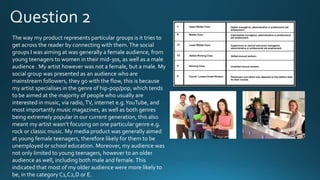
The way my product represents particular groups is it tries to
get across the reader by connecting with them. The social
groups I was aiming at was generally a female audience, from
young teenagers to women in their mid-30s, as well as a male
audience . My artist however was not a female, but a male. My
social group was presented as an audience who are
mainstream followers, they go with the flow, this is because
my artist specialises in the genre of hip-pop/pop, which tends
to be aimed at the majority of people who usually are
interested in music, via radio, TV, internet e.g. YouTube, and
most importantly music magazines, as well as both genres
being extremely popular in our current generation, this also
meant my artist wasn’t focusing on one particular genre e.g.
rock or classic music. My media product was generally aimed
at young female teenagers, therefore likely for them to be
unemployed or school education. Moreover, my audience was
not only limited to young teenagers, however to an older
audience as well, including both male and female. This
indicated that most of my older audience were more likely to
be, in the category C1,C2,D or E.
Question 3
Question 4
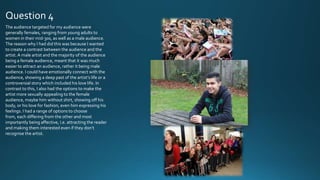
The audience targeted for my audience were
generally females, ranging from young adults to
women in their mid-30s, as well as a male audience.
The reason why I had did this was because I wanted
to create a contrast between the audience and the
artist. A male artist and the majority of the audience
being a female audience, meant that it was much
easier to attract an audience, rather it being male
audience. I could have emotionally connect with the
audience, showing a deep past of the artist’s life or a
controversial story which included his love life. In
contrast to this, I also had the options to make the
artist more sexually appealing to the female
audience, maybe him without shirt, showing off his
body, or his love for fashion, even him expressing his
feelings. I had a range of options to choose
from, each differing from the other and most
importantly being affective, i.e. attracting the reader
and making them interested even if they don’t
recognise the artist.
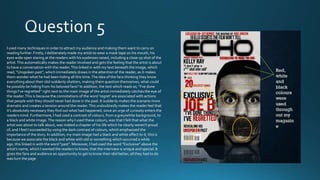
I used many techniques in order to attract my audience and making them want to carry on
reading further. Firstly, I deliberately made my artist to wear a mask tape on his mouth, his
eyes wide open staring at the readers with his eyebrows raised, including a close up shot of the
artist. This automatically makes the reader involved and gets the feeling that the artist is about
to have a conversation with the reader. This linked in with my text beneath the image, which
read, “Unspoken past”, which immediately draws in the attention of the reader, as it makes
them wonder what he had been hiding all this time. The idea of the fans thinking they know
everything about their idol suddenly shatters, making them question themselves, what could
he possibly be hiding from his beloved fans? In addition, the text which reads as; “I’ve done
things I’ve regretted” right next to the main image of the artist immediately catches the eye of
the reader. This is because the connotations of the word ‘regret’ are associated with actions
that people wish they should never had done in the past. It suddenly makes the scenario more
dramatic and creates a tension around the reader. This undoubtedly makes the reader feel that
it’s absolutely necessary they find out what had happened, since an urge of curiosity enters the
readers mind. Furthermore, I had used a contrast of colours, from a grey/white background, to
a black and white image. The reason why I used these colours, was that I felt that what the
artist was about to talk about, was indeed a chapter of his life which he clearly weren’t proud
of, and I feel I succeeded by using the dark contrast of colours, which emphasised the
importance of the story. In addition, my main image had a black and white affect to it, this is
because we associate the black and white with old or something which occurred a while
ago, this linked in with the word “past”. Moreover, I had used the word “Exclusive” above the
artist’s name, which I wanted the readers to know, that the interview is unique and special. It
gives the fans and audience an opportunity to get to know their idol better, all they had to do
was turn the page
Since this process, I have learnt a lot of things which I could
never have done, if it were not for this project. When I had
started the process, I had very basic skills in Photoshop. I had
trouble with the tools, inserting images, cropping
images, choosing specific colours, however I feel I have come a
long way ever since. Since the process has started, I now
believe I am at a level where I could guide a younger student in
how to use the tools on Photoshop. I believe I have developed
Photoshop skills over these past few months, which I can then
produce a high level piece of work. Not only that, I feel I have
improved my analysing skills, and have been able to process
that onto my media product. I have improved my vocabulary
skills, as well as been able to manipulate words. I am now fully
confident in able to recognise the connotations of some words
and associate words with other things much easier. In
addition, during this process, I had the opportunity to take
pictures and learnt about all the various angles of shots. I am
now much more comfortable handling a camera and confident
taking high quality pictures. Furthermore, I had used many
tech products during this process, which included e-mailing my
model, making my own blogger account, using slide share as
part of downloading my work I had produced.
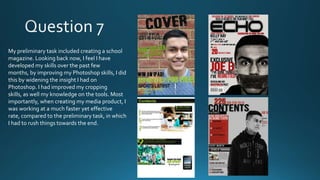
My preliminary task included creating a school
magazine. Looking back now, I feel I have
developed my skills over the past few
months, by improving my Photoshop skills, I did
this by widening the insight I had on
Photoshop. I had improved my cropping
skills, as well my knowledge on the tools. Most
importantly, when creating my media product, I
was working at a much faster yet effective
rate, compared to the preliminary task, in which
I had to rush things towards the end.

Official evaluation

  • 1.
  • 2.
    The way myproduct represents particular groups is it tries to get across the reader by connecting with them. The social groups I was aiming at was generally a female audience, from young teenagers to women in their mid-30s, as well as a male audience . My artist however was not a female, but a male. My social group was presented as an audience who are mainstream followers, they go with the flow, this is because my artist specialises in the genre of hip-pop/pop, which tends to be aimed at the majority of people who usually are interested in music, via radio, TV, internet e.g. YouTube, and most importantly music magazines, as well as both genres being extremely popular in our current generation, this also meant my artist wasn’t focusing on one particular genre e.g. rock or classic music. My media product was generally aimed at young female teenagers, therefore likely for them to be unemployed or school education. Moreover, my audience was not only limited to young teenagers, however to an older audience as well, including both male and female. This indicated that most of my older audience were more likely to be, in the category C1,C2,D or E.
  • 3.
  • 4.
    Question 4 The audiencetargeted for my audience were generally females, ranging from young adults to women in their mid-30s, as well as a male audience. The reason why I had did this was because I wanted to create a contrast between the audience and the artist. A male artist and the majority of the audience being a female audience, meant that it was much easier to attract an audience, rather it being male audience. I could have emotionally connect with the audience, showing a deep past of the artist’s life or a controversial story which included his love life. In contrast to this, I also had the options to make the artist more sexually appealing to the female audience, maybe him without shirt, showing off his body, or his love for fashion, even him expressing his feelings. I had a range of options to choose from, each differing from the other and most importantly being affective, i.e. attracting the reader and making them interested even if they don’t recognise the artist.
  • 5.
    I used manytechniques in order to attract my audience and making them want to carry on reading further. Firstly, I deliberately made my artist to wear a mask tape on his mouth, his eyes wide open staring at the readers with his eyebrows raised, including a close up shot of the artist. This automatically makes the reader involved and gets the feeling that the artist is about to have a conversation with the reader. This linked in with my text beneath the image, which read, “Unspoken past”, which immediately draws in the attention of the reader, as it makes them wonder what he had been hiding all this time. The idea of the fans thinking they know everything about their idol suddenly shatters, making them question themselves, what could he possibly be hiding from his beloved fans? In addition, the text which reads as; “I’ve done things I’ve regretted” right next to the main image of the artist immediately catches the eye of the reader. This is because the connotations of the word ‘regret’ are associated with actions that people wish they should never had done in the past. It suddenly makes the scenario more dramatic and creates a tension around the reader. This undoubtedly makes the reader feel that it’s absolutely necessary they find out what had happened, since an urge of curiosity enters the readers mind. Furthermore, I had used a contrast of colours, from a grey/white background, to a black and white image. The reason why I used these colours, was that I felt that what the artist was about to talk about, was indeed a chapter of his life which he clearly weren’t proud of, and I feel I succeeded by using the dark contrast of colours, which emphasised the importance of the story. In addition, my main image had a black and white affect to it, this is because we associate the black and white with old or something which occurred a while ago, this linked in with the word “past”. Moreover, I had used the word “Exclusive” above the artist’s name, which I wanted the readers to know, that the interview is unique and special. It gives the fans and audience an opportunity to get to know their idol better, all they had to do was turn the page
  • 6.
    Since this process,I have learnt a lot of things which I could never have done, if it were not for this project. When I had started the process, I had very basic skills in Photoshop. I had trouble with the tools, inserting images, cropping images, choosing specific colours, however I feel I have come a long way ever since. Since the process has started, I now believe I am at a level where I could guide a younger student in how to use the tools on Photoshop. I believe I have developed Photoshop skills over these past few months, which I can then produce a high level piece of work. Not only that, I feel I have improved my analysing skills, and have been able to process that onto my media product. I have improved my vocabulary skills, as well as been able to manipulate words. I am now fully confident in able to recognise the connotations of some words and associate words with other things much easier. In addition, during this process, I had the opportunity to take pictures and learnt about all the various angles of shots. I am now much more comfortable handling a camera and confident taking high quality pictures. Furthermore, I had used many tech products during this process, which included e-mailing my model, making my own blogger account, using slide share as part of downloading my work I had produced.
  • 7.
    My preliminary taskincluded creating a school magazine. Looking back now, I feel I have developed my skills over the past few months, by improving my Photoshop skills, I did this by widening the insight I had on Photoshop. I had improved my cropping skills, as well my knowledge on the tools. Most importantly, when creating my media product, I was working at a much faster yet effective rate, compared to the preliminary task, in which I had to rush things towards the end.