OFFICE MANAGEMENT
Presented by:-
Abdul Sattar Asghar
Principal (Rtd.)
Govt. College for Elementary Teachers,
Bahawalpur.
Email: ab.sattarasghar@gmail.com
Cell No. 030142668825, 03357756421
DEFINITIONS OF MANAGEMENT
 The group of individual who make decisions about
how a business is run.
 Education modifies the behavior of a person
 It is a social activity which deals with human
resources and material resources.
 To plan , to organize, to command, to coordinate
and to control.
 The act, art or manner on handling , controlling,
directing etc. skillful managing, care, tactful treatment,
carrying on or using for a purpose.
DEFINATION OF MANAGEMENT
ELEMENTS OF
MANAGEMENT
 Planning, Organization, Directing, Controlling.
We can add some more elements in the
management process:-
i. Motivating
ii. Coordinating
iii. Staffing
iv. Communicating
ELEMENTS OF MANAGEMENT
According to Luther Gullic,
Seven Functions of Management
POSDCORB
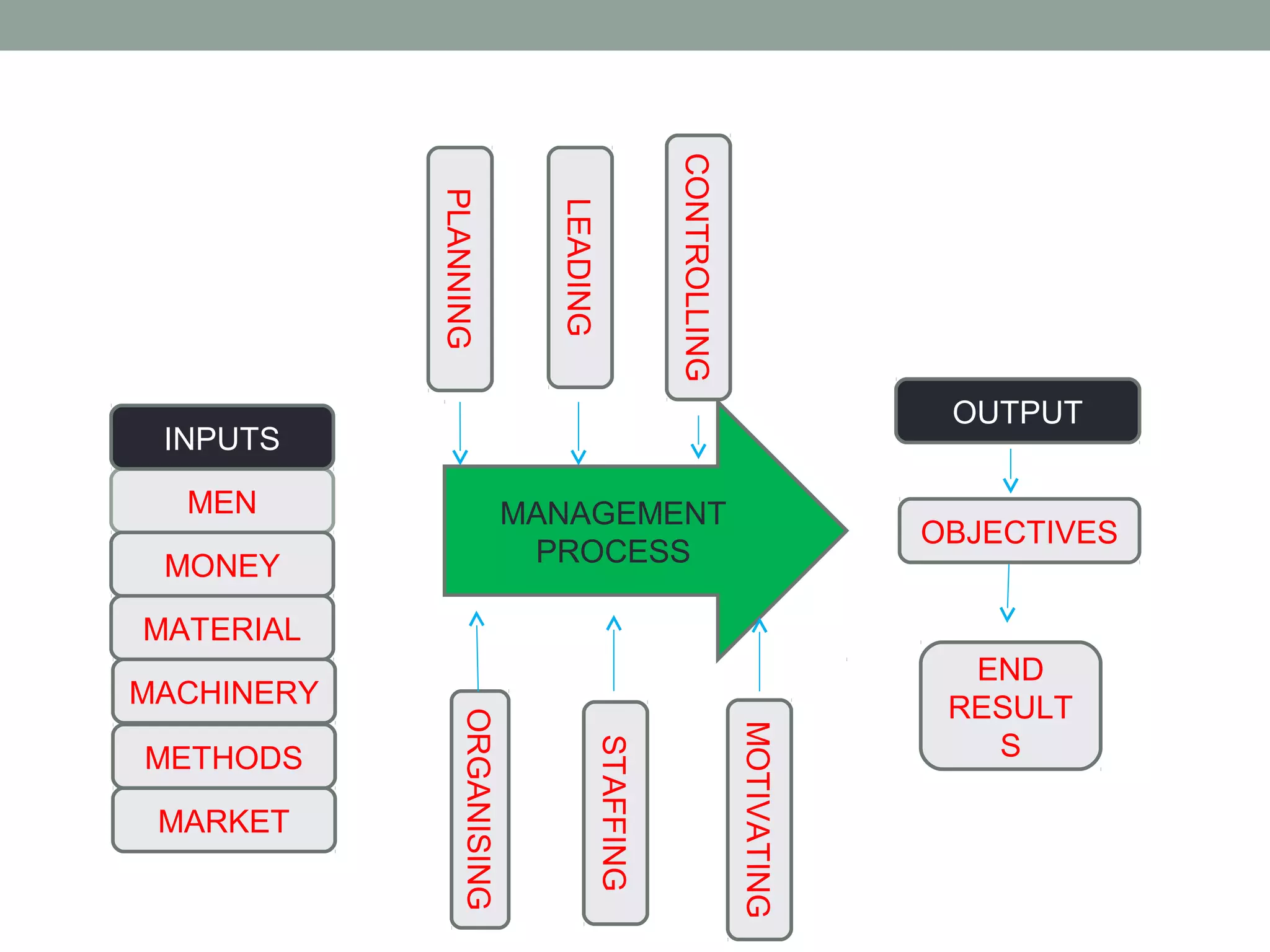
MANAGEMENT
PROCESSLEADING
MEN
MONEY
MATERIAL
MACHINERY
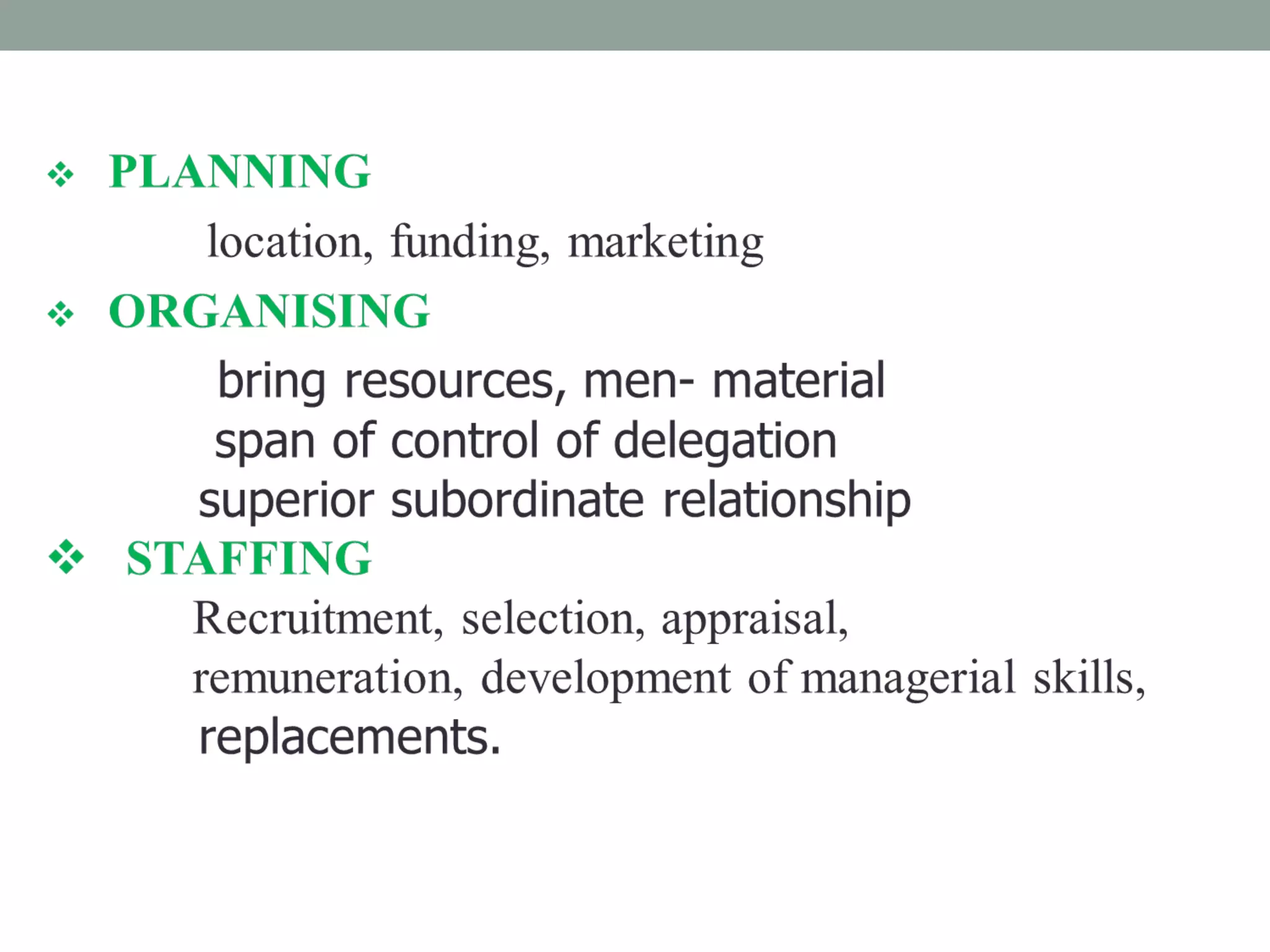
PLANNING
CONTROLLING
MOTIVATING
STAFFING
ORGANISING
END
RESULT
S
OBJECTIVES
INPUTS
MARKET
METHODS
OUTPUT
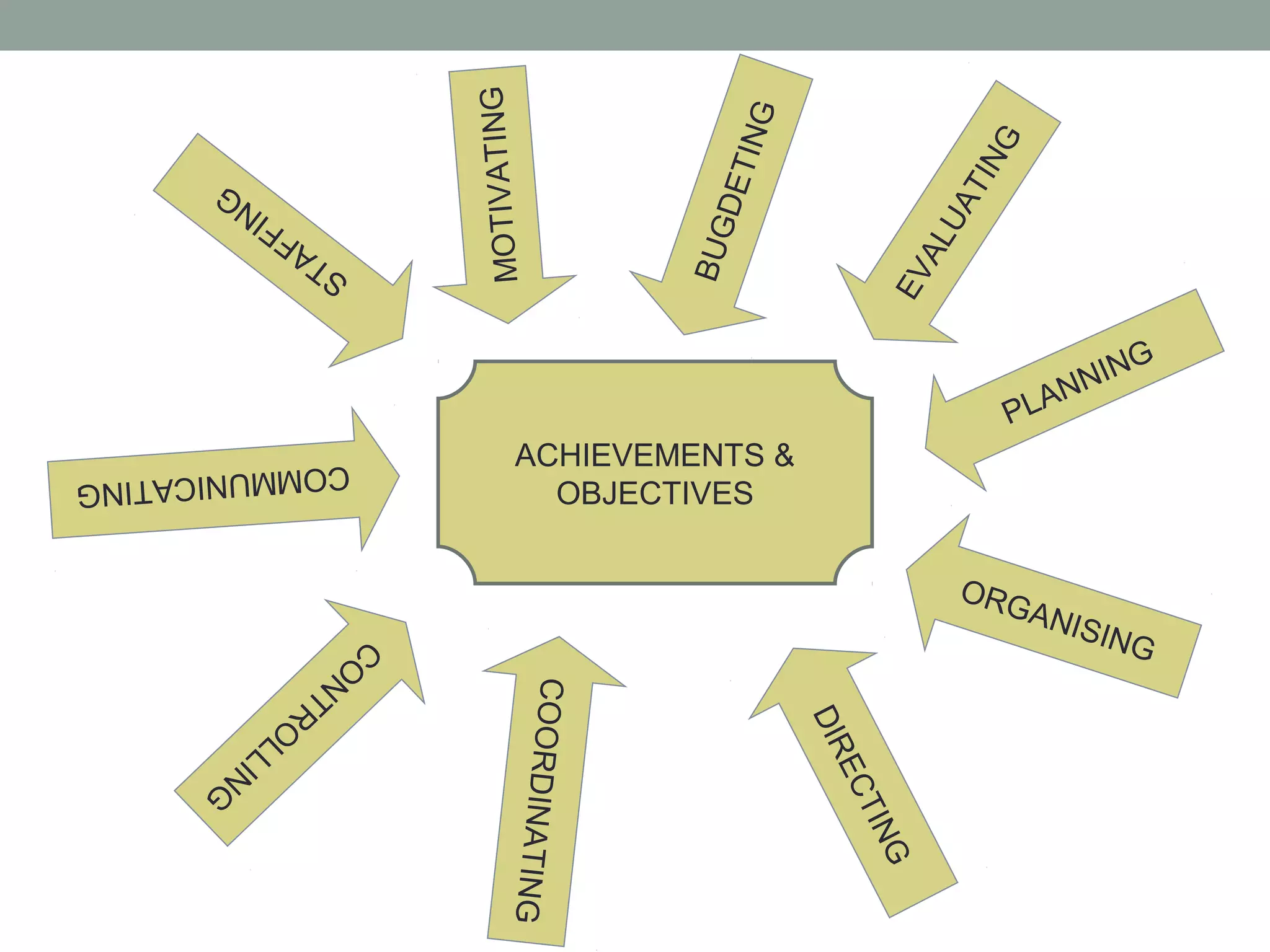
ACHIEVEMENTS &
OBJECTIVES
PLANNING
ORGANISING
DIRECTING
COORDINATING
CO
N
TR
O
LLIN
G
MOTIVATING
STAFFING
COMMUNICATING
BUGDETING
EVALUATING
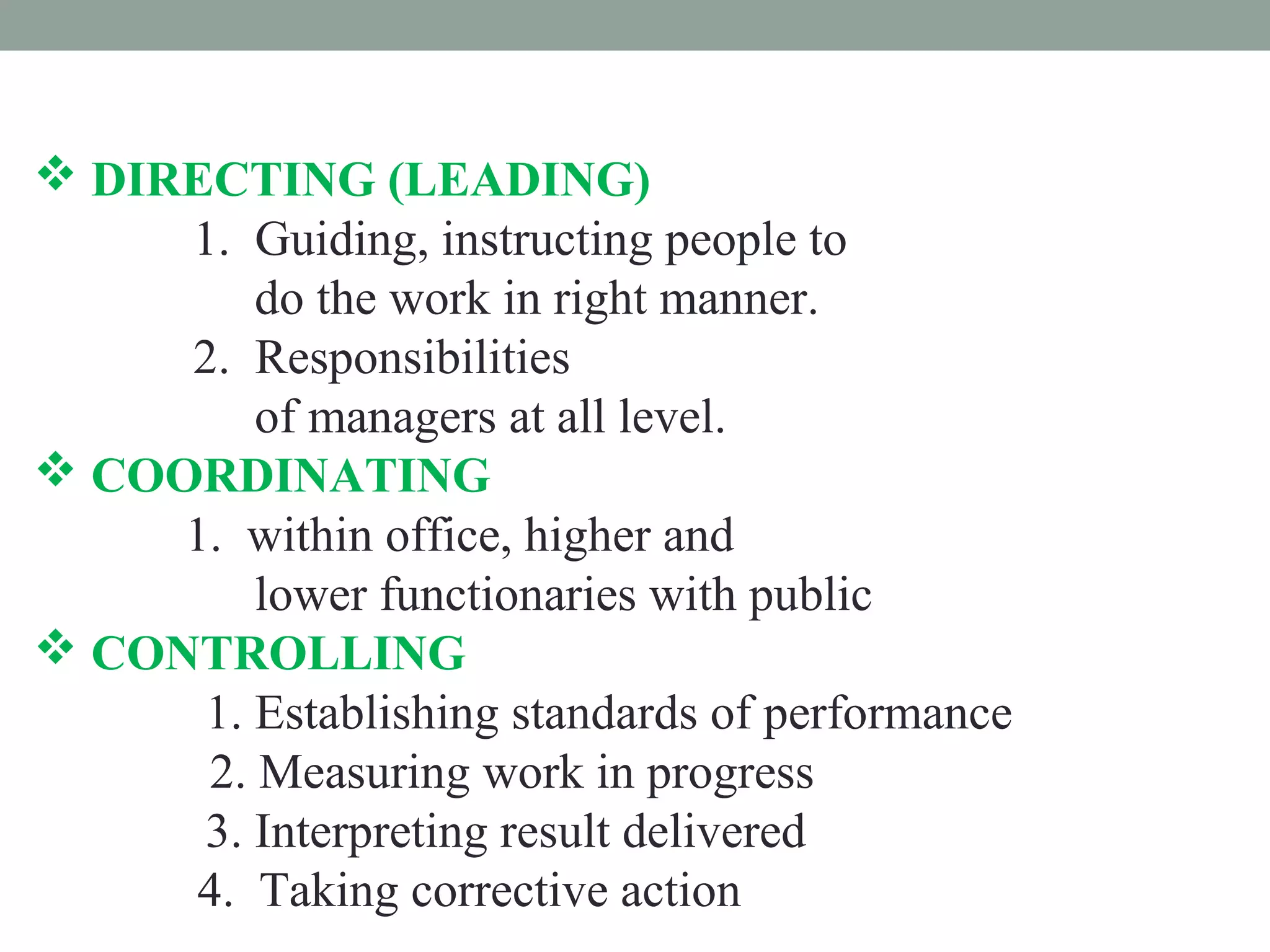
 DIRECTING (LEADING)
1. Guiding, instructing people to
do the work in right manner.
2. Responsibilities
of managers at all level.
 COORDINATING
1. within office, higher and
lower functionaries with public
 CONTROLLING
1. Establishing standards of performance
2. Measuring work in progress
3. Interpreting result delivered
4. Taking corrective action
 MOTIVATING
encourage, Initiative, provision of facilities, incentives,
inspiring and encouragement
 COMMUNICATING
written, oral, exchange of facts, ideas, information
between individual and department, guidance.
 REPORTING
performance of the year, profit and loss liabilities,
assist, extension of programme etc.
 BUDGETING
Financial assistance, loans etc.
Importance of management
Get maximum benefits with minimum efforts.
Optimum utilization of resources.
Management facilities optimum utilization of
available human and physical resources to minimize
wastage of all type of elements.
Competitive strength.
Cordial industrial relation
Motivation
Introduction new techniques
Innovation
 Smooth functioning
 Reduce turnover and absenteeism
 Survival of enterprise depends on its
management. Ineffective management leads to
disastrous consequences.
 “Ineffective management cuts at the very roots
of economy of an enterprise.” George Terry
 No placement in market and un-utilizing of
resources fully and properly due to lack of
management skill
TOP MANAGEMENT
Policies, Objectives
Top management (Minister, Secretary, EDO)
Policy formation
Approval of budget/ programme
Initiating projects
Budget control
Staff
Coordination/ communication
Middle Management
Dy. Secretary, DEO, Dy. DEOs, Head of
Colleges /Schools
Analyzing
Directing
Implementation
Routine decision
Controlling
Managers
On going activities- director of operations necessary to
produce the goods or services day to day results
Lower management
(Section officer, Superintendent,
Assistant /Clerks, School Staff)
Implementation
Monitoring
Evaluation
Operational
Supervision
Lower
Lower/supervisory managers plan and put into effect day
to day activity that should be carried out by the workers.
STYLE OF MANAGEMENT
COACHING
helping showing how to improve performance
 AFFILIATIVE
team work, repair broken trust
DEMOCRATIC
create a group of commitment to the resulting goals
AUTOCRATIC MANAGER
 AUTHORITY
TYPES OF EDUCATIONAL
LEADERSHIP
1. ADMINISTRATIVE:
Focused on administration policy, bureaucracy
accountability, concerned with following rules
ORDER IS ORDER
2. INSTRUCTIONAL LEADERSHIP:
Improving curriculum
Monitoring student behaviors in classroom
Evaluating student result
Closely with teachers to identify weak areas necessary for
school fallen behind
3. TRANSFORMATIONAL:
Build up confidence of followers
Systematic change
Helping style teachers/students/parents
Unified vision
4. FACILITATOR:
It helps to make progress and understands the need of
students, teachers and communities.
5. LAISSEZ-FAIRE:
Tolerance, non constructive supervision, no pain, no
interest
6. WORK SPACE:
Physical space, layout, design,
requirement of employees
7. SUPPLIES:
office requirements, stationery, furniture, computers and
accessories, photo stat machine, transportation, etc
OFFICE + MANAGEMENT
SOMETHING PROVISION OF SERVICES
PHYSICAL
HARDWARE SOFTWARE
(in computer technology) (in computer technology)
COMPONENTS OF AN OFFICE
1. BUILDING
2. LOCATION
3. MACHINERY
4. FURNITURE & FIXTURE
5. EQUIPMENTSTAFF / WORKERS
6. RECORD
7. PUBLIC
COMPONENTS OF OFFICE
MANAGEMENT
1. COMMUNICATIONS
2. EXCHANGE OF INFORMATION
3. DISPOSAL OF CASES / DECISIONS TAKEN AND THEIR
IMPLEMENTATION
4. DELEGATION OF POWERS
5. SUGGESTIONS TO MAKE FURTHER IMPROVEMENT
6. MONITORING
7. CHANGE MANAGEMENT
8. MOTIVATION TO WORK
MANAGEMENT RESOURCES
 HUMAN RESOURCES
Men power,
Staff,
Officers, Manager,
Admn Officer, Fore man, Shift In charge,
Ministerial staff, Superintendent,
worker
Service Staff(Peon, security guard, Mali,
Baildar, Driver,
 PHYSICALRESOURCES/ METERIAL RESOURCES
BULIDING
MACHINERY
FURNITURE AND FIXTURE
COMPUTER, PRINTER,
RAW METERIAL
BUSES, TRUCKS ETC
INFRASTRUCURE
HANDLING OF OFFICIAL
PAPERS
HANDLING OF OFFICIAL
PAPERS
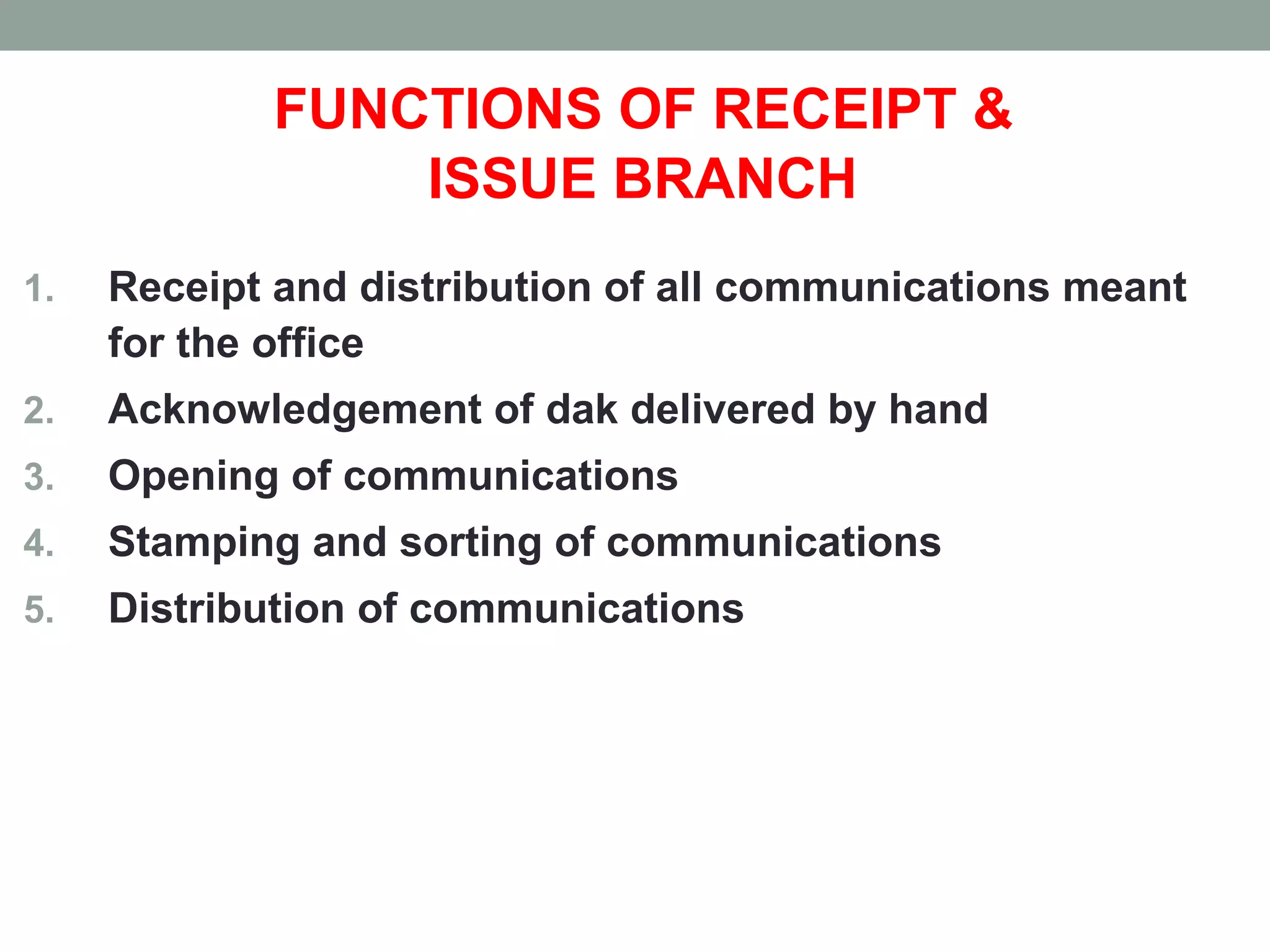
 It is the duty of every member of the staff to protect
from rough or careless handling.
 Keep all official papers in good condition as
Government property.
ACKNOWLEDGEMENT OF DAK
 Receipts and dispatch of all official letters.
FUNCTIONS OF RECEIPT &
ISSUE BRANCH
1. Receipt and distribution of all communications meant
for the office
2. Acknowledgement of dak delivered by hand
3. Opening of communications
4. Stamping and sorting of communications
5. Distribution of communications
Treatment of Papers Received in an Office
1. Receipt of communications
2. Perusal of a communications by an Officer
3. Diarizing of communications
4. Categories of communications to be and not to be
diarized
5. Receipt marked Top Secret, Secret and Confidential
6. Enclosures, Appendix and Annexes
7. Segregation of receipts according to category
8. Placing of reference in a new or existing file
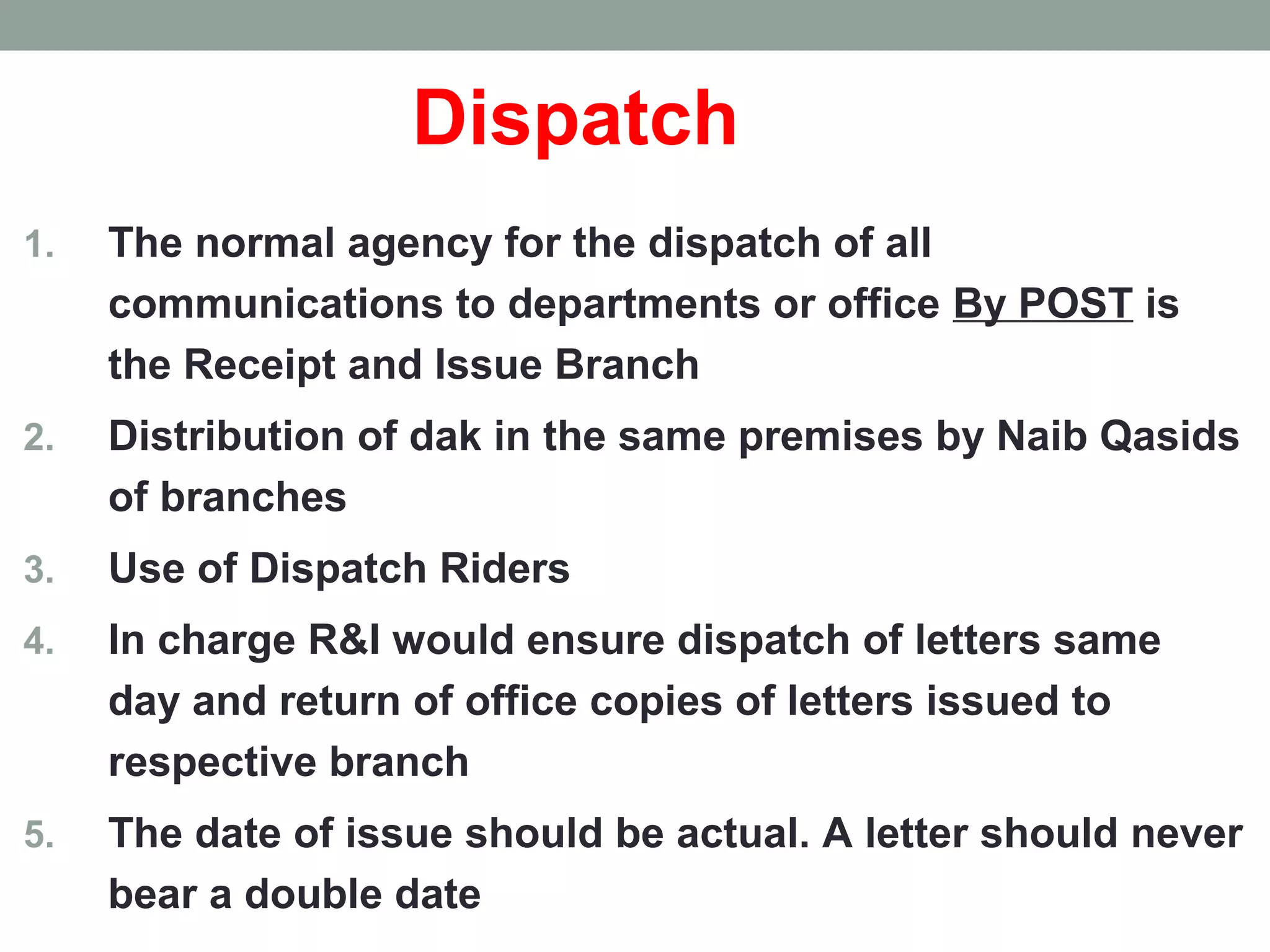
Dispatch
1. The normal agency for the dispatch of all
communications to departments or office By POST is
the Receipt and Issue Branch
2. Distribution of dak in the same premises by Naib Qasids
of branches
3. Use of Dispatch Riders
4. In charge R&I would ensure dispatch of letters same
day and return of office copies of letters issued to
respective branch
5. The date of issue should be actual. A letter should never
bear a double date
6. Documents should be placed in cover with names and
addresses
7. The dak to be issued by post should be entered in a separate
register with:-
i. Reference numbers
ii. Particulars of addressees and
iii. Amount of stamp on each letter
8. After issue of letter, office copy should be stamped and
returned to the concerned branch
Duties of Dispatcher
1. Receives paper for dispatch
2. Checks the enclosures, if any
3. Inserts date, if the date space is blank, both in the fair copy
and in the office copy
4. Separates fair copy from the office copy
5. Affixes rubber stamp ‘issued’ on the office copy and puts his
dated initial under it
6. Returns the office copy to the section concerned
7. Places fair copies in the relevant compartment of the sorting
rack
8. Clears compartment of sorting rack one by one and arrange
letters office – wise, separating communications for local
dispatch from those to be dispatched by post
9. Enters communications for local dispatch in peon book
10. Passes communications and peon books to Naib Qasid for
delivery
11. Prepares covers where necessary and writes addresses on
covers, for communication to be dispatched by post
(cyclostyled addresses slips may be used where available)
12. Makes necessary entries in the register of stamps account
13. Hands over covers to Naib Qasid for posting
14. At the end of each day, he shall check the peon books and
satisfy himself that all kinds of the dak delivered to the
addressees concerned
Duties of Daftri
1. Closes covers
2. Weighs and notes value of postage
stamps required
3. Affixes required postage stamps
4. Rubber stamps the cover
5. Returns covers to the Dispatcher
Treatment of Confidential Papers
1. All official papers are confidential papers and
should not be discussed with unauthorized persons
2. The rule applies with greater force when marked as
confidential / secret
3. Breach of this rule is an offence punishable with
imprisonment or fine under the Official Secret Act,
1923
Treatment of Priority Cases and Use of Priority Labels
1. The use of priority labels should be used where necessary
2. The label should be fixed to the top binder of the file board on the
left side
3. Priority references should be separated from ordinary papers and
transmitted at once
i. Top Priority
ii. Assembly Business
iii. Urgent / Immediate
iv. Budget
v. Secret / Confidential
vi. Time Limit Case
vii. Meeting Notice
viii. Court Case
Action Upon Written Remarks of Officers on the PUC
1. The officer to whom communications are submitted in
dak issue directions regarding the course of action to
be taken by the office
2. If an officer intends to deal with the reference himself,
he directs the office to provide him the relevant file and
all other connected papers
3. The communications on which no special instructions
are recorded will be initialed by the officer in token of
his having seen them
ASSIGNMENTS OF AN OFFICE
a. Recruitment
b. Promotion
c. Leave
d. Enquiries
e. Transfers
f. Pensions etc.
g. Promotions
h. Purchases
i. Implementation of department’s policies
j. Redressal of complaints
PRIORITIES / LABELS:
1. Top Priority - Prompt attention, even at
residence on holidays /after office hours.
Disposal within 24 hours
2. Assembly Business As per time limit
3. Budget As per time limit
4. Urgent / immediate - Disposal Within 48 hours
5. Court Case - Disposal Within prescribed limit
6. Time Limit Case - Disposal within fixed time limit
7. Confidential - Submitted under sealed cover or by hand
Officer submitting priority cases
i- Should keep a close watch
ii- Should remind personally
iii- Should get it done at personal level
MODES OF COMMUNICATION
 Ordinary Mail / Post
 Through Special Messenger
 Through UMS / Registered Post
 Through Courier Service
 Fax
 E-Mail
NOTING ON CASES
• Definition
• Importance
• Notes and orders should be recorded
on the note-sheet only
• Noting is not required on cases where:-
• The officer is himself competent
to dispose of the case.
• The line of action has
been indicated by higher officers
 A file consists two parts:-
 A. Notes portion/noting portion
 B. Correspondence portion
 Separate folder / cover being used
for each portion.
PART OF A FILE
WHY NOTING/ NOTING TECHNIQUE
1. For proper examination & processing of the case
2. To create proper record
3. To assist and support the seniors
4. To facilitate the seniors in decision making
5. To appreciate the point / issue
6. To criticize the point / issue
USE OF 5 P’s
1. What is PUC / what is current issue?
2. Previous history and background of the case
3. Policy and Legal position of the case
4. Precedent, if any
5. Proposal on the issue
DRAFT FOR APPROVAL
• Draft for approval (DFA)
• A draft is an outline in the form of rough notes
• It is rough copy of a document to be perfected
letter on by means of certain modalities.
• After drafting, it is submitted to a competent officer
for his approval.
GENERAL INSTRUCTION
• Assumption – PUC would be read by higher ups
• Reproduction of the contents of PUC not appropriate
• Preparation of up-to-date summary
• Notes less than half page should be legibly written
• Notes exceeding half page should be typed
• One paragraph -one particular point
• Wording – temperate and polite
• Devoid of personal remarks and criticism
• Special care –in making observations on notes of
senior officers, ministers and summary for chief
minister
• Signatures of the officer on the right side at
the end of the note
• When the higher officer agrees with the note,
he may merely append his signatures or initials
Higher officer should initiate his own note
in-case he differs with the views of junior officer
• Confirmation of verbal instructions
should be obtained in writing.
• All Government business should be
made in writing
DRAFT
A draft is put up when:-
 The course of action is absolutely clear
 Orders have been passed on the
communication by higher officers
 Preparation of draft in all other cases
QUALITIES OF A GOOD
DRAFT
• Clear and straight forward manner
• Correct information
• Clear idea in your mind of what you want to say.
• Comprehension
• Clarity
• Brevity
• Courtesy
• Concreteness.
DIFFERENT FORMS OF
DRAFTS
1. Simple Official Letter
2. Office Memorandum
3. Circular letter
4. Notification
5. Demi Official Letter
6. UO Letter
7. Office Order
8. Endorsement
9. Official Invitation Letter
10. Press Release
11. Application
SAMPLES OF
SOME OFFICIAL LETTERS
ABBREVIATIONS
PUC Paper under consideration
DFA Draft for approval
Corr: Correspondence
N Noting
S.O. Section Officer
D.S Deputy Secretary
A.S. Additional Secretary
Secy. Secretary
D.G. Director General
NFA No further action
ABBREVIATIONS
A.D. Administrative Department
C.R. Character Roll
Deptt. Department
K.W. Keep with (file)
L.F. Linked file
L.P.R. Leave Preparatory to Retirement
O/c Office copy
O.O Office Order
P.P.O. Pension Payment Order
P.P. Previous Paper
ABBREVIATIONS
DDO Drawing and disbursing officer
DAO District Accounts Officer/ Office.
EDO Executive District Officer
DEO(SE) District Education Officer(Secondary Edu)
DEO(EE-W) District Education Officer Ele. Edu. Women.
DEO(EE-M) District Education Officer Ele. Edu. Male
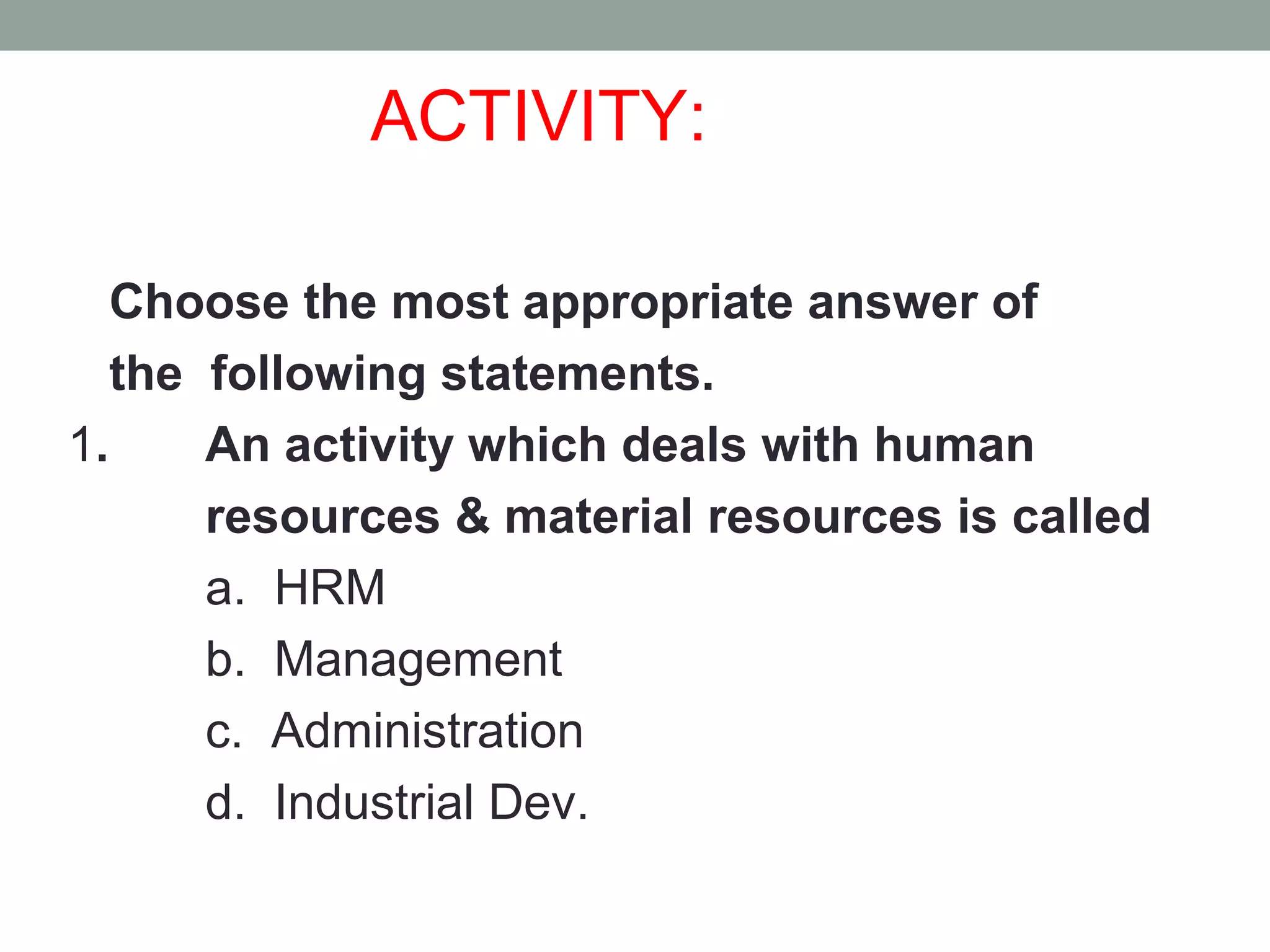
ACTIVITY:
Choose the most appropriate answer of
the following statements.
1. An activity which deals with human
resources & material resources is called
a. HRM
b. Management
c. Administration
d. Industrial Dev.
2. Who modifies the behavior of a person
a) Education
b) Environment
c) Heredity
d) All above
3. Management is the process and a person
who perform this process is called
a) Head teacher
b) Foreman
c) Administration
d) Manager
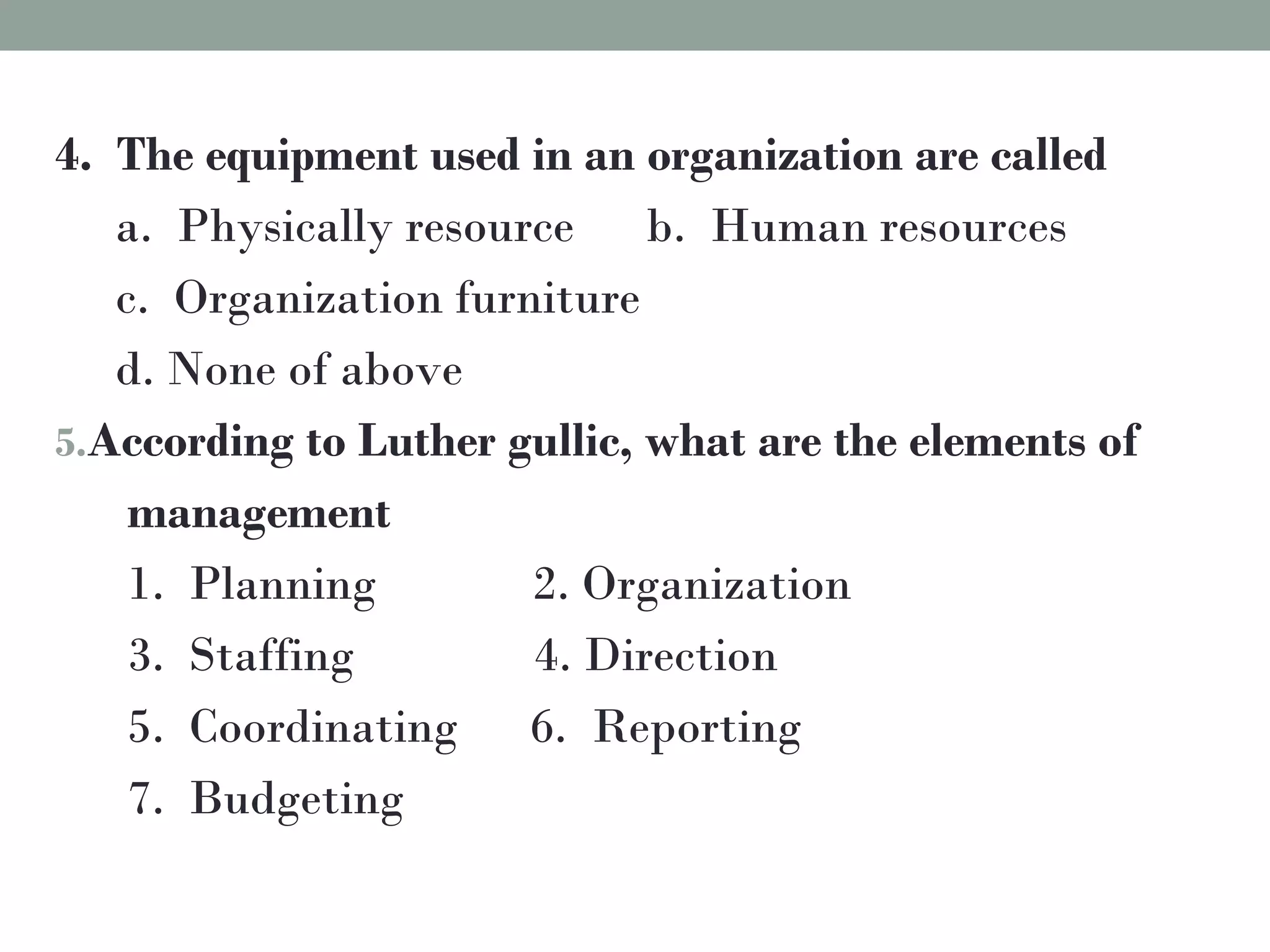
4. The equipment used in an organization are called
a. Physically resource b. Human resources
c. Organization furniture
d. None of above
5.According to Luther gullic, what are the elements of
management
1. Planning 2. Organization
3. Staffing 4. Direction
5. Coordinating 6. Reporting
7. Budgeting
6. In an organization money and material were
used as resources. what will be achieved
a)Input
b)Output
c)Good will
d)None of above
7. In the process of recruitment of staff, what
kind of information have to provide to personnel
a)Minimum qualification
b)Min + Max age limit
c)Experiences
d)Domicile
e)All above
8. Coordination means relations
a)Within office
b)Higher functionaries
c)Lower formulation
d)All above
9. After elapse a period of one year , in
performance of a arguments can be checked
by
a)Evaluation
b)Auditing
c)To see products
d)None of above
10.Followings are the important steps to be remember
in good management
1) Available human & material resources
2) Competition in market
3) Cordial relationship
4) Facilitations
5) Motivation
6) Introduction to new techniques
7) Innovation
8) Incentives
9) Maximize wastage of all types of resources
10) Optimum utilization of resources
11. In effective managements means
a)Lack of management skill
b)Cuts the roots of economy of an organization
c)Use the old technology
d)All above
12. Write down name of 4 styles of management
1)Democratic
2)Autocratic
3)Administration
4)Coaching
5)Affiliates
6)laissze-faire
13. Levels of management
a)Top management
b)Middle management
c)Lower management
d)All above
14. Policy formation is main duty of
a)Top management
b)Middle management
c)Lower management
d)All above
15. A manager is responsible for
a)Ongoing activity
b)Day to day result
c)Production of goods & services
d)None of above
16. Monitoring & supervision is the responsibilities of
a)Top management
b)Middle management
c)Lower management
d)All above
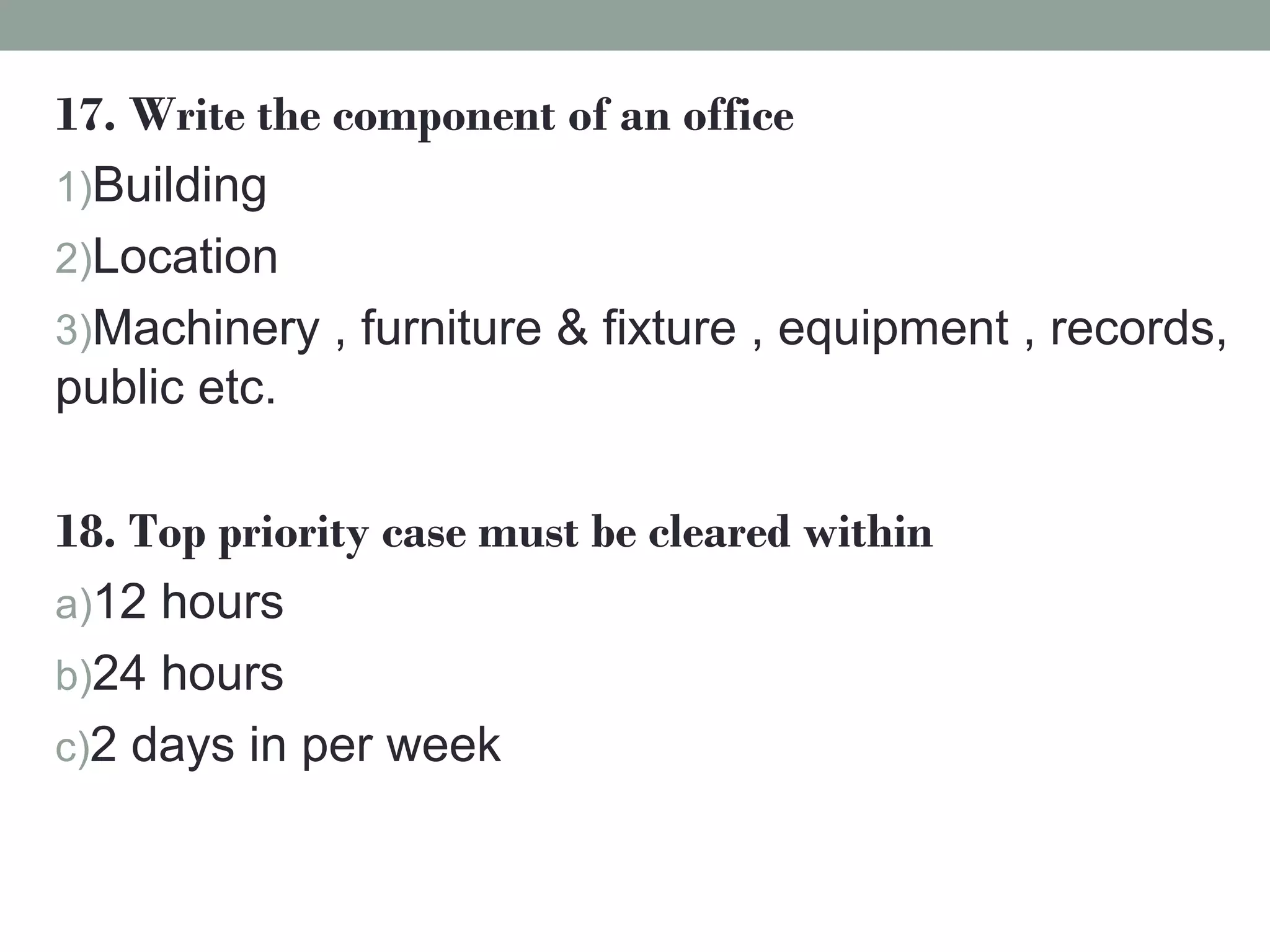
17. Write the component of an office
1)Building
2)Location
3)Machinery , furniture & fixture , equipment , records,
public etc.
18. Top priority case must be cleared within
a)12 hours
b)24 hours
c)2 days in per week
19. PUC means
a)Project under compilation
b)Paper under consideration
c)Paper urgent & care nature
d)Pakistan under development country
20. Urgent/immediate nature cares should dispose off
within
a)12 hours
b)24 hours
c)36 hours
d)48 hours
21. DFA means
a. Directly Financial assistance
b. District Finance Authority
c. Draft for approval
d. None of above
22. Time Limit Case means
a. Dispose at an early date
b. Dispose out today
c. Dispose when it is put before officer
d. Dispose within fixed period
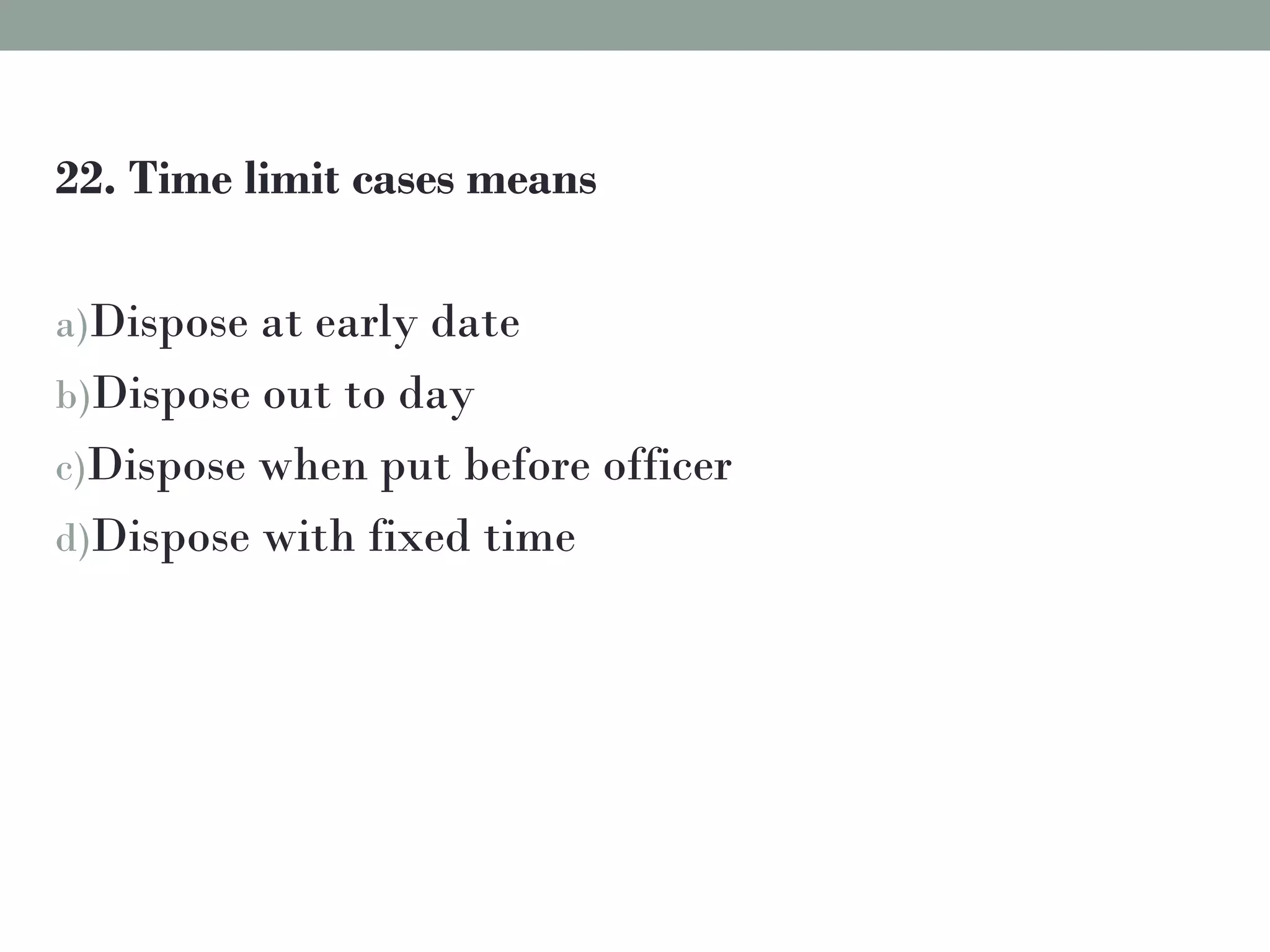
22. Time limit cases means
a)Dispose at early date
b)Dispose out to day
c)Dispose when put before officer
d)Dispose with fixed time
Office managment

Office managment

  • 1.
    OFFICE MANAGEMENT Presented by:- AbdulSattar Asghar Principal (Rtd.) Govt. College for Elementary Teachers, Bahawalpur. Email: ab.sattarasghar@gmail.com Cell No. 030142668825, 03357756421
  • 2.
    DEFINITIONS OF MANAGEMENT The group of individual who make decisions about how a business is run.  Education modifies the behavior of a person  It is a social activity which deals with human resources and material resources.  To plan , to organize, to command, to coordinate and to control.  The act, art or manner on handling , controlling, directing etc. skillful managing, care, tactful treatment, carrying on or using for a purpose.
  • 3.
  • 4.
    ELEMENTS OF MANAGEMENT  Planning,Organization, Directing, Controlling. We can add some more elements in the management process:- i. Motivating ii. Coordinating iii. Staffing iv. Communicating
  • 5.
    ELEMENTS OF MANAGEMENT Accordingto Luther Gullic, Seven Functions of Management POSDCORB
  • 6.
  • 7.
  • 9.
     DIRECTING (LEADING) 1.Guiding, instructing people to do the work in right manner. 2. Responsibilities of managers at all level.  COORDINATING 1. within office, higher and lower functionaries with public  CONTROLLING 1. Establishing standards of performance 2. Measuring work in progress 3. Interpreting result delivered 4. Taking corrective action
  • 10.
     MOTIVATING encourage, Initiative,provision of facilities, incentives, inspiring and encouragement  COMMUNICATING written, oral, exchange of facts, ideas, information between individual and department, guidance.  REPORTING performance of the year, profit and loss liabilities, assist, extension of programme etc.  BUDGETING Financial assistance, loans etc.
  • 11.
    Importance of management Getmaximum benefits with minimum efforts. Optimum utilization of resources. Management facilities optimum utilization of available human and physical resources to minimize wastage of all type of elements. Competitive strength. Cordial industrial relation Motivation Introduction new techniques Innovation
  • 12.
     Smooth functioning Reduce turnover and absenteeism  Survival of enterprise depends on its management. Ineffective management leads to disastrous consequences.  “Ineffective management cuts at the very roots of economy of an enterprise.” George Terry  No placement in market and un-utilizing of resources fully and properly due to lack of management skill
  • 13.
    TOP MANAGEMENT Policies, Objectives Topmanagement (Minister, Secretary, EDO) Policy formation Approval of budget/ programme Initiating projects Budget control Staff Coordination/ communication
  • 14.
    Middle Management Dy. Secretary,DEO, Dy. DEOs, Head of Colleges /Schools Analyzing Directing Implementation Routine decision Controlling Managers On going activities- director of operations necessary to produce the goods or services day to day results
  • 15.
    Lower management (Section officer,Superintendent, Assistant /Clerks, School Staff) Implementation Monitoring Evaluation Operational Supervision Lower Lower/supervisory managers plan and put into effect day to day activity that should be carried out by the workers.
  • 16.
    STYLE OF MANAGEMENT COACHING helpingshowing how to improve performance  AFFILIATIVE team work, repair broken trust DEMOCRATIC create a group of commitment to the resulting goals AUTOCRATIC MANAGER  AUTHORITY
  • 17.
    TYPES OF EDUCATIONAL LEADERSHIP 1.ADMINISTRATIVE: Focused on administration policy, bureaucracy accountability, concerned with following rules ORDER IS ORDER 2. INSTRUCTIONAL LEADERSHIP: Improving curriculum Monitoring student behaviors in classroom Evaluating student result Closely with teachers to identify weak areas necessary for school fallen behind
  • 18.
    3. TRANSFORMATIONAL: Build upconfidence of followers Systematic change Helping style teachers/students/parents Unified vision 4. FACILITATOR: It helps to make progress and understands the need of students, teachers and communities.
  • 19.
    5. LAISSEZ-FAIRE: Tolerance, nonconstructive supervision, no pain, no interest 6. WORK SPACE: Physical space, layout, design, requirement of employees 7. SUPPLIES: office requirements, stationery, furniture, computers and accessories, photo stat machine, transportation, etc
  • 21.
    OFFICE + MANAGEMENT SOMETHINGPROVISION OF SERVICES PHYSICAL HARDWARE SOFTWARE (in computer technology) (in computer technology)
  • 22.
    COMPONENTS OF ANOFFICE 1. BUILDING 2. LOCATION 3. MACHINERY 4. FURNITURE & FIXTURE 5. EQUIPMENTSTAFF / WORKERS 6. RECORD 7. PUBLIC
  • 23.
    COMPONENTS OF OFFICE MANAGEMENT 1.COMMUNICATIONS 2. EXCHANGE OF INFORMATION 3. DISPOSAL OF CASES / DECISIONS TAKEN AND THEIR IMPLEMENTATION 4. DELEGATION OF POWERS 5. SUGGESTIONS TO MAKE FURTHER IMPROVEMENT 6. MONITORING 7. CHANGE MANAGEMENT 8. MOTIVATION TO WORK
  • 24.
    MANAGEMENT RESOURCES  HUMANRESOURCES Men power, Staff, Officers, Manager, Admn Officer, Fore man, Shift In charge, Ministerial staff, Superintendent, worker Service Staff(Peon, security guard, Mali, Baildar, Driver,
  • 25.
     PHYSICALRESOURCES/ METERIALRESOURCES BULIDING MACHINERY FURNITURE AND FIXTURE COMPUTER, PRINTER, RAW METERIAL BUSES, TRUCKS ETC INFRASTRUCURE
  • 26.
  • 27.
    HANDLING OF OFFICIAL PAPERS It is the duty of every member of the staff to protect from rough or careless handling.  Keep all official papers in good condition as Government property. ACKNOWLEDGEMENT OF DAK  Receipts and dispatch of all official letters.
  • 28.
    FUNCTIONS OF RECEIPT& ISSUE BRANCH 1. Receipt and distribution of all communications meant for the office 2. Acknowledgement of dak delivered by hand 3. Opening of communications 4. Stamping and sorting of communications 5. Distribution of communications
  • 29.
    Treatment of PapersReceived in an Office 1. Receipt of communications 2. Perusal of a communications by an Officer 3. Diarizing of communications 4. Categories of communications to be and not to be diarized 5. Receipt marked Top Secret, Secret and Confidential 6. Enclosures, Appendix and Annexes 7. Segregation of receipts according to category 8. Placing of reference in a new or existing file
  • 30.
    Dispatch 1. The normalagency for the dispatch of all communications to departments or office By POST is the Receipt and Issue Branch 2. Distribution of dak in the same premises by Naib Qasids of branches 3. Use of Dispatch Riders 4. In charge R&I would ensure dispatch of letters same day and return of office copies of letters issued to respective branch 5. The date of issue should be actual. A letter should never bear a double date
  • 31.
    6. Documents shouldbe placed in cover with names and addresses 7. The dak to be issued by post should be entered in a separate register with:- i. Reference numbers ii. Particulars of addressees and iii. Amount of stamp on each letter 8. After issue of letter, office copy should be stamped and returned to the concerned branch
  • 32.
    Duties of Dispatcher 1.Receives paper for dispatch 2. Checks the enclosures, if any 3. Inserts date, if the date space is blank, both in the fair copy and in the office copy 4. Separates fair copy from the office copy 5. Affixes rubber stamp ‘issued’ on the office copy and puts his dated initial under it 6. Returns the office copy to the section concerned 7. Places fair copies in the relevant compartment of the sorting rack 8. Clears compartment of sorting rack one by one and arrange letters office – wise, separating communications for local dispatch from those to be dispatched by post 9. Enters communications for local dispatch in peon book
  • 33.
    10. Passes communicationsand peon books to Naib Qasid for delivery 11. Prepares covers where necessary and writes addresses on covers, for communication to be dispatched by post (cyclostyled addresses slips may be used where available) 12. Makes necessary entries in the register of stamps account 13. Hands over covers to Naib Qasid for posting 14. At the end of each day, he shall check the peon books and satisfy himself that all kinds of the dak delivered to the addressees concerned
  • 34.
    Duties of Daftri 1.Closes covers 2. Weighs and notes value of postage stamps required 3. Affixes required postage stamps 4. Rubber stamps the cover 5. Returns covers to the Dispatcher
  • 35.
    Treatment of ConfidentialPapers 1. All official papers are confidential papers and should not be discussed with unauthorized persons 2. The rule applies with greater force when marked as confidential / secret 3. Breach of this rule is an offence punishable with imprisonment or fine under the Official Secret Act, 1923
  • 36.
    Treatment of PriorityCases and Use of Priority Labels 1. The use of priority labels should be used where necessary 2. The label should be fixed to the top binder of the file board on the left side 3. Priority references should be separated from ordinary papers and transmitted at once i. Top Priority ii. Assembly Business iii. Urgent / Immediate iv. Budget v. Secret / Confidential vi. Time Limit Case vii. Meeting Notice viii. Court Case
  • 37.
    Action Upon WrittenRemarks of Officers on the PUC 1. The officer to whom communications are submitted in dak issue directions regarding the course of action to be taken by the office 2. If an officer intends to deal with the reference himself, he directs the office to provide him the relevant file and all other connected papers 3. The communications on which no special instructions are recorded will be initialed by the officer in token of his having seen them
  • 38.
    ASSIGNMENTS OF ANOFFICE a. Recruitment b. Promotion c. Leave d. Enquiries e. Transfers f. Pensions etc. g. Promotions h. Purchases i. Implementation of department’s policies j. Redressal of complaints
  • 39.
    PRIORITIES / LABELS: 1.Top Priority - Prompt attention, even at residence on holidays /after office hours. Disposal within 24 hours 2. Assembly Business As per time limit 3. Budget As per time limit 4. Urgent / immediate - Disposal Within 48 hours 5. Court Case - Disposal Within prescribed limit 6. Time Limit Case - Disposal within fixed time limit 7. Confidential - Submitted under sealed cover or by hand Officer submitting priority cases i- Should keep a close watch ii- Should remind personally iii- Should get it done at personal level
  • 40.
    MODES OF COMMUNICATION Ordinary Mail / Post  Through Special Messenger  Through UMS / Registered Post  Through Courier Service  Fax  E-Mail
  • 41.
    NOTING ON CASES •Definition • Importance • Notes and orders should be recorded on the note-sheet only • Noting is not required on cases where:- • The officer is himself competent to dispose of the case. • The line of action has been indicated by higher officers
  • 42.
     A fileconsists two parts:-  A. Notes portion/noting portion  B. Correspondence portion  Separate folder / cover being used for each portion. PART OF A FILE
  • 43.
    WHY NOTING/ NOTINGTECHNIQUE 1. For proper examination & processing of the case 2. To create proper record 3. To assist and support the seniors 4. To facilitate the seniors in decision making 5. To appreciate the point / issue 6. To criticize the point / issue USE OF 5 P’s 1. What is PUC / what is current issue? 2. Previous history and background of the case 3. Policy and Legal position of the case 4. Precedent, if any 5. Proposal on the issue
  • 44.
    DRAFT FOR APPROVAL •Draft for approval (DFA) • A draft is an outline in the form of rough notes • It is rough copy of a document to be perfected letter on by means of certain modalities. • After drafting, it is submitted to a competent officer for his approval.
  • 45.
    GENERAL INSTRUCTION • Assumption– PUC would be read by higher ups • Reproduction of the contents of PUC not appropriate • Preparation of up-to-date summary • Notes less than half page should be legibly written • Notes exceeding half page should be typed • One paragraph -one particular point • Wording – temperate and polite • Devoid of personal remarks and criticism
  • 46.
    • Special care–in making observations on notes of senior officers, ministers and summary for chief minister • Signatures of the officer on the right side at the end of the note • When the higher officer agrees with the note, he may merely append his signatures or initials Higher officer should initiate his own note in-case he differs with the views of junior officer • Confirmation of verbal instructions should be obtained in writing. • All Government business should be made in writing
  • 47.
    DRAFT A draft isput up when:-  The course of action is absolutely clear  Orders have been passed on the communication by higher officers  Preparation of draft in all other cases
  • 48.
    QUALITIES OF AGOOD DRAFT • Clear and straight forward manner • Correct information • Clear idea in your mind of what you want to say. • Comprehension • Clarity • Brevity • Courtesy • Concreteness.
  • 49.
    DIFFERENT FORMS OF DRAFTS 1.Simple Official Letter 2. Office Memorandum 3. Circular letter 4. Notification 5. Demi Official Letter 6. UO Letter 7. Office Order 8. Endorsement 9. Official Invitation Letter 10. Press Release 11. Application
  • 50.
  • 51.
    ABBREVIATIONS PUC Paper underconsideration DFA Draft for approval Corr: Correspondence N Noting S.O. Section Officer D.S Deputy Secretary A.S. Additional Secretary Secy. Secretary D.G. Director General NFA No further action
  • 52.
    ABBREVIATIONS A.D. Administrative Department C.R.Character Roll Deptt. Department K.W. Keep with (file) L.F. Linked file L.P.R. Leave Preparatory to Retirement O/c Office copy O.O Office Order P.P.O. Pension Payment Order P.P. Previous Paper
  • 53.
    ABBREVIATIONS DDO Drawing anddisbursing officer DAO District Accounts Officer/ Office. EDO Executive District Officer DEO(SE) District Education Officer(Secondary Edu) DEO(EE-W) District Education Officer Ele. Edu. Women. DEO(EE-M) District Education Officer Ele. Edu. Male
  • 54.
    ACTIVITY: Choose the mostappropriate answer of the following statements. 1. An activity which deals with human resources & material resources is called a. HRM b. Management c. Administration d. Industrial Dev.
  • 55.
    2. Who modifiesthe behavior of a person a) Education b) Environment c) Heredity d) All above 3. Management is the process and a person who perform this process is called a) Head teacher b) Foreman c) Administration d) Manager
  • 56.
    4. The equipmentused in an organization are called a. Physically resource b. Human resources c. Organization furniture d. None of above 5.According to Luther gullic, what are the elements of management 1. Planning 2. Organization 3. Staffing 4. Direction 5. Coordinating 6. Reporting 7. Budgeting
  • 57.
    6. In anorganization money and material were used as resources. what will be achieved a)Input b)Output c)Good will d)None of above 7. In the process of recruitment of staff, what kind of information have to provide to personnel a)Minimum qualification b)Min + Max age limit c)Experiences d)Domicile e)All above
  • 58.
    8. Coordination meansrelations a)Within office b)Higher functionaries c)Lower formulation d)All above 9. After elapse a period of one year , in performance of a arguments can be checked by a)Evaluation b)Auditing c)To see products d)None of above
  • 59.
    10.Followings are theimportant steps to be remember in good management 1) Available human & material resources 2) Competition in market 3) Cordial relationship 4) Facilitations 5) Motivation 6) Introduction to new techniques 7) Innovation 8) Incentives 9) Maximize wastage of all types of resources 10) Optimum utilization of resources
  • 60.
    11. In effectivemanagements means a)Lack of management skill b)Cuts the roots of economy of an organization c)Use the old technology d)All above 12. Write down name of 4 styles of management 1)Democratic 2)Autocratic 3)Administration 4)Coaching 5)Affiliates 6)laissze-faire
  • 61.
    13. Levels ofmanagement a)Top management b)Middle management c)Lower management d)All above 14. Policy formation is main duty of a)Top management b)Middle management c)Lower management d)All above
  • 62.
    15. A manageris responsible for a)Ongoing activity b)Day to day result c)Production of goods & services d)None of above 16. Monitoring & supervision is the responsibilities of a)Top management b)Middle management c)Lower management d)All above
  • 63.
    17. Write thecomponent of an office 1)Building 2)Location 3)Machinery , furniture & fixture , equipment , records, public etc. 18. Top priority case must be cleared within a)12 hours b)24 hours c)2 days in per week
  • 64.
    19. PUC means a)Projectunder compilation b)Paper under consideration c)Paper urgent & care nature d)Pakistan under development country 20. Urgent/immediate nature cares should dispose off within a)12 hours b)24 hours c)36 hours d)48 hours
  • 65.
    21. DFA means a.Directly Financial assistance b. District Finance Authority c. Draft for approval d. None of above 22. Time Limit Case means a. Dispose at an early date b. Dispose out today c. Dispose when it is put before officer d. Dispose within fixed period
  • 66.
    22. Time limitcases means a)Dispose at early date b)Dispose out to day c)Dispose when put before officer d)Dispose with fixed time