Embedding Open Educational Resources in Research Methods Teaching in Education, Social Science and CriminologyDr Ester Ehiyazaryan, Lecturer University Centre Doncaster, SCORE FellowEster.ehiyazaryan@don.ac.ukTel: 01302553809
ContextSCORE – Support Centre for Open Resources in Educationhttp://www8.open.ac.uk/score/Aims of SCORE:Provide skills training in developing and reusing OER
Build evidence of the impact of OER in HE
Address issues such as IPR and support the establishment of a legal framework for rights management
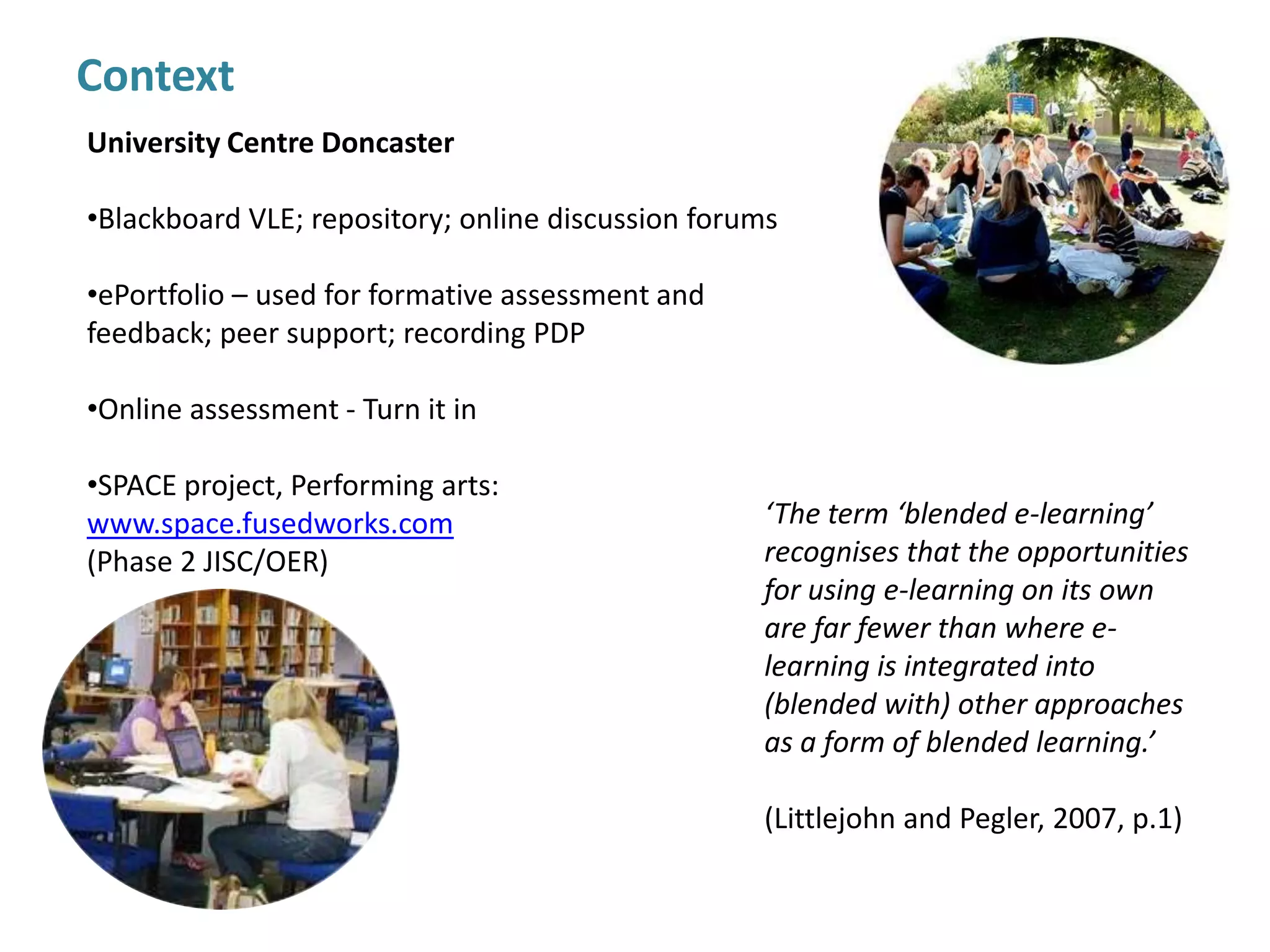
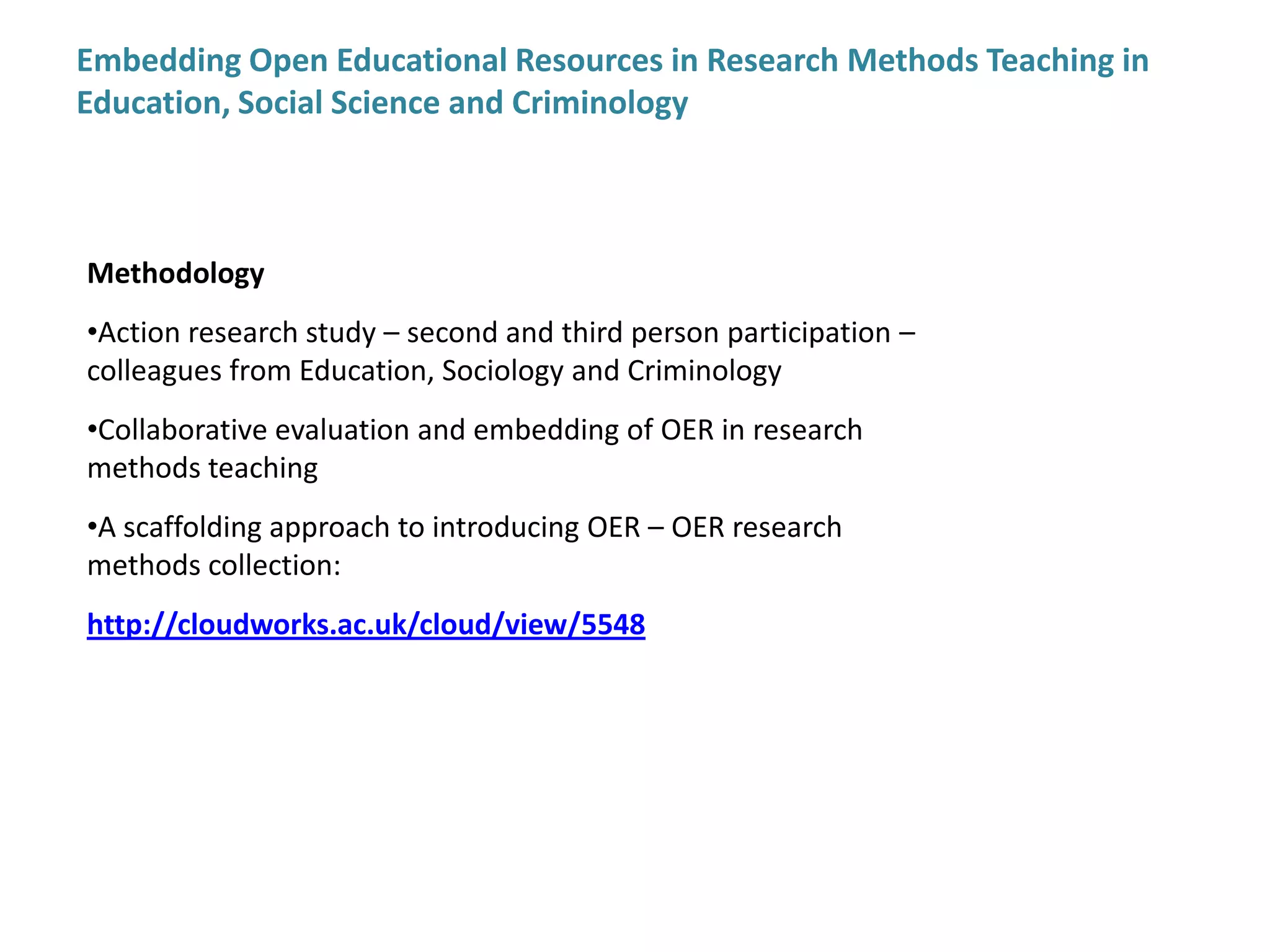
Enhance our understanding of how OER are used in various contextsContextUniversity Centre DoncasterBlackboard VLE; repository; online discussion forums
ePortfolio – used for formative assessment and feedback; peer support; recording PDP
Online assessment - Turn it in
SPACE project, Performing arts: www.space.fusedworks.com(Phase 2 JISC/OER)‘The term ‘blended e-learning’ recognises that the opportunities for using e-learning on its own are far fewer than where e-learning is integrated into (blended with) other approaches as a form of blended learning.’(Littlejohn and Pegler, 2007, p.1)
Embedding Open Educational Resources in Research Methods Teaching in Education, Social Science and CriminologyMethodologyAction research study – second and third person participation – colleagues from Education, Sociology and Criminology
Collaborative evaluation and embedding of OER in research methods teaching
A scaffolding approach to introducing OER – OER research methods collection:http://cloudworks.ac.uk/cloud/view/5548
Embedding Open Educational Resources in Research Methods Teaching in Education, Social Science and CriminologyRepositories used:Jorum Open: http://www.jorum.ac.uk/HumBox – humanities teaching resources on the web: http://www.humbox.ac.uk/SlideShare– sharing presentations online: http://www.slideshare.net/iTunesU– audio and video OER available from the iTunes storeNCRM – the National Centre for Research Methods – developed by the ESRC and part of a strategy to improve the quality of research methods teaching: http://eprints.ncrm.ac.uk/view/subjects/(see also John MacInnes report to ESRC: ‘Proposals to Support and Improve the Teaching of Quantitative Research Methods at Undergraduate Level in the UK’.
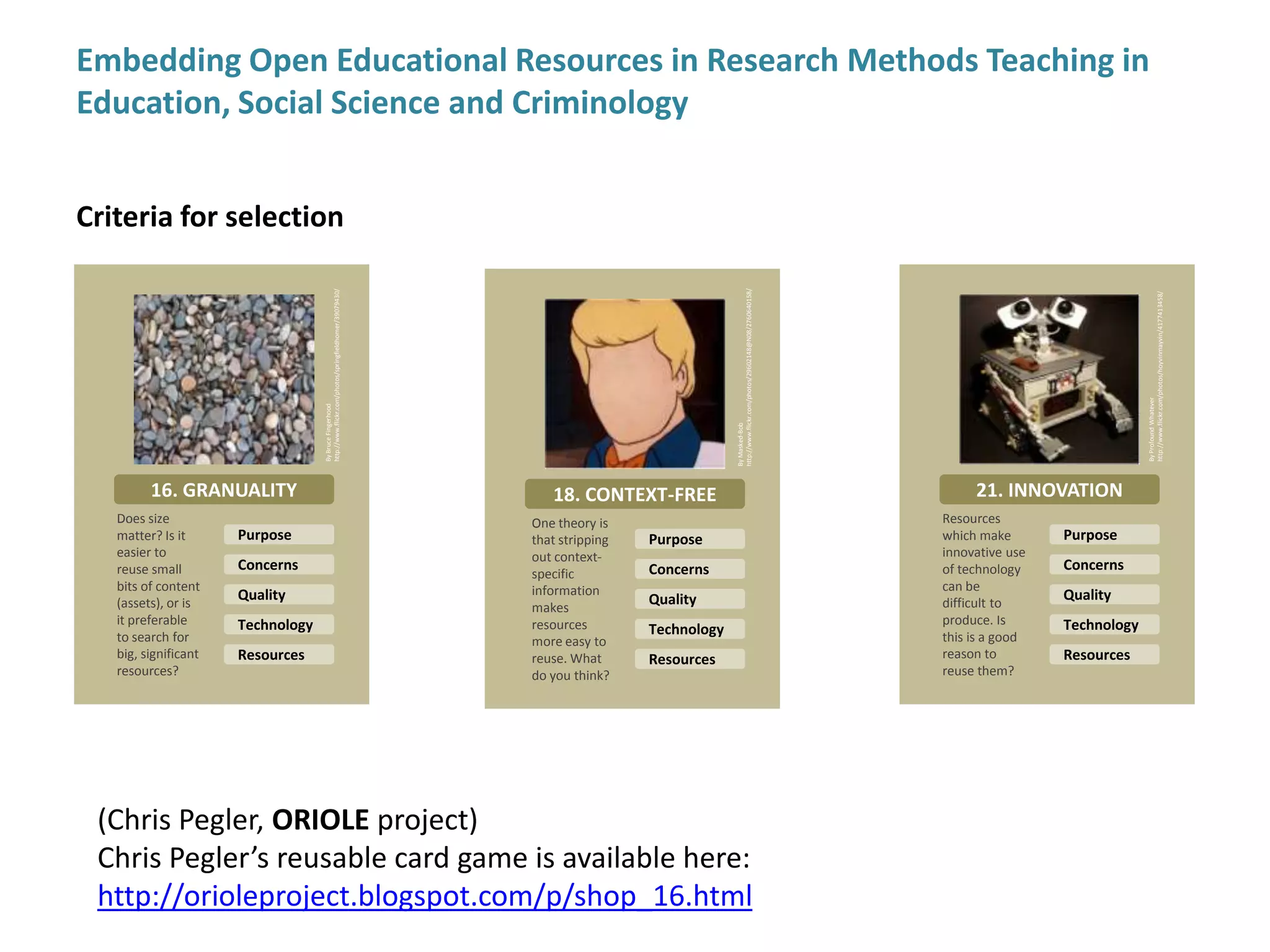
Embedding Open Educational Resources in Research Methods Teaching in Education, Social Science and CriminologyCriteria for selectionBy Masked-Bob http://www.flickr.com/photos/29602148@N08/2760640158/By Profound Whatever http://www.flickr.com/photos/hoyvinmayvin/4177413458/By Bruce Fingerhood http://www.flickr.com/photos/springfieldhomer/39079430/16. GRANUALITY18. CONTEXT-FREE21. INNOVATIONDoes size matter? Is it easier to reuse small bits of content (assets), or is it preferable to search for big, significant resources? One theory is that stripping out context-specific information makes  resources more easy to reuse. What do you think? Resources which make innovative use of technology can be difficult to produce. Is this is a good reason to reuse them? PurposePurposePurposeConcernsConcernsConcernsQualityQualityQualityTechnologyTechnologyTechnologyResourcesResourcesResources(Chris Pegler, ORIOLE project)Chris Pegler’s reusable card game is available here:  http://orioleproject.blogspot.com/p/shop_16.html
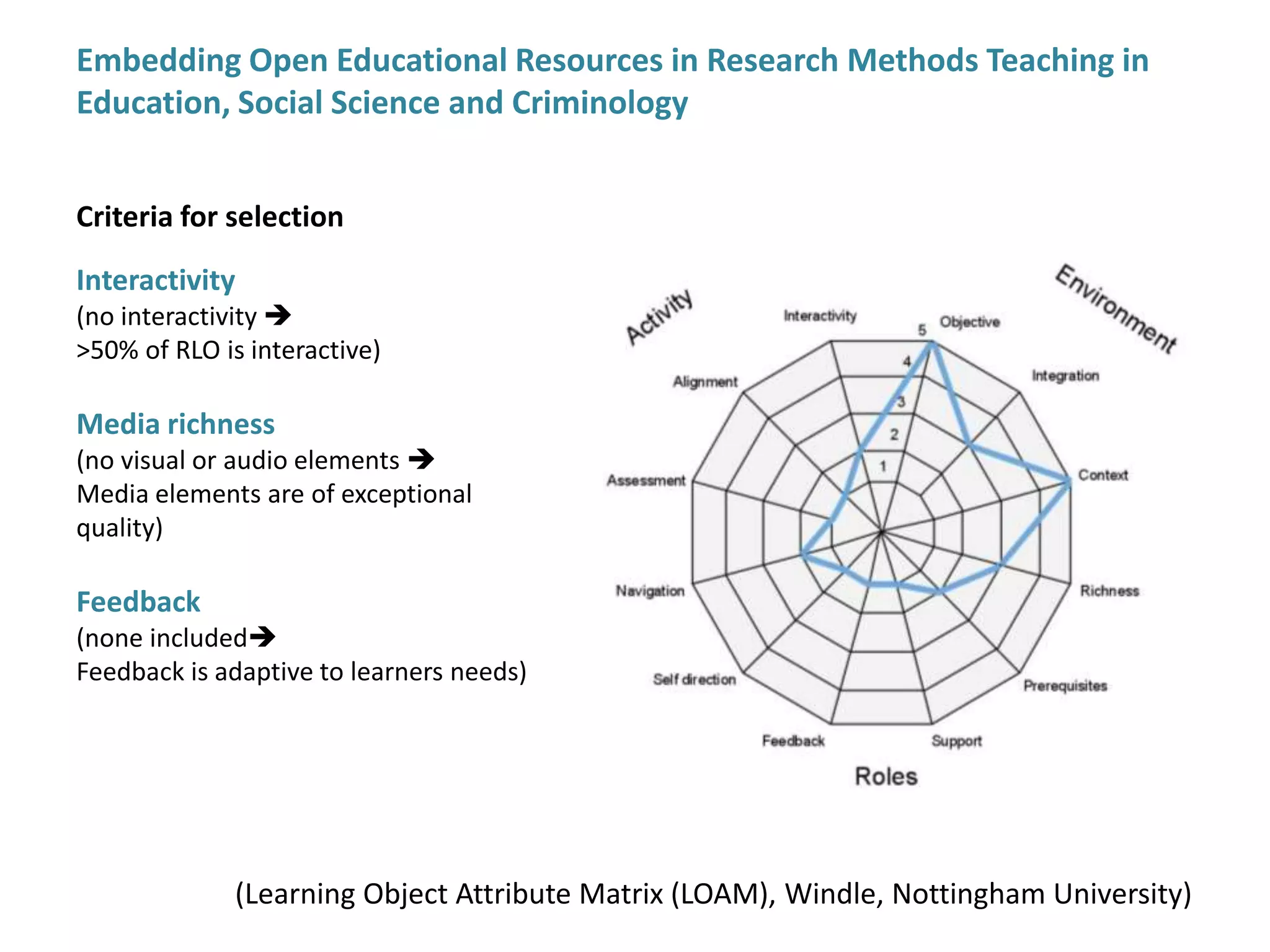
Embedding Open Educational Resources in Research Methods Teaching in Education, Social Science and CriminologyCriteria for selectionInteractivity (no interactivity >50% of RLO is interactive)Media richness(no visual or audio elements Media elements are of exceptional quality)Feedback(none includedFeedback is adaptive to learners needs)(Learning Object Attribute Matrix (LOAM), Windle, Nottingham University)
Embedding Open Educational Resources in Research Methods Teaching in Education, Social Science and CriminologyResearch questions:What considerations were key for tutors in deciding whether to reuse a resource?
What was the USP of OER as identified by tutors (what differentiates OER from current provision)

OERs in research methods teaching

  • 1.
    Embedding Open EducationalResources in Research Methods Teaching in Education, Social Science and CriminologyDr Ester Ehiyazaryan, Lecturer University Centre Doncaster, SCORE FellowEster.ehiyazaryan@don.ac.ukTel: 01302553809
  • 2.
    ContextSCORE – SupportCentre for Open Resources in Educationhttp://www8.open.ac.uk/score/Aims of SCORE:Provide skills training in developing and reusing OER
  • 3.
    Build evidence ofthe impact of OER in HE
  • 4.
    Address issues suchas IPR and support the establishment of a legal framework for rights management
  • 5.
    Enhance our understandingof how OER are used in various contextsContextUniversity Centre DoncasterBlackboard VLE; repository; online discussion forums
  • 6.
    ePortfolio – usedfor formative assessment and feedback; peer support; recording PDP
  • 7.
  • 8.
    SPACE project, Performingarts: www.space.fusedworks.com(Phase 2 JISC/OER)‘The term ‘blended e-learning’ recognises that the opportunities for using e-learning on its own are far fewer than where e-learning is integrated into (blended with) other approaches as a form of blended learning.’(Littlejohn and Pegler, 2007, p.1)
  • 9.
    Embedding Open EducationalResources in Research Methods Teaching in Education, Social Science and CriminologyMethodologyAction research study – second and third person participation – colleagues from Education, Sociology and Criminology
  • 10.
    Collaborative evaluation andembedding of OER in research methods teaching
  • 11.
    A scaffolding approachto introducing OER – OER research methods collection:http://cloudworks.ac.uk/cloud/view/5548
  • 12.
    Embedding Open EducationalResources in Research Methods Teaching in Education, Social Science and CriminologyRepositories used:Jorum Open: http://www.jorum.ac.uk/HumBox – humanities teaching resources on the web: http://www.humbox.ac.uk/SlideShare– sharing presentations online: http://www.slideshare.net/iTunesU– audio and video OER available from the iTunes storeNCRM – the National Centre for Research Methods – developed by the ESRC and part of a strategy to improve the quality of research methods teaching: http://eprints.ncrm.ac.uk/view/subjects/(see also John MacInnes report to ESRC: ‘Proposals to Support and Improve the Teaching of Quantitative Research Methods at Undergraduate Level in the UK’.
  • 13.
    Embedding Open EducationalResources in Research Methods Teaching in Education, Social Science and CriminologyCriteria for selectionBy Masked-Bob http://www.flickr.com/photos/29602148@N08/2760640158/By Profound Whatever http://www.flickr.com/photos/hoyvinmayvin/4177413458/By Bruce Fingerhood http://www.flickr.com/photos/springfieldhomer/39079430/16. GRANUALITY18. CONTEXT-FREE21. INNOVATIONDoes size matter? Is it easier to reuse small bits of content (assets), or is it preferable to search for big, significant resources? One theory is that stripping out context-specific information makes resources more easy to reuse. What do you think? Resources which make innovative use of technology can be difficult to produce. Is this is a good reason to reuse them? PurposePurposePurposeConcernsConcernsConcernsQualityQualityQualityTechnologyTechnologyTechnologyResourcesResourcesResources(Chris Pegler, ORIOLE project)Chris Pegler’s reusable card game is available here: http://orioleproject.blogspot.com/p/shop_16.html
  • 14.
    Embedding Open EducationalResources in Research Methods Teaching in Education, Social Science and CriminologyCriteria for selectionInteractivity (no interactivity >50% of RLO is interactive)Media richness(no visual or audio elements Media elements are of exceptional quality)Feedback(none includedFeedback is adaptive to learners needs)(Learning Object Attribute Matrix (LOAM), Windle, Nottingham University)
  • 15.
    Embedding Open EducationalResources in Research Methods Teaching in Education, Social Science and CriminologyResearch questions:What considerations were key for tutors in deciding whether to reuse a resource?
  • 16.
    What was theUSP of OER as identified by tutors (what differentiates OER from current provision)
  • 17.
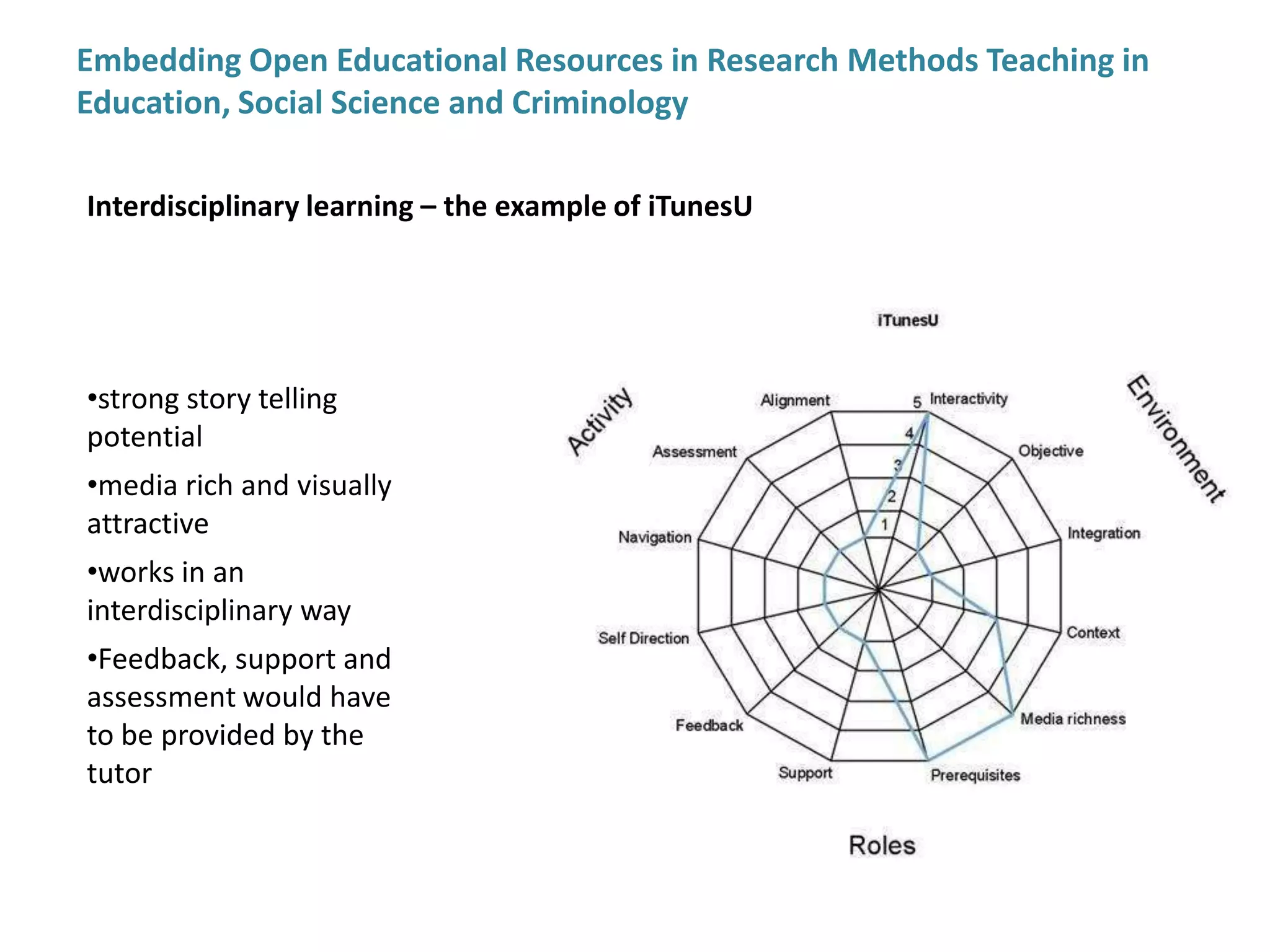
    How did tutorsintend to reuse and embed the resources in current provision?Embedding Open Educational Resources in Research Methods Teaching in Education, Social Science and CriminologyInterdisciplinary learning – the example of iTunesUThe Experiment (video file). A discussion of an experiment based in prison on guard-prisoner relationships. The experiment is compared to the controversial Zimbardo study (1971):http://dl.dropbox.com/u/9786447/1-05 The Experiment.m4v‘The Experiment’, The Open University, iTunesU
  • 18.
    Embedding Open EducationalResources in Research Methods Teaching in Education, Social Science and CriminologyInterdisciplinary learning – the example of iTunesUstrong story telling potential
  • 19.
    media rich andvisually attractive
  • 20.
    works in aninterdisciplinary way
  • 21.
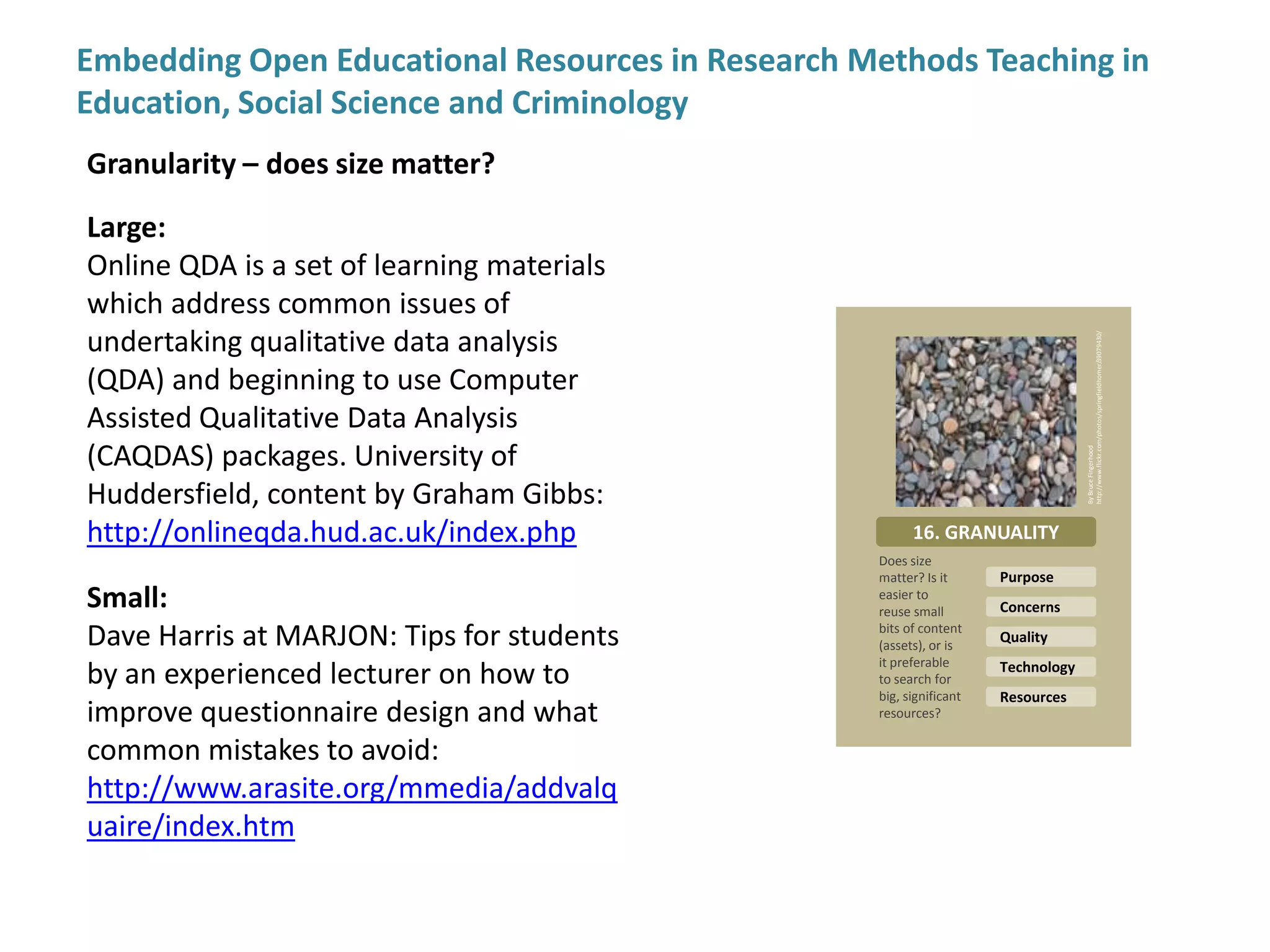
    Feedback, support andassessment would have to be provided by the tutorEmbedding Open Educational Resources in Research Methods Teaching in Education, Social Science and CriminologyGranularity – does size matter?Large: Online QDA is a set of learning materials which address common issues of undertaking qualitative data analysis (QDA) and beginning to use Computer Assisted Qualitative Data Analysis (CAQDAS) packages. University of Huddersfield, content by Graham Gibbs:http://onlineqda.hud.ac.uk/index.phpBy Bruce Fingerhood http://www.flickr.com/photos/springfieldhomer/39079430/16. GRANUALITYDoes size matter? Is it easier to reuse small bits of content (assets), or is it preferable to search for big, significant resources? PurposeConcernsSmall:Dave Harris at MARJON: Tips for students by an experienced lecturer on how to improve questionnaire design and what common mistakes to avoid:http://www.arasite.org/mmedia/addvalquaire/index.htmQualityTechnologyResources
  • 22.
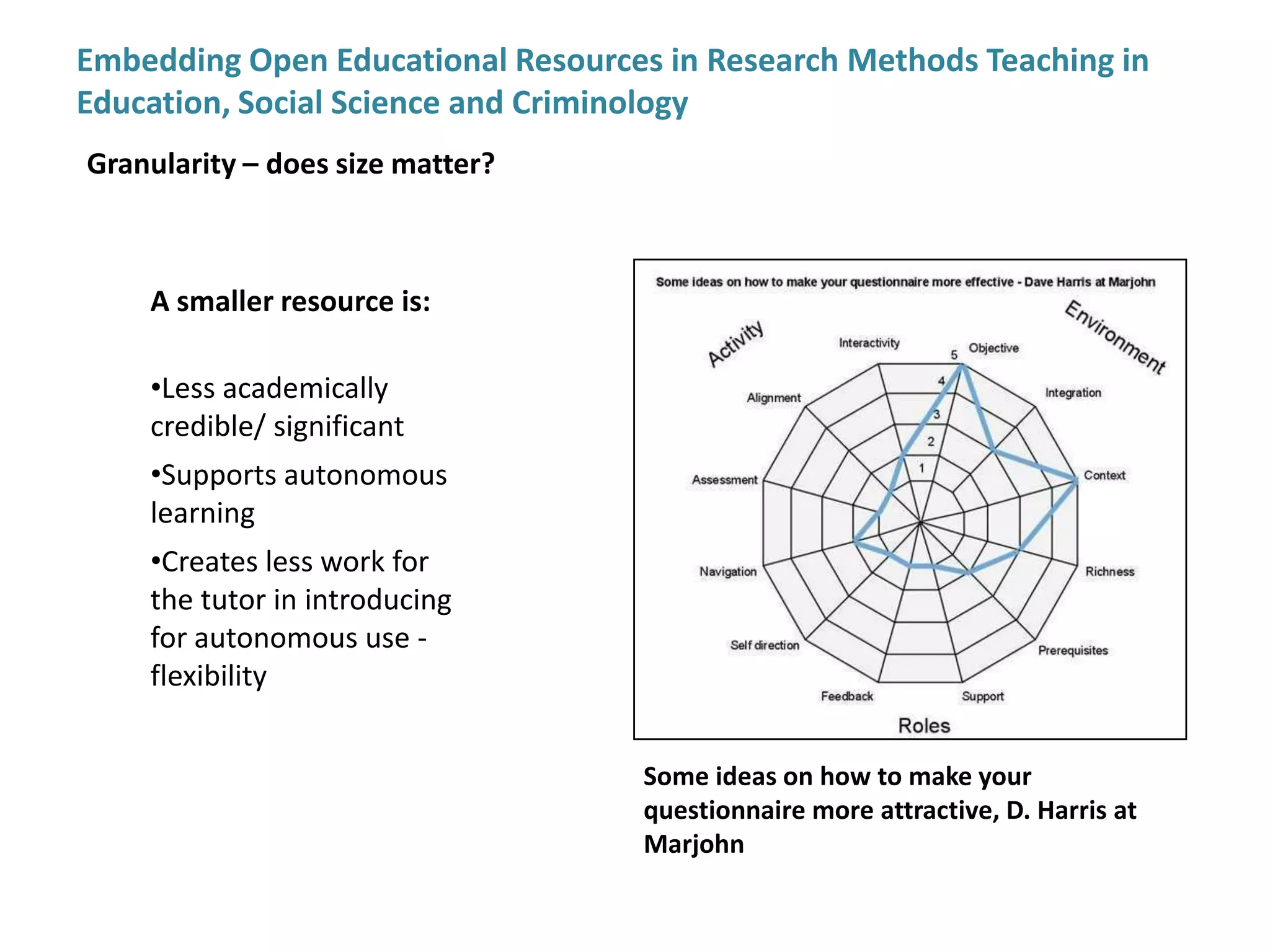
    Embedding Open EducationalResources in Research Methods Teaching in Education, Social Science and CriminologyGranularity – does size matter?A smaller resource is:Less academically credible/ significant
  • 23.
  • 24.
    Creates less workfor the tutor in introducing for autonomous use - flexibilitySome ideas on how to make your questionnaire more attractive, D. Harris at Marjohn
  • 25.
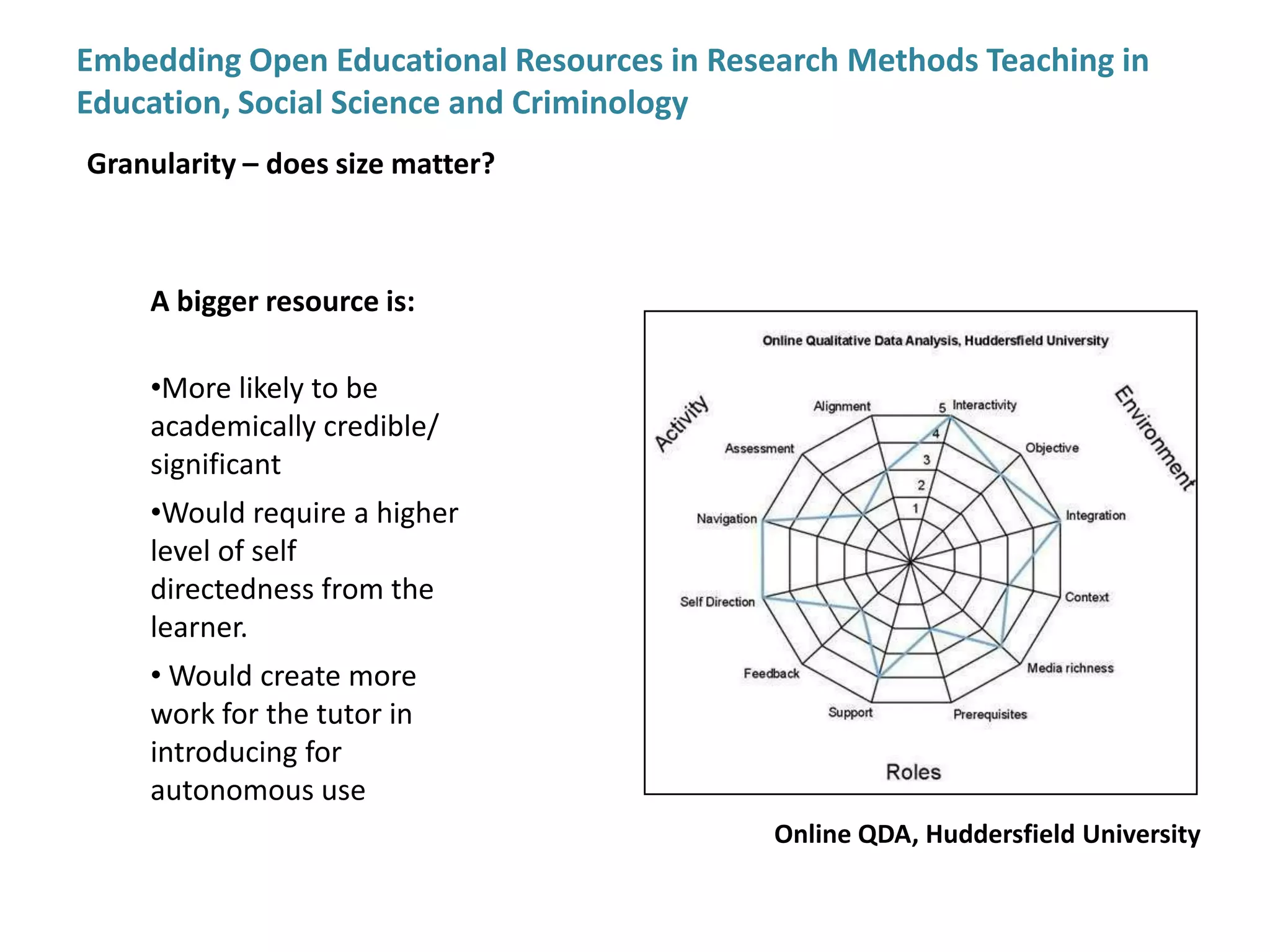
    Embedding Open EducationalResources in Research Methods Teaching in Education, Social Science and CriminologyGranularity – does size matter?A bigger resource is:More likely to be academically credible/ significant
  • 26.
    Would require ahigher level of self directedness from the learner.
  • 27.
    Would createmore work for the tutor in introducing for autonomous useOnline QDA, Huddersfield University
  • 28.
    Embedding Open EducationalResources in Research Methods Teaching in Education, Social Science and CriminologyLevel and context specificityRigid level specificity can detract from the flexibility of the resource.
  • 29.
    Level specificity iswhere the workload for the tutor comes in where reuse is concerned (this does not necessarily imply repurposing)
  • 30.
    Working 'at differentlevels' is what OER naturally do and this underlying pedagogical principle supports the theory of ZPD (Vygotsky).
  • 31.
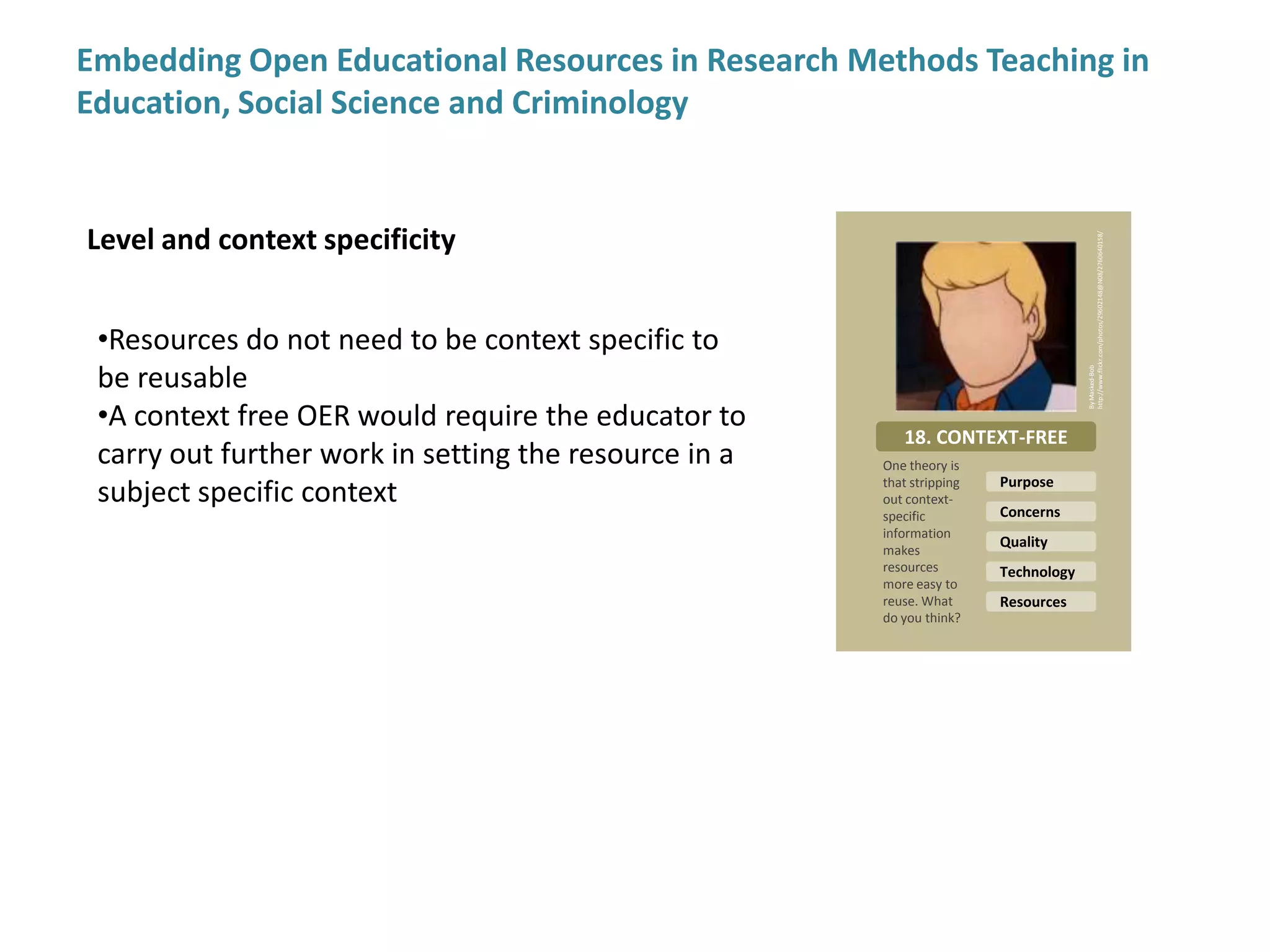
    OER need towork at different levels in order to be truly reusable. Embedding Open Educational Resources in Research Methods Teaching in Education, Social Science and CriminologyLevel and context specificityResources do not need to be context specific to be reusable
  • 32.
    A context freeOER would require the educator to carry out further work in setting the resource in a subject specific contextBy Masked-Bob http://www.flickr.com/photos/29602148@N08/2760640158/18. CONTEXT-FREEOne theory is that stripping out context-specific information makes resources more easy to reuse. What do you think? PurposeConcernsQualityTechnologyResources
  • 33.
    Embedding Open EducationalResources in Research Methods Teaching in Education, Social Science and CriminologyConclusionsThe interdisciplinary nature of OER aids narrative construction; allows learners to internalise knowledge (constructivism); has the potential to address some of the difficulties which learners have with research methods learning. The size of the resource (granularity) …influences learner autonomy; …affects perception of the resource by tutors (academic credibility); …determines the level of work the tutor will have to do in introducing the resource in a programme of study.Context and level specificity – rigid level specificity detracts from the flexibility and reusability of the resource. Level and context specificity is where the real work for the tutors comes in. This is what creates a clash with the assumption of time saving – the time will still have to be put in, in making the resources context and level specific, but not in creating of new content – moving away from creating content and towards designing learning.