International Research Journal of Engineering and Technology (IRJET) e-ISSN: 2395-0056
Volume: 06 Issue: 05 | May 2019 www.irjet.net p-ISSN: 2395-0072
© 2019, IRJET | Impact Factor value: 7.211 | ISO 9001:2008 Certified Journal | Page 8167
Optical Character Recognition using ANN
Shilpa Choudhary1
1Associate Professor, Department of Electronics and Communication Engineering, G. L. Bajaj Institute Of
Technology and Management, Greater Noida, INDIA
---------------------------------------------------------------------***----------------------------------------------------------------------
Abstract - Optical Character Recognition (OCR) is a type of
PC vision that concentrates alphanumeric characters from a
computerized picture. The innovation can be utilized for
digitizing printed content, penmanship acknowledgment, and
making computerized picturesaccessibleforcontent. Standard
example acknowledgment strategies thathavebeeneffectively
connected to OCR incorporate point by point worldwide
correlations, worldwide changes, extraction of nearby
properties, format coordinating, investigation by methods for
ebbs and flows and auxiliary techniques. In any case, the use of
these techniques for manually written character
acknowledgment is discussable on accountofthevastvarieties
of character shapes coming about because of composing
propensities, style, training, district of starting point, social
condition, state of mind, wellbeing and different states of the
author. In addition, factors, for example, the composition
instrument, composing surface, examining techniques, and so
on likewise radically influence the effective of standard
character acknowledgment calculations.
In this paper we will discuss about to make an application
interface for Optical Character Recognition that would utilize
an Artificial Neural Network (ANN) as the backend to tackle
the arrangement issue.
Key Words: OCR, ANN, Offline handwritten text, online
handwritten text.
1. INTRODUCTION
Optical character Recognition (OCR) is a very well-
considered issue in the immense territory of example
acknowledgment. Its roots can be found as right on time as
1870 when a picturetransmissionframework wasdeveloped
which utilized a variety of photocells to perceive designs.
Until the center of the twentieth century OCR wasessentially
created as a guide to the outwardly impaired. With the
appearance of computerized PCs during the 1940s, OCR was
acknowledged as an information preparing approach out of
the blue. The principal business OCR frameworks started to
show up in the mid 1950s and soon they were being utilized
by the US postal support of sort mail.
Different territories including acknowledgment of hand
printing, cursive penmanship, and printed message in
different contents (particularly those with an enormous
number of characters) are as yet the subject of dynamic
research." The real plans in OCR beginning from the
moderately simpler to the most troublesome are as per the
following.
 Fixed-textual style character acknowledgment is the
acknowledgment of explicit textual styles(Ariel,Courier,
and so forth.) of typewritten characters.
 On-line characteracknowledgmentistheacknowledgmentof
single hand-drawn characters where the character pictureis
given as well as the planning data of each stroke.
 Handwritten character acknowledgment is the
acknowledgment of single hand-drawn characters of a
letter set which are detached and not written in
calligraphy.
 Script acknowledgment is the acknowledgment of
unlimited written by hand characters which might be
associated and cursive.
The objective of this paper is to makeanapplicationinterface
for Optical Character Recognition that would utilize an
Artificial Neural Network as the backend to take care of the
arrangement issue. It was initially roused by Sural and Das
(1999), which reports utilizing a multi-layer recognitions
way to deal with do OCR for an Indian language,tobespecific
Bengali. Be that as it may, the methodologyshouldwork with
English also.
2. TYPES OF OCR
OCR are of three types –
2.1 Offline Handwritten Text
A handwritten content of an individual and thenisconverted
in to advanced configuration utilizing scanner after process
of filtration is called an offline handwritten text.
2.2 Online Handwritten Text
Online transcribed content is the one composed
straightforwardly on a digitized tablet consisting of stylus.
The yield is an arrangement of x-y organizesthatexpresspen
position just as other data, for example, weight (applied by
the essayist) and speed of composing.
International Research Journal of Engineering and Technology (IRJET) e-ISSN: 2395-0056
Volume: 06 Issue: 05 | May 2019 www.irjet.net p-ISSN: 2395-0072
© 2019, IRJET | Impact Factor value: 7.211 | ISO 9001:2008 Certified Journal | Page 8168
2.3 Machine Printed Text
Machine is used to print the content and is quite common in
our daily life. Created with help of counterbalance forms.E.g.
laser printer, inkjet printer etc.
3. Uses of OCR
In order to change over the reports of various kinds we use
OCR technology. It helps in converting the PDF documents
and images which are captured by an technological sound
camera into an editable and readable data. The OCR
innovation could be used for following activities as well:
 Handling checks
 Recording library materials
Putting away records, seeking content and removing
information from paper based reports.
4. Benefits and Pitfalls of OCR
OCR Technology not only offers advantages but a few
shortfalls also. The advantages of the OCT are mentioned
below:
 We can scan and preserve the historical documents.
 We can also convert the historical scanned
documents into text which support searching
feature
 OCR also facilitates obtaining the scanned data in
shortest possible time and it is user friendly.
The short comings of OCR are to be known are mentioned
below:
 The effectiveness of OCR diminishes if font size of
the document is below 10.
 It we consider the threshold value than the
necessary pixels of scanning also is compromised,
hence decreasing quality.
5. Proposed Approach
The target of the paper is to build up an OCR for transcribed
numeric characters and filteredpicture,forexample, number
plate and some other checked picture. The contribution to
the framework would be an examined picture content and
yield would be a perceivedin Computermeaningful rendition
of information substance. Following were the fundamental
goals of the venture.
5.1 Text lines ought to be practically straight
The sentences inputted to the OCR ought not have huge
inclines. They ought to be practically straight. In spite of the
fact that the framework is sufficiently powerful to deal with
lines with slants of 10-20 degrees.
5.2 Image ought to be without clamor
Another suspicion about the information picture of Hindi
content ought to be without commotion. This presumption
does not diminish the intricacy of the issue as this is only a
piece of preprocessing module. A loud picture can be made
commotion free by applying standard capacities and
procedures. These were avoidedbecauseoftimeimperatives
included.
5.3 Normalizing
Presently as we have separated the character we have to
standardize the extent of the characters. There are huge
varieties in the sizes of each Character henceforth we need a
strategy to standardize the size. We have discovered a
straightforward technique to execute the normalizing.
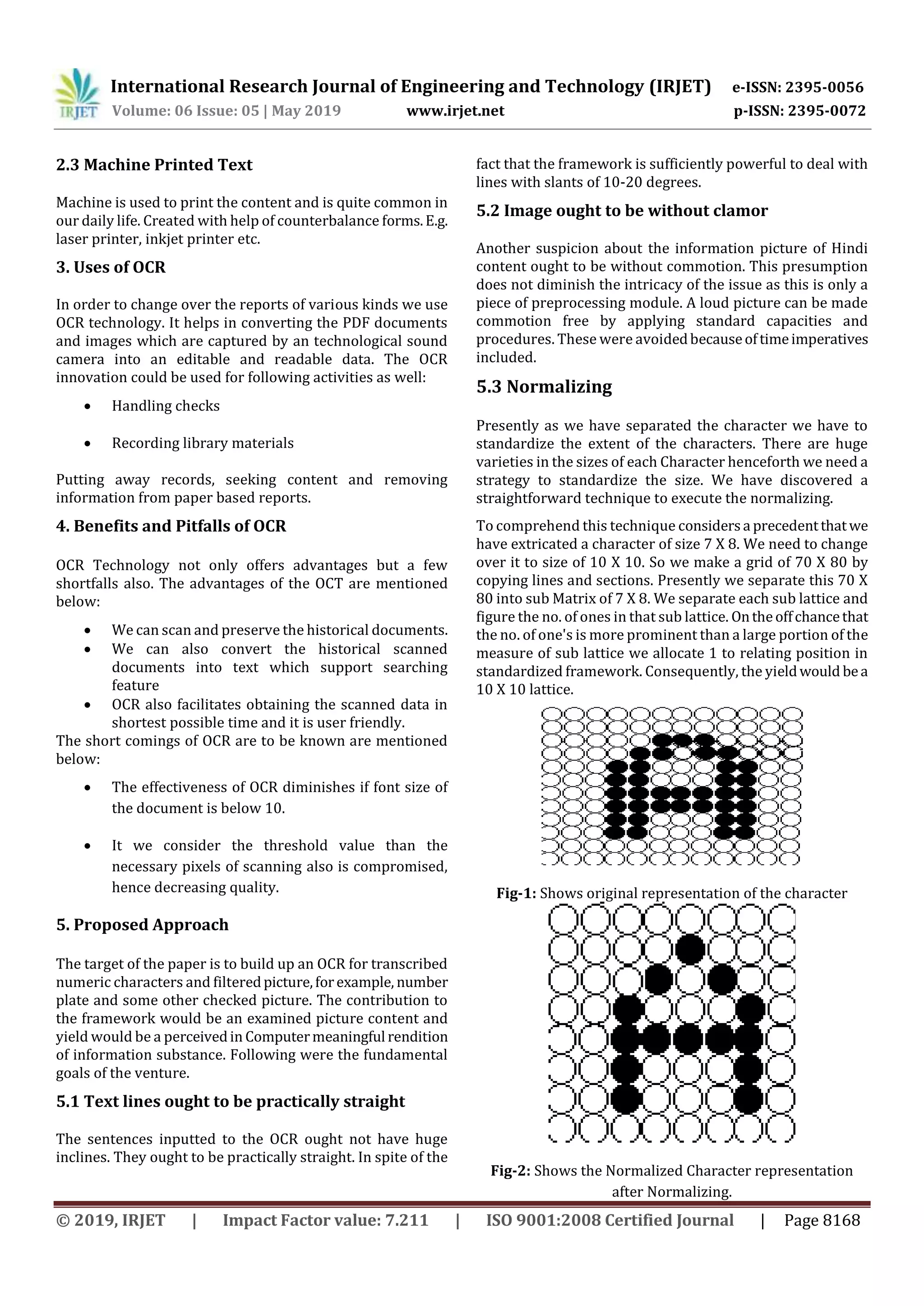
To comprehend this technique considersa precedentthatwe
have extricated a character of size 7 X 8. We need to change
over it to size of 10 X 10. So we make a grid of 70 X 80 by
copying lines and sections. Presently we separate this 70 X
80 into sub Matrix of 7 X 8. We separate each sub lattice and
figure the no. of ones in that sub lattice. Ontheoffchancethat
the no. of one's is more prominent than a large portion of the
measure of sub lattice we allocate 1 to relating position in
standardized framework. Consequently, the yieldwould bea
10 X 10 lattice.
Fig-1: Shows original representation of the character
Fig-2: Shows the Normalized Character representation
after Normalizing.
International Research Journal of Engineering and Technology (IRJET) e-ISSN: 2395-0056
Volume: 06 Issue: 05 | May 2019 www.irjet.net p-ISSN: 2395-0072
© 2019, IRJET | Impact Factor value: 7.211 | ISO 9001:2008 Certified Journal | Page 8169
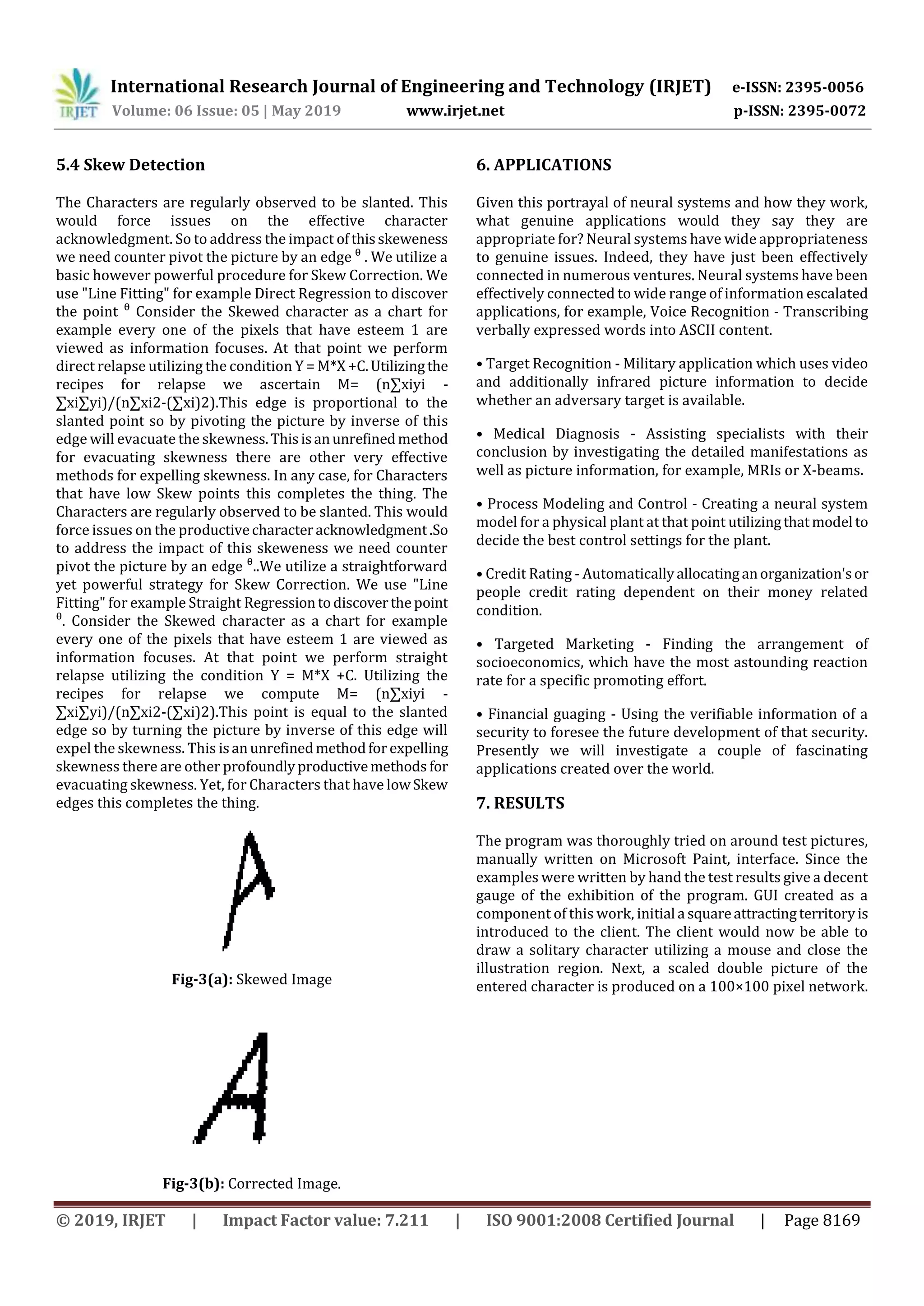
5.4 Skew Detection
The Characters are regularly observed to be slanted. This
would force issues on the effective character
acknowledgment. So to address the impact ofthisskeweness
we need counter pivot the picture by an edge ᶿ . We utilize a
basic however powerful procedure for Skew Correction. We
use "Line Fitting" for example Direct Regression to discover
the point ᶿ Consider the Skewed character as a chart for
example every one of the pixels that have esteem 1 are
viewed as information focuses. At that point we perform
direct relapse utilizing the condition Y = M*X +C.Utilizingthe
recipes for relapse we ascertain M= (n∑xiyi -
∑xi∑yi)/(n∑xi2-(∑xi)2).This edge is proportional to the
slanted point so by pivoting the picture by inverse of this
edge will evacuate the skewness.Thisisanunrefinedmethod
for evacuating skewness there are other very effective
methods for expelling skewness. In any case, for Characters
that have low Skew points this completes the thing. The
Characters are regularly observed to be slanted. This would
force issues on the productivecharacteracknowledgment .So
to address the impact of this skeweness we need counter
pivot the picture by an edge ᶿ..We utilize a straightforward
yet powerful strategy for Skew Correction. We use "Line
Fitting" for example Straight Regressiontodiscoverthepoint
ᶿ. Consider the Skewed character as a chart for example
every one of the pixels that have esteem 1 are viewed as
information focuses. At that point we perform straight
relapse utilizing the condition Y = M*X +C. Utilizing the
recipes for relapse we compute M= (n∑xiyi -
∑xi∑yi)/(n∑xi2-(∑xi)2).This point is equal to the slanted
edge so by turning the picture by inverse of this edge will
expel the skewness. This isanunrefinedmethodforexpelling
skewness there are other profoundlyproductivemethods for
evacuating skewness. Yet, for Characters that have lowSkew
edges this completes the thing.
Fig-3(a): Skewed Image
Fig-3(b): Corrected Image.
6. APPLICATIONS
Given this portrayal of neural systems and how they work,
what genuine applications would they say they are
appropriate for? Neural systems have wide appropriateness
to genuine issues. Indeed, they have just been effectively
connected in numerous ventures. Neural systems have been
effectively connected to wide range of information escalated
applications, for example, Voice Recognition - Transcribing
verbally expressed words into ASCII content.
• Target Recognition - Military application which uses video
and additionally infrared picture information to decide
whether an adversary target is available.
• Medical Diagnosis - Assisting specialists with their
conclusion by investigating the detailed manifestations as
well as picture information, for example, MRIs or X-beams.
• Process Modeling and Control - Creating a neural system
model for a physical plant at that point utilizingthatmodel to
decide the best control settings for the plant.
• Credit Rating - Automaticallyallocatinganorganization'sor
people credit rating dependent on their money related
condition.
• Targeted Marketing - Finding the arrangement of
socioeconomics, which have the most astounding reaction
rate for a specific promoting effort.
• Financial guaging - Using the verifiable information of a
security to foresee the future development of that security.
Presently we will investigate a couple of fascinating
applications created over the world.
7. RESULTS
The program was thoroughly tried on around test pictures,
manually written on Microsoft Paint, interface. Since the
examples were written by hand the test results give a decent
gauge of the exhibition of the program. GUI created as a
component of this work, initial a squareattractingterritoryis
introduced to the client. The client would now be able to
draw a solitary character utilizing a mouse and close the
illustration region. Next, a scaled double picture of the
entered character is produced on a 100×100 pixel network.
International Research Journal of Engineering and Technology (IRJET) e-ISSN: 2395-0056
Volume: 06 Issue: 05 | May 2019 www.irjet.net p-ISSN: 2395-0072
© 2019, IRJET | Impact Factor value: 7.211 | ISO 9001:2008 Certified Journal | Page 8170
Table-1: Result of character recognition in percentage.
8. CONCLUSION:
In this paper, we have elaborated on a system for OCR of
script which is printed in English and numeric material. The
recognition precision level of the prototype implementation
is satisfactory but leaves some improvisation scope which
will ensure good quality. If the fine-tuning is done in the
system the quality would be better. So does the character
segmentation is left desired to be better, so to increase its
ability to address a large variety of touching parameters,
which is frequent case in images obtained from low quality
printed material. The actual sample size of test should have
large variety of images containing different characters,
different font types and fonts sizes. ASthisextensiveexercise
could identify some loopholes in the system and will enable
us to rectify and improvise it.
REFERENCES
[1] Pratik Madhukar Manwatkar, Shashank H. Yadav, “Text
Recognition from Images”, IEEE Sponsored 2nd
International Conference on Innovations in
Information,Embedded and Communication systems
(ICIIECS), 2015.
[2] M. Abdul Rahiman, M. S. Rajasree, “A Detailed Study and
Analysis of OCR Research in South Indian Scripts”, 2009
International Conference on Advances in Recent
Technologies in Communication and Computing, 2009.
[3] Zongxiao Zhu, Xianli Wu, Sai Liu , Wei Tian,LiChen,“The
Research of Printed Yi Character Recognition”, 2009
World Congress on Computer Science and Information
Engineering.
[4] Puja Romulus, Yan Maraden, Prima Dewi Purnamasari,
and Anak Agung Putri Ratna, “An Analysis of Optical
Character RecognitionImplementationforAncientBatak
Characters Using K-Nearest Neighbors Principle”,
International Conference on Quality in Research, 2015.
[5] Muhammed Tawfiq Chowdhury, Md. Saiful Islam, Baijed
Hossain Bipul and Md. Khalilur Rhaman,
“Implementation of an Optical Character Reader (OCR)
for Bengali Language”, International ConferenceonData
and Software Engineering, 2015.
[6] T. K. Das, Asis Kumar Tripathy, Alekha Kumar Mishra,
“Optical Character Recognition using Artificial Neural
Network”, International Conference on Computer
Communication and Informatics (ICCCI -2017),2017.

IRJET-Optical Character Recognition using ANN

  • 1.
    International Research Journalof Engineering and Technology (IRJET) e-ISSN: 2395-0056 Volume: 06 Issue: 05 | May 2019 www.irjet.net p-ISSN: 2395-0072 © 2019, IRJET | Impact Factor value: 7.211 | ISO 9001:2008 Certified Journal | Page 8167 Optical Character Recognition using ANN Shilpa Choudhary1 1Associate Professor, Department of Electronics and Communication Engineering, G. L. Bajaj Institute Of Technology and Management, Greater Noida, INDIA ---------------------------------------------------------------------***---------------------------------------------------------------------- Abstract - Optical Character Recognition (OCR) is a type of PC vision that concentrates alphanumeric characters from a computerized picture. The innovation can be utilized for digitizing printed content, penmanship acknowledgment, and making computerized picturesaccessibleforcontent. Standard example acknowledgment strategies thathavebeeneffectively connected to OCR incorporate point by point worldwide correlations, worldwide changes, extraction of nearby properties, format coordinating, investigation by methods for ebbs and flows and auxiliary techniques. In any case, the use of these techniques for manually written character acknowledgment is discussable on accountofthevastvarieties of character shapes coming about because of composing propensities, style, training, district of starting point, social condition, state of mind, wellbeing and different states of the author. In addition, factors, for example, the composition instrument, composing surface, examining techniques, and so on likewise radically influence the effective of standard character acknowledgment calculations. In this paper we will discuss about to make an application interface for Optical Character Recognition that would utilize an Artificial Neural Network (ANN) as the backend to tackle the arrangement issue. Key Words: OCR, ANN, Offline handwritten text, online handwritten text. 1. INTRODUCTION Optical character Recognition (OCR) is a very well- considered issue in the immense territory of example acknowledgment. Its roots can be found as right on time as 1870 when a picturetransmissionframework wasdeveloped which utilized a variety of photocells to perceive designs. Until the center of the twentieth century OCR wasessentially created as a guide to the outwardly impaired. With the appearance of computerized PCs during the 1940s, OCR was acknowledged as an information preparing approach out of the blue. The principal business OCR frameworks started to show up in the mid 1950s and soon they were being utilized by the US postal support of sort mail. Different territories including acknowledgment of hand printing, cursive penmanship, and printed message in different contents (particularly those with an enormous number of characters) are as yet the subject of dynamic research." The real plans in OCR beginning from the moderately simpler to the most troublesome are as per the following.  Fixed-textual style character acknowledgment is the acknowledgment of explicit textual styles(Ariel,Courier, and so forth.) of typewritten characters.  On-line characteracknowledgmentistheacknowledgmentof single hand-drawn characters where the character pictureis given as well as the planning data of each stroke.  Handwritten character acknowledgment is the acknowledgment of single hand-drawn characters of a letter set which are detached and not written in calligraphy.  Script acknowledgment is the acknowledgment of unlimited written by hand characters which might be associated and cursive. The objective of this paper is to makeanapplicationinterface for Optical Character Recognition that would utilize an Artificial Neural Network as the backend to take care of the arrangement issue. It was initially roused by Sural and Das (1999), which reports utilizing a multi-layer recognitions way to deal with do OCR for an Indian language,tobespecific Bengali. Be that as it may, the methodologyshouldwork with English also. 2. TYPES OF OCR OCR are of three types – 2.1 Offline Handwritten Text A handwritten content of an individual and thenisconverted in to advanced configuration utilizing scanner after process of filtration is called an offline handwritten text. 2.2 Online Handwritten Text Online transcribed content is the one composed straightforwardly on a digitized tablet consisting of stylus. The yield is an arrangement of x-y organizesthatexpresspen position just as other data, for example, weight (applied by the essayist) and speed of composing.
  • 2.
    International Research Journalof Engineering and Technology (IRJET) e-ISSN: 2395-0056 Volume: 06 Issue: 05 | May 2019 www.irjet.net p-ISSN: 2395-0072 © 2019, IRJET | Impact Factor value: 7.211 | ISO 9001:2008 Certified Journal | Page 8168 2.3 Machine Printed Text Machine is used to print the content and is quite common in our daily life. Created with help of counterbalance forms.E.g. laser printer, inkjet printer etc. 3. Uses of OCR In order to change over the reports of various kinds we use OCR technology. It helps in converting the PDF documents and images which are captured by an technological sound camera into an editable and readable data. The OCR innovation could be used for following activities as well:  Handling checks  Recording library materials Putting away records, seeking content and removing information from paper based reports. 4. Benefits and Pitfalls of OCR OCR Technology not only offers advantages but a few shortfalls also. The advantages of the OCT are mentioned below:  We can scan and preserve the historical documents.  We can also convert the historical scanned documents into text which support searching feature  OCR also facilitates obtaining the scanned data in shortest possible time and it is user friendly. The short comings of OCR are to be known are mentioned below:  The effectiveness of OCR diminishes if font size of the document is below 10.  It we consider the threshold value than the necessary pixels of scanning also is compromised, hence decreasing quality. 5. Proposed Approach The target of the paper is to build up an OCR for transcribed numeric characters and filteredpicture,forexample, number plate and some other checked picture. The contribution to the framework would be an examined picture content and yield would be a perceivedin Computermeaningful rendition of information substance. Following were the fundamental goals of the venture. 5.1 Text lines ought to be practically straight The sentences inputted to the OCR ought not have huge inclines. They ought to be practically straight. In spite of the fact that the framework is sufficiently powerful to deal with lines with slants of 10-20 degrees. 5.2 Image ought to be without clamor Another suspicion about the information picture of Hindi content ought to be without commotion. This presumption does not diminish the intricacy of the issue as this is only a piece of preprocessing module. A loud picture can be made commotion free by applying standard capacities and procedures. These were avoidedbecauseoftimeimperatives included. 5.3 Normalizing Presently as we have separated the character we have to standardize the extent of the characters. There are huge varieties in the sizes of each Character henceforth we need a strategy to standardize the size. We have discovered a straightforward technique to execute the normalizing. To comprehend this technique considersa precedentthatwe have extricated a character of size 7 X 8. We need to change over it to size of 10 X 10. So we make a grid of 70 X 80 by copying lines and sections. Presently we separate this 70 X 80 into sub Matrix of 7 X 8. We separate each sub lattice and figure the no. of ones in that sub lattice. Ontheoffchancethat the no. of one's is more prominent than a large portion of the measure of sub lattice we allocate 1 to relating position in standardized framework. Consequently, the yieldwould bea 10 X 10 lattice. Fig-1: Shows original representation of the character Fig-2: Shows the Normalized Character representation after Normalizing.
  • 3.
    International Research Journalof Engineering and Technology (IRJET) e-ISSN: 2395-0056 Volume: 06 Issue: 05 | May 2019 www.irjet.net p-ISSN: 2395-0072 © 2019, IRJET | Impact Factor value: 7.211 | ISO 9001:2008 Certified Journal | Page 8169 5.4 Skew Detection The Characters are regularly observed to be slanted. This would force issues on the effective character acknowledgment. So to address the impact ofthisskeweness we need counter pivot the picture by an edge ᶿ . We utilize a basic however powerful procedure for Skew Correction. We use "Line Fitting" for example Direct Regression to discover the point ᶿ Consider the Skewed character as a chart for example every one of the pixels that have esteem 1 are viewed as information focuses. At that point we perform direct relapse utilizing the condition Y = M*X +C.Utilizingthe recipes for relapse we ascertain M= (n∑xiyi - ∑xi∑yi)/(n∑xi2-(∑xi)2).This edge is proportional to the slanted point so by pivoting the picture by inverse of this edge will evacuate the skewness.Thisisanunrefinedmethod for evacuating skewness there are other very effective methods for expelling skewness. In any case, for Characters that have low Skew points this completes the thing. The Characters are regularly observed to be slanted. This would force issues on the productivecharacteracknowledgment .So to address the impact of this skeweness we need counter pivot the picture by an edge ᶿ..We utilize a straightforward yet powerful strategy for Skew Correction. We use "Line Fitting" for example Straight Regressiontodiscoverthepoint ᶿ. Consider the Skewed character as a chart for example every one of the pixels that have esteem 1 are viewed as information focuses. At that point we perform straight relapse utilizing the condition Y = M*X +C. Utilizing the recipes for relapse we compute M= (n∑xiyi - ∑xi∑yi)/(n∑xi2-(∑xi)2).This point is equal to the slanted edge so by turning the picture by inverse of this edge will expel the skewness. This isanunrefinedmethodforexpelling skewness there are other profoundlyproductivemethods for evacuating skewness. Yet, for Characters that have lowSkew edges this completes the thing. Fig-3(a): Skewed Image Fig-3(b): Corrected Image. 6. APPLICATIONS Given this portrayal of neural systems and how they work, what genuine applications would they say they are appropriate for? Neural systems have wide appropriateness to genuine issues. Indeed, they have just been effectively connected in numerous ventures. Neural systems have been effectively connected to wide range of information escalated applications, for example, Voice Recognition - Transcribing verbally expressed words into ASCII content. • Target Recognition - Military application which uses video and additionally infrared picture information to decide whether an adversary target is available. • Medical Diagnosis - Assisting specialists with their conclusion by investigating the detailed manifestations as well as picture information, for example, MRIs or X-beams. • Process Modeling and Control - Creating a neural system model for a physical plant at that point utilizingthatmodel to decide the best control settings for the plant. • Credit Rating - Automaticallyallocatinganorganization'sor people credit rating dependent on their money related condition. • Targeted Marketing - Finding the arrangement of socioeconomics, which have the most astounding reaction rate for a specific promoting effort. • Financial guaging - Using the verifiable information of a security to foresee the future development of that security. Presently we will investigate a couple of fascinating applications created over the world. 7. RESULTS The program was thoroughly tried on around test pictures, manually written on Microsoft Paint, interface. Since the examples were written by hand the test results give a decent gauge of the exhibition of the program. GUI created as a component of this work, initial a squareattractingterritoryis introduced to the client. The client would now be able to draw a solitary character utilizing a mouse and close the illustration region. Next, a scaled double picture of the entered character is produced on a 100×100 pixel network.
  • 4.
    International Research Journalof Engineering and Technology (IRJET) e-ISSN: 2395-0056 Volume: 06 Issue: 05 | May 2019 www.irjet.net p-ISSN: 2395-0072 © 2019, IRJET | Impact Factor value: 7.211 | ISO 9001:2008 Certified Journal | Page 8170 Table-1: Result of character recognition in percentage. 8. CONCLUSION: In this paper, we have elaborated on a system for OCR of script which is printed in English and numeric material. The recognition precision level of the prototype implementation is satisfactory but leaves some improvisation scope which will ensure good quality. If the fine-tuning is done in the system the quality would be better. So does the character segmentation is left desired to be better, so to increase its ability to address a large variety of touching parameters, which is frequent case in images obtained from low quality printed material. The actual sample size of test should have large variety of images containing different characters, different font types and fonts sizes. ASthisextensiveexercise could identify some loopholes in the system and will enable us to rectify and improvise it. REFERENCES [1] Pratik Madhukar Manwatkar, Shashank H. Yadav, “Text Recognition from Images”, IEEE Sponsored 2nd International Conference on Innovations in Information,Embedded and Communication systems (ICIIECS), 2015. [2] M. Abdul Rahiman, M. S. Rajasree, “A Detailed Study and Analysis of OCR Research in South Indian Scripts”, 2009 International Conference on Advances in Recent Technologies in Communication and Computing, 2009. [3] Zongxiao Zhu, Xianli Wu, Sai Liu , Wei Tian,LiChen,“The Research of Printed Yi Character Recognition”, 2009 World Congress on Computer Science and Information Engineering. [4] Puja Romulus, Yan Maraden, Prima Dewi Purnamasari, and Anak Agung Putri Ratna, “An Analysis of Optical Character RecognitionImplementationforAncientBatak Characters Using K-Nearest Neighbors Principle”, International Conference on Quality in Research, 2015. [5] Muhammed Tawfiq Chowdhury, Md. Saiful Islam, Baijed Hossain Bipul and Md. Khalilur Rhaman, “Implementation of an Optical Character Reader (OCR) for Bengali Language”, International ConferenceonData and Software Engineering, 2015. [6] T. K. Das, Asis Kumar Tripathy, Alekha Kumar Mishra, “Optical Character Recognition using Artificial Neural Network”, International Conference on Computer Communication and Informatics (ICCCI -2017),2017.