ENERGY FROM THE OCEAN
ENERGY FROM THE OCEAN:
:
• Waves
Waves
• Tides
Tides
• Temperature Differences
Temperature Differences
– Ocean Thermal Energy Converter
Ocean Thermal Energy Converter
Sources of Energy
Sources of Energy
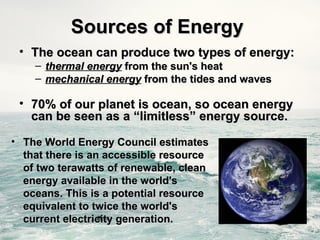
• The ocean can produce two types of energy:
The ocean can produce two types of energy:
– thermal energy
thermal energy from the sun's heat
from the sun's heat
– mechanical energy
mechanical energy from the tides and waves
from the tides and waves
• 70% of our planet is ocean, so ocean energy
70% of our planet is ocean, so ocean energy
can be seen as a “limitless” energy source.
• The World Energy Council estimates
The World Energy Council estimates
that there is an accessible resource
of two terawatts of renewable, clean
energy available in the world's
oceans. This is a potential resource
equivalent to twice the world's
current electricity generation.
Wave Energy
Wave Energy
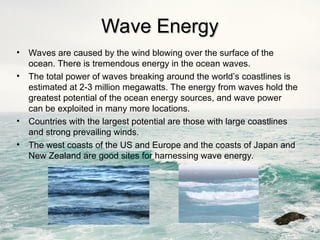
• Waves are caused by the wind blowing over the surface of the
ocean. There is tremendous energy in the ocean waves.
• The total power of waves breaking around the world’s coastlines is
estimated at 2-3 million megawatts. The energy from waves hold the
greatest potential of the ocean energy sources, and wave power
can be exploited in many more locations.
• Countries with the largest potential are those with large coastlines
and strong prevailing winds.
• The west coasts of the US and Europe and the coasts of Japan and
New Zealand are good sites for harnessing wave energy.
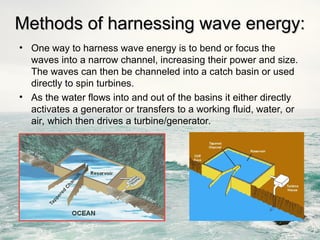
• One way to harness wave energy is to bend or focus the
waves into a narrow channel, increasing their power and size.
The waves can then be channeled into a catch basin or used
directly to spin turbines.
• As the water flows into and out of the basins it either directly
activates a generator or transfers to a working fluid, water, or
air, which then drives a turbine/generator.
Methods of harnessing wave energy:
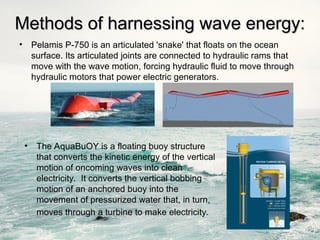
• Pelamis P-750 is an articulated 'snake' that floats on the ocean
surface. Its articulated joints are connected to hydraulic rams that
move with the wave motion, forcing hydraulic fluid to move through
hydraulic motors that power electric generators.
• The AquaBuOY is a floating buoy structure
that converts the kinetic energy of the vertical
motion of oncoming waves into clean
electricity. It converts the vertical bobbing
motion of an anchored buoy into the
movement of pressurized water that, in turn,
moves through a turbine to make electricity.
Current Projects
Current Projects
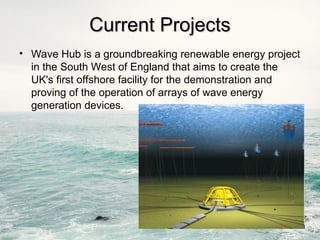
• Wave Hub is a groundbreaking renewable energy project
in the South West of England that aims to create the
UK's first offshore facility for the demonstration and
proving of the operation of arrays of wave energy
generation devices.
Disadvantages
Disadvantages
• Possible threat to navigation from collisions due to the low
profile of the wave energy devices
• Interference of anchorage lines for commercial and sport-fishing
• Degradation of scenic ocean front views from wave energy
devices located near or on the shore
Advantages
Advantages
• Waves are continuous and predictable
• Produces no liquid or solid pollution
• Many locations for energy production
• Almost no negative environmental impact
Tidal Energy
Tidal Energy
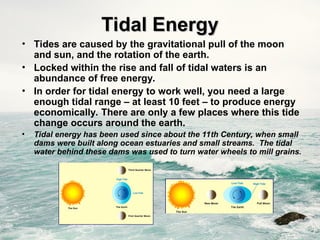
• Tides are caused by the gravitational pull of the moon
and sun, and the rotation of the earth.
• Locked within the rise and fall of tidal waters is an
abundance of free energy.
• In order for tidal energy to work well, you need a large
enough tidal range – at least 10 feet – to produce energy
economically. There are only a few places where this tide
change occurs around the earth.
• Tidal energy has been used since about the 11th Century, when small
dams were built along ocean estuaries and small streams. The tidal
water behind these dams was used to turn water wheels to mill grains.
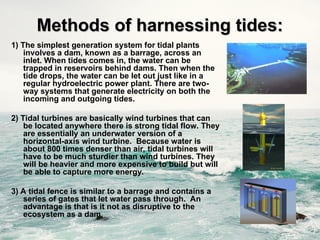
1) The simplest generation system for tidal plants
involves a dam, known as a barrage, across an
inlet. When tides comes in, the water can be
trapped in reservoirs behind dams. Then when the
tide drops, the water can be let out just like in a
regular hydroelectric power plant. There are two-
way systems that generate electricity on both the
incoming and outgoing tides.
2) Tidal turbines are basically wind turbines that can
be located anywhere there is strong tidal flow. They
are essentially an underwater version of a
horizontal-axis wind turbine. Because water is
about 800 times denser than air, tidal turbines will
have to be much sturdier than wind turbines. They
will be heavier and more expensive to build but will
be able to capture more energy.
3) A tidal fence is similar to a barrage and contains a
series of gates that let water pass through. An
advantage is that is it not as disruptive to the
ecosystem as a dam.
Methods of harnessing tides:
Disadvantages
Disadvantages
• Can change the tidal levels and increase turbidity in the water
• Installation and maintenance are very costly
• They can also affect boat navigation and recreation
• Time lag – 12 hours between high and low tides
• Potentially the largest disadvantage of tidal power is the effect a
tidal station can have on plants and animals in the estuaries
• Reliable and predictable energy source – the rise and fall of the
tide driven by the steady motion of the moon – unlike wind
turbines which are at the mercy of the wind
• Very abundant energy in certain areas
• Produces no liquid or solid pollution
• Shelters the coast, useful in hurricane/cyclone prone areas and
erosion zones
Advantages
Advantages
Current Projects
Current Projects
• The US has no tidal plants
and only a few sites where
tidal energy could be
produced economically
(Maine, Alaska). France,
England, Canada, and
Russia have much more
potential.
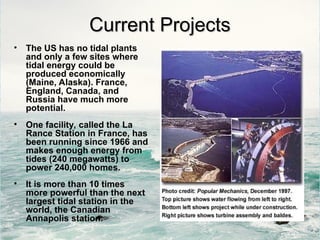
• One facility, called the La
Rance Station in France, has
been running since 1966 and
makes enough energy from
tides (240 megawatts) to
power 240,000 homes.
• It is more than 10 times
more powerful than the next
largest tidal station in the
world, the Canadian
Annapolis station.
Ocean Thermal Energy Conversion (OTEC)
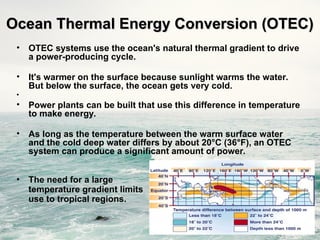
• OTEC systems use the ocean's natural thermal gradient to drive
a power-producing cycle.
• It's warmer on the surface because sunlight warms the water.
But below the surface, the ocean gets very cold.
•
• Power plants can be built that use this difference in temperature
to make energy.
• As long as the temperature between the warm surface water
and the cold deep water differs by about 20°C (36°F), an OTEC
system can produce a significant amount of power.
• The need for a large
temperature gradient limits
use to tropical regions.
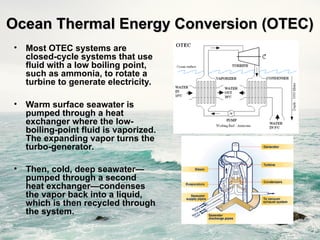
• Most OTEC systems are
closed-cycle systems that use
fluid with a low boiling point,
such as ammonia, to rotate a
turbine to generate electricity.
• Warm surface seawater is
pumped through a heat
exchanger where the low-
boiling-point fluid is vaporized.
The expanding vapor turns the
turbo-generator.
• Then, cold, deep seawater—
pumped through a second
heat exchanger—condenses
the vapor back into a liquid,
which is then recycled through
the system.
Ocean Thermal Energy Conversion (OTEC)
Advantages
Advantages
• Potential to produce massive amounts of electrical energy
• Produces desalinated water for industrial, agricultural, and
residential uses
• Provides air-conditioning for buildings
• Produces no liquid or solid pollution
• Has significant potential to provide clean, cost-effective
electricity for the future
Disadvantages
Disadvantages
• OTEC plants are extremely expensive
• Current plants only achieve about 1-3% efficiency
• Limited geographic availability
• Electricity must also be transported to land
• It will probably be 10–20 yrs. before technology is available to
produce/transmit electricity economically from OTEC systems
Sources
Sources
• Energy Kid’s Page – Energy Information Administration:
– http://www.eia.doe.gov/kids/energyfacts/sources/renewable/ocean.html
• Renewable Energy World:
– http://www.renewableenergyworld.com/rea/tech/oceanenergy
• California Energy Commission:
– www.energy.ca.gov/development/oceanenergy/
– http://www.energyquest.ca.gov/story/chapter14.html
• World of Renewables:
– http://www.worldofrenewables.com/page.php?pageid=54
• Symscape – Energy from the environment:
– http://www.symscape.com/blog/energy_from_environment

Energy from ocean sources, 5849792.ppt

  • 1.
    ENERGY FROM THEOCEAN ENERGY FROM THE OCEAN: : • Waves Waves • Tides Tides • Temperature Differences Temperature Differences – Ocean Thermal Energy Converter Ocean Thermal Energy Converter
  • 2.
    Sources of Energy Sourcesof Energy • The ocean can produce two types of energy: The ocean can produce two types of energy: – thermal energy thermal energy from the sun's heat from the sun's heat – mechanical energy mechanical energy from the tides and waves from the tides and waves • 70% of our planet is ocean, so ocean energy 70% of our planet is ocean, so ocean energy can be seen as a “limitless” energy source. can be seen as a “limitless” energy source. • The World Energy Council estimates The World Energy Council estimates that there is an accessible resource that there is an accessible resource of two terawatts of renewable, clean of two terawatts of renewable, clean energy available in the world's energy available in the world's oceans. This is a potential resource oceans. This is a potential resource equivalent to twice the world's equivalent to twice the world's current electricity generation. current electricity generation.
  • 3.
    Wave Energy Wave Energy •Waves are caused by the wind blowing over the surface of the ocean. There is tremendous energy in the ocean waves. • The total power of waves breaking around the world’s coastlines is estimated at 2-3 million megawatts. The energy from waves hold the greatest potential of the ocean energy sources, and wave power can be exploited in many more locations. • Countries with the largest potential are those with large coastlines and strong prevailing winds. • The west coasts of the US and Europe and the coasts of Japan and New Zealand are good sites for harnessing wave energy.
  • 4.
    • One wayto harness wave energy is to bend or focus the waves into a narrow channel, increasing their power and size. The waves can then be channeled into a catch basin or used directly to spin turbines. • As the water flows into and out of the basins it either directly activates a generator or transfers to a working fluid, water, or air, which then drives a turbine/generator. Methods of harnessing wave energy: Methods of harnessing wave energy:
  • 5.
    Methods of harnessingwave energy: Methods of harnessing wave energy: • Pelamis P-750 is an articulated 'snake' that floats on the ocean surface. Its articulated joints are connected to hydraulic rams that move with the wave motion, forcing hydraulic fluid to move through hydraulic motors that power electric generators. • The AquaBuOY is a floating buoy structure that converts the kinetic energy of the vertical motion of oncoming waves into clean electricity. It converts the vertical bobbing motion of an anchored buoy into the movement of pressurized water that, in turn, moves through a turbine to make electricity.
  • 6.
    Current Projects Current Projects •Wave Hub is a groundbreaking renewable energy project in the South West of England that aims to create the UK's first offshore facility for the demonstration and proving of the operation of arrays of wave energy generation devices.
  • 7.
    Disadvantages Disadvantages • Possible threatto navigation from collisions due to the low profile of the wave energy devices • Interference of anchorage lines for commercial and sport-fishing • Degradation of scenic ocean front views from wave energy devices located near or on the shore Advantages Advantages • Waves are continuous and predictable • Produces no liquid or solid pollution • Many locations for energy production • Almost no negative environmental impact
  • 8.
    Tidal Energy Tidal Energy •Tides are caused by the gravitational pull of the moon and sun, and the rotation of the earth. • Locked within the rise and fall of tidal waters is an abundance of free energy. • In order for tidal energy to work well, you need a large enough tidal range – at least 10 feet – to produce energy economically. There are only a few places where this tide change occurs around the earth. • Tidal energy has been used since about the 11th Century, when small dams were built along ocean estuaries and small streams. The tidal water behind these dams was used to turn water wheels to mill grains.
  • 9.
    1) The simplestgeneration system for tidal plants involves a dam, known as a barrage, across an inlet. When tides comes in, the water can be trapped in reservoirs behind dams. Then when the tide drops, the water can be let out just like in a regular hydroelectric power plant. There are two- way systems that generate electricity on both the incoming and outgoing tides. 2) Tidal turbines are basically wind turbines that can be located anywhere there is strong tidal flow. They are essentially an underwater version of a horizontal-axis wind turbine. Because water is about 800 times denser than air, tidal turbines will have to be much sturdier than wind turbines. They will be heavier and more expensive to build but will be able to capture more energy. 3) A tidal fence is similar to a barrage and contains a series of gates that let water pass through. An advantage is that is it not as disruptive to the ecosystem as a dam. Methods of harnessing tides: Methods of harnessing tides:
  • 10.
    Disadvantages Disadvantages • Can changethe tidal levels and increase turbidity in the water • Installation and maintenance are very costly • They can also affect boat navigation and recreation • Time lag – 12 hours between high and low tides • Potentially the largest disadvantage of tidal power is the effect a tidal station can have on plants and animals in the estuaries • Reliable and predictable energy source – the rise and fall of the tide driven by the steady motion of the moon – unlike wind turbines which are at the mercy of the wind • Very abundant energy in certain areas • Produces no liquid or solid pollution • Shelters the coast, useful in hurricane/cyclone prone areas and erosion zones Advantages Advantages
  • 11.
    Current Projects Current Projects •The US has no tidal plants and only a few sites where tidal energy could be produced economically (Maine, Alaska). France, England, Canada, and Russia have much more potential. • One facility, called the La Rance Station in France, has been running since 1966 and makes enough energy from tides (240 megawatts) to power 240,000 homes. • It is more than 10 times more powerful than the next largest tidal station in the world, the Canadian Annapolis station.
  • 12.
    Ocean Thermal EnergyConversion (OTEC) Ocean Thermal Energy Conversion (OTEC) • OTEC systems use the ocean's natural thermal gradient to drive a power-producing cycle. • It's warmer on the surface because sunlight warms the water. But below the surface, the ocean gets very cold. • • Power plants can be built that use this difference in temperature to make energy. • As long as the temperature between the warm surface water and the cold deep water differs by about 20°C (36°F), an OTEC system can produce a significant amount of power. • The need for a large temperature gradient limits use to tropical regions.
  • 13.
    • Most OTECsystems are closed-cycle systems that use fluid with a low boiling point, such as ammonia, to rotate a turbine to generate electricity. • Warm surface seawater is pumped through a heat exchanger where the low- boiling-point fluid is vaporized. The expanding vapor turns the turbo-generator. • Then, cold, deep seawater— pumped through a second heat exchanger—condenses the vapor back into a liquid, which is then recycled through the system. Ocean Thermal Energy Conversion (OTEC) Ocean Thermal Energy Conversion (OTEC)
  • 14.
    Advantages Advantages • Potential toproduce massive amounts of electrical energy • Produces desalinated water for industrial, agricultural, and residential uses • Provides air-conditioning for buildings • Produces no liquid or solid pollution • Has significant potential to provide clean, cost-effective electricity for the future Disadvantages Disadvantages • OTEC plants are extremely expensive • Current plants only achieve about 1-3% efficiency • Limited geographic availability • Electricity must also be transported to land • It will probably be 10–20 yrs. before technology is available to produce/transmit electricity economically from OTEC systems
  • 15.
    Sources Sources • Energy Kid’sPage – Energy Information Administration: – http://www.eia.doe.gov/kids/energyfacts/sources/renewable/ocean.html • Renewable Energy World: – http://www.renewableenergyworld.com/rea/tech/oceanenergy • California Energy Commission: – www.energy.ca.gov/development/oceanenergy/ – http://www.energyquest.ca.gov/story/chapter14.html • World of Renewables: – http://www.worldofrenewables.com/page.php?pageid=54 • Symscape – Energy from the environment: – http://www.symscape.com/blog/energy_from_environment