
DEPARTMENT OF CHEMICALENGINEERING
CHAPTER-9
“ENERGY FROM OCEAN”
PROF. DEVARSHI P. TADVI
ASSISTANT PROFESSOR
CHEMICAL ENGINEERING
DEPARTMENT
S S AGRAWAL INSTITUTE OF
ENGINEERING & TECHNOLOGY,
NAVSARI
Index
• Principle
• OTEC
• methods (open cycle & close cycle) energy from tides
• components of tidal power plants
• Operation
• methods of utilization of tidal energy
• Storage
• ocean waves
• wave energy conversion devices
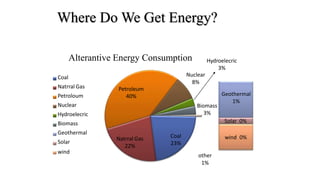
Coal
23%
Natrral Gas
22%
Petroleum
40%
Nuclear
8%
Hydroelecric
3%
Biomass
3%
Geothermal
1%
Solar 0%
wind 0%
other
1%
Coal
Natrral Gas
Petroloum
Nuclear
Hydroelecric
Biomass
Geothermal
Solar
wind
Where Do We Get Energy?
Alterantive Energy Consumption
Introduction
• The ocean has a tremendous amount energy in the form Renewable Energy
around the world.
• Ocean energy or ocean power (or marine, hydrokinetic energy)
• Refers to energy carried by ocean waves, tides, salinity and ocean
temperature difference.
• The ocean have both,
(1) wave power i.e. Power from surface waves
(2) tidal energy i.e. Kinetic energy of large moving water body.
What is ocean energy?
• The world’s oceans cover nearly 70% of the world's surface
• The oceans are the world's largest collector of the sun’s energy that is continually
renewed at all times
• The ocean is an amazing resources that could be utilized but many challenges
stand in the way
• The various forms of ocean energy generation in use and researched into today
are:
• Ocean Currents, Offshore Wind, Ocean Thermal Energy Conversion/ OTEC,
Wave Energy and Tidal Energy.
Different Form of Ocean Energy
1. Ocean Current power
2. Osmotic Power
3. Tidal energy
4. Ocean Thermal energy
5. Wave Energy
Ocean Current power
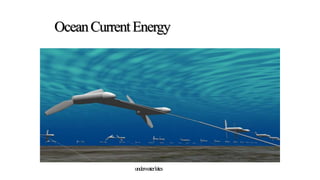
• Marine current power is the kinetic energy of ocean
currents.
• Strong ocean currents are generated from a combination of
temperature, wind, salinity, and the rotation of the earth.
• It is understudy to develop a ocean current power plant.
Japan is building underwater kites to harness the current
energy .
OceanCurrentEnergy
underwaterkites
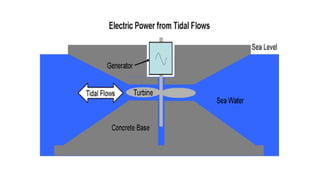
Two types of tidal plant facilities.
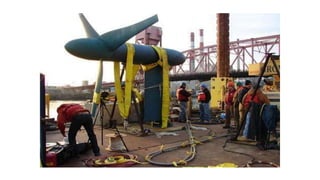
• Tidal barrages
• Tidal stream generator
Tidal Enegy
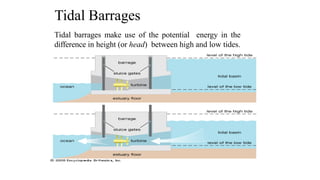
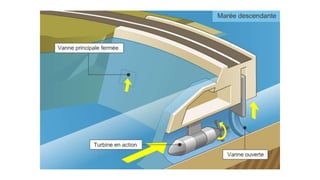
Tidal barrages make use of the potential energy in the
difference in height (or head) between high and low tides.
Tidal Barrages
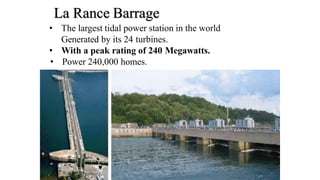
La Rance Barrage
• The largest tidal power station in the world
Generated by its 24 turbines.
• With a peak rating of 240 Megawatts.
• Power 240,000 homes.
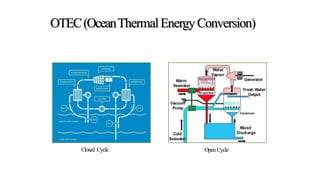
OTEC (Ocean Thermal Energy Conversion)
 Uses the temperature difference between cooler deep
and warmer shallow or surface ocean waters to run a
heat engine and produce useful work, usually in the
form of electricity.
 Power plants can be built that use this difference in
temperature to make energy. A difference of at least 38
degrees Fahrenheit is needed between the warmer
surface water and the colder deep ocean water.
OTEC(OceanThermalEnergyConversion)
Closed Cycle Open Cycle
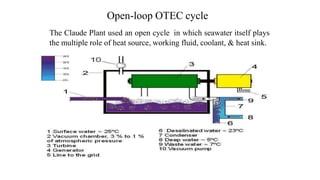
Open-loop OTEC cycle
The Claude Plant used an open cycle in which seawater itself plays
the multiple role of heat source, working fluid, coolant, & heat sink.
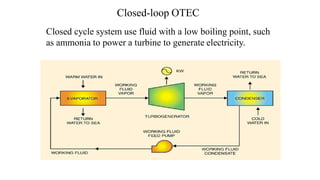
Closed-loop OTEC
Closed cycle system use fluid with a low boiling point, such
as ammonia to power a turbine to generate electricity.
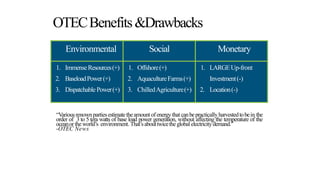
OTECBenefits&Drawbacks
Environmental Social Monetary
1. ImmenseResources(+)
2. BaseloadPower(+)
3. DispatchablePower(+)
1. Offshore(+)
2. AquacultureFarms(+)
3. ChilledAgriculture(+)
1. LARGEUp-front
Investment(-)
2. Location(-)
“Variousrenownpartiesestimatetheamountofenergythatcanbepractically harvestedtobein the
order of 3 to 5 tera watts of base load power generation, without affecting the temperature of the
oceanor theworld’s environment. That’sabouttwicetheglobalelectricitydemand.”
-OTEC News
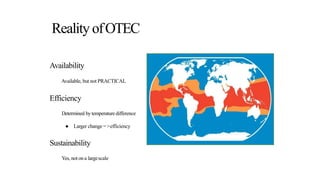
Reality ofOTEC
Availability
Available, but not PRACTICAL
Efficiency
Determined by temperaturedifference
● Larger change =>efficiency
Sustainability
Yes, not ona largescale
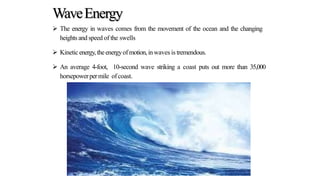
WaveEnergy
 The energy in waves comes from the movement of the ocean and the changing
heights and speed of the swells
 Kineticenergy,theenergyof motion,inwaves is tremendous.
 An average 4-foot, 10-second wave striking a coast puts out more than 35,000
horsepowerpermile ofcoast.
WaveEnergy
• As long as the sun shines, wave energy will never be depleted. It varies in intensity,
butitis availabletwenty-fourhoursa day,365days a year.
WaveEnergy
• Wave power is renewable, green, pollution-free, and environmentally invisible, especially
if placedoffshore.
• The best wave generator technology being used in the United Kingdom is producing
energyat anaveragecostof7.5cents perkWh
WhatCanHarnessWaveEnergy?
• There are three basic methods for converting wave
energy to electricity
1. Float or buoysystems
2. Oscillating water columndevices
3. “Tapered channel” or “tapchan”systems
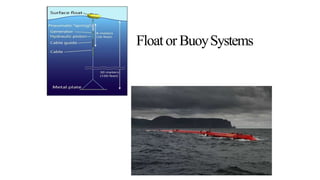
Floator BuoySystems
 These use the rise and fall of ocean swells to drive hydraulic pumps.
 The object can be mounted to a floating raft or to a device fixed on
the ocean floor.
 Aseries of anchoredbuoys rise and fall with the wave.
 The movement allows an electrical generator to make electricity that
is thenshipped ashore
Floator BuoySystems
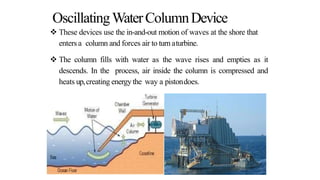
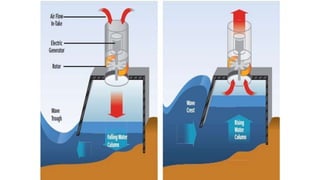
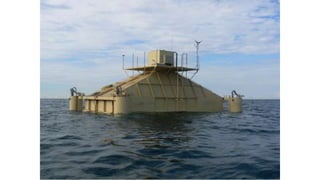
OscillatingWaterColumnDevice
 These devices use the in-and-out motion of waves at the shore that
entersa column and forces air to turnaturbine.
 The column fills with water as the wave rises and empties as it
descends. In the process, air inside the column is compressed and
heats up,creating energy the way a pistondoes.
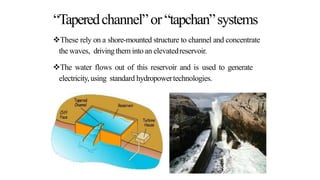
“Taperedchannel”or “tapchan”systems
These rely on a shore-mounted structure to channel and concentrate
the waves, drivingthem into an elevatedreservoir.
The water flows out of this reservoir and is used to generate
electricity,using standard hydropowertechnologies.
WavePower
 Unlike wind and solar power, power from ocean waves continues to be produced around the
clock.
 while the industry has made halting progress, experts agree that it remains decades behind other
forms of renewables, with large amounts of money and research requiredfor it to make progress
 The Ocean provides a huge issue from a technical point of view and is far more difficult than on
land. Saltwater is a hostile environment for devices, and the waves themselves offer a challenge
for energy harvesting as they not only roll past a device but also bob up and down or converge
from all sides that creates a complicated factor to adjust for.
 Wave energy shows huge potential for energy capture, but an optimum design is far from being
agreed on. Lack of large company investment could aid progress but it is not economically
smart decision.
 The United Kingdom — Scotland in particular — is focusing heavily on wave energy
development and could help the technology along.
ADVANTAGES
Doesnotproducegreenhousesgasesandwaste product.
Doesnotrequireanyfuel,
Oncethetechnologyisbuilt, itdoesnotrequireextra cost,
Itdoesnothaveabigenvironmentalimpact.
DISADVANTAGES
• Electricitygenerationcostismore,
• No energy company will put money because these technologies
havebeentestedforsmallscale.
• Localisedmarineecosystemwillbeaffected.
• Frozenoceanareaslimitlocationsfor machinery.
Thank You

Ch 9 ocean energy

  • 1.
    DEPARTMENT OF CHEMICALENGINEERING CHAPTER-9 “ENERGYFROM OCEAN” PROF. DEVARSHI P. TADVI ASSISTANT PROFESSOR CHEMICAL ENGINEERING DEPARTMENT S S AGRAWAL INSTITUTE OF ENGINEERING & TECHNOLOGY, NAVSARI
  • 2.
    Index • Principle • OTEC •methods (open cycle & close cycle) energy from tides • components of tidal power plants • Operation • methods of utilization of tidal energy • Storage • ocean waves • wave energy conversion devices
  • 3.
    Coal 23% Natrral Gas 22% Petroleum 40% Nuclear 8% Hydroelecric 3% Biomass 3% Geothermal 1% Solar 0% wind0% other 1% Coal Natrral Gas Petroloum Nuclear Hydroelecric Biomass Geothermal Solar wind Where Do We Get Energy? Alterantive Energy Consumption
  • 4.
    Introduction • The oceanhas a tremendous amount energy in the form Renewable Energy around the world. • Ocean energy or ocean power (or marine, hydrokinetic energy) • Refers to energy carried by ocean waves, tides, salinity and ocean temperature difference. • The ocean have both, (1) wave power i.e. Power from surface waves (2) tidal energy i.e. Kinetic energy of large moving water body.
  • 5.
    What is oceanenergy? • The world’s oceans cover nearly 70% of the world's surface • The oceans are the world's largest collector of the sun’s energy that is continually renewed at all times • The ocean is an amazing resources that could be utilized but many challenges stand in the way • The various forms of ocean energy generation in use and researched into today are: • Ocean Currents, Offshore Wind, Ocean Thermal Energy Conversion/ OTEC, Wave Energy and Tidal Energy.
  • 6.
    Different Form ofOcean Energy 1. Ocean Current power 2. Osmotic Power 3. Tidal energy 4. Ocean Thermal energy 5. Wave Energy
  • 7.
    Ocean Current power •Marine current power is the kinetic energy of ocean currents. • Strong ocean currents are generated from a combination of temperature, wind, salinity, and the rotation of the earth. • It is understudy to develop a ocean current power plant. Japan is building underwater kites to harness the current energy .
  • 8.
  • 10.
    Two types oftidal plant facilities. • Tidal barrages • Tidal stream generator Tidal Enegy
  • 11.
    Tidal barrages makeuse of the potential energy in the difference in height (or head) between high and low tides. Tidal Barrages
  • 13.
    La Rance Barrage •The largest tidal power station in the world Generated by its 24 turbines. • With a peak rating of 240 Megawatts. • Power 240,000 homes.
  • 16.
    OTEC (Ocean ThermalEnergy Conversion)  Uses the temperature difference between cooler deep and warmer shallow or surface ocean waters to run a heat engine and produce useful work, usually in the form of electricity.  Power plants can be built that use this difference in temperature to make energy. A difference of at least 38 degrees Fahrenheit is needed between the warmer surface water and the colder deep ocean water.
  • 17.
  • 18.
    Open-loop OTEC cycle TheClaude Plant used an open cycle in which seawater itself plays the multiple role of heat source, working fluid, coolant, & heat sink.
  • 19.
    Closed-loop OTEC Closed cyclesystem use fluid with a low boiling point, such as ammonia to power a turbine to generate electricity.
  • 20.
    OTECBenefits&Drawbacks Environmental Social Monetary 1.ImmenseResources(+) 2. BaseloadPower(+) 3. DispatchablePower(+) 1. Offshore(+) 2. AquacultureFarms(+) 3. ChilledAgriculture(+) 1. LARGEUp-front Investment(-) 2. Location(-) “Variousrenownpartiesestimatetheamountofenergythatcanbepractically harvestedtobein the order of 3 to 5 tera watts of base load power generation, without affecting the temperature of the oceanor theworld’s environment. That’sabouttwicetheglobalelectricitydemand.” -OTEC News
  • 21.
    Reality ofOTEC Availability Available, butnot PRACTICAL Efficiency Determined by temperaturedifference ● Larger change =>efficiency Sustainability Yes, not ona largescale
  • 22.
    WaveEnergy  The energyin waves comes from the movement of the ocean and the changing heights and speed of the swells  Kineticenergy,theenergyof motion,inwaves is tremendous.  An average 4-foot, 10-second wave striking a coast puts out more than 35,000 horsepowerpermile ofcoast.
  • 23.
    WaveEnergy • As longas the sun shines, wave energy will never be depleted. It varies in intensity, butitis availabletwenty-fourhoursa day,365days a year.
  • 24.
    WaveEnergy • Wave poweris renewable, green, pollution-free, and environmentally invisible, especially if placedoffshore. • The best wave generator technology being used in the United Kingdom is producing energyat anaveragecostof7.5cents perkWh
  • 25.
    WhatCanHarnessWaveEnergy? • There arethree basic methods for converting wave energy to electricity 1. Float or buoysystems 2. Oscillating water columndevices 3. “Tapered channel” or “tapchan”systems
  • 26.
    Floator BuoySystems  Theseuse the rise and fall of ocean swells to drive hydraulic pumps.  The object can be mounted to a floating raft or to a device fixed on the ocean floor.  Aseries of anchoredbuoys rise and fall with the wave.  The movement allows an electrical generator to make electricity that is thenshipped ashore
  • 27.
  • 28.
    OscillatingWaterColumnDevice  These devicesuse the in-and-out motion of waves at the shore that entersa column and forces air to turnaturbine.  The column fills with water as the wave rises and empties as it descends. In the process, air inside the column is compressed and heats up,creating energy the way a pistondoes.
  • 31.
    “Taperedchannel”or “tapchan”systems These relyon a shore-mounted structure to channel and concentrate the waves, drivingthem into an elevatedreservoir. The water flows out of this reservoir and is used to generate electricity,using standard hydropowertechnologies.
  • 32.
    WavePower  Unlike windand solar power, power from ocean waves continues to be produced around the clock.  while the industry has made halting progress, experts agree that it remains decades behind other forms of renewables, with large amounts of money and research requiredfor it to make progress  The Ocean provides a huge issue from a technical point of view and is far more difficult than on land. Saltwater is a hostile environment for devices, and the waves themselves offer a challenge for energy harvesting as they not only roll past a device but also bob up and down or converge from all sides that creates a complicated factor to adjust for.  Wave energy shows huge potential for energy capture, but an optimum design is far from being agreed on. Lack of large company investment could aid progress but it is not economically smart decision.  The United Kingdom — Scotland in particular — is focusing heavily on wave energy development and could help the technology along.
  • 33.
  • 34.
    DISADVANTAGES • Electricitygenerationcostismore, • Noenergy company will put money because these technologies havebeentestedforsmallscale. • Localisedmarineecosystemwillbeaffected. • Frozenoceanareaslimitlocationsfor machinery.
  • 35.