INTRODUCTION 
• A source of renewable energy, uses the heat energy 
stored in the earth’s oceans to generate electricity. 
• Works best when the temperature difference 
between warmer and the colder water is 36 deg F 
• Exists in tropical coastal areas roughly between the 
tropic of Capricorn and the tropic of cancer.
NARRATION 
• OTEC was first proposed in 
the year 1881 by Jacques 
Arsene d’Arsonval a French 
physicist. 
• The US became involved in 
OTEC research in 1974 with 
the establishment of the 
Natural Energy Laboratory of 
Hawaii Authority.
OTEC TECHNOLOGIES 
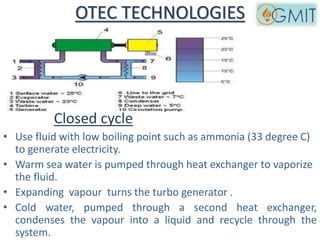
Closed cycle 
• Use fluid with low boiling point such as ammonia (33 degree C) 
to generate electricity. 
• Warm sea water is pumped through heat exchanger to vaporize 
the fluid. 
• Expanding vapour turns the turbo generator . 
• Cold water, pumped through a second heat exchanger, 
condenses the vapour into a liquid and recycle through the 
system.
OTEC TECHNOLOGIES 
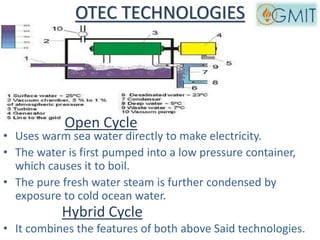
Open Cycle 
• Uses warm sea water directly to make electricity. 
• The water is first pumped into a low pressure container, 
which causes it to boil. 
• The pure fresh water steam is further condensed by 
exposure to cold ocean water. 
Hybrid Cycle 
• It combines the features of both above Said technologies.
CURRENTLY OPERATING OTEC PLANTS 
• In March 2013, Saga University with various 
Japanese industries completed the installation 
of a new OTEC plant. 
• Okinawa prefecture announced the start of 
the OTEC operation testing at KUME Island on 
April 15,2013. 
• In July 2014 DCNS groups partnered with 
energy announced NER 300 funding for their 
NEMO project.
ENVIRONMENTAL IMPACT 
HYDRO DYNAMIC MODELING WORK 
 In 2010 a computer model was developed to 
stimulate the physical oceanographic effects of one 
or several 100 MW OTEC. 
 The model suggest that OTEC plants can be 
configured such that the plant can conduct 
continuous operation with variations of 
temperatures and nutrients within natural levels.
ENVIRONMENTAL IMPACT 
BIOLOGICAL MODELING WORK 
The discharged nutrients could potentially 
increase biological activity when accumulated 
in large quantities in the photic zones. 
 A biological component was added to the 
hydrodynamic computer model to stimulate 
the biological response to plumes from 100 
MW OTEC plants.
TECHNICAL DIFFICULTIES 
DISSOLVED GASSES 
The direct contact condensers offer significant 
disadvantages: 
• As cold water rises in the intake pipe, the 
pressure decreases to the point where gas begins 
to evolve. 
• The direct contact heat exchanges may be 
justified if a significant amount of gas comes out 
of solution.
TECHNICAL DIFFICULTIES 
SEALING:- 
• The evaporator, turbine and condenser must be 
carefully sealed to prevent in- leakage of 
atmospheric air that can degrade operation. 
PARASITIC POWER CONSUMPTION BY EXHAUST 
COMPRESSURE:- 
• A counter current region increases the gas steam 
reaction over which the non condensable gas 
steam is passed through after condensation. 
• Result is 80% reduction in exhaust pumping 
power requirements.
ADVANTAGES 
•Totally Renewable. 
•Generates electricity with no green house effect. 
•Produces desalinated water. 
DISADVANTAGES 
•Needs a large difference in temperatures for best 
results. 
•Needs to be close to the national grid. 
•Plant needs safe location from storms and surf.
THANK YOU 
PRAKASH JHA 
SANJEEV HALDAR 
RAJNARAYAN ROY 
RISHAV KUMAR SETHIA 
KAUSHIK DUARI 
SHUBHAM ROY 
GOURANGA SAW 
MD. SHAMSHER HOSSAIN 
RAVI PAL

Otec

  • 2.
    INTRODUCTION • Asource of renewable energy, uses the heat energy stored in the earth’s oceans to generate electricity. • Works best when the temperature difference between warmer and the colder water is 36 deg F • Exists in tropical coastal areas roughly between the tropic of Capricorn and the tropic of cancer.
  • 3.
    NARRATION • OTECwas first proposed in the year 1881 by Jacques Arsene d’Arsonval a French physicist. • The US became involved in OTEC research in 1974 with the establishment of the Natural Energy Laboratory of Hawaii Authority.
  • 4.
    OTEC TECHNOLOGIES Closedcycle • Use fluid with low boiling point such as ammonia (33 degree C) to generate electricity. • Warm sea water is pumped through heat exchanger to vaporize the fluid. • Expanding vapour turns the turbo generator . • Cold water, pumped through a second heat exchanger, condenses the vapour into a liquid and recycle through the system.
  • 5.
    OTEC TECHNOLOGIES OpenCycle • Uses warm sea water directly to make electricity. • The water is first pumped into a low pressure container, which causes it to boil. • The pure fresh water steam is further condensed by exposure to cold ocean water. Hybrid Cycle • It combines the features of both above Said technologies.
  • 6.
    CURRENTLY OPERATING OTECPLANTS • In March 2013, Saga University with various Japanese industries completed the installation of a new OTEC plant. • Okinawa prefecture announced the start of the OTEC operation testing at KUME Island on April 15,2013. • In July 2014 DCNS groups partnered with energy announced NER 300 funding for their NEMO project.
  • 7.
    ENVIRONMENTAL IMPACT HYDRODYNAMIC MODELING WORK  In 2010 a computer model was developed to stimulate the physical oceanographic effects of one or several 100 MW OTEC.  The model suggest that OTEC plants can be configured such that the plant can conduct continuous operation with variations of temperatures and nutrients within natural levels.
  • 8.
    ENVIRONMENTAL IMPACT BIOLOGICALMODELING WORK The discharged nutrients could potentially increase biological activity when accumulated in large quantities in the photic zones.  A biological component was added to the hydrodynamic computer model to stimulate the biological response to plumes from 100 MW OTEC plants.
  • 9.
    TECHNICAL DIFFICULTIES DISSOLVEDGASSES The direct contact condensers offer significant disadvantages: • As cold water rises in the intake pipe, the pressure decreases to the point where gas begins to evolve. • The direct contact heat exchanges may be justified if a significant amount of gas comes out of solution.
  • 10.
    TECHNICAL DIFFICULTIES SEALING:- • The evaporator, turbine and condenser must be carefully sealed to prevent in- leakage of atmospheric air that can degrade operation. PARASITIC POWER CONSUMPTION BY EXHAUST COMPRESSURE:- • A counter current region increases the gas steam reaction over which the non condensable gas steam is passed through after condensation. • Result is 80% reduction in exhaust pumping power requirements.
  • 11.
    ADVANTAGES •Totally Renewable. •Generates electricity with no green house effect. •Produces desalinated water. DISADVANTAGES •Needs a large difference in temperatures for best results. •Needs to be close to the national grid. •Plant needs safe location from storms and surf.
  • 12.
    THANK YOU PRAKASHJHA SANJEEV HALDAR RAJNARAYAN ROY RISHAV KUMAR SETHIA KAUSHIK DUARI SHUBHAM ROY GOURANGA SAW MD. SHAMSHER HOSSAIN RAVI PAL