OCEAN POWER GENERATION
the way of generation of electric energy……….
Non-Conventional Energy Sources
Definition: The energy can be obtained from various sources such as the sun, wind,
geothermal, biomass, tides, etc. used to generate heat and power. These sources are
present in abundance in nature, and they are constantly generated, so it cannot be
exhausted easily, and used again and again.
Types of Non-conventional energy sources
1. Solar Energy
2. Wind Energy
3. Tidal Energy
4. Geothermal Energy
5. Biomass
1) Introduction
2) Tidal and wave energy generation
3) Tidal energy
4) Wave energy
5) Ocean Thermal energy
6) Global production
7) Advantages &Disadvantages
8) Future Scope
9) Conclusion
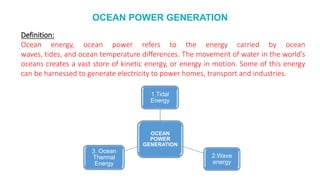
OCEAN POWER GENERATION
Definition:
Ocean energy, ocean power refers to the energy carried by ocean
waves, tides, and ocean temperature differences. The movement of water in the world’s
oceans creates a vast store of kinetic energy, or energy in motion. Some of this energy
can be harnessed to generate electricity to power homes, transport and industries.
OCEAN
POWER
GENERATION
3. Ocean
Thermal
Energy
2.Wave
energy
1.Tidal
Energy
TIDES:
Definition :The rise and fall of the water level is known as
tide.
WAVES:
Definition :Waves are generated by the wind on ocean
surface, this is also called ocean surface wave.
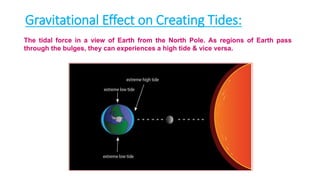
Gravitational Effect on Creating Tides:
The tidal force in a view of Earth from the North Pole. As regions of Earth pass
through the bulges, they can experiences a high tide & vice versa.
LOW TIDE AND HIGH TIDE
WAVES GENERATION
They are formed by the friction generated as wind blows over the surface of the
sea, the greater the strength of the wind and the longer it blows over the sea for
the greater the energy in the wave and so the greater the size.
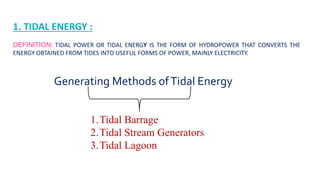
Generating Methods ofTidal Energy
1.Tidal Barrage
2.Tidal Stream Generators
3.Tidal Lagoon
1. TIDAL ENERGY :
DEFINITION: TIDAL POWER OR TIDAL ENERGY IS THE FORM OF HYDROPOWER THAT CONVERTS THE
ENERGY OBTAINED FROM TIDES INTO USEFUL FORMS OF POWER, MAINLY ELECTRICITY.
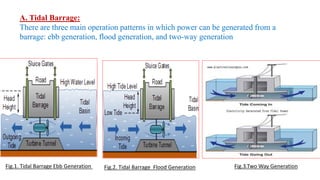
A. Tidal Barrage:
There are three main operation patterns in which power can be generated from a
barrage: ebb generation, flood generation, and two-way generation
Fig.2. Tidal Barrage Flood GenerationFig.1. Tidal Barrage Ebb Generation Fig.3.Two Way Generation
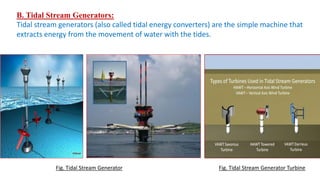
B. Tidal Stream Generators:
Tidal stream generators (also called tidal energy converters) are the simple machine that
extracts energy from the movement of water with the tides.
Fig. Tidal Stream Generator Fig. Tidal Stream Generator Turbine
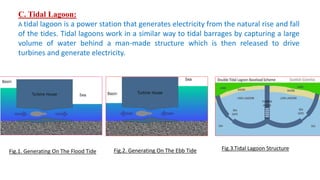
C. Tidal Lagoon:
A tidal lagoon is a power station that generates electricity from the natural rise and fall
of the tides. Tidal lagoons work in a similar way to tidal barrages by capturing a large
volume of water behind a man-made structure which is then released to drive
turbines and generate electricity.
Fig.1. Generating On The Flood Tide Fig.2. Generating On The Ebb Tide Fig.3.Tidal Lagoon Structure
2. WAVE ENERGY
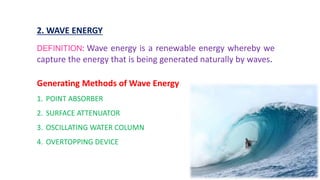
DEFINITION: Wave energy is a renewable energy whereby we
capture the energy that is being generated naturally by waves.
Generating Methods of Wave Energy
1. POINT ABSORBER
2. SURFACE ATTENUATOR
3. OSCILLATING WATER COLUMN
4. OVERTOPPING DEVICE
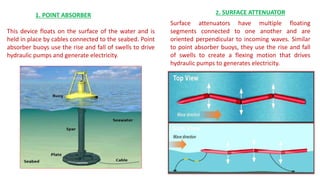
1. POINT ABSORBER 2. SURFACE ATTENUATOR
This device floats on the surface of the water and is
held in place by cables connected to the seabed. Point
absorber buoys use the rise and fall of swells to drive
hydraulic pumps and generate electricity.
Surface attenuators have multiple floating
segments connected to one another and are
oriented perpendicular to incoming waves. Similar
to point absorber buoys, they use the rise and fall
of swells to create a flexing motion that drives
hydraulic pumps to generates electricity.
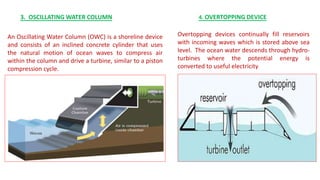
3. OSCILLATING WATER COLUMN 4. OVERTOPPING DEVICE
An Oscillating Water Column (OWC) is a shoreline device
and consists of an inclined concrete cylinder that uses
the natural motion of ocean waves to compress air
within the column and drive a turbine, similar to a piston
compression cycle.
Overtopping devices continually fill reservoirs
with incoming waves which is stored above sea
level. The ocean water descends through hydro-
turbines where the potential energy is
converted to useful electricity
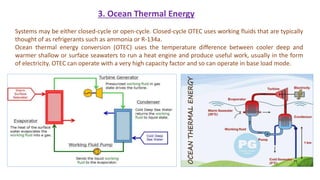
3. Ocean Thermal Energy
Systems may be either closed-cycle or open-cycle. Closed-cycle OTEC uses working fluids that are typically
thought of as refrigerants such as ammonia or R-134a.
Ocean thermal energy conversion (OTEC) uses the temperature difference between cooler deep and
warmer shallow or surface seawaters to run a heat engine and produce useful work, usually in the form
of electricity. OTEC can operate with a very high capacity factor and so can operate in base load mode.
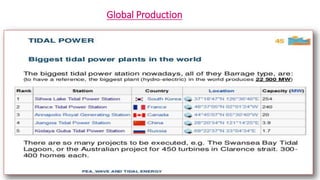
Global Production
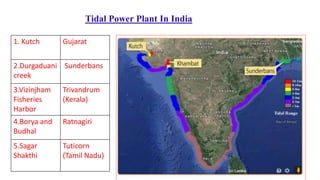
Tidal Power Plant In India
1. Kutch Gujarat
2.Durgaduani
creek
Sunderbans
3.Vizinjham
Fisheries
Harbor
Trivandrum
(Kerala)
4.Borya and
Budhal
Ratnagiri
5.Sagar
Shakthi
Tuticorn
(Tamil Nadu)
 High predictability as high and low tides can be predicted years in advance, unlike wind.
 Tidal barrages provide protection against flooding and land damage.
 Low noise pollution as any sound generated is transmitted through the water.
 As 71% of the earth’s surface is covered by water, there is scope to generate this energy on
large scale.
Tidal Energy requires a suitable site, where the tides and tidal streams are consistently strong
Tidal energy is not always a constant energy source
High capital, construction and maintenance costs.
High power distribution costs to send the generated power
Influences aquatic life adversely and can disrupt migration of fish.
Conclusion
Ocean energy is a result of the orbital kinetic energy of the moon, earth, and sun. It
provides zero gas, solid, or radiation pollution and is an inexhaustible supply of energy. As
a kind of green energy, tidal energy has some significant merits. Tidal power energy does
not depend on the season or the weather type, so it is more predictable, compared to other
sources of energy such as wind or solar energy.
Ocean Power Generation

Ocean Power Generation

  • 1.
    OCEAN POWER GENERATION theway of generation of electric energy……….
  • 2.
    Non-Conventional Energy Sources Definition:The energy can be obtained from various sources such as the sun, wind, geothermal, biomass, tides, etc. used to generate heat and power. These sources are present in abundance in nature, and they are constantly generated, so it cannot be exhausted easily, and used again and again.
  • 3.
    Types of Non-conventionalenergy sources 1. Solar Energy 2. Wind Energy 3. Tidal Energy 4. Geothermal Energy 5. Biomass
  • 4.
    1) Introduction 2) Tidaland wave energy generation 3) Tidal energy 4) Wave energy 5) Ocean Thermal energy 6) Global production 7) Advantages &Disadvantages 8) Future Scope 9) Conclusion
  • 5.
    OCEAN POWER GENERATION Definition: Oceanenergy, ocean power refers to the energy carried by ocean waves, tides, and ocean temperature differences. The movement of water in the world’s oceans creates a vast store of kinetic energy, or energy in motion. Some of this energy can be harnessed to generate electricity to power homes, transport and industries. OCEAN POWER GENERATION 3. Ocean Thermal Energy 2.Wave energy 1.Tidal Energy
  • 6.
    TIDES: Definition :The riseand fall of the water level is known as tide. WAVES: Definition :Waves are generated by the wind on ocean surface, this is also called ocean surface wave.
  • 7.
    Gravitational Effect onCreating Tides: The tidal force in a view of Earth from the North Pole. As regions of Earth pass through the bulges, they can experiences a high tide & vice versa.
  • 8.
    LOW TIDE ANDHIGH TIDE WAVES GENERATION They are formed by the friction generated as wind blows over the surface of the sea, the greater the strength of the wind and the longer it blows over the sea for the greater the energy in the wave and so the greater the size.
  • 9.
    Generating Methods ofTidalEnergy 1.Tidal Barrage 2.Tidal Stream Generators 3.Tidal Lagoon 1. TIDAL ENERGY : DEFINITION: TIDAL POWER OR TIDAL ENERGY IS THE FORM OF HYDROPOWER THAT CONVERTS THE ENERGY OBTAINED FROM TIDES INTO USEFUL FORMS OF POWER, MAINLY ELECTRICITY.
  • 10.
    A. Tidal Barrage: Thereare three main operation patterns in which power can be generated from a barrage: ebb generation, flood generation, and two-way generation Fig.2. Tidal Barrage Flood GenerationFig.1. Tidal Barrage Ebb Generation Fig.3.Two Way Generation
  • 11.
    B. Tidal StreamGenerators: Tidal stream generators (also called tidal energy converters) are the simple machine that extracts energy from the movement of water with the tides. Fig. Tidal Stream Generator Fig. Tidal Stream Generator Turbine
  • 12.
    C. Tidal Lagoon: Atidal lagoon is a power station that generates electricity from the natural rise and fall of the tides. Tidal lagoons work in a similar way to tidal barrages by capturing a large volume of water behind a man-made structure which is then released to drive turbines and generate electricity. Fig.1. Generating On The Flood Tide Fig.2. Generating On The Ebb Tide Fig.3.Tidal Lagoon Structure
  • 13.
    2. WAVE ENERGY DEFINITION:Wave energy is a renewable energy whereby we capture the energy that is being generated naturally by waves. Generating Methods of Wave Energy 1. POINT ABSORBER 2. SURFACE ATTENUATOR 3. OSCILLATING WATER COLUMN 4. OVERTOPPING DEVICE
  • 14.
    1. POINT ABSORBER2. SURFACE ATTENUATOR This device floats on the surface of the water and is held in place by cables connected to the seabed. Point absorber buoys use the rise and fall of swells to drive hydraulic pumps and generate electricity. Surface attenuators have multiple floating segments connected to one another and are oriented perpendicular to incoming waves. Similar to point absorber buoys, they use the rise and fall of swells to create a flexing motion that drives hydraulic pumps to generates electricity.
  • 15.
    3. OSCILLATING WATERCOLUMN 4. OVERTOPPING DEVICE An Oscillating Water Column (OWC) is a shoreline device and consists of an inclined concrete cylinder that uses the natural motion of ocean waves to compress air within the column and drive a turbine, similar to a piston compression cycle. Overtopping devices continually fill reservoirs with incoming waves which is stored above sea level. The ocean water descends through hydro- turbines where the potential energy is converted to useful electricity
  • 16.
    3. Ocean ThermalEnergy Systems may be either closed-cycle or open-cycle. Closed-cycle OTEC uses working fluids that are typically thought of as refrigerants such as ammonia or R-134a. Ocean thermal energy conversion (OTEC) uses the temperature difference between cooler deep and warmer shallow or surface seawaters to run a heat engine and produce useful work, usually in the form of electricity. OTEC can operate with a very high capacity factor and so can operate in base load mode.
  • 17.
  • 18.
    Tidal Power PlantIn India 1. Kutch Gujarat 2.Durgaduani creek Sunderbans 3.Vizinjham Fisheries Harbor Trivandrum (Kerala) 4.Borya and Budhal Ratnagiri 5.Sagar Shakthi Tuticorn (Tamil Nadu)
  • 19.
     High predictabilityas high and low tides can be predicted years in advance, unlike wind.  Tidal barrages provide protection against flooding and land damage.  Low noise pollution as any sound generated is transmitted through the water.  As 71% of the earth’s surface is covered by water, there is scope to generate this energy on large scale.
  • 20.
    Tidal Energy requiresa suitable site, where the tides and tidal streams are consistently strong Tidal energy is not always a constant energy source High capital, construction and maintenance costs. High power distribution costs to send the generated power Influences aquatic life adversely and can disrupt migration of fish.
  • 21.
    Conclusion Ocean energy isa result of the orbital kinetic energy of the moon, earth, and sun. It provides zero gas, solid, or radiation pollution and is an inexhaustible supply of energy. As a kind of green energy, tidal energy has some significant merits. Tidal power energy does not depend on the season or the weather type, so it is more predictable, compared to other sources of energy such as wind or solar energy.