Occupational Health &
Safety Management
System
ISO 45001:2018
qc All Rights Reserved Rev: 5 /Sept 2007
Every system contains
Policies
Structure,
Resources,
Processes and Procedure
Outputs
Wait
React
Identify
Cure
Plan
Check
Implement
Review
Typical OHS driven
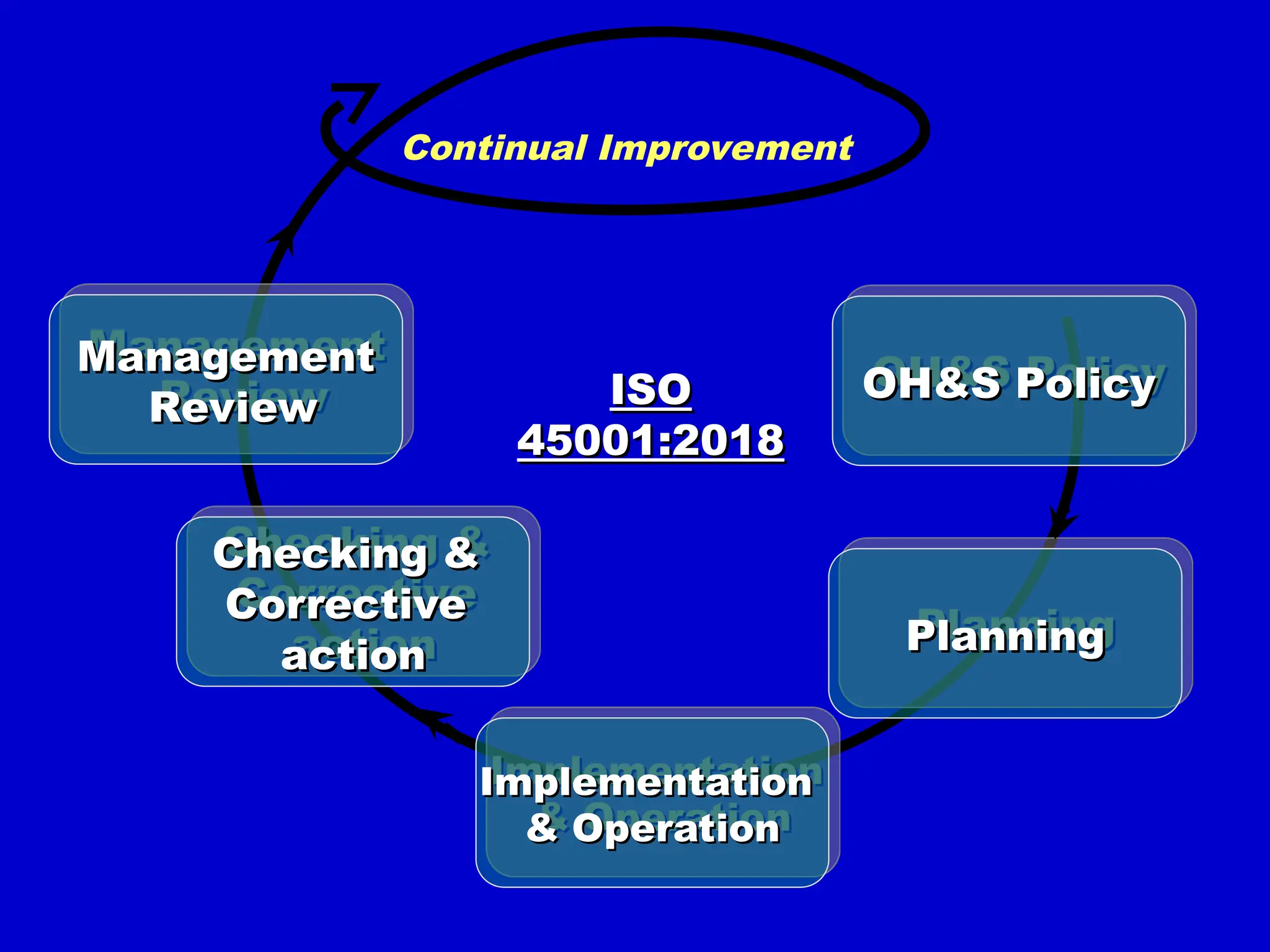
Continual Improvement
OH&S Policy
OH&S Policy
Management
Management
Review
Review
Checking &
Checking &
Corrective
Corrective
action
action Planning
Planning
Implementation
Implementation
& Operation
& Operation
ISO
ISO
45001:2018
45001:2018
ISO 45001:2018
OHS of XYZ
OHS Manual
OHS Procedures
OHS Work Instructions
OHS Formats
DO
Check
Act to
Improve
• Corporate Policy
• National laws
• Views of
interested parties
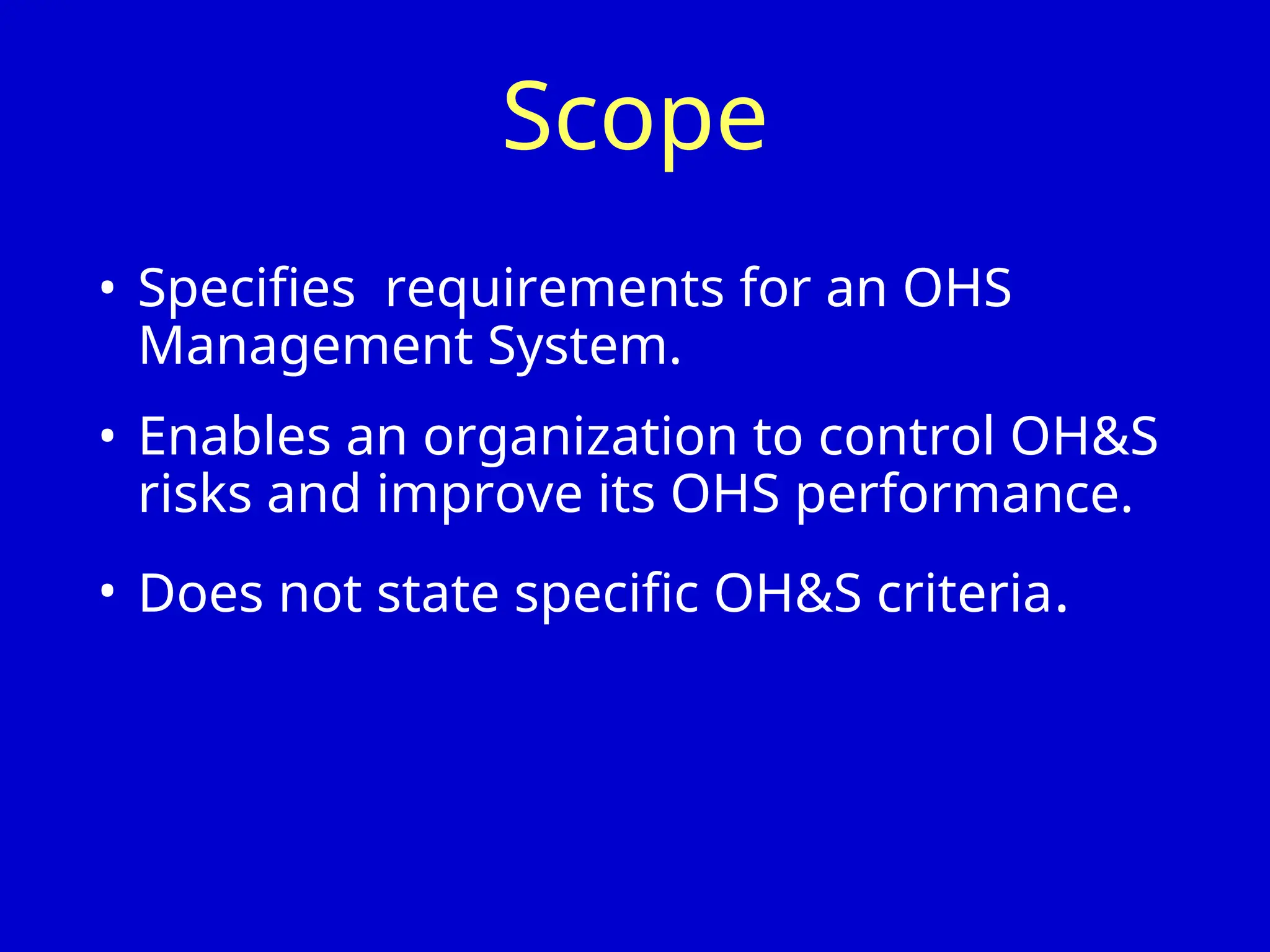
Scope
• Specifies requirements for an OHS
Management System.
• Enables an organization to control OH&S
risks and improve its OHS performance.
• Does not state specific OH&S criteria.
Applicable to any organization that
wishes to:
• Establish a system to eliminate or minimize
risk
• Implement, maintain and continually
improve an OH&S system.
• Assure itself and demonstrate to others, its
conformance to OH&S policy.
• Seek certification.
ISO 45001:2018 is intended
to
Address occupational
health and safety - and
not product safety,
property damage, or
environmental impacts.
Worker is now defined as any
person performing work or work-
related activities that are under the
control of the organisation. Workers
include top management as well as
those who perform managerial or
non-managerial functions. For the
purposes of OH&S, it does not matter
if the work arrangement of a worker is
paid, unpaid, regular, part-time,
temporary, seasonal or casual.
Workplace has been
defined as a place under
the control of the
organisation , where a
person needs to be or
go for work purposes.
Hazard is defined as a source with
a potential to cause injury or ill
health.
OH&S Risk is defined as the
combination of the likelihood of
occurrence of a work-related
hazardous event or exposure and the
severity of injury and ill health that
can be caused by the event or
exposure.
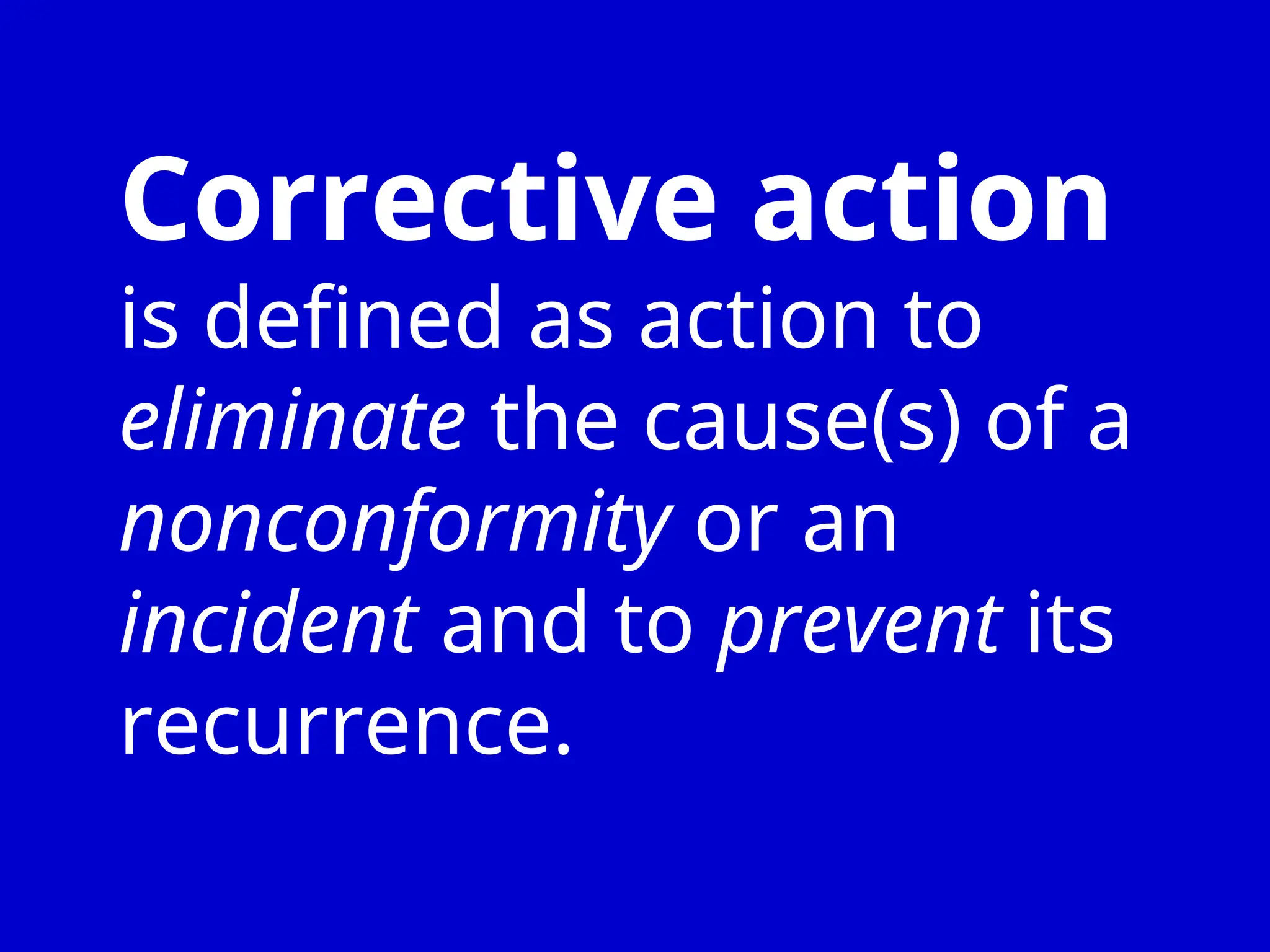
Corrective action
is defined as action to
eliminate the cause(s) of a
nonconformity or an
incident and to prevent its
recurrence.
4.4 OH&S Management System
The organization shall establish,
document, implement, maintain
and continually improve an OHS
management system, in
accordance with the requirements
of this ISO standard.
The organisation shall define and document the
scope of its OHS management system.
4.2 Determine needs and
expectations of Workers.
4.3 Determine the Scope of
OH&S management system
Leadership and commitment
•Overall responsibility
•Establish policy & objectives
•Provide resources
•Ensure achieve OHS outcomes
•Establish processes
•Continual improvement
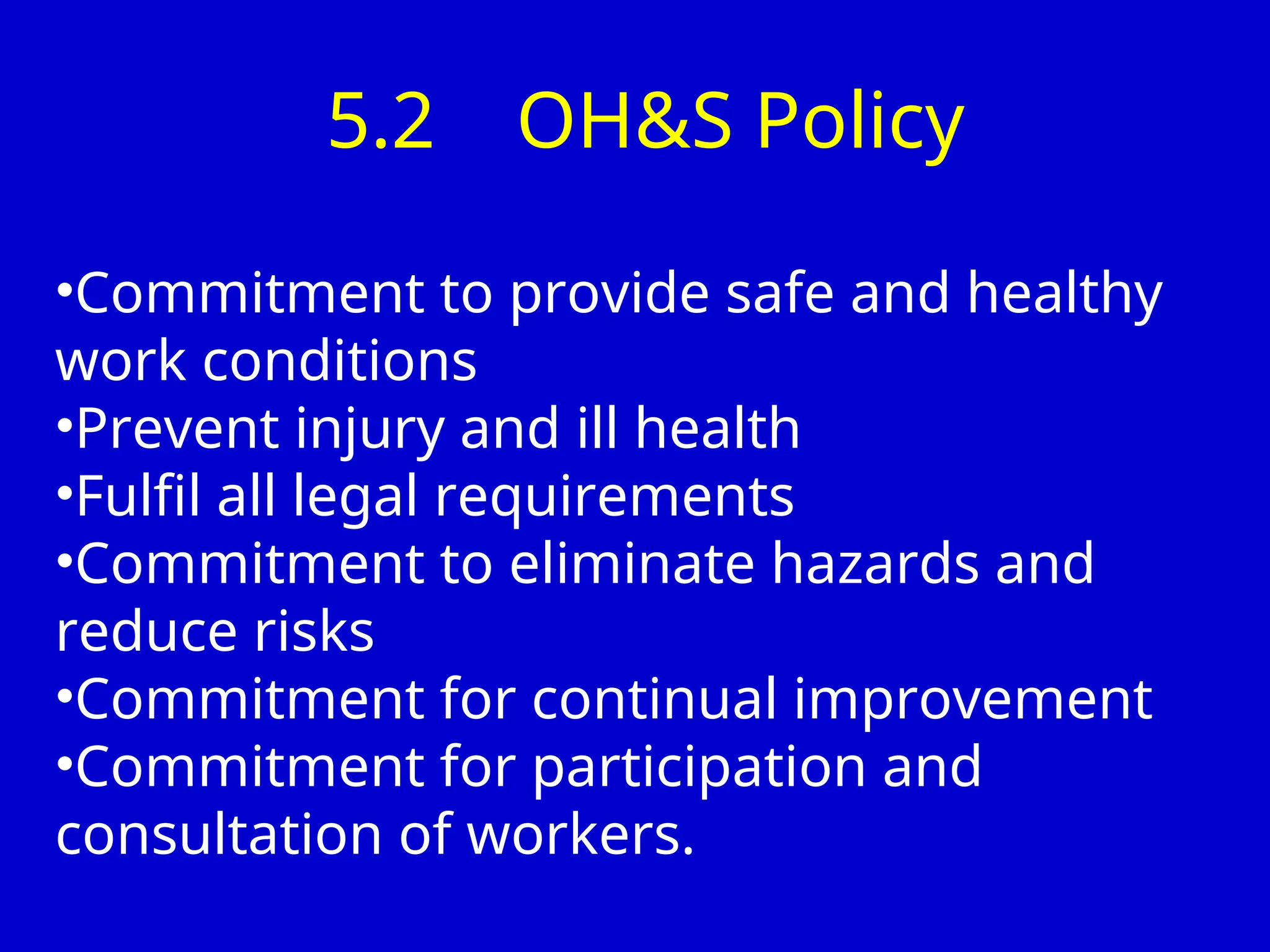
5.2 OH&S Policy
•Commitment to provide safe and healthy
work conditions
•Prevent injury and ill health
•Fulfil all legal requirements
•Commitment to eliminate hazards and
reduce risks
•Commitment for continual improvement
•Commitment for participation and
consultation of workers.
OH&S Policy
Dolls Eye Scream Factory
Dolls Eye Scream Factory is committed to safe health
and safety practices at all its locations. It is committed
to the following corporate OH&S policy objectives.
•To the extent possible, apply practices and control
technologies that minimise hazards and risks.
•Comply with current Unilever laws.
•Reduce accidents and incidents
•To train all employees on matters of OH&S.
•To keep our factory environments free of hazards and
ready to respond to an emergency.
Signed : Safety Co-ordinator.
Dolls Eye Scream Factory
Dated: 12. 06, 2010
Last reviewed: 12.06, 2014
5.3 Define organisational roles
responsibilities and
authorities
5.4 Consultation and
participation of workers
6.1.2.1 Identify Hazards arising out
of:
•Routine & Non routine activities
•Infrastructure, materials, equipment,
substances, location
•Design, testing, production, assembly,
construction, delivery, maintenance
•Human factors.
•How work is performed
•Emergency situations
Risk assessment and Control
process
1.Identify Hazards
2.Determine Risk, after considering risk
control measures already in place.
3.Assess if the risk is acceptable or
unacceptable –
4.Determine what additional risk controls
need to be applied.
5.Plan and Implement additional risk
reduction measures.
6.Verify, validate and document risk
6.1.3 Determine Legal requirements
6.1.4 Planning to address:
•OH&S Risks
•Legal requirements
•Emergency situations
6.2 Establish OH&S Objectives
and plan to achieve them
7. Provide Resources,
Competence and
awareness needed to
maintain and improve
OH&S system.
What training may be required?
 OH&S Training
 Hazardous and non-hazardous waste handling
 Emergency response procedures.
 Handling of chemicals.
 Operational procedures i.e, machine
maintenance,
machine operations, storing, stacking, labelling,
 Monitoring & measuring.
 Calibration of equipment.
 Packaging & transport of chemicals.
7.4 Establish and
maintain processes for
internal and external
communication
7.5 Establish documentation
required by :
• ISO 45001
• Organisation itself
• Control Documented
information – that includes
both documents and
records
8. Operational Planning and
Control
• Plan to control hazards
• Management of change
• Procurement
• Contractors
• Emergency preparedness and
response
Emergency plans can include
 Emergency organization and
responsibilities
 A list of key personnel
 Details of emergency services (e.g. fire
department, bomb disposal,
 Clean-up services, police, hospitals
 Internal and external communication
plans
Emergency Equipment can include
 Alarm system
 Emergency lights and power
 Escape means and routes
 Safe refuge
 Isolation valves, switches, cut-outs,
 Fire fighting equipment
 First aid, medical support
 Communication facilities.
Planning for determining controls
Consider the following hierarchy:
a. Elimination
b.Substitution
c. Engineering Controls
d.Signage/warning/administrative
control
e. Personal protective equipment
9.1 Performance Monitoring,
Measuring and Analysis
• Measure Legal Compliance
• Conduct Internal audit
• Measure OH&S objectives
• Check, monitor, activities,
equipment
• Check Effectiveness of
Controls
•
9.3 Conduct Management Review
Input report on performance:
• Actions from previous Mgt Rev.
• Legal compliance
• Risks and opportunities
• Incidents, accidents & corrective actions
• Internal and External communication
• Audit results
• Progress on objectives
• Results of measuring & monitoring
• Resources adequacy
• Continual improvement
10.2 Incident, non-conformity
and corrective actions
10.3 Continual improvement
While auditing PCB Pvt. Ltd.,
Auditor Mr. Akalmund Khan finds
the following:
“Buland Iqbal was climbing a 200 feet
high antenna, without any Permit to
Work. His supervisor said Buland
Iqbal was highly trained.”
Audit finding
Mr. Tarbiat Yafta had
received no training in
emergency procedures
and had also not taken
part in any emergency
drill.
• Auditor Mr. Insaf Pasand while
auditing EYE SEE EYE Factory asked
to see the risk assessment register.
He found that no risk assessment had
been done for repair and maintenance
workshop. The company closed the
NCR by saying” Risk assessment of
maintenance workshop done”
• There was no other action taken.
“The real enemy
of safety is not
non-compliance
but non-thinking”

2 Health Safety and enviroment 45001.ppt

  • 1.
    Occupational Health & SafetyManagement System ISO 45001:2018
  • 2.
    qc All RightsReserved Rev: 5 /Sept 2007 Every system contains Policies Structure, Resources, Processes and Procedure Outputs
  • 3.
  • 4.
    Continual Improvement OH&S Policy OH&SPolicy Management Management Review Review Checking & Checking & Corrective Corrective action action Planning Planning Implementation Implementation & Operation & Operation ISO ISO 45001:2018 45001:2018
  • 5.
    ISO 45001:2018 OHS ofXYZ OHS Manual OHS Procedures OHS Work Instructions OHS Formats DO Check Act to Improve • Corporate Policy • National laws • Views of interested parties
  • 6.
    Scope • Specifies requirementsfor an OHS Management System. • Enables an organization to control OH&S risks and improve its OHS performance. • Does not state specific OH&S criteria.
  • 7.
    Applicable to anyorganization that wishes to: • Establish a system to eliminate or minimize risk • Implement, maintain and continually improve an OH&S system. • Assure itself and demonstrate to others, its conformance to OH&S policy. • Seek certification.
  • 8.
    ISO 45001:2018 isintended to Address occupational health and safety - and not product safety, property damage, or environmental impacts.
  • 9.
    Worker is nowdefined as any person performing work or work- related activities that are under the control of the organisation. Workers include top management as well as those who perform managerial or non-managerial functions. For the purposes of OH&S, it does not matter if the work arrangement of a worker is paid, unpaid, regular, part-time, temporary, seasonal or casual.
  • 10.
    Workplace has been definedas a place under the control of the organisation , where a person needs to be or go for work purposes.
  • 11.
    Hazard is definedas a source with a potential to cause injury or ill health. OH&S Risk is defined as the combination of the likelihood of occurrence of a work-related hazardous event or exposure and the severity of injury and ill health that can be caused by the event or exposure.
  • 12.
    Corrective action is definedas action to eliminate the cause(s) of a nonconformity or an incident and to prevent its recurrence.
  • 13.
    4.4 OH&S ManagementSystem The organization shall establish, document, implement, maintain and continually improve an OHS management system, in accordance with the requirements of this ISO standard. The organisation shall define and document the scope of its OHS management system.
  • 14.
    4.2 Determine needsand expectations of Workers. 4.3 Determine the Scope of OH&S management system
  • 15.
    Leadership and commitment •Overallresponsibility •Establish policy & objectives •Provide resources •Ensure achieve OHS outcomes •Establish processes •Continual improvement
  • 16.
    5.2 OH&S Policy •Commitmentto provide safe and healthy work conditions •Prevent injury and ill health •Fulfil all legal requirements •Commitment to eliminate hazards and reduce risks •Commitment for continual improvement •Commitment for participation and consultation of workers.
  • 17.
    OH&S Policy Dolls EyeScream Factory Dolls Eye Scream Factory is committed to safe health and safety practices at all its locations. It is committed to the following corporate OH&S policy objectives. •To the extent possible, apply practices and control technologies that minimise hazards and risks. •Comply with current Unilever laws. •Reduce accidents and incidents •To train all employees on matters of OH&S. •To keep our factory environments free of hazards and ready to respond to an emergency. Signed : Safety Co-ordinator. Dolls Eye Scream Factory Dated: 12. 06, 2010 Last reviewed: 12.06, 2014
  • 18.
    5.3 Define organisationalroles responsibilities and authorities 5.4 Consultation and participation of workers
  • 19.
    6.1.2.1 Identify Hazardsarising out of: •Routine & Non routine activities •Infrastructure, materials, equipment, substances, location •Design, testing, production, assembly, construction, delivery, maintenance •Human factors. •How work is performed •Emergency situations
  • 20.
    Risk assessment andControl process 1.Identify Hazards 2.Determine Risk, after considering risk control measures already in place. 3.Assess if the risk is acceptable or unacceptable – 4.Determine what additional risk controls need to be applied. 5.Plan and Implement additional risk reduction measures. 6.Verify, validate and document risk
  • 21.
  • 22.
    6.1.4 Planning toaddress: •OH&S Risks •Legal requirements •Emergency situations
  • 23.
    6.2 Establish OH&SObjectives and plan to achieve them
  • 24.
    7. Provide Resources, Competenceand awareness needed to maintain and improve OH&S system.
  • 25.
    What training maybe required?  OH&S Training  Hazardous and non-hazardous waste handling  Emergency response procedures.  Handling of chemicals.  Operational procedures i.e, machine maintenance, machine operations, storing, stacking, labelling,  Monitoring & measuring.  Calibration of equipment.  Packaging & transport of chemicals.
  • 26.
    7.4 Establish and maintainprocesses for internal and external communication
  • 27.
    7.5 Establish documentation requiredby : • ISO 45001 • Organisation itself • Control Documented information – that includes both documents and records
  • 28.
    8. Operational Planningand Control • Plan to control hazards • Management of change • Procurement • Contractors • Emergency preparedness and response
  • 29.
    Emergency plans caninclude  Emergency organization and responsibilities  A list of key personnel  Details of emergency services (e.g. fire department, bomb disposal,  Clean-up services, police, hospitals  Internal and external communication plans
  • 30.
    Emergency Equipment caninclude  Alarm system  Emergency lights and power  Escape means and routes  Safe refuge  Isolation valves, switches, cut-outs,  Fire fighting equipment  First aid, medical support  Communication facilities.
  • 31.
    Planning for determiningcontrols Planning for determining controls Consider the following hierarchy: a. Elimination b.Substitution c. Engineering Controls d.Signage/warning/administrative control e. Personal protective equipment
  • 32.
    9.1 Performance Monitoring, Measuringand Analysis • Measure Legal Compliance • Conduct Internal audit • Measure OH&S objectives • Check, monitor, activities, equipment • Check Effectiveness of Controls •
  • 33.
    9.3 Conduct ManagementReview Input report on performance: • Actions from previous Mgt Rev. • Legal compliance • Risks and opportunities • Incidents, accidents & corrective actions • Internal and External communication • Audit results • Progress on objectives • Results of measuring & monitoring • Resources adequacy • Continual improvement
  • 34.
    10.2 Incident, non-conformity andcorrective actions 10.3 Continual improvement
  • 35.
    While auditing PCBPvt. Ltd., Auditor Mr. Akalmund Khan finds the following: “Buland Iqbal was climbing a 200 feet high antenna, without any Permit to Work. His supervisor said Buland Iqbal was highly trained.”
  • 36.
    Audit finding Mr. TarbiatYafta had received no training in emergency procedures and had also not taken part in any emergency drill.
  • 37.
    • Auditor Mr.Insaf Pasand while auditing EYE SEE EYE Factory asked to see the risk assessment register. He found that no risk assessment had been done for repair and maintenance workshop. The company closed the NCR by saying” Risk assessment of maintenance workshop done” • There was no other action taken.
  • 38.
    “The real enemy ofsafety is not non-compliance but non-thinking”