OCCUPATIONAL
HEALTH
11/20/15 1
Definition
3
• "Occupational health should aim at the promotion
and maintenance of the highest degree of physical,
mental and social well-being of workers in all
occupations;
• The prevention of health
• The protection of workers in their employment
Objectives
• The maintenance and promotion of workers’ health and working
capacity
•
•
The improvement of working environment and work to become
conducive to safety and health
Development of work organizations and working which promotes
a positive social climate and smooth operation and may enhance
productivity of the undertakings.
—Joint ILO/WHO Committee on Occupational Health
11/20/15 5
Level of preventive measures
•Health promotion
•Specific protection
•Early diagnosis and treatment
•Disability limitation
•Rehabilitation
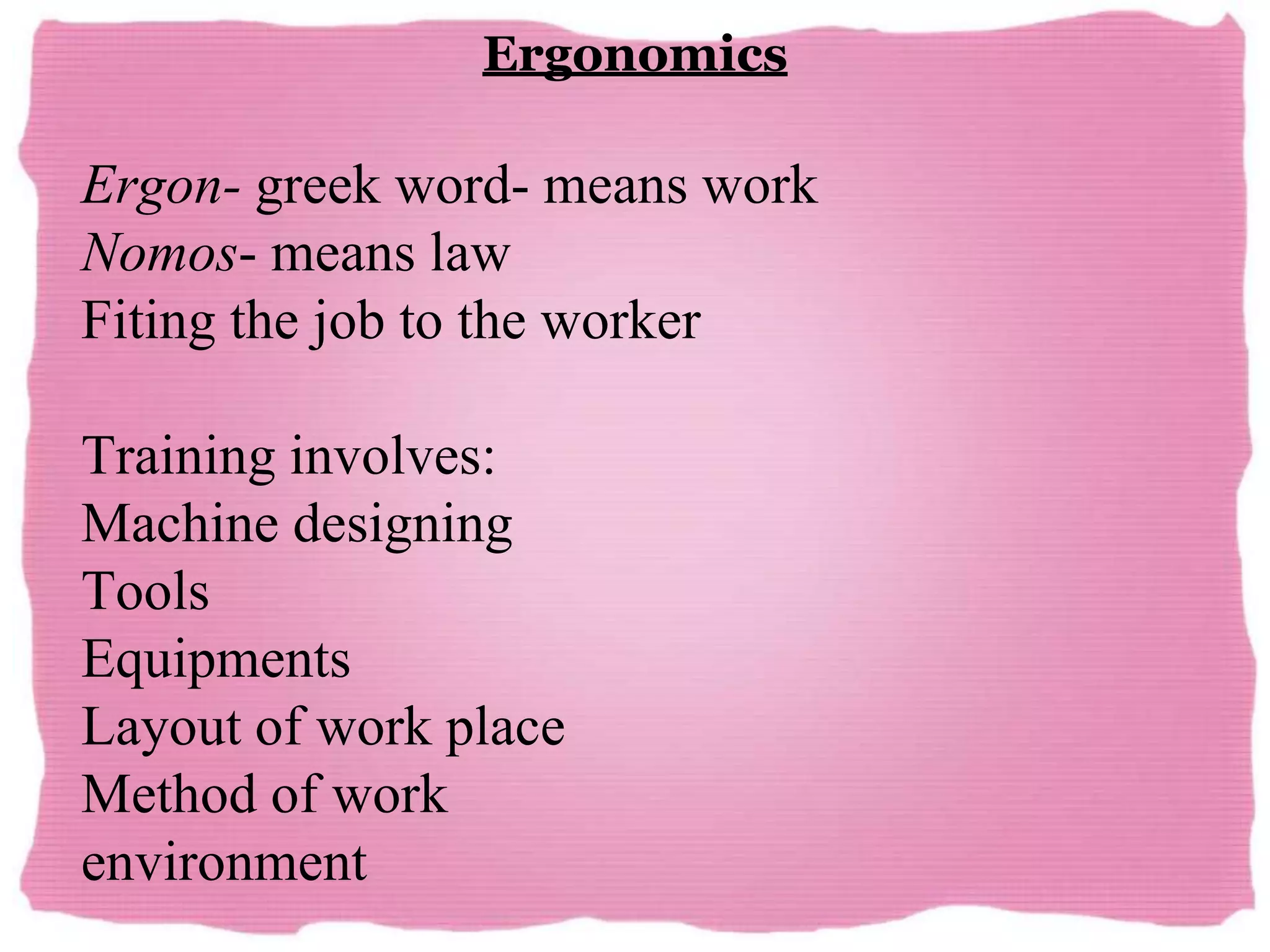
Ergonomics
Ergon- greek word- means work
Nomos- means law
Fiting the job to the worker
Training involves:
Machine designing
Tools
Equipments
Layout of work place
Method of work
environment
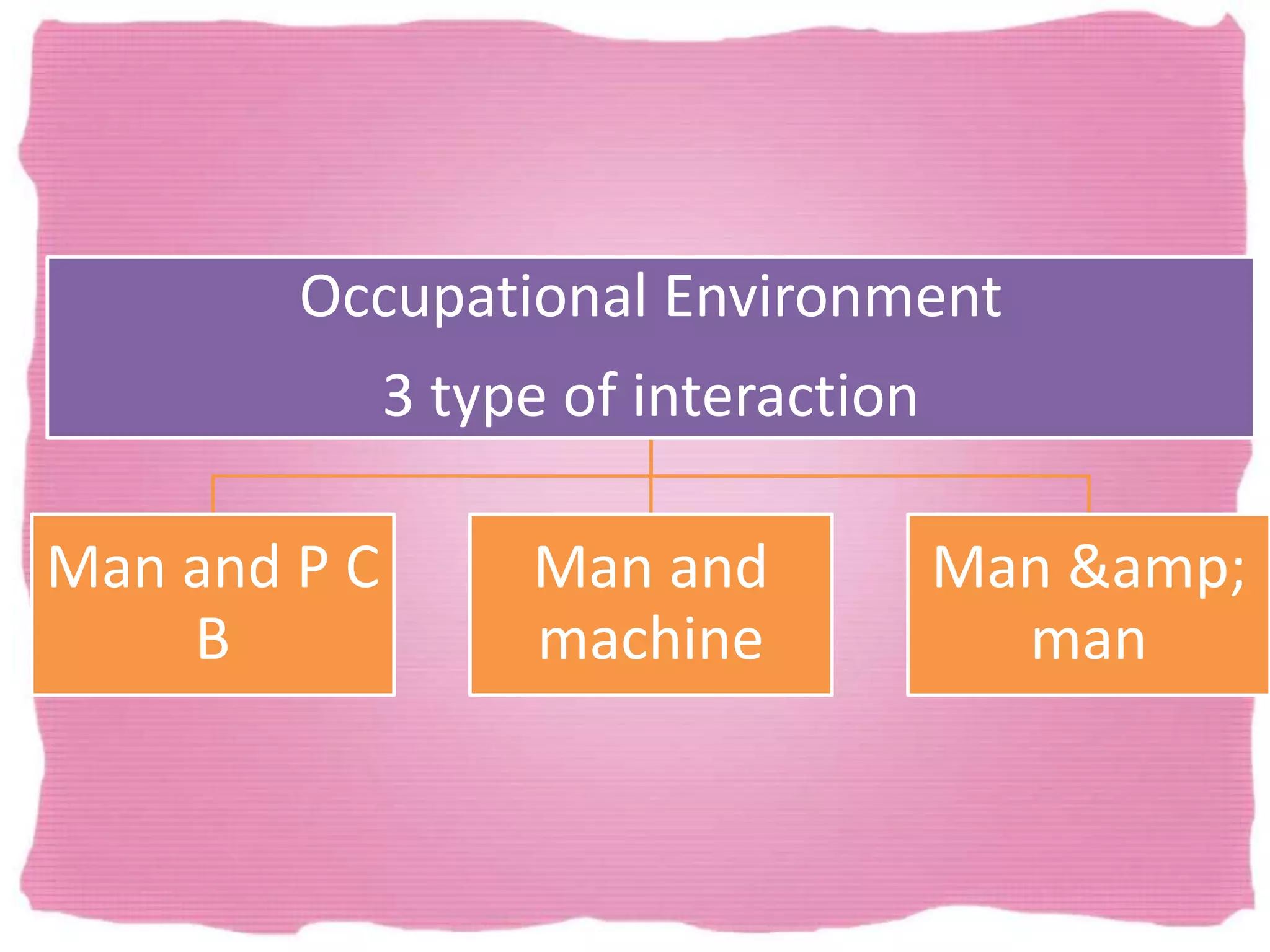
Occupational Environment
3 type of interaction
Man and P C
B
Man and
machine
Man &
man
OCCUPATIONAL
HAZARDS
11/20/156
Physical hazards
11/20/15 8
• Heat and cold
• Light
• Noise
• Vibration
• Ultraviolet radiation
• Ionizing radiation
• Burns
• Heat exhaustion
• Heat stroke
• Heat cramps
11/20/15 9
• Decreased
efficiency,
• Increased fatigue
• Enhanced accident
rates.
Heat
Direct effects Indirect effects
Cold
• Chilblains
• Erythrocyanosis
• Immersion foot
• Frostbite as a result of
cutaneous
vasoconstriction.
•11
G/20/
e15
neral hypothermia 9
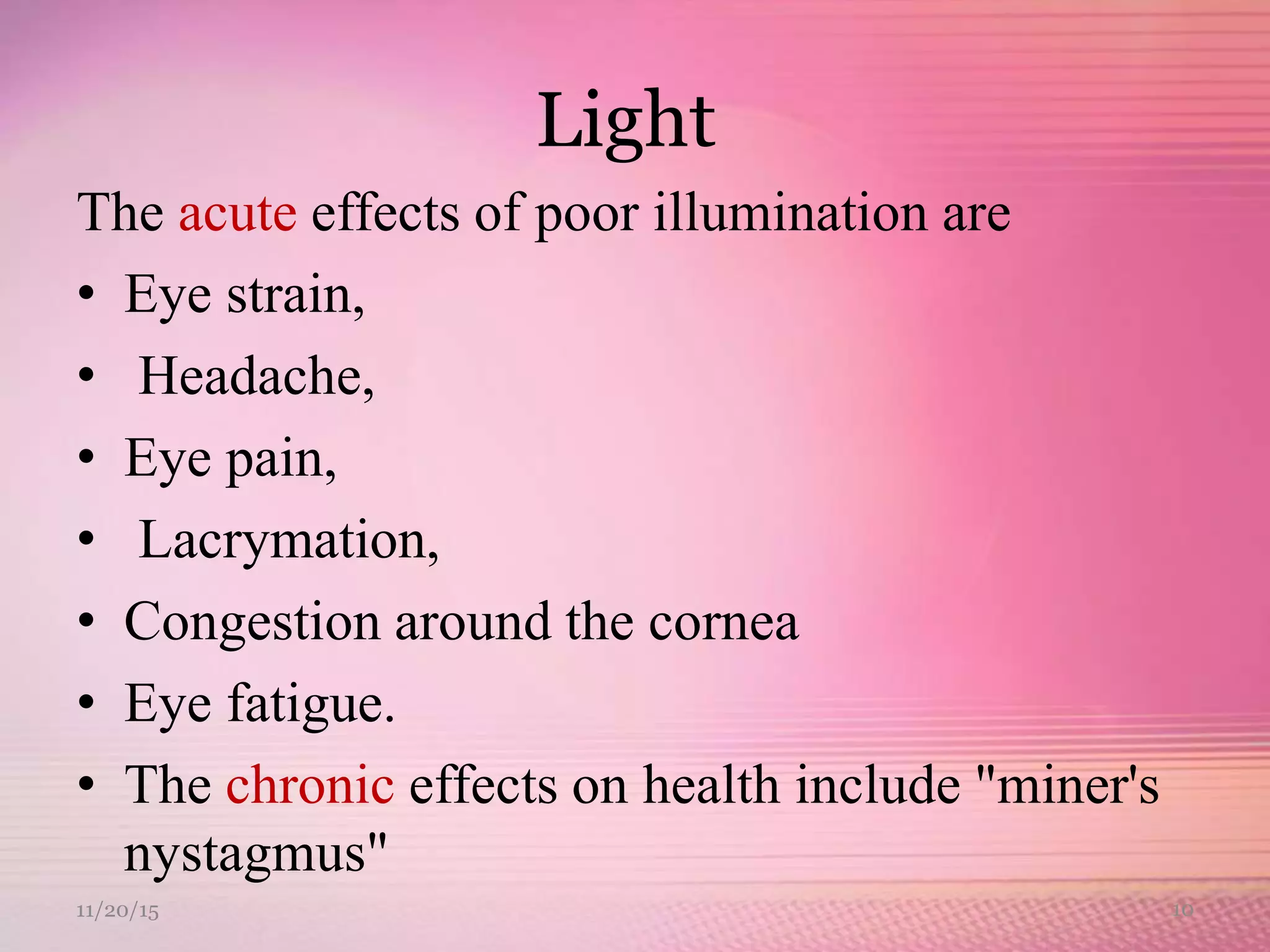
Light
The acute effects of poor illumination are
• Eye strain,
• Headache,
• Eye pain,
• Lacrymation,
• Congestion around the cornea
• Eye fatigue.
• The chronic effects on health include "miner's
nystagmus"
11/20/15 10
Noise
(i) Auditory effects
 Temporary or permanent hearing
loss
(ii) Non auditory effects
 Nervousness,
 Fatigue,
 Interference with communication
by speech,
 Decreased efficiency
 Annoyance 11
Vibration
• Exposure to vibration may also produce
injuries of the joints of the hands elbows and
shoulders.
12
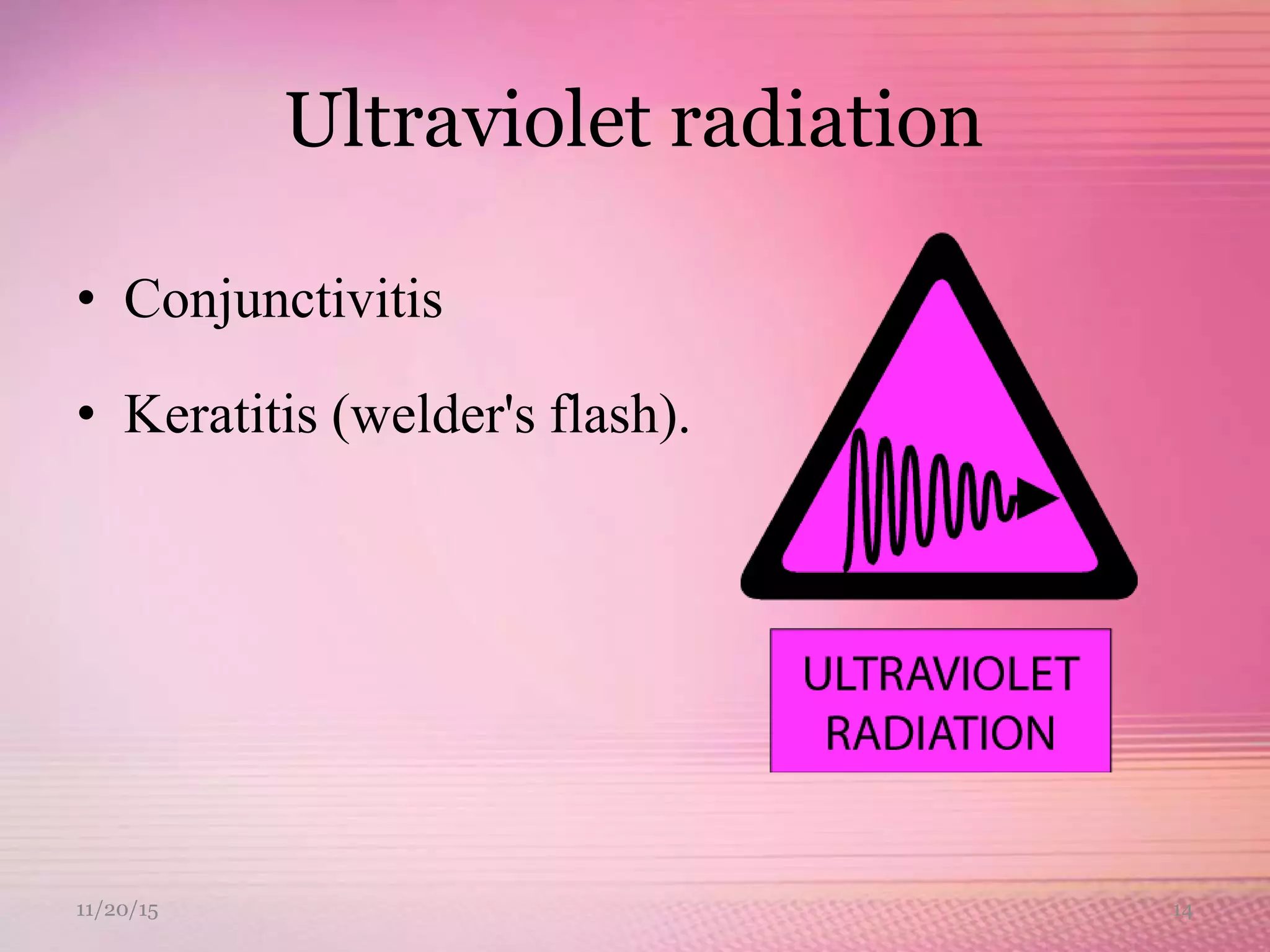
Ultraviolet radiation
• Conjunctivitis
• Keratitis (welder's flash).
11/20/15 14
Ionizing radiation
11/20/15 15
The radiation hazards comprise
• Genetic changes
• Malformation
• Cancer
• Leukaemia
• Depilation
• Ulceration
• Sterility
• in extreme cases death.
Ionizing radiation
11/20/15 16
The International Commission of Radiological
Protection has set the maximum permissible
level of occupational exposure at 5 rem per
year to the whole body.
Chemical hazards
11/20/15 17
Chemical hazards
11/20/15 18
1)Local Action :
Dermatitis
Eczema
Ulcers
Cancer by primary irritant action
Chemical hazards
(2) Inhalation :
• Dusts
• Gases
• Metals and their
compounds
11/20/15 19
Chemical hazards
11/20/15 20
• Dusts
Dusts are finely divided solid particles with size ranging from
0.1 to 150 microns
Dust particles larger than 10 microns settle down from the
air rapidly,
IndefinitelyParticles smaller than 5 microns are directly
inhaled into the lungs and are retained there and is mainly
responsible for pneumoconiosis.
11/20/15 21
Chemical hazards
11/20/15 22
Classification of dusts
• Inorganic and organic dusts;
• Soluble and insoluble dusts.
Chemical hazards
11/20/15 23
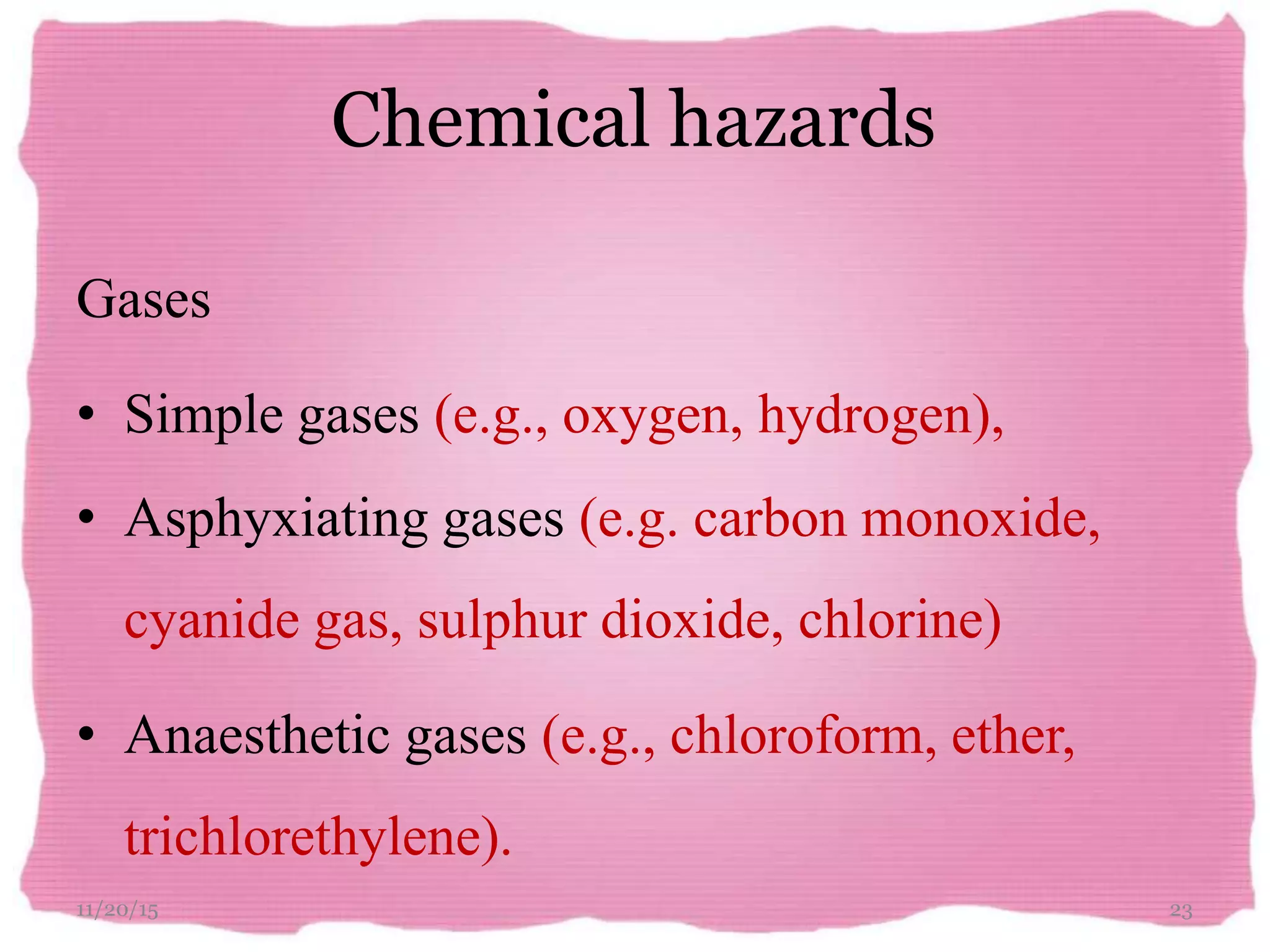
Gases
• Simple gases (e.g., oxygen, hydrogen),
• Asphyxiating gases (e.g. carbon monoxide,
cyanide gas, sulphur dioxide, chlorine)
• Anaesthetic gases (e.g., chloroform, ether,
trichlorethylene).
Chemical hazards
11/20/15 24
• Metals and their compounds
Lead, antimony, arsenic, beryllium, cadmium,
cobalt, manganese, mercury, phosphorus,
chromium, zinc and others
Chemical hazards
11/20/15 25
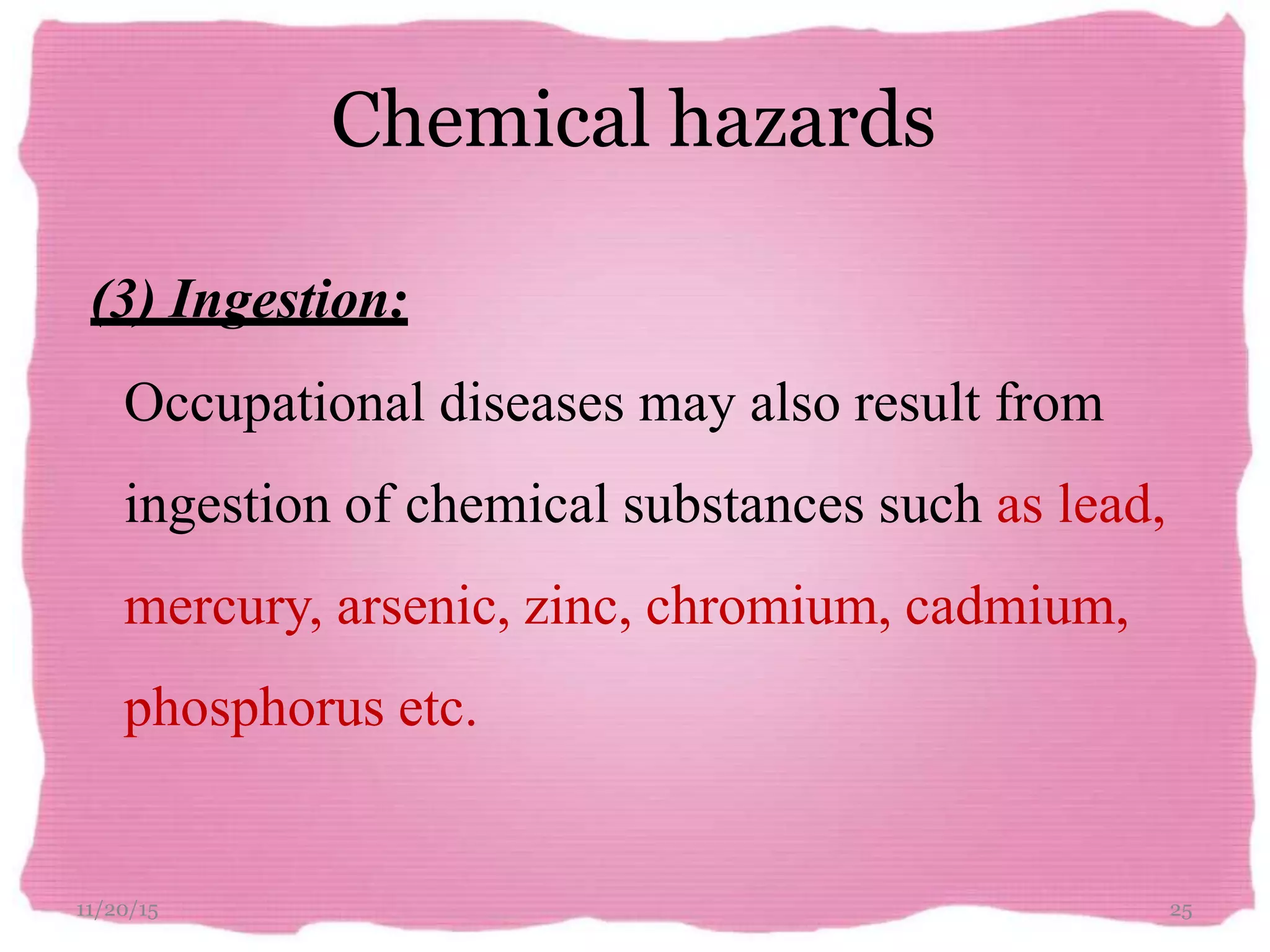
(3) Ingestion:
Occupational diseases may also result from
ingestion of chemical substances such as lead,
mercury, arsenic, zinc, chromium, cadmium,
phosphorus etc.
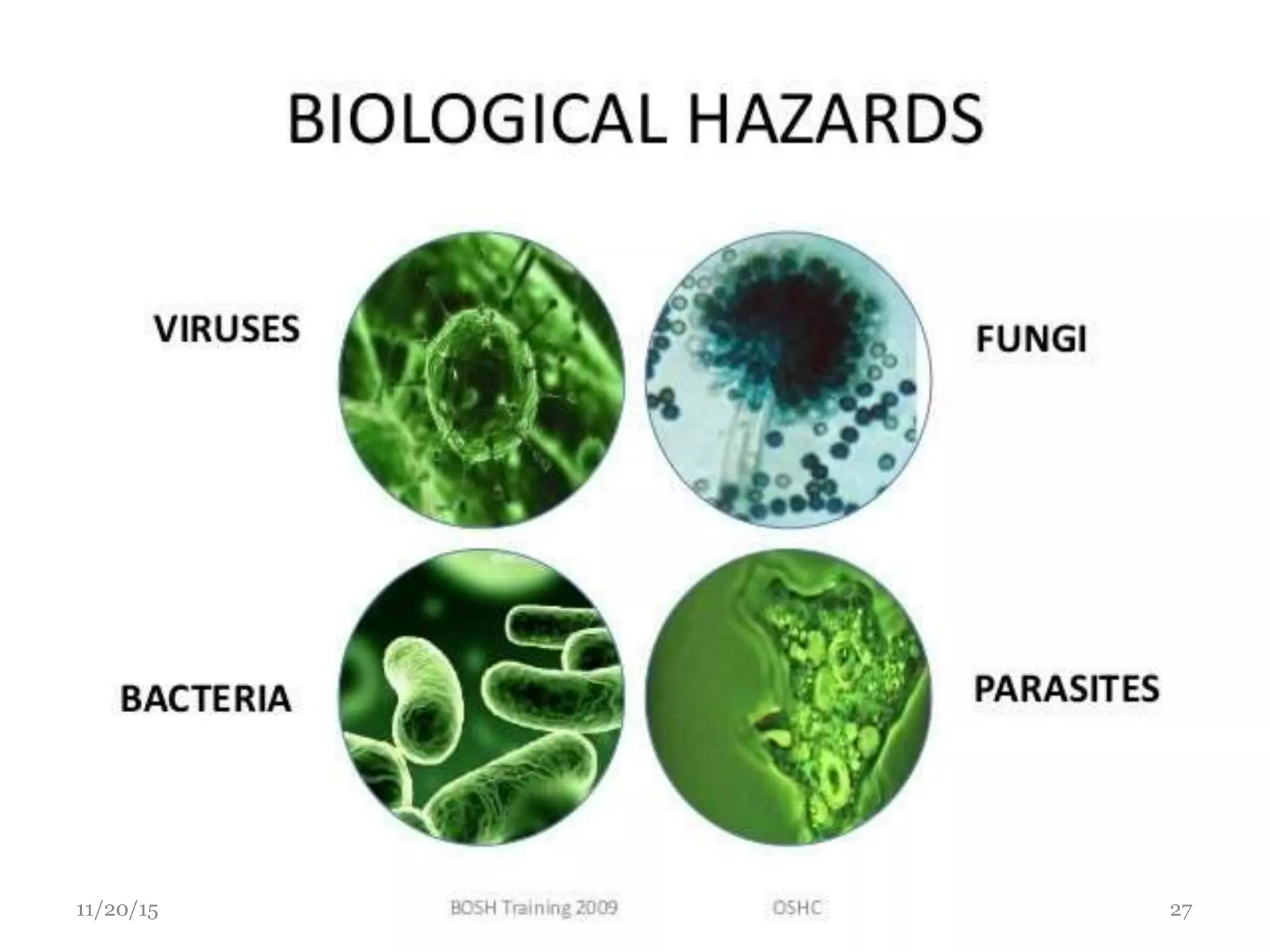
Biological hazards
• Brucellosis
• Leptospirosis
• Anthrax
• Hydatidosis
• Tetanus
• Encephalitis
• fungal infections
• Schistosomiasis
• host of others 25
11/20/15 27
Mechanical hazards
11/20/15 28
Psychosocial hazrds
Factors affect health
• Frustration
• Lack of job
satisfaction,
• Insecurity
• Poor human
relationships,
• Emotional tension
11/20/15 29
Psychosocial hazrds
The health effects can be classified in two
(a) Psychological and behavioural changes
(b) Psychosomatic ill health
11/20/15 30
OCCUPATIONAL DISEASES
DISEASE DUE TO
PHYSICAL AGENT
• Heat
• Cold
• Light
• Pressure
• Noise
• Radiation
• Mechanical factors
• Electricity
11/20/15 ARUN PIRAVOM 30
OCCUPATIONAL DISEASES
ARUN PIRAVOM 32 11/20/15
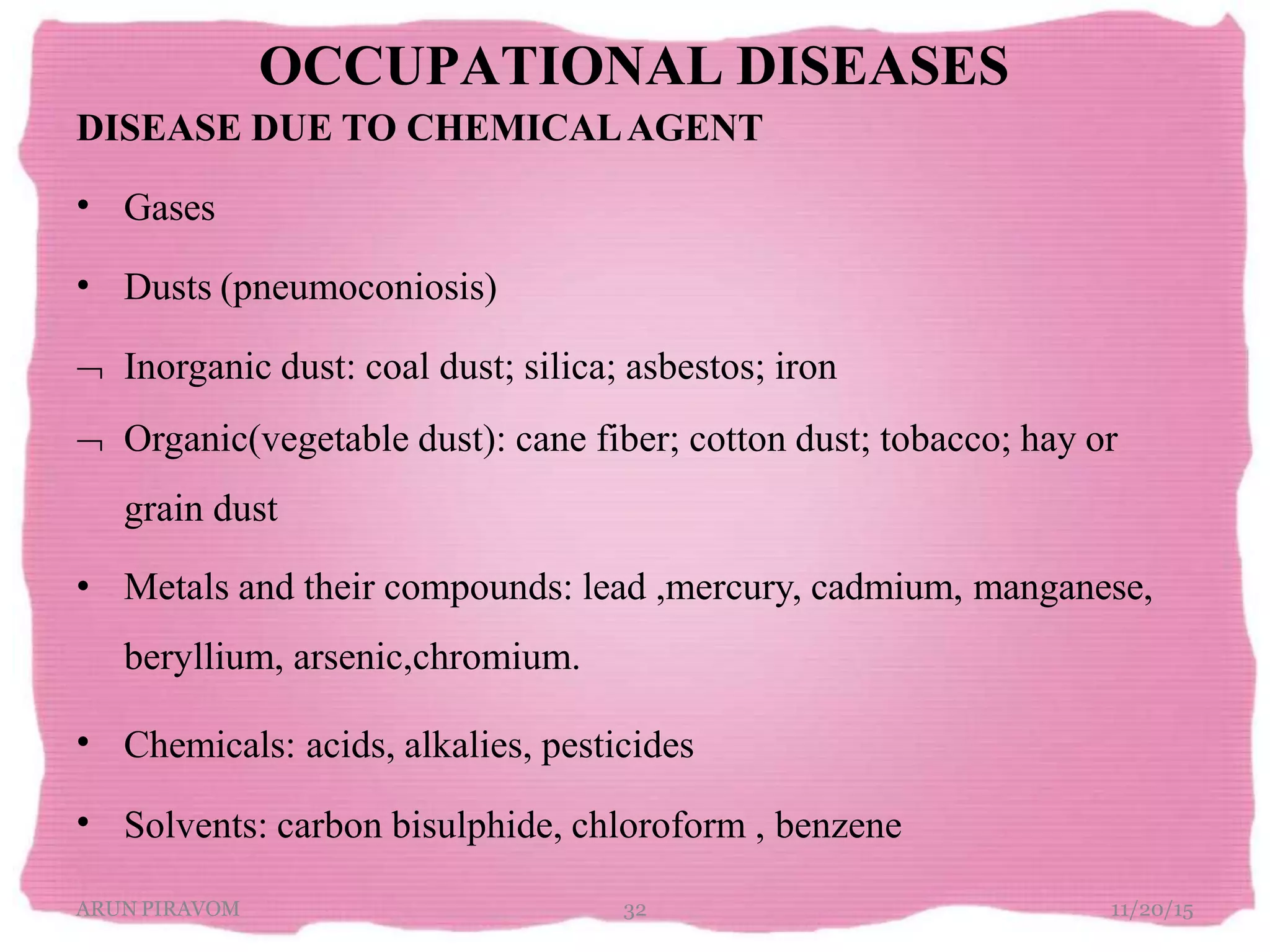
DISEASE DUE TO CHEMICALAGENT
Gases•
• Dusts (pneumoconiosis)
 Inorganic dust: coal dust; silica; asbestos; iron
 Organic(vegetable dust): cane fiber; cotton dust; tobacco; hay or
grain dust
•
•
• Metals and their compounds: lead ,mercury, cadmium, manganese,
beryllium, arsenic,chromium.
Chemicals: acids, alkalies, pesticides
Solvents: carbon bisulphide, chloroform , benzene
OCCUPATIONAL DISEASES
ARUN PIRAVOM 33 11/20/15
III. DISEASE DUE TO BIOLOGICALAGENT
• Brucellosis, leptospirosis, anthrax, tetanus, encephalities,
fungal infection.
IV. OCCUPATIONAL CANCER
• Cancer of the skin, lungs, bladder
V. OCCUPATIONAL DERMATOSIS
• Dermatitis, eczema
VI. DISEASE OF PSYCHOLOGICAL ORIGIN
• Industrial neurosis, hypertension, peptic ulcer.
PNEUMOCONIOSIS
ARUN PIRAVOM 34 11/20/15
• Dusts within the range of 0.5 micron to 3
micron is a health hazard producing, after a
variable period of exposure, a lung disease
known as pneumoconiosis, which may
gradually cripple a man by reducing his work
capacity due to lung fibrosis and other
complications.
PNEUMOCONIOSIS
ARUN PIRAVOM 35 11/20/15
• Silicosis
• Anthracosis
• Byssinosis
• Bagassosis
• Asbestosis
• Farmers lungs
Silicosis
• Major cause of morbidity
• First reported in 1947 in
kolar gold mines
• Caused by inhalation of dust
containing free silica or
silicon dioxide
11/20/15 36
Incubation period may be from few mths upto
6yrs
Chatageriseed by dense nodular fibrosis, 3-4 cm
dia nodules
SYMP:
irritant cough, exertional dyspnea, chest pain
Impaired TLC, Snow storm appearance in X ray
Advanced condition Silico TB
NO TREATMENT
Fibrotic changes cannot be reversed
Prevention:
1. Dust control by substitution, complete
enclosure, isolation, hydroblasting, protective
gears
2. Regular physical examination
Anthracosis
11/20/15 39
• It is caused by inhalation of dust containing
coal miners.
• First phase is called simple pneumoconiasis
which is associated with little impairment.
• Second phase is characterized by Progressive
massive fibrosis
Byssinosis
• Inhalation of cotton fibre dust over long periods
of time.
• 7-8% incidence
The symptoms are
• Chronic cough
• Progressive dyspnoea,
• Chronic bronchitis
1•1/20E/15mphysema. 37
Bagassosis
• Caused by inhalation of bagasse or sugar-cane
dust.
• Bagassosis has been shown to be due to a
thermophilic actinomycet for which the
name
The symptoms
• Breathlessness
• Cough
• haemoptysis
11•/20/s15light fever. 38
Bagassosis
Preventive measures
• Dust control
• Personal protection
• Medical control
• Bagasse control
11/20/15 39
Asbestosis
• Asbestos is of two types- serpentine or chrysolite
variety and amphibole type.
• Clinically the disease is characterized by dyspnoea.
• Clubbing of fingers,
• Cardiac distress and cyanosis.
• The sputum shows "asbestos bodies"
• An X-ray of the chest shows a ground-glass
11/20
a/1
p5
pearance in the lower two thirds of the lung 40
Asbestosis
PREVENTIVE MEASURES
• Use of safer types of asbestos (chrysolite and amosite)
• Substitution of other insulants: glass fibre, mineral wool,
calcium silicate, plastic foams, etc.
Rigorous dust control•
• Periodic examination of workers; biological monitoring
(clinical, X-ray, lung function), and
11•/20/C15 ontinuing research. 41
Asbestosis
• Ground glass
apperance in X
ray chest
11/20/15 45
Farmer's lung
11/20/15 46
Farmer's lung is due to the inhalation of
mouldy hay or grain dust.
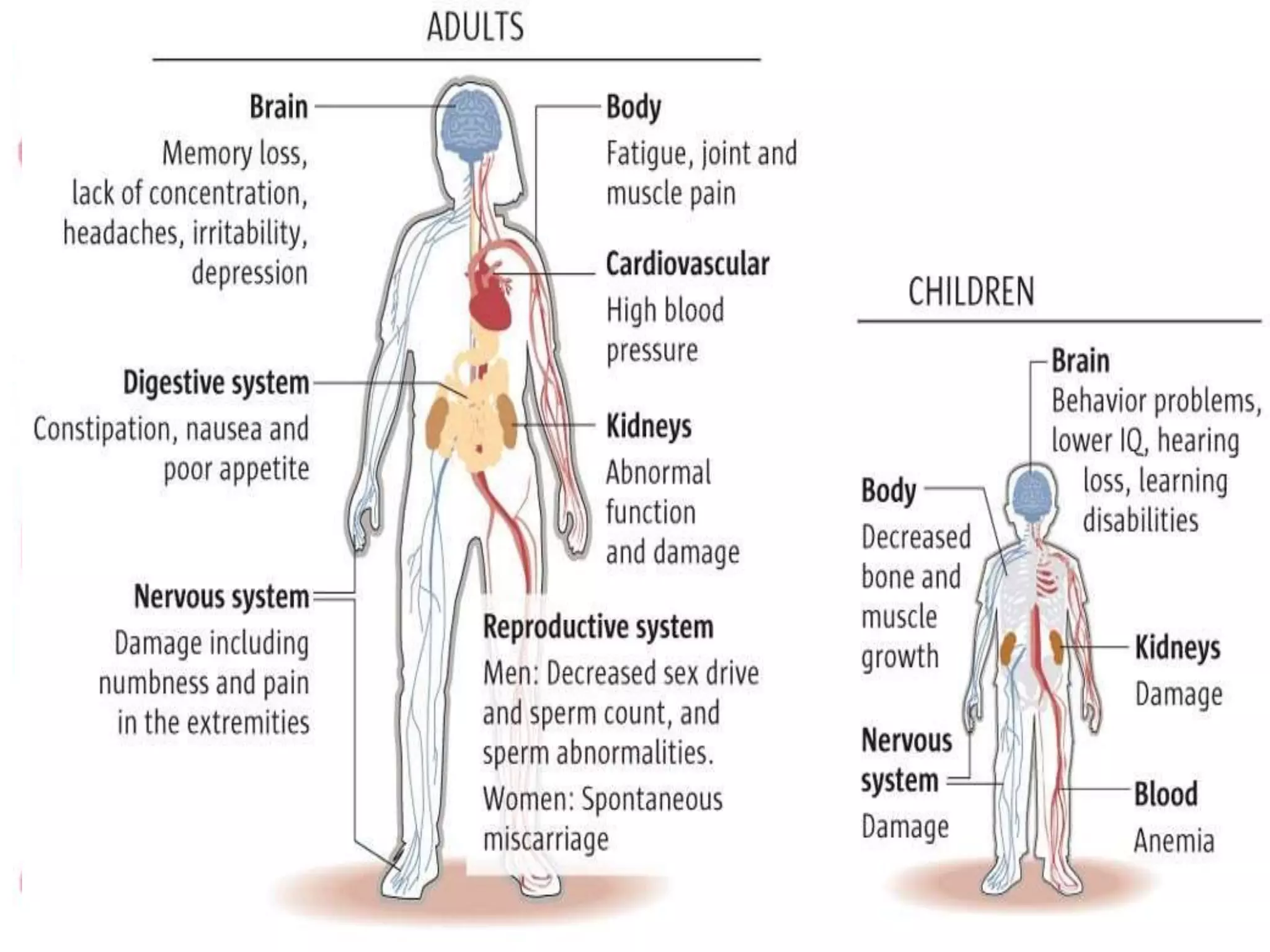
LEAD POISONING
MODE OFABSORPTION
(1) INHALATION.
(2) INGESTION.
(3) SKIN
11/20/15 47
LEAD POISONING
11/20/15 48
CLINICAL PICTURE
•
•
•
•
•
•
•
•
•
The toxic effects of inorganic exposure
abdominal colic
Constipation
loss of appetite
blue-line on the gums
stippling of red cells
Anaemia
wrist drop
foot drop.
LEAD POISONING
11/20/15 49
• The toxic effects of organic lead compounds
are mostly on the central nervous system
• Insomnia
• Headache
• Mental confusion
• Delirium.
11/20/15 47
LEAD POISONING
11/20/15 51
DIAGNOSIS
(1) HISTORY
(2) CLINICAL FEATURES
(3) LABORATORY TESTS:
• Coproporphyrin in urine (CPU) :
• Amino levulinic acid in urine (ALAU) :
Lead in blood and urine:•
• Basophilic stipling of RBC
LEAD POISONING
PREVENTIVE MEASURES
•
•
•
•
•
•
•
•
•
Substitution
Isolation
Local exhaust ventilation
Personal protection.
Good house-keeping
Working atmosphere:
Periodic examination of workers
Personal hygiene.
Health education :
11/20/15 52
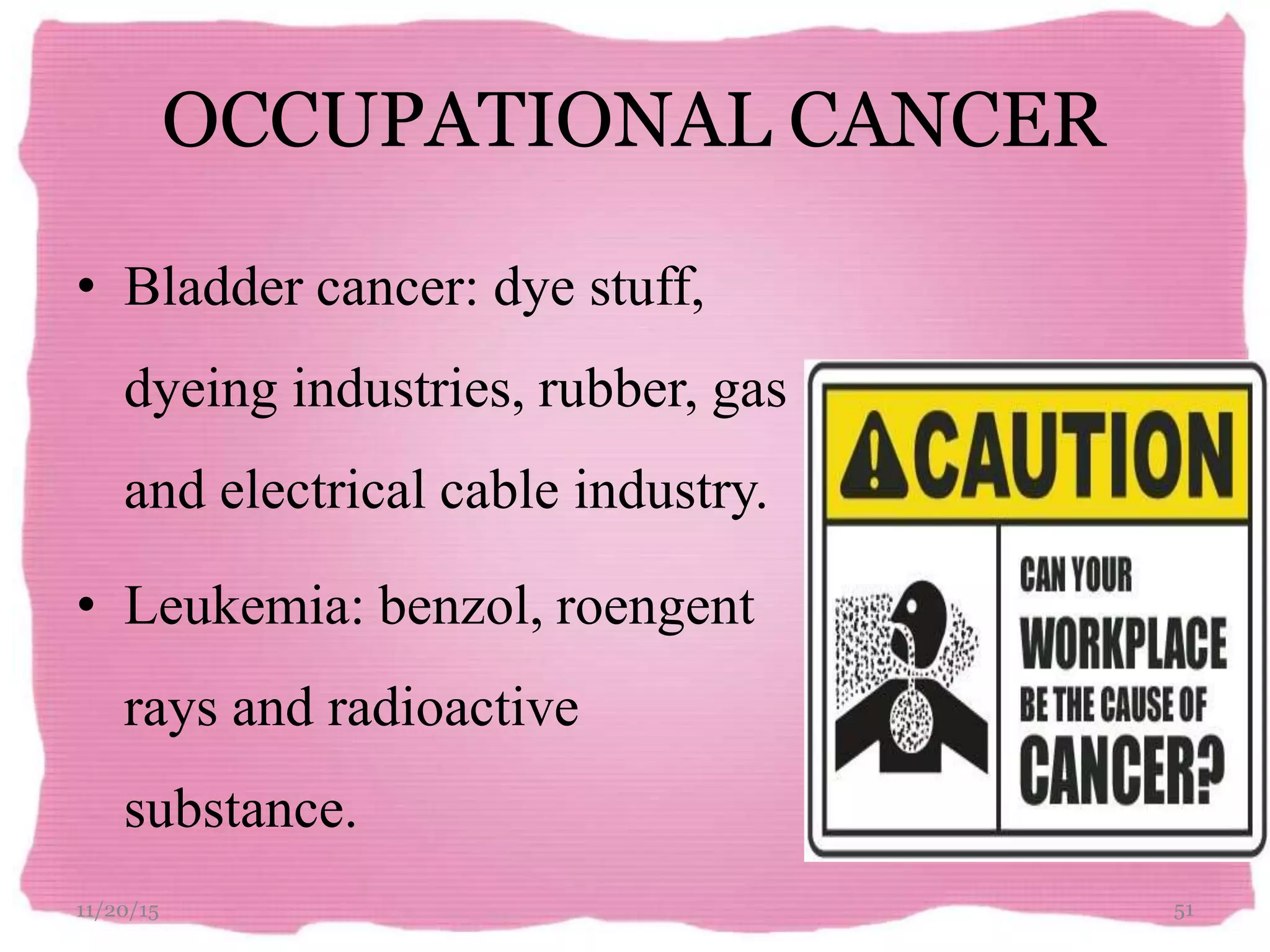
OCCUPATIONAL CANCER
• Skin cancer: gas workers, oil refiners, tar
distillers, oven workers.
• Lung cancer: gas industry, nickle and
chromium work, mining of radio active
substance
11/20/15ARUN PIRAVOM 50
OCCUPATIONAL CANCER
• Bladder cancer: dye stuff,
dyeing industries, rubber, gas
and electrical cable industry.
• Leukemia: benzol, roengent
rays and radioactive
substance.
11/20/15 51
OCCUPATIONAL CANCER
The control measures
•
•
•
•
•
•
• Elimination or control of industrial carcinogens.
Medical examinations
Inspection of factories,
Notification,
Licensing of establishments,
Personal hygiene measures,
Education of workers and management, research.
52
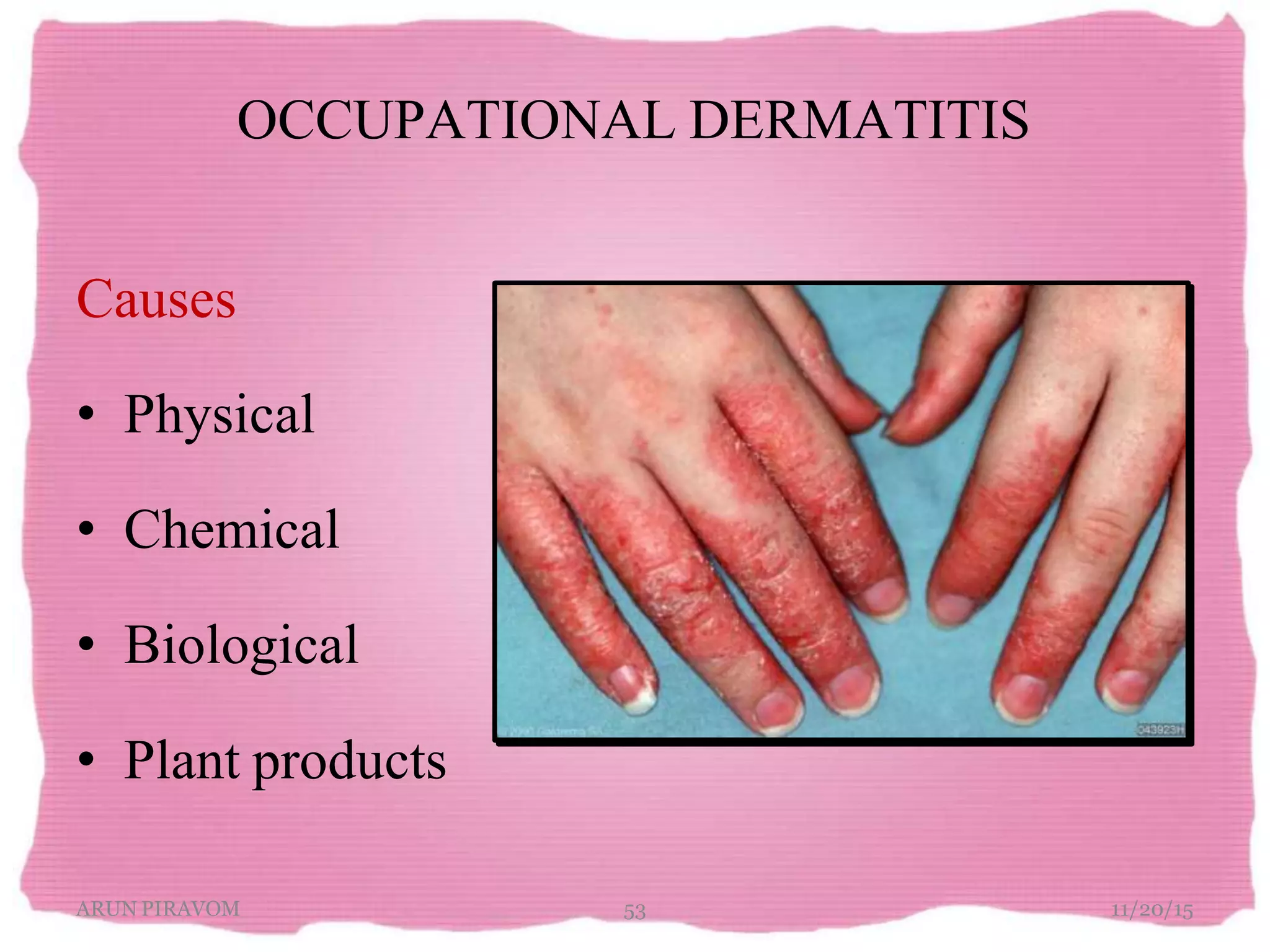
OCCUPATIONAL DERMATITIS
Causes
• Physical
• Chemical
• Biological
• Plant products
11/20/15ARUN PIRAVOM 53
OCCUPATIONAL DERMATITIS
PREVENTION
(1) Pre-selection
(2) Protection
(3) Personal hygiene
(4) Periodic inspection
11/20/15 54
RADIATION HAZARDS
11/20/15
• Shielding of workers
• Monitoring the employees
• Protective clothing
• Adequate ventilation
• Replacement and periodic examination
• Avoidance of pregnant women to work
ARUN PIRAVOM 55
Sickness Absenteeism
11/20/15 59
Causes
• Economic
• Social
• Medical
• Non occupational causes
Sickness Absenteeism
11/20/15 60
Prevention
• Good factory managementand practices
• Adequate preplacement examination
• Good human relations
• Application of ergonomics
Accidents
Causes
a. Human factors
• Physical
• Physiological (age, Sex, time, experience,
working hrs)
• Psychological
• Environmental factors11/20/15 61
Accidents
Prevention
• Adequate preplacement examination
Adequate job training
Continuing education
•
•
• Ensure safe working conditions
• Establishing safety department in the organization under a
competent safety engineer.
• Periodic surveys for finding out hazards
•
11/2
C
0/1
a
5
reful reporting
59
HEALTH PROBLEM DUE TO
INDUSTRIALIZATION
• Environmental sanitation problems
• Communicable disease
• Food sanitation
• Mental health
• Accidents and social problems
• Morbidity and mortalityARUN PIRAVOM 63 11/20/15
MEASURES FOR HEALTH
PROMOTION OF WORKERS
• Nutrition
• Communicable disease control
• Environmental sanitation
• Mental health
• Measures for women and children
• Health education
• Family planning
ARUN PIRAVOM 64 11/20/15
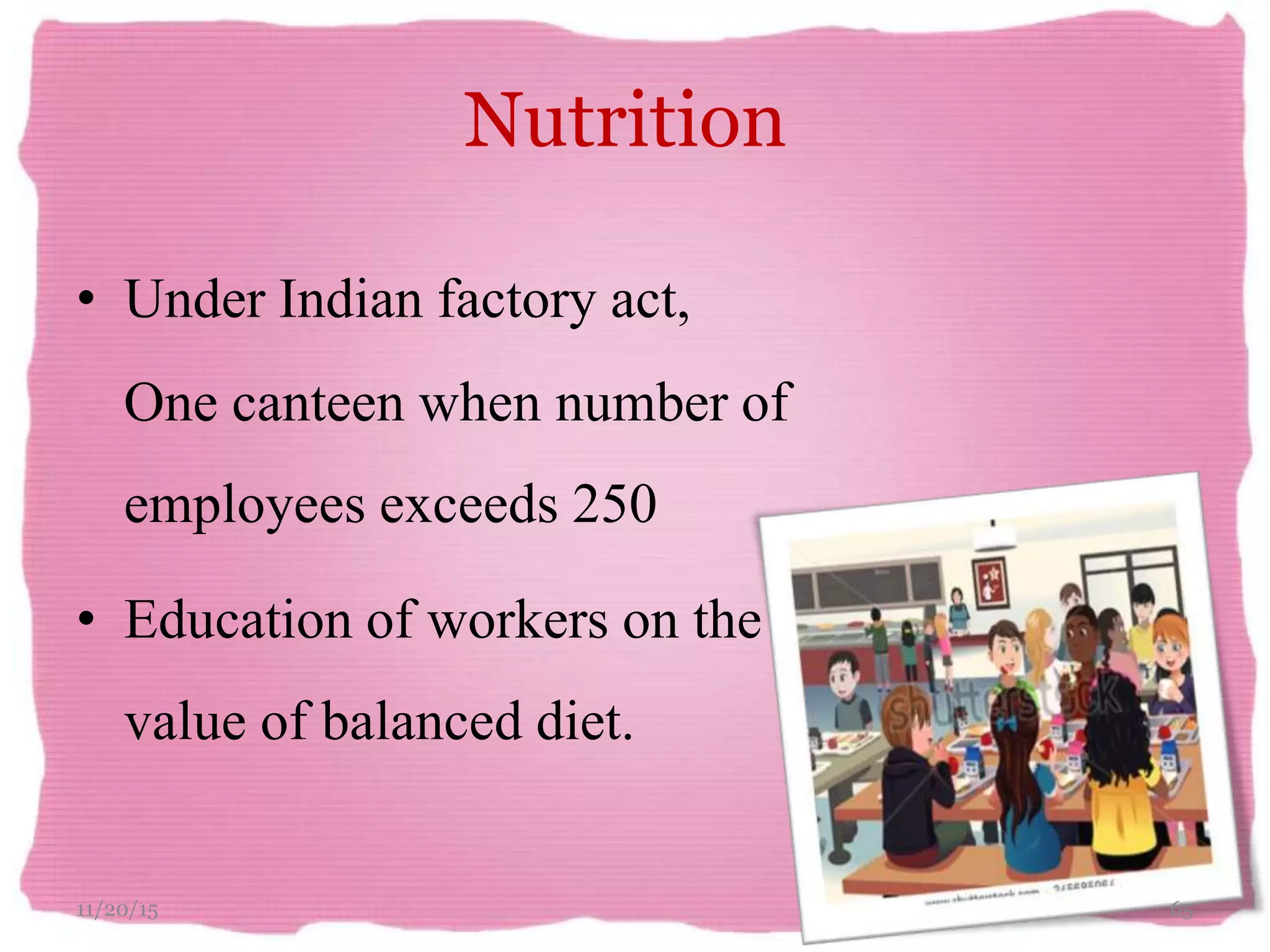
Nutrition
• Under Indian factory act,
One canteen when number of
employees exceeds 250
• Education of workers on the
value of balanced diet.
11/20/15 65
Communicable disease control
• Adequate
immunization against
communicable
diseases
11/20/15 66
Environmental sanitation
• Water supply
Installation of drinking water fountains
• Food
Sanitary preparation, storage and
handling of food
Education of food handlers
11/20/15 67
Environmental sanitation
11/20/15 68
• Toilet
One sanitary convenience for
25 employees for the first 100
employees and thereafter one
for 50
• General plant cleanliness
Environmental sanitation
11/20/15 69
• Sufficient space
The recommended standard is of minimum of 500cuft
• Lighting
Standards for illumination
High precision work 50-75 foot candles
Regular work- 6 to 12 foot candles
Corridoors and passages- 0.5 foot candles
Environmental sanitation
11/20/15 70
• Ventilation, temperature
• Protection against hazards
• Housing
Mental health
• To promote the health and happiness of the
workers.
• To detect signs of emotional stress and strain
and to secure relief of stress and strain where
possible
• The treatment of employees suffering from
mental illness and the rehabilitation of those
11/20w/15 ho become ill. 68
MEASURES FOR WOMEN AND
CHILDREN
(1)Expectant mothers are given maternity leave for 12
weeks,
(2) Provision of free antenatal, natal and postnatal services.
(3)The Factories Act (Section 66) prohibits night work
between 7 p.m. and 6 a.m.;
(4)The Indian Mines Act (1923) prohibits work
underground.
(5) The Factories Act, 1976 provides for creches in factories
11/2w0/1h5 ere more than 30 women workers are employed, 69
Health education
11/20/15 73
Family planning
11/20/15 74
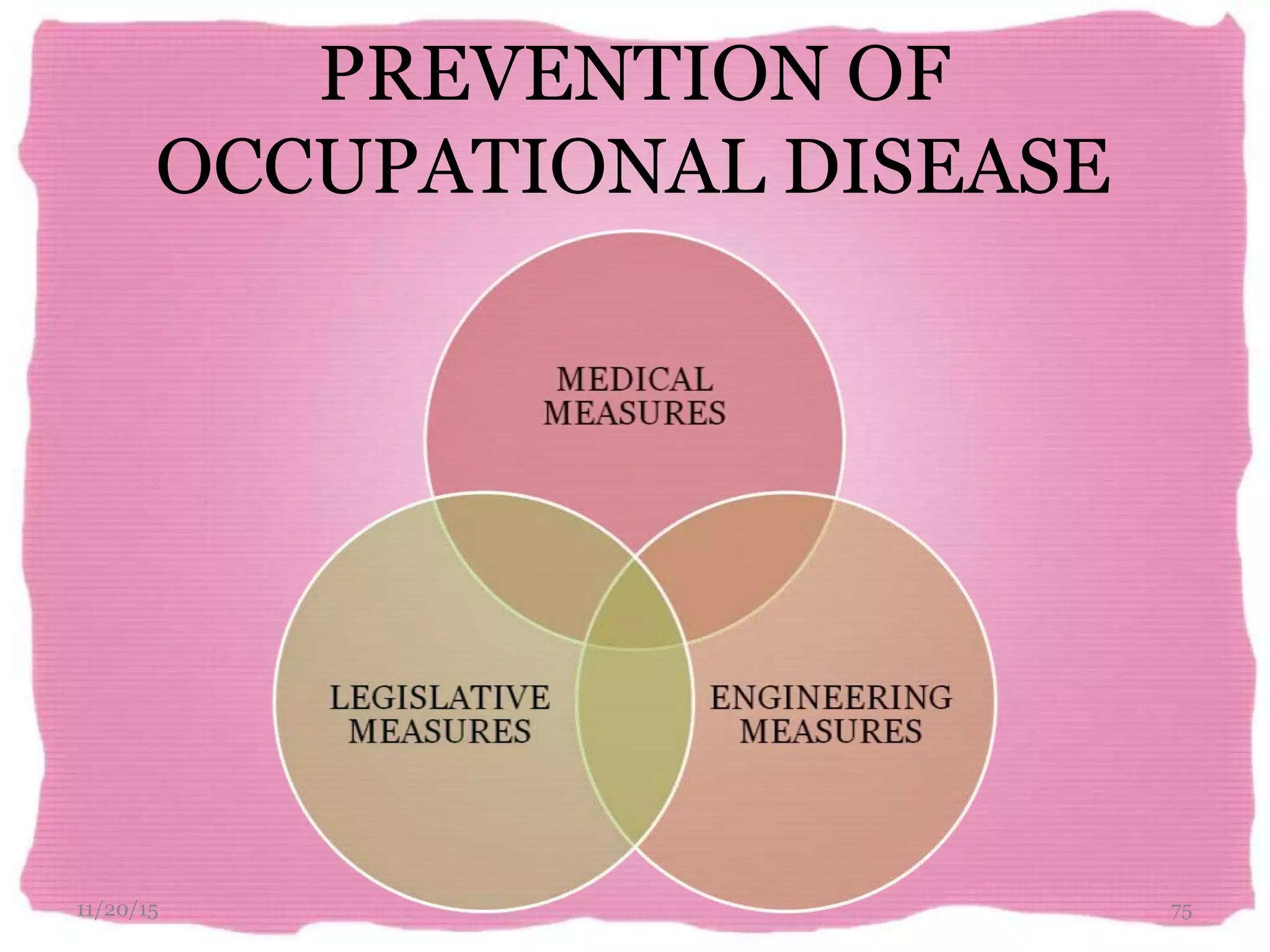
PREVENTION OF
OCCUPATIONAL DISEASE
11/20/15 75
PREVENTION OF OCCUPATIONAL DISEASE
MEDICAL MEASURES
Pre-placement examination
Periodical examination
Medical and health care services
Notification
Supervision of working environment
Maintenance and analysis of records
Health education and counselingARUN PIRAVOM 76 11/20/15
PREVENTION OF OCCUPATIONAL DISEASE
• ENGINEERING MEASURES
Design of building
Good housekeeping
General ventilation
Mechanization
Substitution
ARUN PIRAVOM 77 11/20/15
PREVENTION OF OCCUPATIONAL DISEASE
ENGINEERING MEASURES
Dust-enclosure and isolation
Local exhaust ventilation
Protection device
Environmental monitoring
Statistical monitoring and research
11/20/15 75
PREVENTION OF OCCUPATIONAL
DISEASE
• LEGISLATION
The FactoryAct-1948
The Employees state
insurance act-1948
11/20/15ARUN PIRAVOM 76
FACTORIES ACT,1948
11/20/15 80
1. Scope
For purposes of the act, a factory means an establishment,
•
•
In which 10 or more workers have been employed during
the preceding 12 months in a manufacturing process,
operated on power Or
In which 20 or more workers have been employed during
the preceding 12 months in manufacturing process
without power.
FACTORIES ACT,1948
Appointment and employment
• Inspector of factories
• Medical practitioners
11/20/15 81
FACTORIES ACT,1948
2. Health, safety and Welfare.
(Chapter iii, iv, ivA, v)
Provisions for Industrial workers
• Employment provisions
• Welfare provisions
• Safety provisions
• Sanitary provisions
11/20/15 82
3. Employment of young persons
•Children below 14 are prohibited
•b/w 15- 18 adolscent- “certificate of fittness”
by the doctors/ surgeon (6am- 7pm)
•Restriction of women & children in dangerous
job
4. Hours of work
Max 48 hrs/ week
Not exceeding 9 hrs/day
½ hrs rest after 5 hrs of work
Adolescent 4n half – 5 hrs/day
1978 ammendment
Max 60 hrs a week
5. Leave with wages
Weekly holiday
Adult- 1 day- 20days of work
Adolescent- day- days of work
6. Occupational diseases
Information regarding accident, death ,injury
7. Employment and hazardeous process
Information regarding accident, deatg injury
ESI ACT
Employees’ State Insurance Act 1948
•Passed in 1949
•Amended in 1975, 84, 89
•Provides benefit in cash and kind to workers in
sickness, maternity, employment injury, thereby
removing economic and physical fear
Scope
•All India
•All employee (manual, clerical, supervisory)
with 7500/mth salary
•Factory, restaurant, cinema, shops
•State govt takes responsibility to intervene
•1-2.5% of salary is premium
Administration
Governed by autonomous body “ESI Corporation”
Following members
•Chairman, Vice Chairman,
•5 repres. Of Central Govt
•1 from each state govt
•1 from UT
•5 reprs from employee
• 5 “ “ employer
• 2 “ “ medical profession
• 3 MPs
ESI Act- Administration
Chief executive officer- Director general
Assisted by four principal officers
• Insurance commissiners
• Medical commissioners
• Finance commissioners
• Acturay11/20/15 83
Finance
Regional, sub regional, local offices
•Contribution by employees: 1.75% of wage
•Contribution by employers:4.75% of wage of
worker
•State govt: 1/8 total cost of medical expenditure
•ESI Corporation: 7/8 total cost of medical
expenditure
•Govt of India: 2/3 of administrative expenditure
Benefits
1. Sickness benefit
2. Maternity
3. Disablement
4. Dependent
5. Funeral
6. Medical
7. Rehabilitation
First 5 in case, 6th in kind
Only for employee with 7500/mth salary
THE EMPLOYEE STATE INSURANCE ACT,1948
11/20/15 93
Sickness benefit
• The benefit is payable for a maximum period of
91 days, in any continuous period of 365 days, the
daily rate being about 70% of the average daily
wages
• 34 diseases for which Extended Sickness Benefit
where the insured person has been in continuous
employment for 2 years:
THE EMPLOYEE STATE INSURANCE
ACT,1948
Maternity benefit (full wage)
• For confinement, the duration of benefit is 26
weeks,
• for miscarriage and premature birth 6 weeks and
• for sickness arising out of confinement etc. 30
days.
11/20/15 94
THE EMPLOYEE STATE INSURANCE
ACT,1948
11/20/15 95
Disablement benefit
• The rate of temporary disablement benefit is about
90% of the wages as long as the temporary
disablement lasts.
• In case of total permanent disablement, the insured
person is given 90% life pension on the basis of
loss of earning capacity determined by a medical
board
THE EMPLOYEE STATE INSURANCE ACT,1948
11/20/15 96
Dependent’s benefit
• DB paid at the rate of 90% of wage in the form of
monthly payment to the dependants of a deceased
Insured person in cases where death occurs due to
employment injury or occupational hazards.
Funeral expenses
•The amount not exceeding Rs. 15000.
Rehabilitation
• On monthly payment of Rs 10
THE EMPLOYEE STATE INSURANCE
ACT,1948
Medical benefit•
• The services comprises
(1) out-patient care
(2) supply of drugs and dressings
(3) specialist services in all branches of medicine
(4) pathological and radiological investigations
(5) domiciliary services
11(/620)/15antenatal, natal and postnatal services 85
THE EMPLOYEE STATE INSURANCE ACT,1948
• Medical benefit
(7) immunization services
(8) family planning services
(9) emergency services
(10) ambulance services
(11) health education and
(12) in-patient treatment.
11/20/15 98
Offensive trade:
•Offensive trades are premises that are used for
the production and/or processing of foods that
may cause some kind of offence, generally in
terms of odour, environmental pollution and in
general posing public health risk
Covers a range of potential public health risks
including:
physical risk e.g. noise, mechanical hazards,
radiation and vibration
chemical risk from either naturally occurring
or synthetic substances or
biological risk e.g. viruses, bacteria and
vermin.
Permit requirement
No person may conduct an offensive trade in or on any premises, except in terms of a permit
authorizing.
Requirements for premises
No person may conduct an offensive trade in or on any premises unless
A. The floors of the premises are constructed of cement concrete or a similar impervious material,
brought to a smooth finish
B. The floors of the premises are adequately graded and drained for the disposal of effluent to an
approved disposal system;
C. The inside walls, except where glazed or glass brick or glazed tiles are used, are plastered,
brought to a smooth finish and painted with a light-coloured, washable paint
D. The surface of any backyard or open space is paved with concrete or similar impervious
material, brought to a smooth finish;
E. The premises are provided with adequate light and ventilation as prescribed
F. An adequate supply of running potable water is provided.
G. An adequate number of portable containers constructed of iron or another nonabsorbent
material, equipped with closely fitting lids, are provided for the removal of all waste and waste
water from the premises;
H. Adequate means are provided for the disposal of all effluent arising from the manufacturing or
other process performed on the premises
I. Adequate accommodation is provided for the storage of all finished products, articles or
materials which are used in the manufacturing or other process and which may Discharge
offensive or injurious effluent or liquid; or Decompose in the course of the work or trade
J. Adequate means are provided to control the discharge in the open air of any noxious,
injurious or offensive gas, fume, vapour or dust produced during any handling, preparation, drying, melting,
rendering, boiling or grinding process or storage of material:
K. Adequate sanitary fixtures are provided as prescribed in the National Building.
Regulations and Building Standards Act
1. A perimeter wall made of brick or some other impervious material, with a minimum height of 2 meters, is
constructed around the premises;
2. All gates to the premises are of solid construction with a minimum height of 2 meters;
3. All perimeter walls and gates adequately screen activities on the premises from public view
4. All materials are stacked or stored on the premises below the height of the perimeter
screening
5. Adequate separate change-rooms for males and females,where five or more persons
of the same sex are employed, must be provided containing -
a. An adequate metal locker for every employee;
b. A wash-hand basin provided with a supply of persons hot and cold potable water,
c. An adequate supply of soap and disposable towels at every wash-hand basin;
6. If no change-room has been provided in terms of paragraph (p) -
i A wash hand basin with a supply of running hot and cold potable water, must be provided in an accessible
position; and
ii. adequate metal locker must be provided for every employee in the work area.
Duties of offensive traders
Every offensive trader must -
A. Maintain the premises in a clean, hygienic and good condition at all times;
B. Maintain all walls and floors of the premises in a manner and condition that prevents
the absorption of any waste or waste water; C. Maintain all machinery, plant, apparatus, furniture, fittings,
tools, implements,
vessels,
containers, receptacles and vehicles in a clean, hygienic and good condition at all times:
D. Prevent any waste accumulating on the premises; and E. Prevent the emission of noxious, injurious or
offensive gases, fumes, vapours or dust generated during any handling, preparation, drying, melting,
rendering, boiling or
Thank You
11/20/15 102

Occupational health

  • 1.
  • 2.
    Definition 3 • "Occupational healthshould aim at the promotion and maintenance of the highest degree of physical, mental and social well-being of workers in all occupations; • The prevention of health • The protection of workers in their employment
  • 3.
    Objectives • The maintenanceand promotion of workers’ health and working capacity • • The improvement of working environment and work to become conducive to safety and health Development of work organizations and working which promotes a positive social climate and smooth operation and may enhance productivity of the undertakings. —Joint ILO/WHO Committee on Occupational Health 11/20/15 5
  • 4.
    Level of preventivemeasures •Health promotion •Specific protection •Early diagnosis and treatment •Disability limitation •Rehabilitation
  • 5.
    Ergonomics Ergon- greek word-means work Nomos- means law Fiting the job to the worker Training involves: Machine designing Tools Equipments Layout of work place Method of work environment
  • 6.
    Occupational Environment 3 typeof interaction Man and P C B Man and machine Man & man
  • 7.
  • 8.
    Physical hazards 11/20/15 8 •Heat and cold • Light • Noise • Vibration • Ultraviolet radiation • Ionizing radiation
  • 9.
    • Burns • Heatexhaustion • Heat stroke • Heat cramps 11/20/15 9 • Decreased efficiency, • Increased fatigue • Enhanced accident rates. Heat Direct effects Indirect effects
  • 10.
    Cold • Chilblains • Erythrocyanosis •Immersion foot • Frostbite as a result of cutaneous vasoconstriction. •11 G/20/ e15 neral hypothermia 9
  • 11.
    Light The acute effectsof poor illumination are • Eye strain, • Headache, • Eye pain, • Lacrymation, • Congestion around the cornea • Eye fatigue. • The chronic effects on health include "miner's nystagmus" 11/20/15 10
  • 12.
    Noise (i) Auditory effects Temporary or permanent hearing loss (ii) Non auditory effects  Nervousness,  Fatigue,  Interference with communication by speech,  Decreased efficiency  Annoyance 11
  • 13.
    Vibration • Exposure tovibration may also produce injuries of the joints of the hands elbows and shoulders. 12
  • 14.
    Ultraviolet radiation • Conjunctivitis •Keratitis (welder's flash). 11/20/15 14
  • 15.
    Ionizing radiation 11/20/15 15 Theradiation hazards comprise • Genetic changes • Malformation • Cancer • Leukaemia • Depilation • Ulceration • Sterility • in extreme cases death.
  • 16.
    Ionizing radiation 11/20/15 16 TheInternational Commission of Radiological Protection has set the maximum permissible level of occupational exposure at 5 rem per year to the whole body.
  • 17.
  • 18.
    Chemical hazards 11/20/15 18 1)LocalAction : Dermatitis Eczema Ulcers Cancer by primary irritant action
  • 19.
    Chemical hazards (2) Inhalation: • Dusts • Gases • Metals and their compounds 11/20/15 19
  • 20.
    Chemical hazards 11/20/15 20 •Dusts Dusts are finely divided solid particles with size ranging from 0.1 to 150 microns Dust particles larger than 10 microns settle down from the air rapidly, IndefinitelyParticles smaller than 5 microns are directly inhaled into the lungs and are retained there and is mainly responsible for pneumoconiosis.
  • 21.
  • 22.
    Chemical hazards 11/20/15 22 Classificationof dusts • Inorganic and organic dusts; • Soluble and insoluble dusts.
  • 23.
    Chemical hazards 11/20/15 23 Gases •Simple gases (e.g., oxygen, hydrogen), • Asphyxiating gases (e.g. carbon monoxide, cyanide gas, sulphur dioxide, chlorine) • Anaesthetic gases (e.g., chloroform, ether, trichlorethylene).
  • 24.
    Chemical hazards 11/20/15 24 •Metals and their compounds Lead, antimony, arsenic, beryllium, cadmium, cobalt, manganese, mercury, phosphorus, chromium, zinc and others
  • 25.
    Chemical hazards 11/20/15 25 (3)Ingestion: Occupational diseases may also result from ingestion of chemical substances such as lead, mercury, arsenic, zinc, chromium, cadmium, phosphorus etc.
  • 26.
    Biological hazards • Brucellosis •Leptospirosis • Anthrax • Hydatidosis • Tetanus • Encephalitis • fungal infections • Schistosomiasis • host of others 25
  • 27.
  • 28.
  • 29.
    Psychosocial hazrds Factors affecthealth • Frustration • Lack of job satisfaction, • Insecurity • Poor human relationships, • Emotional tension 11/20/15 29
  • 30.
    Psychosocial hazrds The healtheffects can be classified in two (a) Psychological and behavioural changes (b) Psychosomatic ill health 11/20/15 30
  • 31.
    OCCUPATIONAL DISEASES DISEASE DUETO PHYSICAL AGENT • Heat • Cold • Light • Pressure • Noise • Radiation • Mechanical factors • Electricity 11/20/15 ARUN PIRAVOM 30
  • 32.
    OCCUPATIONAL DISEASES ARUN PIRAVOM32 11/20/15 DISEASE DUE TO CHEMICALAGENT Gases• • Dusts (pneumoconiosis)  Inorganic dust: coal dust; silica; asbestos; iron  Organic(vegetable dust): cane fiber; cotton dust; tobacco; hay or grain dust • • • Metals and their compounds: lead ,mercury, cadmium, manganese, beryllium, arsenic,chromium. Chemicals: acids, alkalies, pesticides Solvents: carbon bisulphide, chloroform , benzene
  • 33.
    OCCUPATIONAL DISEASES ARUN PIRAVOM33 11/20/15 III. DISEASE DUE TO BIOLOGICALAGENT • Brucellosis, leptospirosis, anthrax, tetanus, encephalities, fungal infection. IV. OCCUPATIONAL CANCER • Cancer of the skin, lungs, bladder V. OCCUPATIONAL DERMATOSIS • Dermatitis, eczema VI. DISEASE OF PSYCHOLOGICAL ORIGIN • Industrial neurosis, hypertension, peptic ulcer.
  • 34.
    PNEUMOCONIOSIS ARUN PIRAVOM 3411/20/15 • Dusts within the range of 0.5 micron to 3 micron is a health hazard producing, after a variable period of exposure, a lung disease known as pneumoconiosis, which may gradually cripple a man by reducing his work capacity due to lung fibrosis and other complications.
  • 35.
    PNEUMOCONIOSIS ARUN PIRAVOM 3511/20/15 • Silicosis • Anthracosis • Byssinosis • Bagassosis • Asbestosis • Farmers lungs
  • 36.
    Silicosis • Major causeof morbidity • First reported in 1947 in kolar gold mines • Caused by inhalation of dust containing free silica or silicon dioxide 11/20/15 36
  • 37.
    Incubation period maybe from few mths upto 6yrs Chatageriseed by dense nodular fibrosis, 3-4 cm dia nodules SYMP: irritant cough, exertional dyspnea, chest pain Impaired TLC, Snow storm appearance in X ray Advanced condition Silico TB
  • 38.
    NO TREATMENT Fibrotic changescannot be reversed Prevention: 1. Dust control by substitution, complete enclosure, isolation, hydroblasting, protective gears 2. Regular physical examination
  • 39.
    Anthracosis 11/20/15 39 • Itis caused by inhalation of dust containing coal miners. • First phase is called simple pneumoconiasis which is associated with little impairment. • Second phase is characterized by Progressive massive fibrosis
  • 40.
    Byssinosis • Inhalation ofcotton fibre dust over long periods of time. • 7-8% incidence The symptoms are • Chronic cough • Progressive dyspnoea, • Chronic bronchitis 1•1/20E/15mphysema. 37
  • 41.
    Bagassosis • Caused byinhalation of bagasse or sugar-cane dust. • Bagassosis has been shown to be due to a thermophilic actinomycet for which the name The symptoms • Breathlessness • Cough • haemoptysis 11•/20/s15light fever. 38
  • 42.
    Bagassosis Preventive measures • Dustcontrol • Personal protection • Medical control • Bagasse control 11/20/15 39
  • 43.
    Asbestosis • Asbestos isof two types- serpentine or chrysolite variety and amphibole type. • Clinically the disease is characterized by dyspnoea. • Clubbing of fingers, • Cardiac distress and cyanosis. • The sputum shows "asbestos bodies" • An X-ray of the chest shows a ground-glass 11/20 a/1 p5 pearance in the lower two thirds of the lung 40
  • 44.
    Asbestosis PREVENTIVE MEASURES • Useof safer types of asbestos (chrysolite and amosite) • Substitution of other insulants: glass fibre, mineral wool, calcium silicate, plastic foams, etc. Rigorous dust control• • Periodic examination of workers; biological monitoring (clinical, X-ray, lung function), and 11•/20/C15 ontinuing research. 41
  • 45.
    Asbestosis • Ground glass apperancein X ray chest 11/20/15 45
  • 46.
    Farmer's lung 11/20/15 46 Farmer'slung is due to the inhalation of mouldy hay or grain dust.
  • 47.
    LEAD POISONING MODE OFABSORPTION (1)INHALATION. (2) INGESTION. (3) SKIN 11/20/15 47
  • 48.
    LEAD POISONING 11/20/15 48 CLINICALPICTURE • • • • • • • • • The toxic effects of inorganic exposure abdominal colic Constipation loss of appetite blue-line on the gums stippling of red cells Anaemia wrist drop foot drop.
  • 49.
    LEAD POISONING 11/20/15 49 •The toxic effects of organic lead compounds are mostly on the central nervous system • Insomnia • Headache • Mental confusion • Delirium.
  • 50.
  • 51.
    LEAD POISONING 11/20/15 51 DIAGNOSIS (1)HISTORY (2) CLINICAL FEATURES (3) LABORATORY TESTS: • Coproporphyrin in urine (CPU) : • Amino levulinic acid in urine (ALAU) : Lead in blood and urine:• • Basophilic stipling of RBC
  • 52.
    LEAD POISONING PREVENTIVE MEASURES • • • • • • • • • Substitution Isolation Localexhaust ventilation Personal protection. Good house-keeping Working atmosphere: Periodic examination of workers Personal hygiene. Health education : 11/20/15 52
  • 53.
    OCCUPATIONAL CANCER • Skincancer: gas workers, oil refiners, tar distillers, oven workers. • Lung cancer: gas industry, nickle and chromium work, mining of radio active substance 11/20/15ARUN PIRAVOM 50
  • 54.
    OCCUPATIONAL CANCER • Bladdercancer: dye stuff, dyeing industries, rubber, gas and electrical cable industry. • Leukemia: benzol, roengent rays and radioactive substance. 11/20/15 51
  • 55.
    OCCUPATIONAL CANCER The controlmeasures • • • • • • • Elimination or control of industrial carcinogens. Medical examinations Inspection of factories, Notification, Licensing of establishments, Personal hygiene measures, Education of workers and management, research. 52
  • 56.
    OCCUPATIONAL DERMATITIS Causes • Physical •Chemical • Biological • Plant products 11/20/15ARUN PIRAVOM 53
  • 57.
    OCCUPATIONAL DERMATITIS PREVENTION (1) Pre-selection (2)Protection (3) Personal hygiene (4) Periodic inspection 11/20/15 54
  • 58.
    RADIATION HAZARDS 11/20/15 • Shieldingof workers • Monitoring the employees • Protective clothing • Adequate ventilation • Replacement and periodic examination • Avoidance of pregnant women to work ARUN PIRAVOM 55
  • 59.
    Sickness Absenteeism 11/20/15 59 Causes •Economic • Social • Medical • Non occupational causes
  • 60.
    Sickness Absenteeism 11/20/15 60 Prevention •Good factory managementand practices • Adequate preplacement examination • Good human relations • Application of ergonomics
  • 61.
    Accidents Causes a. Human factors •Physical • Physiological (age, Sex, time, experience, working hrs) • Psychological • Environmental factors11/20/15 61
  • 62.
    Accidents Prevention • Adequate preplacementexamination Adequate job training Continuing education • • • Ensure safe working conditions • Establishing safety department in the organization under a competent safety engineer. • Periodic surveys for finding out hazards • 11/2 C 0/1 a 5 reful reporting 59
  • 63.
    HEALTH PROBLEM DUETO INDUSTRIALIZATION • Environmental sanitation problems • Communicable disease • Food sanitation • Mental health • Accidents and social problems • Morbidity and mortalityARUN PIRAVOM 63 11/20/15
  • 64.
    MEASURES FOR HEALTH PROMOTIONOF WORKERS • Nutrition • Communicable disease control • Environmental sanitation • Mental health • Measures for women and children • Health education • Family planning ARUN PIRAVOM 64 11/20/15
  • 65.
    Nutrition • Under Indianfactory act, One canteen when number of employees exceeds 250 • Education of workers on the value of balanced diet. 11/20/15 65
  • 66.
    Communicable disease control •Adequate immunization against communicable diseases 11/20/15 66
  • 67.
    Environmental sanitation • Watersupply Installation of drinking water fountains • Food Sanitary preparation, storage and handling of food Education of food handlers 11/20/15 67
  • 68.
    Environmental sanitation 11/20/15 68 •Toilet One sanitary convenience for 25 employees for the first 100 employees and thereafter one for 50 • General plant cleanliness
  • 69.
    Environmental sanitation 11/20/15 69 •Sufficient space The recommended standard is of minimum of 500cuft • Lighting Standards for illumination High precision work 50-75 foot candles Regular work- 6 to 12 foot candles Corridoors and passages- 0.5 foot candles
  • 70.
    Environmental sanitation 11/20/15 70 •Ventilation, temperature • Protection against hazards • Housing
  • 71.
    Mental health • Topromote the health and happiness of the workers. • To detect signs of emotional stress and strain and to secure relief of stress and strain where possible • The treatment of employees suffering from mental illness and the rehabilitation of those 11/20w/15 ho become ill. 68
  • 72.
    MEASURES FOR WOMENAND CHILDREN (1)Expectant mothers are given maternity leave for 12 weeks, (2) Provision of free antenatal, natal and postnatal services. (3)The Factories Act (Section 66) prohibits night work between 7 p.m. and 6 a.m.; (4)The Indian Mines Act (1923) prohibits work underground. (5) The Factories Act, 1976 provides for creches in factories 11/2w0/1h5 ere more than 30 women workers are employed, 69
  • 73.
  • 74.
  • 75.
  • 76.
    PREVENTION OF OCCUPATIONALDISEASE MEDICAL MEASURES Pre-placement examination Periodical examination Medical and health care services Notification Supervision of working environment Maintenance and analysis of records Health education and counselingARUN PIRAVOM 76 11/20/15
  • 77.
    PREVENTION OF OCCUPATIONALDISEASE • ENGINEERING MEASURES Design of building Good housekeeping General ventilation Mechanization Substitution ARUN PIRAVOM 77 11/20/15
  • 78.
    PREVENTION OF OCCUPATIONALDISEASE ENGINEERING MEASURES Dust-enclosure and isolation Local exhaust ventilation Protection device Environmental monitoring Statistical monitoring and research 11/20/15 75
  • 79.
    PREVENTION OF OCCUPATIONAL DISEASE •LEGISLATION The FactoryAct-1948 The Employees state insurance act-1948 11/20/15ARUN PIRAVOM 76
  • 80.
    FACTORIES ACT,1948 11/20/15 80 1.Scope For purposes of the act, a factory means an establishment, • • In which 10 or more workers have been employed during the preceding 12 months in a manufacturing process, operated on power Or In which 20 or more workers have been employed during the preceding 12 months in manufacturing process without power.
  • 81.
    FACTORIES ACT,1948 Appointment andemployment • Inspector of factories • Medical practitioners 11/20/15 81
  • 82.
    FACTORIES ACT,1948 2. Health,safety and Welfare. (Chapter iii, iv, ivA, v) Provisions for Industrial workers • Employment provisions • Welfare provisions • Safety provisions • Sanitary provisions 11/20/15 82
  • 83.
    3. Employment ofyoung persons •Children below 14 are prohibited •b/w 15- 18 adolscent- “certificate of fittness” by the doctors/ surgeon (6am- 7pm) •Restriction of women & children in dangerous job
  • 84.
    4. Hours ofwork Max 48 hrs/ week Not exceeding 9 hrs/day ½ hrs rest after 5 hrs of work Adolescent 4n half – 5 hrs/day 1978 ammendment Max 60 hrs a week
  • 85.
    5. Leave withwages Weekly holiday Adult- 1 day- 20days of work Adolescent- day- days of work
  • 86.
    6. Occupational diseases Informationregarding accident, death ,injury 7. Employment and hazardeous process Information regarding accident, deatg injury
  • 87.
    ESI ACT Employees’ StateInsurance Act 1948 •Passed in 1949 •Amended in 1975, 84, 89 •Provides benefit in cash and kind to workers in sickness, maternity, employment injury, thereby removing economic and physical fear
  • 88.
    Scope •All India •All employee(manual, clerical, supervisory) with 7500/mth salary •Factory, restaurant, cinema, shops •State govt takes responsibility to intervene •1-2.5% of salary is premium
  • 89.
    Administration Governed by autonomousbody “ESI Corporation” Following members •Chairman, Vice Chairman, •5 repres. Of Central Govt •1 from each state govt •1 from UT •5 reprs from employee • 5 “ “ employer • 2 “ “ medical profession • 3 MPs
  • 90.
    ESI Act- Administration Chiefexecutive officer- Director general Assisted by four principal officers • Insurance commissiners • Medical commissioners • Finance commissioners • Acturay11/20/15 83
  • 91.
    Finance Regional, sub regional,local offices •Contribution by employees: 1.75% of wage •Contribution by employers:4.75% of wage of worker •State govt: 1/8 total cost of medical expenditure •ESI Corporation: 7/8 total cost of medical expenditure •Govt of India: 2/3 of administrative expenditure
  • 92.
    Benefits 1. Sickness benefit 2.Maternity 3. Disablement 4. Dependent 5. Funeral 6. Medical 7. Rehabilitation First 5 in case, 6th in kind Only for employee with 7500/mth salary
  • 93.
    THE EMPLOYEE STATEINSURANCE ACT,1948 11/20/15 93 Sickness benefit • The benefit is payable for a maximum period of 91 days, in any continuous period of 365 days, the daily rate being about 70% of the average daily wages • 34 diseases for which Extended Sickness Benefit where the insured person has been in continuous employment for 2 years:
  • 94.
    THE EMPLOYEE STATEINSURANCE ACT,1948 Maternity benefit (full wage) • For confinement, the duration of benefit is 26 weeks, • for miscarriage and premature birth 6 weeks and • for sickness arising out of confinement etc. 30 days. 11/20/15 94
  • 95.
    THE EMPLOYEE STATEINSURANCE ACT,1948 11/20/15 95 Disablement benefit • The rate of temporary disablement benefit is about 90% of the wages as long as the temporary disablement lasts. • In case of total permanent disablement, the insured person is given 90% life pension on the basis of loss of earning capacity determined by a medical board
  • 96.
    THE EMPLOYEE STATEINSURANCE ACT,1948 11/20/15 96 Dependent’s benefit • DB paid at the rate of 90% of wage in the form of monthly payment to the dependants of a deceased Insured person in cases where death occurs due to employment injury or occupational hazards. Funeral expenses •The amount not exceeding Rs. 15000. Rehabilitation • On monthly payment of Rs 10
  • 97.
    THE EMPLOYEE STATEINSURANCE ACT,1948 Medical benefit• • The services comprises (1) out-patient care (2) supply of drugs and dressings (3) specialist services in all branches of medicine (4) pathological and radiological investigations (5) domiciliary services 11(/620)/15antenatal, natal and postnatal services 85
  • 98.
    THE EMPLOYEE STATEINSURANCE ACT,1948 • Medical benefit (7) immunization services (8) family planning services (9) emergency services (10) ambulance services (11) health education and (12) in-patient treatment. 11/20/15 98
  • 99.
    Offensive trade: •Offensive tradesare premises that are used for the production and/or processing of foods that may cause some kind of offence, generally in terms of odour, environmental pollution and in general posing public health risk
  • 100.
    Covers a rangeof potential public health risks including: physical risk e.g. noise, mechanical hazards, radiation and vibration chemical risk from either naturally occurring or synthetic substances or biological risk e.g. viruses, bacteria and vermin.
  • 102.
    Permit requirement No personmay conduct an offensive trade in or on any premises, except in terms of a permit authorizing. Requirements for premises No person may conduct an offensive trade in or on any premises unless A. The floors of the premises are constructed of cement concrete or a similar impervious material, brought to a smooth finish B. The floors of the premises are adequately graded and drained for the disposal of effluent to an approved disposal system; C. The inside walls, except where glazed or glass brick or glazed tiles are used, are plastered, brought to a smooth finish and painted with a light-coloured, washable paint D. The surface of any backyard or open space is paved with concrete or similar impervious material, brought to a smooth finish; E. The premises are provided with adequate light and ventilation as prescribed F. An adequate supply of running potable water is provided. G. An adequate number of portable containers constructed of iron or another nonabsorbent material, equipped with closely fitting lids, are provided for the removal of all waste and waste water from the premises; H. Adequate means are provided for the disposal of all effluent arising from the manufacturing or other process performed on the premises I. Adequate accommodation is provided for the storage of all finished products, articles or materials which are used in the manufacturing or other process and which may Discharge offensive or injurious effluent or liquid; or Decompose in the course of the work or trade J. Adequate means are provided to control the discharge in the open air of any noxious,
  • 103.
    injurious or offensivegas, fume, vapour or dust produced during any handling, preparation, drying, melting, rendering, boiling or grinding process or storage of material: K. Adequate sanitary fixtures are provided as prescribed in the National Building. Regulations and Building Standards Act 1. A perimeter wall made of brick or some other impervious material, with a minimum height of 2 meters, is constructed around the premises; 2. All gates to the premises are of solid construction with a minimum height of 2 meters; 3. All perimeter walls and gates adequately screen activities on the premises from public view 4. All materials are stacked or stored on the premises below the height of the perimeter screening 5. Adequate separate change-rooms for males and females,where five or more persons of the same sex are employed, must be provided containing - a. An adequate metal locker for every employee; b. A wash-hand basin provided with a supply of persons hot and cold potable water, c. An adequate supply of soap and disposable towels at every wash-hand basin; 6. If no change-room has been provided in terms of paragraph (p) - i A wash hand basin with a supply of running hot and cold potable water, must be provided in an accessible position; and ii. adequate metal locker must be provided for every employee in the work area. Duties of offensive traders Every offensive trader must - A. Maintain the premises in a clean, hygienic and good condition at all times; B. Maintain all walls and floors of the premises in a manner and condition that prevents the absorption of any waste or waste water; C. Maintain all machinery, plant, apparatus, furniture, fittings, tools, implements, vessels, containers, receptacles and vehicles in a clean, hygienic and good condition at all times: D. Prevent any waste accumulating on the premises; and E. Prevent the emission of noxious, injurious or offensive gases, fumes, vapours or dust generated during any handling, preparation, drying, melting, rendering, boiling or
  • 104.

Editor's Notes

  • #38 No mico bact tb is foud in sputum or Post ortem, but radiologcal findings ar same
  • #41 V#8Ddv
  • #62 Human factors are 85% of total accidents Physical capability ot met by employe like eye sight hearing ,strength 5:24 female to male accident Younger and very old are more prone to accidents Early hrs of the day less accidents, 50 % accidents during first 6 months, 23 % in next 6 mths and only 3% in next 3 monthsh Increse when daily/weekly hrs increase
  • #83 Cleanliness, hygeine , lighting, ventilation Waste treatment Min 500 cuF of sapace for each worker Safety Power off Lifts, crane protective gear, Appointment of safety officer for 1000 workers Welfare: Washing drying cloths, stiing room, rest room, canteen lunch room Welfare officer for 500 worker