7.3 CAPACITY OF MEANS OF EGRESS
7.3.1 Occupant Load.
7.3.1.1
The total capacity of the means of egress for any story, balcony, tier, or other occupied space shall be
sufficient for the occupant load thereof.
7.3.1.2*
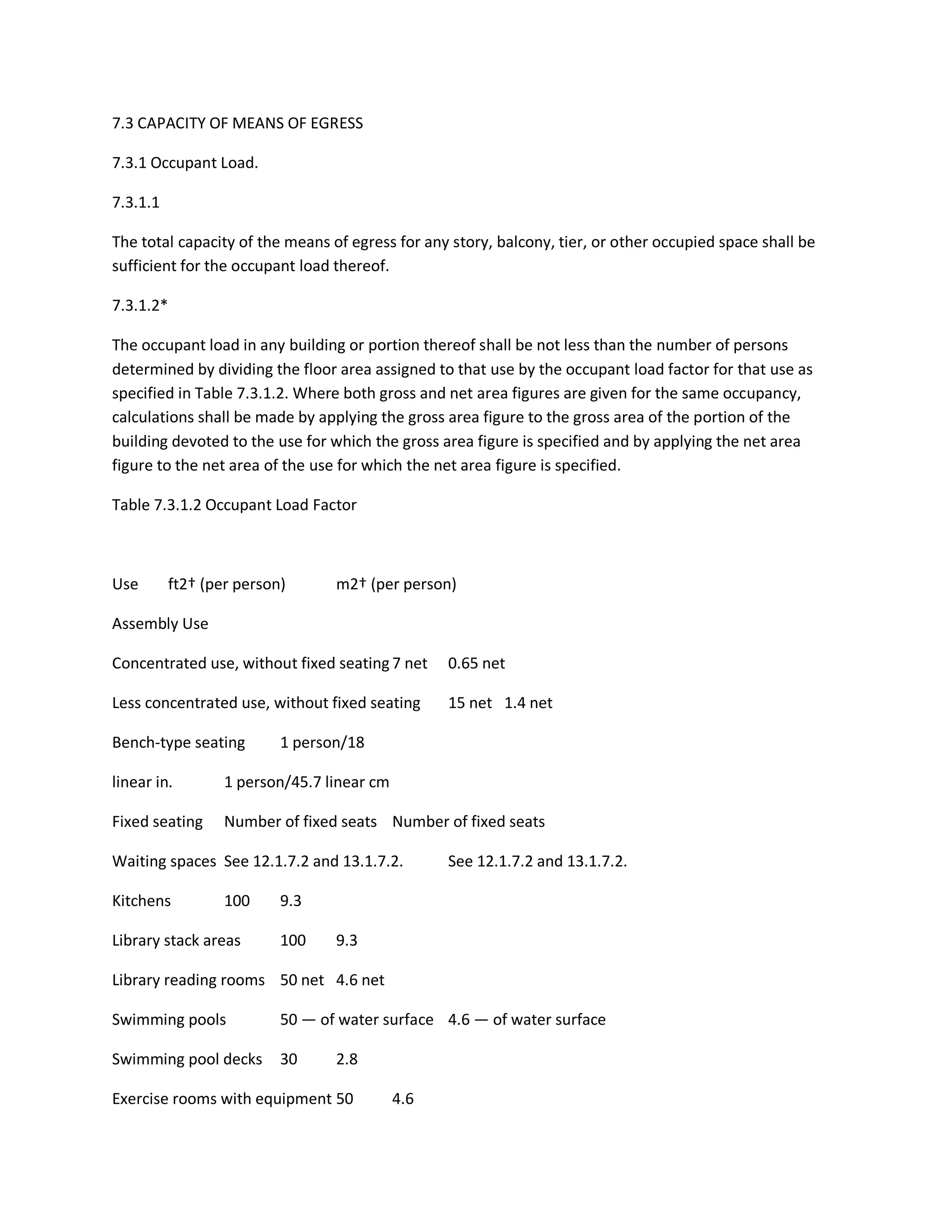
The occupant load in any building or portion thereof shall be not less than the number of persons
determined by dividing the floor area assigned to that use by the occupant load factor for that use as
specified in Table 7.3.1.2. Where both gross and net area figures are given for the same occupancy,
calculations shall be made by applying the gross area figure to the gross area of the portion of the
building devoted to the use for which the gross area figure is specified and by applying the net area
figure to the net area of the use for which the net area figure is specified.
Table 7.3.1.2 Occupant Load Factor
Use ft2โ€  (per person) m2โ€  (per person)
Assembly Use
Concentrated use, without fixed seating 7 net 0.65 net
Less concentrated use, without fixed seating 15 net 1.4 net
Bench-type seating 1 person/18
linear in. 1 person/45.7 linear cm
Fixed seating Number of fixed seats Number of fixed seats
Waiting spaces See 12.1.7.2 and 13.1.7.2. See 12.1.7.2 and 13.1.7.2.
Kitchens 100 9.3
Library stack areas 100 9.3
Library reading rooms 50 net 4.6 net
Swimming pools 50 โ€” of water surface 4.6 โ€” of water surface
Swimming pool decks 30 2.8
Exercise rooms with equipment 50 4.6
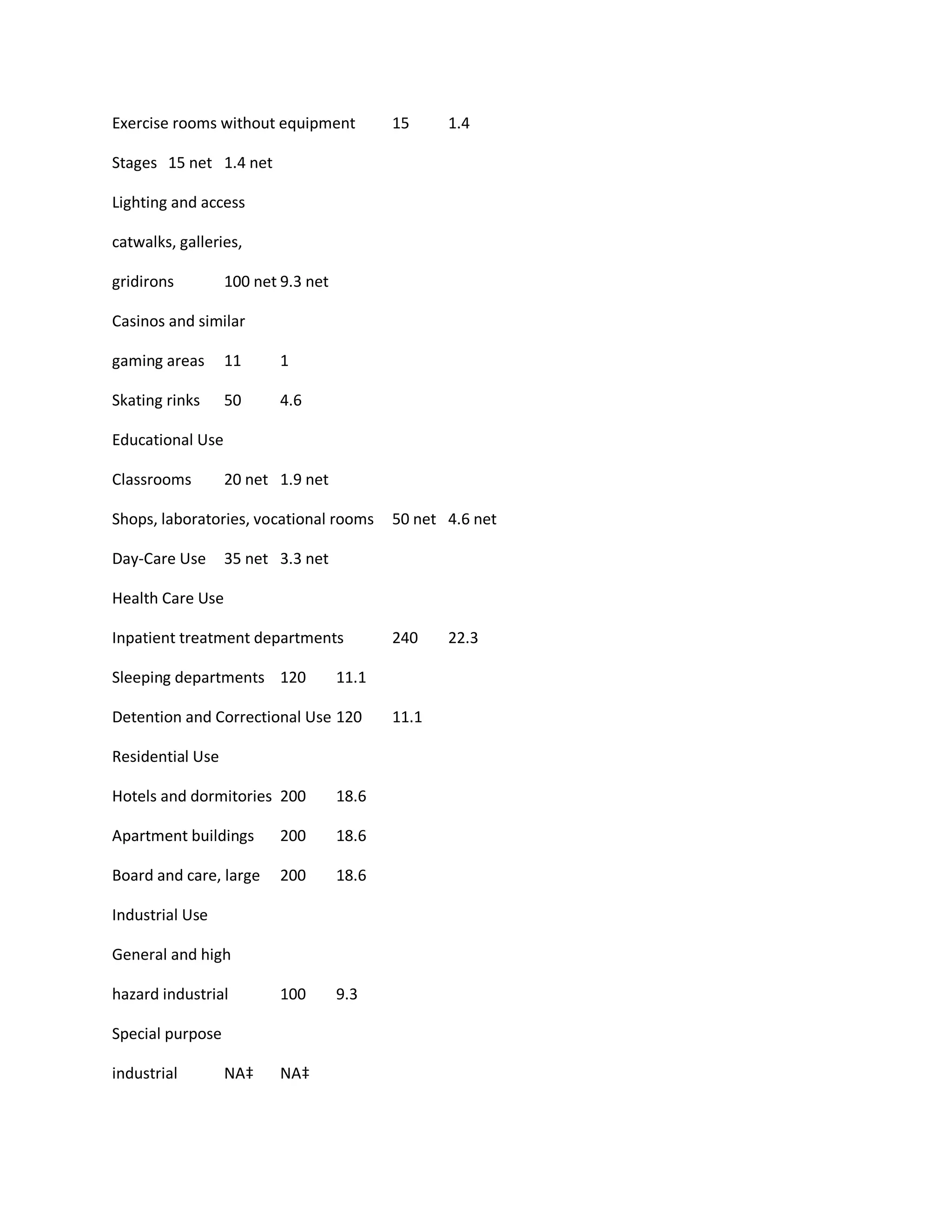
Exercise rooms without equipment 15 1.4
Stages 15 net 1.4 net
Lighting and access
catwalks, galleries,
gridirons 100 net 9.3 net
Casinos and similar
gaming areas 11 1
Skating rinks 50 4.6
Educational Use
Classrooms 20 net 1.9 net
Shops, laboratories, vocational rooms 50 net 4.6 net
Day-Care Use 35 net 3.3 net
Health Care Use
Inpatient treatment departments 240 22.3
Sleeping departments 120 11.1
Detention and Correctional Use 120 11.1
Residential Use
Hotels and dormitories 200 18.6
Apartment buildings 200 18.6
Board and care, large 200 18.6
Industrial Use
General and high
hazard industrial 100 9.3
Special purpose
industrial NAโ€ก NAโ€ก
Business Use 100 9.3
Storage Use (other than mercantile storerooms)NAโ€ก NAโ€ก
Mercantile Use
Sales area on street
floor ยง โ€ก 30 2.8
Sales area on two or more street floors โ€ก 40 3.7
Sales area on floor below street floor โ€ก 30 2.8
Sales area on floors above street floor โ€ก 60 5.6
Floors or portions of floors used only for offices See business use. See business use.
Floors or portions of floors used only for
storage, receiving, and shipping, and not open to general public 300 27.9
Covered mall buildings Per factors
applicable to use of space # Per factors applicable to use of space #
โ€  All factors expressed in gross area unless marked โ€œnetโ€.
โ€ก Not applicable. The occupant load shall be not less than the maximum probable number of occupants
present at any time.
ยง For the purpose of determining occupant load in mercantile occupancies where, due to differences in
grade of streets on different sides, two or more floors directly accessible from streets (not including
alleys or similar back streets) exist, each such floor shall be considered a street floor. The occupant load
factor shall be one person for each 40 ft2 (3.7 m2) of gross floor area of sales space.
โ€กIn mercantile occupancies with no street floor, as defined in 3.3.196, but with access directly from the
street by stairs or escalators, the principal floor at the point of entrance to the mercantile occupancy
shall be considered the street floor.
#The portions of the covered mall, where considered a pedestrian way and not used as gross leasable
area, shall not be assessed an occupant load based on Table 7.3.1.2. However, means of egress from a
covered mall pedestrian way shall be provided for an occupant load determined by dividing the gross
leasable area of the covered mall building (not including anchor stores) by the appropriate lowest whole
number occupant load factor from Figure 7.3.1.2.
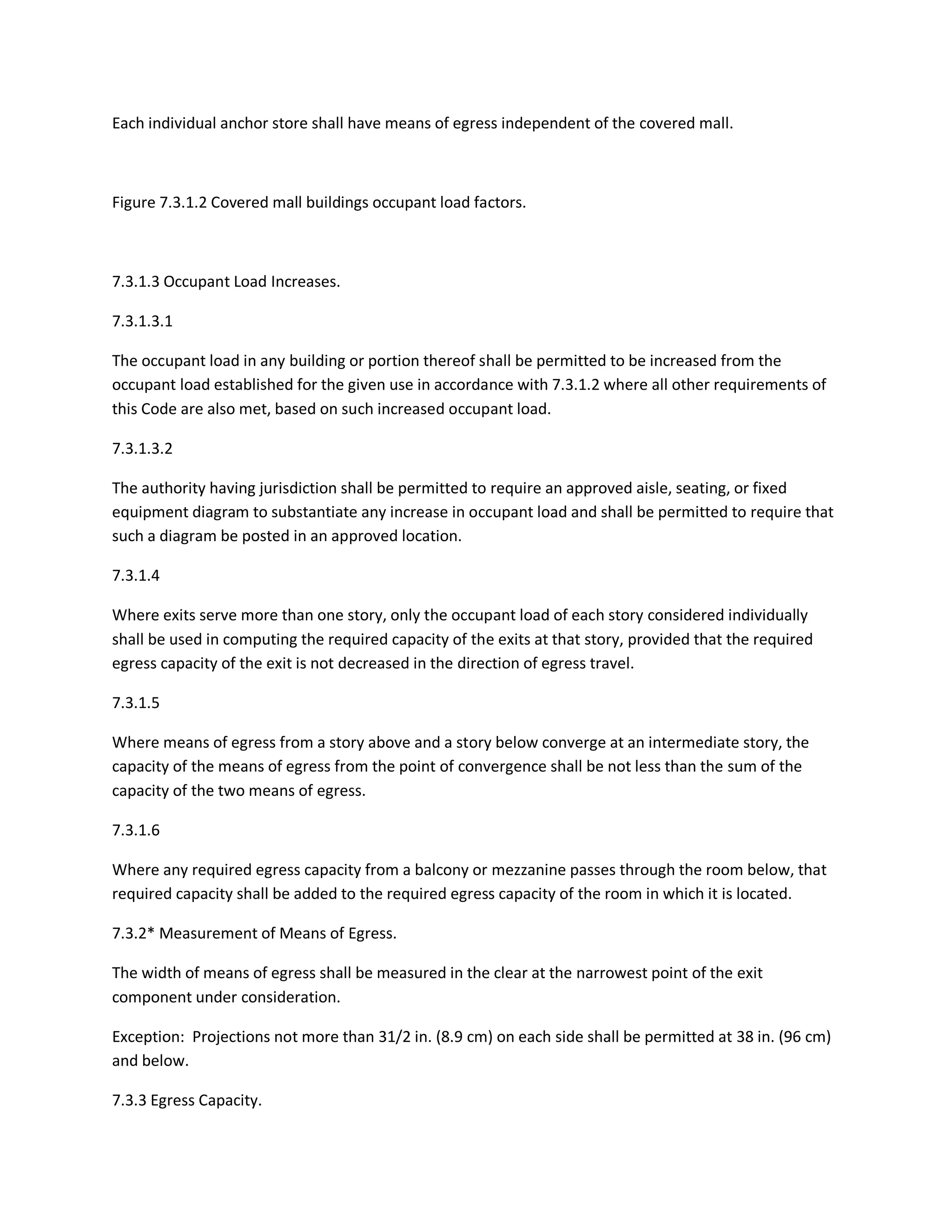
Each individual tenant space shall have means of egress to the outside or to the covered mall based on
occupant loads figured by using the appropriate occupant load factor from Table 7.3.1.2.
Each individual anchor store shall have means of egress independent of the covered mall.
Figure 7.3.1.2 Covered mall buildings occupant load factors.
7.3.1.3 Occupant Load Increases.
7.3.1.3.1
The occupant load in any building or portion thereof shall be permitted to be increased from the
occupant load established for the given use in accordance with 7.3.1.2 where all other requirements of
this Code are also met, based on such increased occupant load.
7.3.1.3.2
The authority having jurisdiction shall be permitted to require an approved aisle, seating, or fixed
equipment diagram to substantiate any increase in occupant load and shall be permitted to require that
such a diagram be posted in an approved location.
7.3.1.4
Where exits serve more than one story, only the occupant load of each story considered individually
shall be used in computing the required capacity of the exits at that story, provided that the required
egress capacity of the exit is not decreased in the direction of egress travel.
7.3.1.5
Where means of egress from a story above and a story below converge at an intermediate story, the
capacity of the means of egress from the point of convergence shall be not less than the sum of the
capacity of the two means of egress.
7.3.1.6
Where any required egress capacity from a balcony or mezzanine passes through the room below, that
required capacity shall be added to the required egress capacity of the room in which it is located.
7.3.2* Measurement of Means of Egress.
The width of means of egress shall be measured in the clear at the narrowest point of the exit
component under consideration.
Exception: Projections not more than 31/2 in. (8.9 cm) on each side shall be permitted at 38 in. (96 cm)
and below.
7.3.3 Egress Capacity.
7.3.3.1
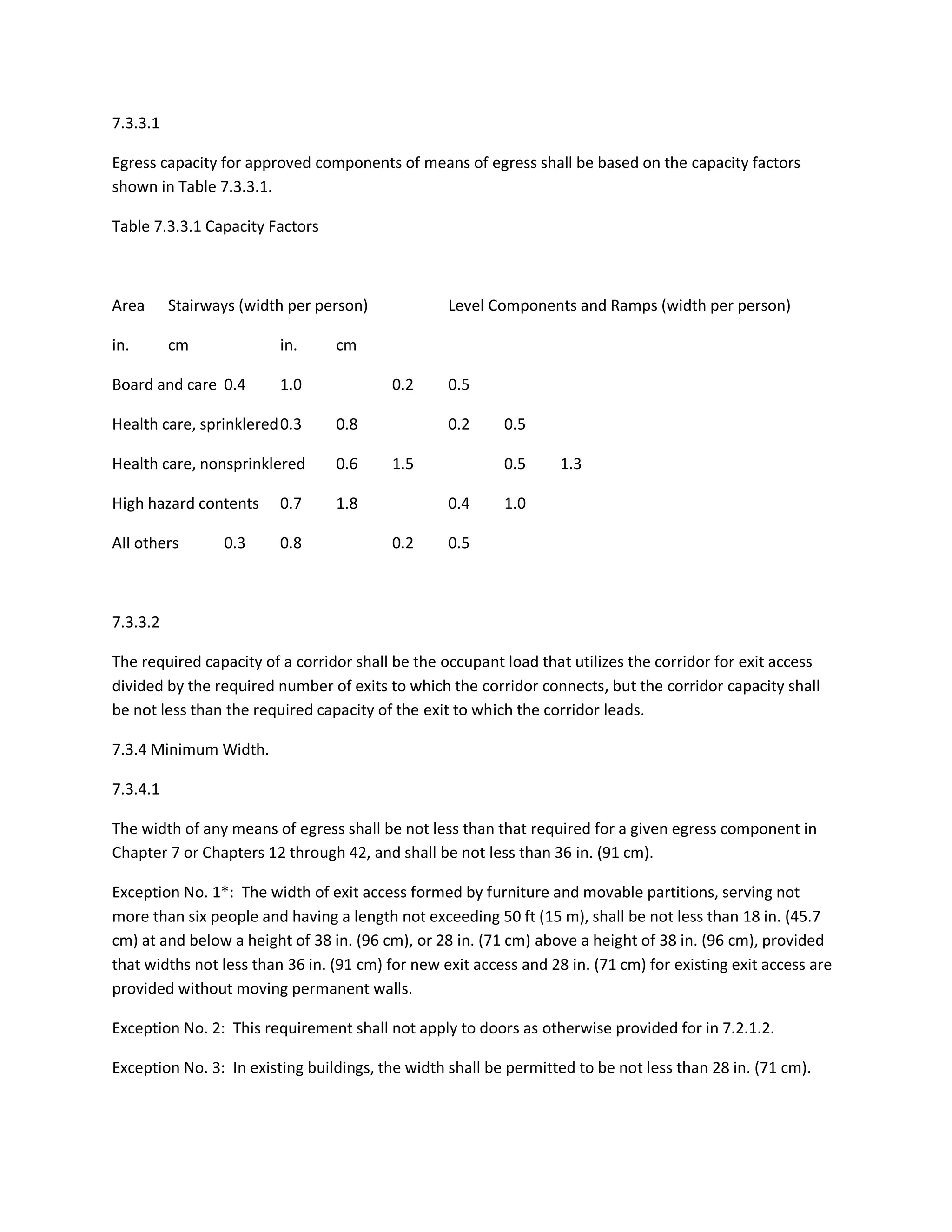
Egress capacity for approved components of means of egress shall be based on the capacity factors
shown in Table 7.3.3.1.
Table 7.3.3.1 Capacity Factors
Area Stairways (width per person) Level Components and Ramps (width per person)
in. cm in. cm
Board and care 0.4 1.0 0.2 0.5
Health care, sprinklered0.3 0.8 0.2 0.5
Health care, nonsprinklered 0.6 1.5 0.5 1.3
High hazard contents 0.7 1.8 0.4 1.0
All others 0.3 0.8 0.2 0.5
7.3.3.2
The required capacity of a corridor shall be the occupant load that utilizes the corridor for exit access
divided by the required number of exits to which the corridor connects, but the corridor capacity shall
be not less than the required capacity of the exit to which the corridor leads.
7.3.4 Minimum Width.
7.3.4.1
The width of any means of egress shall be not less than that required for a given egress component in
Chapter 7 or Chapters 12 through 42, and shall be not less than 36 in. (91 cm).
Exception No. 1*: The width of exit access formed by furniture and movable partitions, serving not
more than six people and having a length not exceeding 50 ft (15 m), shall be not less than 18 in. (45.7
cm) at and below a height of 38 in. (96 cm), or 28 in. (71 cm) above a height of 38 in. (96 cm), provided
that widths not less than 36 in. (91 cm) for new exit access and 28 in. (71 cm) for existing exit access are
provided without moving permanent walls.
Exception No. 2: This requirement shall not apply to doors as otherwise provided for in 7.2.1.2.
Exception No. 3: In existing buildings, the width shall be permitted to be not less than 28 in. (71 cm).
Exception No. 4: This requirement shall not apply to aisles and aisle accessways as otherwise provided
in Chapters 12 and 13.
Exception No. 5: This requirement shall not apply to industrial equipment access as otherwise provided
in Chapter 40.
7.3.4.2
Where a single exit access leads to an exit, its capacity in terms of width shall be not less than the
required capacity of the exit to which it leads. Where more than one exit access leads to an exit, each
shall have a width adequate for the number of persons it accommodates.
7.4 NUMBER OF MEANS OF EGRESS
7.4.1 General.
7.4.1.1
The number of means of egress from any balcony, mezzanine, story, or portion thereof shall be not less
than two.
Exception: This requirement shall not apply where a single means of egress is permitted in Chapters 11
through 42.
Exception: A mezzanine or balcony shall be permitted to have a single means of egress, provided that
the common path of travel limitations of Chapters 12 through 42 are met.
7.4.1.2
The number of means of egress from any story or portion thereof, other than for existing buildings as
permitted in Chapters 12 through 42, shall be as follows:
(1) Occupant load more than 500 but not more than 1000 โ€” not less than 3
(2) Occupant load more than 1000 โ€” not less than 4
7.4.1.3
Accessible means of egress in accordance with 7.5.4, not utilizing elevators, shall be permitted to serve
as any or all of the required minimum number of means of egress.
7.4.1.4
The occupant load of each story considered individually shall be required to be used in computing the
number of means of egress at each story, provided that the required number of means of egress is not
decreased in the direction of egress travel.
7.4.1.5
Doors, other than the hoistway door; the elevator car door; and doors that are readily openable from
the car side without a key, tool, special knowledge, or special effort, shall be prohibited at the point of
access to an elevator car.
7.4.1.6
Elevator lobbies shall have access to at least one exit. Such exit access shall not require the use of a key,
tool, special knowledge, or special effort.

Occupant load

  • 1.
    7.3 CAPACITY OFMEANS OF EGRESS 7.3.1 Occupant Load. 7.3.1.1 The total capacity of the means of egress for any story, balcony, tier, or other occupied space shall be sufficient for the occupant load thereof. 7.3.1.2* The occupant load in any building or portion thereof shall be not less than the number of persons determined by dividing the floor area assigned to that use by the occupant load factor for that use as specified in Table 7.3.1.2. Where both gross and net area figures are given for the same occupancy, calculations shall be made by applying the gross area figure to the gross area of the portion of the building devoted to the use for which the gross area figure is specified and by applying the net area figure to the net area of the use for which the net area figure is specified. Table 7.3.1.2 Occupant Load Factor Use ft2โ€  (per person) m2โ€  (per person) Assembly Use Concentrated use, without fixed seating 7 net 0.65 net Less concentrated use, without fixed seating 15 net 1.4 net Bench-type seating 1 person/18 linear in. 1 person/45.7 linear cm Fixed seating Number of fixed seats Number of fixed seats Waiting spaces See 12.1.7.2 and 13.1.7.2. See 12.1.7.2 and 13.1.7.2. Kitchens 100 9.3 Library stack areas 100 9.3 Library reading rooms 50 net 4.6 net Swimming pools 50 โ€” of water surface 4.6 โ€” of water surface Swimming pool decks 30 2.8 Exercise rooms with equipment 50 4.6
  • 2.
    Exercise rooms withoutequipment 15 1.4 Stages 15 net 1.4 net Lighting and access catwalks, galleries, gridirons 100 net 9.3 net Casinos and similar gaming areas 11 1 Skating rinks 50 4.6 Educational Use Classrooms 20 net 1.9 net Shops, laboratories, vocational rooms 50 net 4.6 net Day-Care Use 35 net 3.3 net Health Care Use Inpatient treatment departments 240 22.3 Sleeping departments 120 11.1 Detention and Correctional Use 120 11.1 Residential Use Hotels and dormitories 200 18.6 Apartment buildings 200 18.6 Board and care, large 200 18.6 Industrial Use General and high hazard industrial 100 9.3 Special purpose industrial NAโ€ก NAโ€ก
  • 3.
    Business Use 1009.3 Storage Use (other than mercantile storerooms)NAโ€ก NAโ€ก Mercantile Use Sales area on street floor ยง โ€ก 30 2.8 Sales area on two or more street floors โ€ก 40 3.7 Sales area on floor below street floor โ€ก 30 2.8 Sales area on floors above street floor โ€ก 60 5.6 Floors or portions of floors used only for offices See business use. See business use. Floors or portions of floors used only for storage, receiving, and shipping, and not open to general public 300 27.9 Covered mall buildings Per factors applicable to use of space # Per factors applicable to use of space # โ€  All factors expressed in gross area unless marked โ€œnetโ€. โ€ก Not applicable. The occupant load shall be not less than the maximum probable number of occupants present at any time. ยง For the purpose of determining occupant load in mercantile occupancies where, due to differences in grade of streets on different sides, two or more floors directly accessible from streets (not including alleys or similar back streets) exist, each such floor shall be considered a street floor. The occupant load factor shall be one person for each 40 ft2 (3.7 m2) of gross floor area of sales space. โ€กIn mercantile occupancies with no street floor, as defined in 3.3.196, but with access directly from the street by stairs or escalators, the principal floor at the point of entrance to the mercantile occupancy shall be considered the street floor. #The portions of the covered mall, where considered a pedestrian way and not used as gross leasable area, shall not be assessed an occupant load based on Table 7.3.1.2. However, means of egress from a covered mall pedestrian way shall be provided for an occupant load determined by dividing the gross leasable area of the covered mall building (not including anchor stores) by the appropriate lowest whole number occupant load factor from Figure 7.3.1.2. Each individual tenant space shall have means of egress to the outside or to the covered mall based on occupant loads figured by using the appropriate occupant load factor from Table 7.3.1.2.
  • 4.
    Each individual anchorstore shall have means of egress independent of the covered mall. Figure 7.3.1.2 Covered mall buildings occupant load factors. 7.3.1.3 Occupant Load Increases. 7.3.1.3.1 The occupant load in any building or portion thereof shall be permitted to be increased from the occupant load established for the given use in accordance with 7.3.1.2 where all other requirements of this Code are also met, based on such increased occupant load. 7.3.1.3.2 The authority having jurisdiction shall be permitted to require an approved aisle, seating, or fixed equipment diagram to substantiate any increase in occupant load and shall be permitted to require that such a diagram be posted in an approved location. 7.3.1.4 Where exits serve more than one story, only the occupant load of each story considered individually shall be used in computing the required capacity of the exits at that story, provided that the required egress capacity of the exit is not decreased in the direction of egress travel. 7.3.1.5 Where means of egress from a story above and a story below converge at an intermediate story, the capacity of the means of egress from the point of convergence shall be not less than the sum of the capacity of the two means of egress. 7.3.1.6 Where any required egress capacity from a balcony or mezzanine passes through the room below, that required capacity shall be added to the required egress capacity of the room in which it is located. 7.3.2* Measurement of Means of Egress. The width of means of egress shall be measured in the clear at the narrowest point of the exit component under consideration. Exception: Projections not more than 31/2 in. (8.9 cm) on each side shall be permitted at 38 in. (96 cm) and below. 7.3.3 Egress Capacity.
  • 5.
    7.3.3.1 Egress capacity forapproved components of means of egress shall be based on the capacity factors shown in Table 7.3.3.1. Table 7.3.3.1 Capacity Factors Area Stairways (width per person) Level Components and Ramps (width per person) in. cm in. cm Board and care 0.4 1.0 0.2 0.5 Health care, sprinklered0.3 0.8 0.2 0.5 Health care, nonsprinklered 0.6 1.5 0.5 1.3 High hazard contents 0.7 1.8 0.4 1.0 All others 0.3 0.8 0.2 0.5 7.3.3.2 The required capacity of a corridor shall be the occupant load that utilizes the corridor for exit access divided by the required number of exits to which the corridor connects, but the corridor capacity shall be not less than the required capacity of the exit to which the corridor leads. 7.3.4 Minimum Width. 7.3.4.1 The width of any means of egress shall be not less than that required for a given egress component in Chapter 7 or Chapters 12 through 42, and shall be not less than 36 in. (91 cm). Exception No. 1*: The width of exit access formed by furniture and movable partitions, serving not more than six people and having a length not exceeding 50 ft (15 m), shall be not less than 18 in. (45.7 cm) at and below a height of 38 in. (96 cm), or 28 in. (71 cm) above a height of 38 in. (96 cm), provided that widths not less than 36 in. (91 cm) for new exit access and 28 in. (71 cm) for existing exit access are provided without moving permanent walls. Exception No. 2: This requirement shall not apply to doors as otherwise provided for in 7.2.1.2. Exception No. 3: In existing buildings, the width shall be permitted to be not less than 28 in. (71 cm).
  • 6.
    Exception No. 4:This requirement shall not apply to aisles and aisle accessways as otherwise provided in Chapters 12 and 13. Exception No. 5: This requirement shall not apply to industrial equipment access as otherwise provided in Chapter 40. 7.3.4.2 Where a single exit access leads to an exit, its capacity in terms of width shall be not less than the required capacity of the exit to which it leads. Where more than one exit access leads to an exit, each shall have a width adequate for the number of persons it accommodates. 7.4 NUMBER OF MEANS OF EGRESS 7.4.1 General. 7.4.1.1 The number of means of egress from any balcony, mezzanine, story, or portion thereof shall be not less than two. Exception: This requirement shall not apply where a single means of egress is permitted in Chapters 11 through 42. Exception: A mezzanine or balcony shall be permitted to have a single means of egress, provided that the common path of travel limitations of Chapters 12 through 42 are met. 7.4.1.2 The number of means of egress from any story or portion thereof, other than for existing buildings as permitted in Chapters 12 through 42, shall be as follows: (1) Occupant load more than 500 but not more than 1000 โ€” not less than 3 (2) Occupant load more than 1000 โ€” not less than 4 7.4.1.3 Accessible means of egress in accordance with 7.5.4, not utilizing elevators, shall be permitted to serve as any or all of the required minimum number of means of egress. 7.4.1.4 The occupant load of each story considered individually shall be required to be used in computing the number of means of egress at each story, provided that the required number of means of egress is not decreased in the direction of egress travel. 7.4.1.5
  • 7.
    Doors, other thanthe hoistway door; the elevator car door; and doors that are readily openable from the car side without a key, tool, special knowledge, or special effort, shall be prohibited at the point of access to an elevator car. 7.4.1.6 Elevator lobbies shall have access to at least one exit. Such exit access shall not require the use of a key, tool, special knowledge, or special effort.