MALPRESENTATION AND MALPOSITION
Summary:
• Definitions
• Risks on mother and fetus
• Predisposing factors
• Breech. occipito posterior. face. brow.
shoulder, compound.
Definitions:
1- Presentation:- leading part of the fetus that
presents to the lower uterine segment.
2- Malpresentation: any other presentation
other than vertex
3- Position: relationship of presenting part to
the pelvic brim.
• Definitions (cont):
4- Denominator: Most definable peripheral
point in the presenting part
- Vertex- occiput
- Face- mentum
- Breech- sacrum
5- Position at start of labour
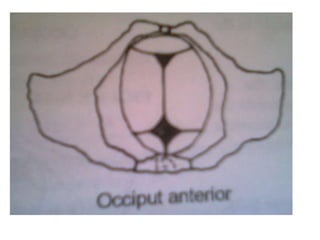
- 90%:LOA,ROA,OA
Risks on mother and fetus:
1- Prolonged and obstructed labour
2- Ruptured uterus
3- Difficult C/S, forceps, ventouse-traumatic
delivery
4- Complications of puperperium
5- Vesico vaginal fistula
6- Increased maternal and perinatal mortality
Prevention of Risks:
1- Early diagnosis
2- Monitoring
3- Trained attendant
4- Facilities
Predisposing factors
1-Pre-maturity
2-Contracted pelvis- malformation
3- Multiple pregnancy
4- Polyhydramnios
5- Big baby
6- Congenital malformation of fetus
Predisposing factors (cont):
7- Congenital malformation of uterus
8- Fibroids
9- Placenta Previa
10 Oligohydramnios
11- Pendulous abdomen, grandmultipara
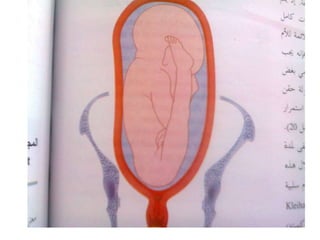
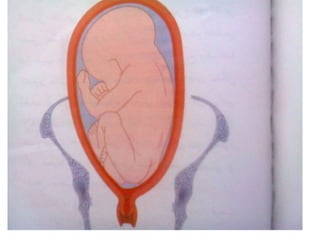
BREECH PRESENTATION:
1- Incidence 3-4% at term
2- Denominator sacrum
3- Diagnosis
– Head occupies the fundus (hard, rounded,
ballotable, tender)
– Breech above pelvic brim (broad, soft, irregular)
– Longitudinal lie
– Fetal heart above umbilicus
Breech (cont):
– U/S: confirm diagnosis.Diagnose, maturity,
placenta previa, fibroids, fetal malformation,
twins, uterine malformation, liquor.
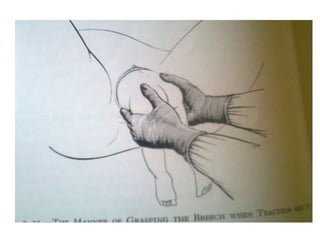
– Vaginal examination
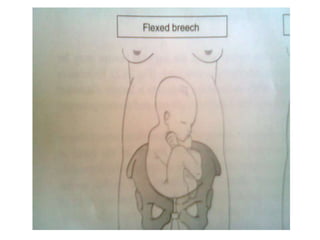
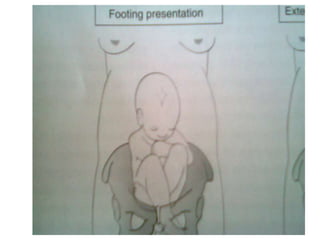
– Incomplete breech: ischial tuberosities sacrum,
anus
– Complete: feet beside buttocks
– Footling:foot
– Knee: knee
Breech (cont):
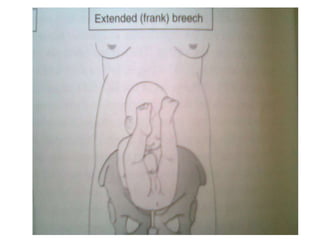
4- Types of breech:
• Group assignment
Breech (cont):
5- Risks to mother:
- Dystocia, sepsis, lacerations, C/S
Breech (cont):
6- Risks to the fetus:
6.1 Stillbirth
- Intracranial haemorrhage Rapid moulding and
rapid correction of moulding Rapid uncontrolled
delivery
- Asphyxia Slow delivery. Pressure of cord between
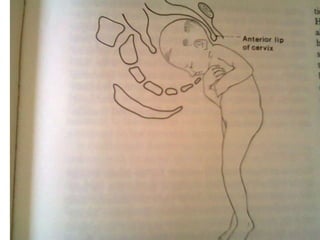
fetal body and pelvic wall
- Medullary coning through foramen magnum
- Spinal cord injury.
6.2 Other injuries ( brachial plexus - femur- liver)
6.3 Intraprtum asphyxia (dystocia, cord prolapse)
Breech (cont)
Management Ante partum:
1- Identify cause by U/S
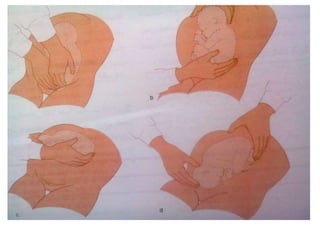
2- External Cephalic Version (ECV)
3- If ECV fail: Decide C/S or assisted vaginal
delivery
• Breech (cont)
• ECV:
– In hospital where C/S can be done immediately
– 37 weeks. <37 = per-term. > 37 = difficult
– Success= 60% in multipara
40% in primigravida
Preparation (ECV):
– U/S: confirm, back IUGR, liquor
– CTG: 20 min before Procedure . well
– Nothing by mouth
– Empty bladder
– I.V line
– 0.25 mg turbutaline subcutaneous 15 min before
start (tocolytic
– Trendelenberg position
Procedure (ECV):
– Elevate breech from pelvis
– Flex fetus and rotate in direction of nose
– Transverse
– Guide head in pelvis
– CTG for 30 min (reactive- no contraction)
Procedure (ECV):
–If no success after 15 min stop
–Stop if severe pain or bradycardia
–If bradycardia persists revert ECV
–If still bradycardia C/S
• Breech (cont)
Contraindications for ECV:
– Vaginal delivery not possible
– Multiple pregnancy
– IUGR
– Previous C/S
– APH
Contraindications for ECV:
– Pre-eclampsia
– Ruptured membranes
– Cardiac disease
– Uterine abnormality
– Rhesus negative
Breech (cont)
Complications of ECV:
– Premature labour
– Cord accident
– Abruptio placenta
– IUFD
– Feto-maternal transfusion
– Bradycardia
Breech (cont)
Difficult ECV:
– Primigravida
– Obese
– Decrease liquor
– Anterior placenta
– Early labour
– Big baby
– Irritable uterus
Breech (cont)
If ECV fails decide: C/S, Vagianl:
Elective C/S
– Hypertension, diabetes, APH
– Big baby ≥ 3.8 kg
– Contracted pelvis < 4.5"AP
– IUGR
– Previous SB
– Relative infertility
Elective C/S
– Primigravida
– Previous C/S
– Footling
– Hydrocephalus
– Hyperextended head
Breech (cont)
Vaginal delivery:
-Adequate pelvis
- Wt: < 3.8 kg
- No complication
- Multipara
- Malformed baby
Breech (cont)
Mechanism of labour:
1- Engagement- bitrochantric diameter transverse
and sacrum ventral
2- Anterior hip rotates anteriorly under the pubic
arch
3- Post hip deliver by lateral flexion
4- Baby straightens and anterior hip delivers
5- Legs and feet
Mechanism of labour:
6- Ext rotation- shoulders antero posterior
7- Head
– Fixed under pubic arch
– Deliver by flextion (chin-mouth-nose-brow-vertex-
occiput)
8- Keep back anterior
9- Second stage not more than 30 min
Breech (cont)
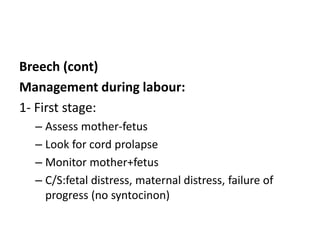
Management during labour:
1- First stage:
– Assess mother-fetus
– Look for cord prolapse
– Monitor mother+fetus
– C/S:fetal distress, maternal distress, failure of
progress (no syntocinon)
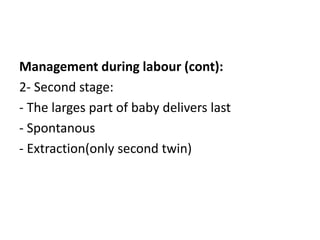
Management during labour (cont):
2- Second stage:
- The larges part of baby delivers last
- Spontanous
- Extraction(only second twin)
Breech (cont):
Assisted vaginal delivery:
1- Empty bladder
2- Cervix fully dilated
3- L ook for cord
4- Sacrum anterior
5- Prineum distended and breech climbs perineum
Breech (cont):
Assisted vaginal delivery:
6- Pudendal block
7- Episitomy
8- Delvier buttocks and legs
9- Frank breech: abduct thigh and flex knee
deliver
10- Hold baby back anterior
Assisted vaginal delivery (cont):
11- WAIT DO NOT PULL
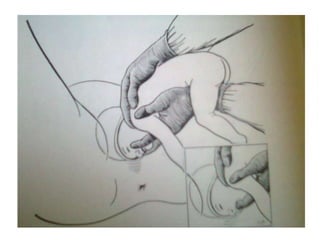
Assisted vaginal delivery (cont):
12- Deliver arms when scapula appears
13- Extended arms due to pulling (LOVSET)
- Rotation of body so that the posterior
shoulder becomes anterior and below pubic
symphysis
14- Leave baby hang by gravity (supported) flexed
and engaged
15- Nape of neck under symphysis pubis
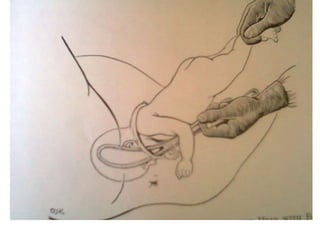
Deliver Head:
A- Mauriceau smellie veit Two fingers press over
maxilla to flex the head, suprapubic pressure.
Shoulder traction
B- Swing the trunk towards the maternal
abdomen until the mouth and nose are visible
C- Forceps Piper-Neville Barnes Forceps Long
Forceps when MSV fails
OCCIPITOPOSTERIOR (OP) AND
DEEP TRANSEVERSE ARREST:
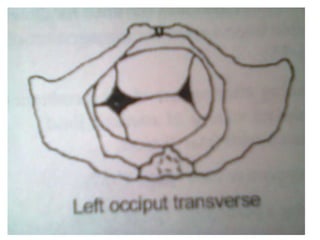
1- Normally head engages with occiput lateral
(LOL,ROL)
– Usually rotates anterior (OA). 80% well flexed.
Presenting diameters: suboccipito bregmatic+
biparietal 9.5× 9.5 cm
– Rarely delivers occipito lateral (small baby)
2- In 1/5 labour starts with occipitposterior.Usually
ROP
– Good contractions: 80% flexion and rotates anterior
OA
– Rarely rotates to deep transverse arrest - C/S.
OP (cont)
3- Head engages as OP
– Small baby and anthropoid pelvis
– No rotation. Deliver face to pubis
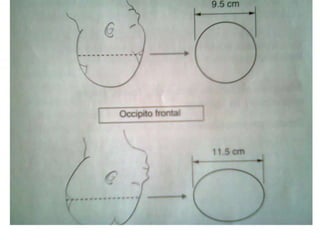
4- Persistent occipito posterior
– Defelxed head
– Occipito frontal diameter 4 1/2 11.5 cm
– Large diameter-difficult labour
OP (cont)
Associate with:
– Android and anthropoid pelvis
– Epidural analgesia
– Most unknown
OP (cont):
Diagnosis:
– Flat abdomen
– Fetal parts anterior
– Difficult to feel the back
– Fetal heart at flanks
OP (cont)
Vaginal Examination:
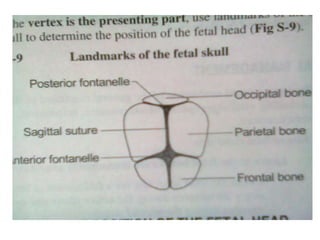
1- Early in labour Head is high and anterior fontanelle
occupies the center. Posterior fontanelle high and
sagital suture anteropsterior
2-Late in labour
– Moulding +caput
– Parietal bones overlap on each other and on the occiput
– Diagnosis difficult, feel ears
– Asymetrical dilatation of Cervix oedema of anterior Lip
OP (cont)
Features of labour:
– Back pain
– Prolonged and Obstructed
– Early rupture of membranes
– Cord prolapse
– Lacerations-vagina perineum
OP (cont)
Management:
1-Similar to occipito anterior
2- Monitoring
– Fetal distress
– Maternal distress
– Failure of progress
3- In primigravida syntocinon may correct
position
OP (cont)
Management:
4- Mode of delivery:
– Spontaneous delivery face to pubis
– Fetal distress or maternal distress or cord prolapse in
first stage=CS
– Failure of progress (after syntocinon) in first stage=C/S
– Fetal distress or maternal distress in second stage and
head not engaged = C/S
OP (cont)
Management:
4- Mode of delivery:
– Head not engaged, no FD or MD, second stage =
syntocinon
– Fetal distress or maternal distress or failure of
progress in second stage and head engaged=
– Vacuum: enhance rotation and delivery OA.
– Forceps: Deliver face to pubis
– Manual rotation- flex head+rotate
FACE PRESENTATION:
1- Incidence 1:300
2- Aetiology
– Hyperextended head +face presenting
– Submentobregmatic diameter 9.5 cm
– Usually secondary in labour
i- Big baby
ii-Contracted pelvis
iii-Pendulous abdomen of grandmultipara
iv-Premature
v-Goitre, anencephaly
• Face presentation (cont):
3- Diagnosis:
Vaginal examination
– Frontal bones, supraorbital ridges, eycs, nose,
mouth, chin.
– Mouth(suckling reflex, alveolar margin, mouth and
maxilla form triangle)
– Anus: Straight line with ischial tuberosities.
Face presentation (cont):
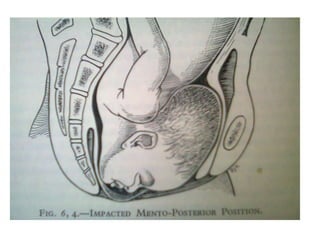
4- Labour:
– Face bones not comperssable
– Submento bregmatic diameter 9.5 cm
– Prolonged labour, early rupture of membranes
– Strats mento-lateral and rotates to mentoanterior
– Neck fixed under pubic arch and head delivers by
flexion
– Mento posterior rotates to mentoanterior
– Persistent nentoposterior- impossible vaginal .
Face presentation (cont):
5- Management:
– Evaluate condition carefully after diagnosis
– Vaginal delivery – Mento anterior and mento
lateral: Monitor (FD,MD, Failure progress)
– Large episiotomy
Face presentation (cont):
5- Management:
– Contra- indicated
• Syntocinon.
• Vacuum
• Scalp electrode
- Forceps may be used
Face presentation (cont):
5- Management:
– Caesarean section
• Contracted pelvis
• Big bay
• Previou C/S
• Hypertension, APH, diabetes
• Presistent mento posterior
Face presentation (cont):
–Dead fetus
• Craniotomy
• C/S
BROW PRESENTATION:
– Incidence 1:600
– Aetiology similar toface
– Deflexed head. Mentovertical diameter 13.5 cm
- Diagnosed by vaginal exam
Frontal sutures, anterior fontanelle, supra
orbital ridges, eyes, nasion (mouth and chin
not felt)
- Management:C/S
TRANSVERSE LIE OR SHOULDER
PRESENTATION:
– Incidence 1:300
– Aetiology
• Multiparous
• Pendulous abdomen
• Pre-term
• Placenta previa
• Abnormal uterus
• Contracted pelvis
• Polyhydramios
• Malformed baby
Transverse lie or shoulder presentation (cont):
Diagnosis:
– Asymmetrical abdomen
– Fundus less than dates
– Head usually to the left
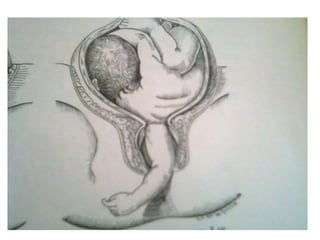
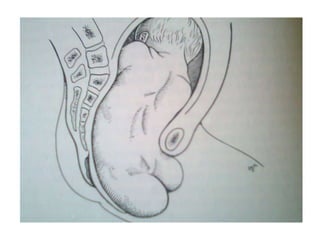
– In back down transeverse lie the shoulder is over the
pelvic inlet (shoulder presentation)
– In back up transever lie (second twin)
– Oblique lie
– Unstable lie
– Empty pelvis
Transverse lie or shoulder presentation (cont):
Vaginal examination:
– Early labour: bag of water with fetal parts
– Late labour: membranes ruptured
– Shoulder presents in back down transevers lie
(ribe in medial side of axilla, clavicle, acromion)
– Arm proplapse.
Transverse lie or shoulder presentation (cont):
Features of labour:
– Ruptured membranes+cord proplapse
– Obstructed labour ruptured uterus
– Neglected shoulder presentation
Transverse lie or shoulder presentation (cont):
Management Antepartum:
1- U/S (Placenta previa etc)
2- Attempt ECV
3- C/S
• Management in labour:
– C/S
PROPLAPSE AND PRESENTATION OF
CORD:
Aetiology:
1- Malpresentaion malposition
2- Multiparous-high head at start of labour
3- Polyhydramnios
4- ARM-high head
5- ECV
6- Forceps-vacuum
7- Long cord
8- Pre-term.
Prolapse and presentation of the cord (cont):
1- Proplapse: Membranes ruptured
- Diagnosed: visual, vag examination Bradycardia
: Cord spasm. Compressed. Asphyxia
2- Presentation: membranes not ruptured (C/S)
• Management of Prolapsed cord:
1- Keep cord in vgina
2- Elevate foot of bed.fill bladder
3- Never attempt to reposition in uterus
4- Forceps:alive +fully dilated cervix
5- C/S:alive
6- Vaginal: dead.
THANK YOU

malposition.pptx midifery obsgynae consultancy

  • 1.
  • 2.
    Summary: • Definitions • Riskson mother and fetus • Predisposing factors • Breech. occipito posterior. face. brow. shoulder, compound.
  • 3.
    Definitions: 1- Presentation:- leadingpart of the fetus that presents to the lower uterine segment. 2- Malpresentation: any other presentation other than vertex 3- Position: relationship of presenting part to the pelvic brim.
  • 4.
    • Definitions (cont): 4-Denominator: Most definable peripheral point in the presenting part - Vertex- occiput - Face- mentum - Breech- sacrum 5- Position at start of labour - 90%:LOA,ROA,OA
  • 5.
    Risks on motherand fetus: 1- Prolonged and obstructed labour 2- Ruptured uterus 3- Difficult C/S, forceps, ventouse-traumatic delivery 4- Complications of puperperium 5- Vesico vaginal fistula 6- Increased maternal and perinatal mortality
  • 6.
    Prevention of Risks: 1-Early diagnosis 2- Monitoring 3- Trained attendant 4- Facilities
  • 7.
    Predisposing factors 1-Pre-maturity 2-Contracted pelvis-malformation 3- Multiple pregnancy 4- Polyhydramnios 5- Big baby 6- Congenital malformation of fetus
  • 8.
    Predisposing factors (cont): 7-Congenital malformation of uterus 8- Fibroids 9- Placenta Previa 10 Oligohydramnios 11- Pendulous abdomen, grandmultipara
  • 9.
    BREECH PRESENTATION: 1- Incidence3-4% at term 2- Denominator sacrum 3- Diagnosis – Head occupies the fundus (hard, rounded, ballotable, tender) – Breech above pelvic brim (broad, soft, irregular) – Longitudinal lie – Fetal heart above umbilicus
  • 10.
    Breech (cont): – U/S:confirm diagnosis.Diagnose, maturity, placenta previa, fibroids, fetal malformation, twins, uterine malformation, liquor. – Vaginal examination – Incomplete breech: ischial tuberosities sacrum, anus – Complete: feet beside buttocks – Footling:foot – Knee: knee
  • 16.
    Breech (cont): 4- Typesof breech: • Group assignment
  • 17.
    Breech (cont): 5- Risksto mother: - Dystocia, sepsis, lacerations, C/S
  • 18.
    Breech (cont): 6- Risksto the fetus: 6.1 Stillbirth - Intracranial haemorrhage Rapid moulding and rapid correction of moulding Rapid uncontrolled delivery - Asphyxia Slow delivery. Pressure of cord between fetal body and pelvic wall - Medullary coning through foramen magnum - Spinal cord injury. 6.2 Other injuries ( brachial plexus - femur- liver) 6.3 Intraprtum asphyxia (dystocia, cord prolapse)
  • 19.
    Breech (cont) Management Antepartum: 1- Identify cause by U/S 2- External Cephalic Version (ECV) 3- If ECV fail: Decide C/S or assisted vaginal delivery
  • 20.
    • Breech (cont) •ECV: – In hospital where C/S can be done immediately – 37 weeks. <37 = per-term. > 37 = difficult – Success= 60% in multipara 40% in primigravida
  • 21.
    Preparation (ECV): – U/S:confirm, back IUGR, liquor – CTG: 20 min before Procedure . well – Nothing by mouth – Empty bladder – I.V line – 0.25 mg turbutaline subcutaneous 15 min before start (tocolytic – Trendelenberg position
  • 22.
    Procedure (ECV): – Elevatebreech from pelvis – Flex fetus and rotate in direction of nose – Transverse – Guide head in pelvis – CTG for 30 min (reactive- no contraction)
  • 24.
    Procedure (ECV): –If nosuccess after 15 min stop –Stop if severe pain or bradycardia –If bradycardia persists revert ECV –If still bradycardia C/S
  • 25.
    • Breech (cont) Contraindicationsfor ECV: – Vaginal delivery not possible – Multiple pregnancy – IUGR – Previous C/S – APH
  • 26.
    Contraindications for ECV: –Pre-eclampsia – Ruptured membranes – Cardiac disease – Uterine abnormality – Rhesus negative
  • 27.
    Breech (cont) Complications ofECV: – Premature labour – Cord accident – Abruptio placenta – IUFD – Feto-maternal transfusion – Bradycardia
  • 28.
    Breech (cont) Difficult ECV: –Primigravida – Obese – Decrease liquor – Anterior placenta – Early labour – Big baby – Irritable uterus
  • 29.
    Breech (cont) If ECVfails decide: C/S, Vagianl:
  • 30.
    Elective C/S – Hypertension,diabetes, APH – Big baby ≥ 3.8 kg – Contracted pelvis < 4.5"AP – IUGR – Previous SB – Relative infertility
  • 31.
    Elective C/S – Primigravida –Previous C/S – Footling – Hydrocephalus – Hyperextended head
  • 32.
    Breech (cont) Vaginal delivery: -Adequatepelvis - Wt: < 3.8 kg - No complication - Multipara - Malformed baby
  • 33.
    Breech (cont) Mechanism oflabour: 1- Engagement- bitrochantric diameter transverse and sacrum ventral 2- Anterior hip rotates anteriorly under the pubic arch 3- Post hip deliver by lateral flexion 4- Baby straightens and anterior hip delivers 5- Legs and feet
  • 34.
    Mechanism of labour: 6-Ext rotation- shoulders antero posterior 7- Head – Fixed under pubic arch – Deliver by flextion (chin-mouth-nose-brow-vertex- occiput) 8- Keep back anterior 9- Second stage not more than 30 min
  • 35.
    Breech (cont) Management duringlabour: 1- First stage: – Assess mother-fetus – Look for cord prolapse – Monitor mother+fetus – C/S:fetal distress, maternal distress, failure of progress (no syntocinon)
  • 36.
    Management during labour(cont): 2- Second stage: - The larges part of baby delivers last - Spontanous - Extraction(only second twin)
  • 42.
    Breech (cont): Assisted vaginaldelivery: 1- Empty bladder 2- Cervix fully dilated 3- L ook for cord 4- Sacrum anterior 5- Prineum distended and breech climbs perineum
  • 43.
    Breech (cont): Assisted vaginaldelivery: 6- Pudendal block 7- Episitomy 8- Delvier buttocks and legs 9- Frank breech: abduct thigh and flex knee deliver 10- Hold baby back anterior
  • 44.
    Assisted vaginal delivery(cont): 11- WAIT DO NOT PULL
  • 45.
    Assisted vaginal delivery(cont): 12- Deliver arms when scapula appears 13- Extended arms due to pulling (LOVSET) - Rotation of body so that the posterior shoulder becomes anterior and below pubic symphysis 14- Leave baby hang by gravity (supported) flexed and engaged 15- Nape of neck under symphysis pubis
  • 46.
    Deliver Head: A- Mauriceausmellie veit Two fingers press over maxilla to flex the head, suprapubic pressure. Shoulder traction B- Swing the trunk towards the maternal abdomen until the mouth and nose are visible C- Forceps Piper-Neville Barnes Forceps Long Forceps when MSV fails
  • 47.
    OCCIPITOPOSTERIOR (OP) AND DEEPTRANSEVERSE ARREST: 1- Normally head engages with occiput lateral (LOL,ROL) – Usually rotates anterior (OA). 80% well flexed. Presenting diameters: suboccipito bregmatic+ biparietal 9.5× 9.5 cm – Rarely delivers occipito lateral (small baby) 2- In 1/5 labour starts with occipitposterior.Usually ROP – Good contractions: 80% flexion and rotates anterior OA – Rarely rotates to deep transverse arrest - C/S.
  • 48.
    OP (cont) 3- Headengages as OP – Small baby and anthropoid pelvis – No rotation. Deliver face to pubis 4- Persistent occipito posterior – Defelxed head – Occipito frontal diameter 4 1/2 11.5 cm – Large diameter-difficult labour
  • 49.
    OP (cont) Associate with: –Android and anthropoid pelvis – Epidural analgesia – Most unknown
  • 50.
    OP (cont): Diagnosis: – Flatabdomen – Fetal parts anterior – Difficult to feel the back – Fetal heart at flanks
  • 51.
    OP (cont) Vaginal Examination: 1-Early in labour Head is high and anterior fontanelle occupies the center. Posterior fontanelle high and sagital suture anteropsterior 2-Late in labour – Moulding +caput – Parietal bones overlap on each other and on the occiput – Diagnosis difficult, feel ears – Asymetrical dilatation of Cervix oedema of anterior Lip
  • 56.
    OP (cont) Features oflabour: – Back pain – Prolonged and Obstructed – Early rupture of membranes – Cord prolapse – Lacerations-vagina perineum
  • 57.
    OP (cont) Management: 1-Similar tooccipito anterior 2- Monitoring – Fetal distress – Maternal distress – Failure of progress 3- In primigravida syntocinon may correct position
  • 58.
    OP (cont) Management: 4- Modeof delivery: – Spontaneous delivery face to pubis – Fetal distress or maternal distress or cord prolapse in first stage=CS – Failure of progress (after syntocinon) in first stage=C/S – Fetal distress or maternal distress in second stage and head not engaged = C/S
  • 59.
    OP (cont) Management: 4- Modeof delivery: – Head not engaged, no FD or MD, second stage = syntocinon – Fetal distress or maternal distress or failure of progress in second stage and head engaged= – Vacuum: enhance rotation and delivery OA. – Forceps: Deliver face to pubis – Manual rotation- flex head+rotate
  • 60.
    FACE PRESENTATION: 1- Incidence1:300 2- Aetiology – Hyperextended head +face presenting – Submentobregmatic diameter 9.5 cm – Usually secondary in labour i- Big baby ii-Contracted pelvis iii-Pendulous abdomen of grandmultipara iv-Premature v-Goitre, anencephaly
  • 61.
    • Face presentation(cont): 3- Diagnosis: Vaginal examination – Frontal bones, supraorbital ridges, eycs, nose, mouth, chin. – Mouth(suckling reflex, alveolar margin, mouth and maxilla form triangle) – Anus: Straight line with ischial tuberosities.
  • 63.
    Face presentation (cont): 4-Labour: – Face bones not comperssable – Submento bregmatic diameter 9.5 cm – Prolonged labour, early rupture of membranes – Strats mento-lateral and rotates to mentoanterior – Neck fixed under pubic arch and head delivers by flexion – Mento posterior rotates to mentoanterior – Persistent nentoposterior- impossible vaginal .
  • 64.
    Face presentation (cont): 5-Management: – Evaluate condition carefully after diagnosis – Vaginal delivery – Mento anterior and mento lateral: Monitor (FD,MD, Failure progress) – Large episiotomy
  • 65.
    Face presentation (cont): 5-Management: – Contra- indicated • Syntocinon. • Vacuum • Scalp electrode - Forceps may be used
  • 66.
    Face presentation (cont): 5-Management: – Caesarean section • Contracted pelvis • Big bay • Previou C/S • Hypertension, APH, diabetes • Presistent mento posterior
  • 67.
    Face presentation (cont): –Deadfetus • Craniotomy • C/S
  • 68.
    BROW PRESENTATION: – Incidence1:600 – Aetiology similar toface – Deflexed head. Mentovertical diameter 13.5 cm - Diagnosed by vaginal exam Frontal sutures, anterior fontanelle, supra orbital ridges, eyes, nasion (mouth and chin not felt) - Management:C/S
  • 69.
    TRANSVERSE LIE ORSHOULDER PRESENTATION: – Incidence 1:300 – Aetiology • Multiparous • Pendulous abdomen • Pre-term • Placenta previa • Abnormal uterus • Contracted pelvis • Polyhydramios • Malformed baby
  • 70.
    Transverse lie orshoulder presentation (cont): Diagnosis: – Asymmetrical abdomen – Fundus less than dates – Head usually to the left – In back down transeverse lie the shoulder is over the pelvic inlet (shoulder presentation) – In back up transever lie (second twin) – Oblique lie – Unstable lie – Empty pelvis
  • 72.
    Transverse lie orshoulder presentation (cont): Vaginal examination: – Early labour: bag of water with fetal parts – Late labour: membranes ruptured – Shoulder presents in back down transevers lie (ribe in medial side of axilla, clavicle, acromion) – Arm proplapse.
  • 73.
    Transverse lie orshoulder presentation (cont): Features of labour: – Ruptured membranes+cord proplapse – Obstructed labour ruptured uterus – Neglected shoulder presentation
  • 74.
    Transverse lie orshoulder presentation (cont): Management Antepartum: 1- U/S (Placenta previa etc) 2- Attempt ECV 3- C/S • Management in labour: – C/S
  • 75.
    PROPLAPSE AND PRESENTATIONOF CORD: Aetiology: 1- Malpresentaion malposition 2- Multiparous-high head at start of labour 3- Polyhydramnios 4- ARM-high head 5- ECV 6- Forceps-vacuum 7- Long cord 8- Pre-term.
  • 76.
    Prolapse and presentationof the cord (cont): 1- Proplapse: Membranes ruptured - Diagnosed: visual, vag examination Bradycardia : Cord spasm. Compressed. Asphyxia 2- Presentation: membranes not ruptured (C/S)
  • 77.
    • Management ofProlapsed cord: 1- Keep cord in vgina 2- Elevate foot of bed.fill bladder 3- Never attempt to reposition in uterus 4- Forceps:alive +fully dilated cervix 5- C/S:alive 6- Vaginal: dead.
  • 78.