Abruptio Placentae 
Prepared by: Crisanto T. Layos
• Abruptio placenta is the premature 
separation of a normally implanted 
placenta before the delivery of the baby. 
• It is characterized by a triad of symptoms: 
vaginal bleeding, uterine hyper tonus, and 
fetal distress.
CAUSES 
• Unknown 
• Hypertension 
• Preterm premature rupture of membranes 
• Smoking 
• Cocaine abuse are the most common 
associated factors
• A short umbilical cord, thrombophilias, 
external trauma, fibroids (especially those 
located behind the placental implantation 
site), severe diabetes or renal disease, 
and vena cava compression are other 
predisposing factors.
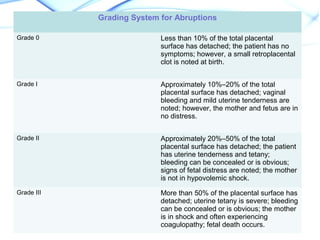
Grading System for Abruptions 
Grade 0 Less than 10% of the total placental 
surface has detached; the patient has no 
symptoms; however, a small retroplacental 
clot is noted at birth. 
Grade I Approximately 10%–20% of the total 
placental surface has detached; vaginal 
bleeding and mild uterine tenderness are 
noted; however, the mother and fetus are in 
no distress. 
Grade II Approximately 20%–50% of the total 
placental surface has detached; the patient 
has uterine tenderness and tetany; 
bleeding can be concealed or is obvious; 
signs of fetal distress are noted; the mother 
is not in hypovolemic shock. 
Grade III More than 50% of the placental surface has 
detached; uterine tetany is severe; bleeding 
can be concealed or is obvious; the mother 
is in shock and often experiencing 
coagulopathy; fetal death occurs.
ASSESSMENT
HISTORY 
• Obtain an obstetric history 
• Determine the date of the last menstrual period to cal-culate 
the estimated day of delivery and gestational age 
of the infant 
• Inquire about alcohol, tobacco, and drug usage, and any 
trauma or abuse situations during pregnancy 
• Ask the patient to describe the onset of bleeding (the 
circumstances, amount, and presence of pain)
PHYSICAL EXAMINATION 
• Assess the amount and character of vaginal bleeding; 
blood is often dark red in color, and the amount may 
vary, depending on the location of abruption. 
• Palpate the uterus; patients complain of uterine 
tenderness and abdominal/back pain. 
• The fundus is woodlike, and poor resting tone can be 
noted. 
• With a mild placental separation, contractions are usually 
of normal frequency, intensity, and duration. 
• If the abruption is more severe, strong, erratic 
contractions occur.
• Assess for signs of concealed hemorrhage: slight or 
absent vaginal bleeding; an increase in fundal height; a 
rigid, boardlike abdomen; poor rest- ing tone; constant 
abdominal pain; and late decelerations or decreased 
variability of the fetal heart rate. 
• A vaginal exam should not be done until an ultrasound 
is performed to rule out placenta previa. 
• Using electronic fetal monitoring, determine the baseline 
fetal heart rate and presence or absence of 
accelerations, decelerations, and variability. 
• At times, persistent uterine hypertonus is noted with an 
elevated baseline resting tone of 20 to 25 mm Hg. 
• Ask the patient if she feels the fetal movement.
• Using electronic fetal monitoring, determine the 
baseline fetal heart rate and presence or 
absence of accelerations, decelerations, and 
variability. 
• At times, persistent uterine hypertonus is noted 
with an elevated baseline resting tone of 20 to 
25 mm Hg. 
• Ask the patient if she feels the fetal movement. 
Fetal position and presentation can be assessed 
by Leopold’s maneuvers.
• Assess the contraction status, and view the fetal monitor 
strip to note the frequency and duration of contractions. 
• Throughout labor, monitor the patient’s bleeding, vital 
signs, color, urine output, level of consciousness, uterine 
resting tone and contractions, and cervical dilation. 
• If placenta previa has been ruled out, perform sterile 
vaginal exams to determine the progress of labor. 
• Assess the patient’s abdominal girth hourly by placing a 
tape measure at the level of the umbili- cus. 
• Maintain continuous fetal monitoring.
PSYCHOSOCIAL 
• Assess the patient’s understanding of the 
situation and also the significant other’s 
degree of anxiety, coping ability, and 
willingness to support the patient.
Diagnostic Highlights 
General Comments: Abruptio placentae is diagnosed based on the clinical 
symptoms, and the diagnosis is confirmed after delivery by examining the 
placenta. 
Test Normal Result Abnormally with 
Condition 
Explanation 
Pelvic ultrasound Placenta is 
visualized in the 
fundus of the 
uterus 
None; ultrasound 
is used to rule out 
a previa 
If the placenta is 
in the lower 
uterine segment, 
a previa (not an 
abruption) exists 
Other Tests: Complete blood count (CBC); coagulation studies; type and 
crossmatch; nonstress test and biophysical profile are done to assess fetal well-being
PRIMARY NURSING DIAGNOSIS 
• Fluid volume deficit related to blood loss 
OUTCOME 
• Fluid balance; Hydration; Circulation status 
INTERVENTIONS 
• Bleeding reduction; Blood product administration; 
Intravenous therapy; Shock management
PLANNING AND IMPLEMENTATION 
Conservative treatment 
• Bedrest 
• tocolytic (inhibition of uterine contractions) therapy 
• constant maternal and fetal surveillance 
• If a vaginal delivery is indicated and no regular 
contractions are occurring, the physician may choose to 
infuse oxytocin cautiously in order to induce the labor.
If the patient’s condition is more severe: 
• assessments of blood loss, vital signs, and fetal heart 
rate pattern and variability are performed. 
• Give LR solution IV 
• Blood transfusions 
• Central venous pressure (CVP) 
(A normal CVP of 10 cm H2O is the goal) 
• CVP readings may indicate: 
fluid volume deficit (low readings) 
fluid overload and possible pulmonary edema 
(high readings).
• If the mother or fetus is in distress - emergency cesarean 
section 
FETAL DISTRESS 
 Flat variability 
 Late decelerations 
 Bradycardia 
 Tachycardia 
Management: 
• Turn the patient to her left side 
• Increase the rate of her IV infusion 
• Administer oxygen via face mask 
• Notify the physician.
If a cesarean section is planned: 
 Informed consent is obtained 
 Prepare the patient’s abdomen for surgery 
 Insert a foley catheter 
 Administer preoperative medications as ordered 
 Notify the necessary personnel to attend the operation
After delivery 
monitor the degree of bleeding 
perform fundal checks frequently 
(fundus should be firm, midline, and at or below 
the level of the umbilicus.) 
Determine the Rh status of the mother; if the 
patient is Rh-negative and the fetus is Rh-positive 
with a negative Coombs’test, administer 
Rho(D) immune globulin (rhoGAM).
Independent 
 During prenatal visits, explain the risk factors and the 
relationship of alcohol and substance abuse to the 
condition. 
 Teach the patient to report any signs of abruption, such 
as cramping and bleeding. 
• If the patient develops abruptio placentae and a vaginal 
delivery is chosen as the treatment option, the mother 
may not receive analgesics because of the fetus’s 
prematurity; regional anesthesia may be considered. 
 Keep the patient and the significant others informed of 
the progress of labor, as well as the condition of the 
mother and fetus.
 Offer as many choices as possible to increase the 
patient’s sense of control. 
 Reassure the significant others that both the fetus and 
the mother are being monitored for complications and 
that surgical intervention may be indicated. 
 Provide the patient and family with an honest 
commentary about the risks. 
 Discuss the possibility of an emergency cesarean 
section or the delivery of a premature infant. 
 Answer the patient’s questions honestly about the risk of 
a neonatal death. 
 If the fetus does not survive, support the patient and 
listen to her feelings about the loss.
DOCUMENTATION GUIDELINES 
• Amount and character of bleeding: Uterine resting tone; 
intensity, frequency, and duration of contractions and 
uterine irritability 
• Response to treatment: Intravenous fluids, blood 
transfusion, medications, surgical interventions 
• Fetal heart rate baseline, variability, absence or 
presence of accelerations or decelerations, bradycardia, 
tachycardia
MEDICATIONS 
 Instruct the patient not to miss a dose of the tocolytic 
medication; usually the medication is prescribed for 
every 4 hours and is to be taken throughout the day and 
night. 
 Tell her to expect side effects of palpitations, fast heart 
rate, and restlessness. 
 Teach the patient to notify the doctor and come to the 
hospital immediately if she experiences any bleeding or 
contractions. 
 Note that being on tocolytic therapy may mask 
contractions. Therefore, if she feels any uterine 
contractions, she may be developing abruptio placentae
POSTPARTUM 
• Give the usual postpartum instructions for avoiding 
complications. 
• Inform the patient that she is at much higher risk of 
developing abruptio placentae in subsequent 
pregnancies. 
• Instruct the patient on how to provide safe care of the 
infant. 
• If the fetus has not survived, provide a list of referrals to 
the patient and significant others to help them manage 
their loss.
Thank You 
Kingsoft Office

Abruptio placenta

  • 1.
    Abruptio Placentae Preparedby: Crisanto T. Layos
  • 2.
    • Abruptio placentais the premature separation of a normally implanted placenta before the delivery of the baby. • It is characterized by a triad of symptoms: vaginal bleeding, uterine hyper tonus, and fetal distress.
  • 3.
    CAUSES • Unknown • Hypertension • Preterm premature rupture of membranes • Smoking • Cocaine abuse are the most common associated factors
  • 4.
    • A shortumbilical cord, thrombophilias, external trauma, fibroids (especially those located behind the placental implantation site), severe diabetes or renal disease, and vena cava compression are other predisposing factors.
  • 5.
    Grading System forAbruptions Grade 0 Less than 10% of the total placental surface has detached; the patient has no symptoms; however, a small retroplacental clot is noted at birth. Grade I Approximately 10%–20% of the total placental surface has detached; vaginal bleeding and mild uterine tenderness are noted; however, the mother and fetus are in no distress. Grade II Approximately 20%–50% of the total placental surface has detached; the patient has uterine tenderness and tetany; bleeding can be concealed or is obvious; signs of fetal distress are noted; the mother is not in hypovolemic shock. Grade III More than 50% of the placental surface has detached; uterine tetany is severe; bleeding can be concealed or is obvious; the mother is in shock and often experiencing coagulopathy; fetal death occurs.
  • 6.
  • 7.
    HISTORY • Obtainan obstetric history • Determine the date of the last menstrual period to cal-culate the estimated day of delivery and gestational age of the infant • Inquire about alcohol, tobacco, and drug usage, and any trauma or abuse situations during pregnancy • Ask the patient to describe the onset of bleeding (the circumstances, amount, and presence of pain)
  • 8.
    PHYSICAL EXAMINATION •Assess the amount and character of vaginal bleeding; blood is often dark red in color, and the amount may vary, depending on the location of abruption. • Palpate the uterus; patients complain of uterine tenderness and abdominal/back pain. • The fundus is woodlike, and poor resting tone can be noted. • With a mild placental separation, contractions are usually of normal frequency, intensity, and duration. • If the abruption is more severe, strong, erratic contractions occur.
  • 9.
    • Assess forsigns of concealed hemorrhage: slight or absent vaginal bleeding; an increase in fundal height; a rigid, boardlike abdomen; poor rest- ing tone; constant abdominal pain; and late decelerations or decreased variability of the fetal heart rate. • A vaginal exam should not be done until an ultrasound is performed to rule out placenta previa. • Using electronic fetal monitoring, determine the baseline fetal heart rate and presence or absence of accelerations, decelerations, and variability. • At times, persistent uterine hypertonus is noted with an elevated baseline resting tone of 20 to 25 mm Hg. • Ask the patient if she feels the fetal movement.
  • 10.
    • Using electronicfetal monitoring, determine the baseline fetal heart rate and presence or absence of accelerations, decelerations, and variability. • At times, persistent uterine hypertonus is noted with an elevated baseline resting tone of 20 to 25 mm Hg. • Ask the patient if she feels the fetal movement. Fetal position and presentation can be assessed by Leopold’s maneuvers.
  • 11.
    • Assess thecontraction status, and view the fetal monitor strip to note the frequency and duration of contractions. • Throughout labor, monitor the patient’s bleeding, vital signs, color, urine output, level of consciousness, uterine resting tone and contractions, and cervical dilation. • If placenta previa has been ruled out, perform sterile vaginal exams to determine the progress of labor. • Assess the patient’s abdominal girth hourly by placing a tape measure at the level of the umbili- cus. • Maintain continuous fetal monitoring.
  • 12.
    PSYCHOSOCIAL • Assessthe patient’s understanding of the situation and also the significant other’s degree of anxiety, coping ability, and willingness to support the patient.
  • 13.
    Diagnostic Highlights GeneralComments: Abruptio placentae is diagnosed based on the clinical symptoms, and the diagnosis is confirmed after delivery by examining the placenta. Test Normal Result Abnormally with Condition Explanation Pelvic ultrasound Placenta is visualized in the fundus of the uterus None; ultrasound is used to rule out a previa If the placenta is in the lower uterine segment, a previa (not an abruption) exists Other Tests: Complete blood count (CBC); coagulation studies; type and crossmatch; nonstress test and biophysical profile are done to assess fetal well-being
  • 14.
    PRIMARY NURSING DIAGNOSIS • Fluid volume deficit related to blood loss OUTCOME • Fluid balance; Hydration; Circulation status INTERVENTIONS • Bleeding reduction; Blood product administration; Intravenous therapy; Shock management
  • 15.
    PLANNING AND IMPLEMENTATION Conservative treatment • Bedrest • tocolytic (inhibition of uterine contractions) therapy • constant maternal and fetal surveillance • If a vaginal delivery is indicated and no regular contractions are occurring, the physician may choose to infuse oxytocin cautiously in order to induce the labor.
  • 16.
    If the patient’scondition is more severe: • assessments of blood loss, vital signs, and fetal heart rate pattern and variability are performed. • Give LR solution IV • Blood transfusions • Central venous pressure (CVP) (A normal CVP of 10 cm H2O is the goal) • CVP readings may indicate: fluid volume deficit (low readings) fluid overload and possible pulmonary edema (high readings).
  • 17.
    • If themother or fetus is in distress - emergency cesarean section FETAL DISTRESS  Flat variability  Late decelerations  Bradycardia  Tachycardia Management: • Turn the patient to her left side • Increase the rate of her IV infusion • Administer oxygen via face mask • Notify the physician.
  • 18.
    If a cesareansection is planned:  Informed consent is obtained  Prepare the patient’s abdomen for surgery  Insert a foley catheter  Administer preoperative medications as ordered  Notify the necessary personnel to attend the operation
  • 19.
    After delivery monitorthe degree of bleeding perform fundal checks frequently (fundus should be firm, midline, and at or below the level of the umbilicus.) Determine the Rh status of the mother; if the patient is Rh-negative and the fetus is Rh-positive with a negative Coombs’test, administer Rho(D) immune globulin (rhoGAM).
  • 20.
    Independent  Duringprenatal visits, explain the risk factors and the relationship of alcohol and substance abuse to the condition.  Teach the patient to report any signs of abruption, such as cramping and bleeding. • If the patient develops abruptio placentae and a vaginal delivery is chosen as the treatment option, the mother may not receive analgesics because of the fetus’s prematurity; regional anesthesia may be considered.  Keep the patient and the significant others informed of the progress of labor, as well as the condition of the mother and fetus.
  • 21.
     Offer asmany choices as possible to increase the patient’s sense of control.  Reassure the significant others that both the fetus and the mother are being monitored for complications and that surgical intervention may be indicated.  Provide the patient and family with an honest commentary about the risks.  Discuss the possibility of an emergency cesarean section or the delivery of a premature infant.  Answer the patient’s questions honestly about the risk of a neonatal death.  If the fetus does not survive, support the patient and listen to her feelings about the loss.
  • 22.
    DOCUMENTATION GUIDELINES •Amount and character of bleeding: Uterine resting tone; intensity, frequency, and duration of contractions and uterine irritability • Response to treatment: Intravenous fluids, blood transfusion, medications, surgical interventions • Fetal heart rate baseline, variability, absence or presence of accelerations or decelerations, bradycardia, tachycardia
  • 23.
    MEDICATIONS  Instructthe patient not to miss a dose of the tocolytic medication; usually the medication is prescribed for every 4 hours and is to be taken throughout the day and night.  Tell her to expect side effects of palpitations, fast heart rate, and restlessness.  Teach the patient to notify the doctor and come to the hospital immediately if she experiences any bleeding or contractions.  Note that being on tocolytic therapy may mask contractions. Therefore, if she feels any uterine contractions, she may be developing abruptio placentae
  • 24.
    POSTPARTUM • Givethe usual postpartum instructions for avoiding complications. • Inform the patient that she is at much higher risk of developing abruptio placentae in subsequent pregnancies. • Instruct the patient on how to provide safe care of the infant. • If the fetus has not survived, provide a list of referrals to the patient and significant others to help them manage their loss.
  • 25.