OBSERVATIONAL STUDIES (COHORT AND CASE-CONTROL STUDIES)
PRESENTATION
BY
BELLO LAWAL DANCHADI
AT
CENTRE FOR ADVANCED MEDICAL RESEARCH AND TRAINING, (CAMRET).
USMANU DANFODIYO UNIVERSITY, SOKOTO.
Outline
• Introduction
• Observational studies
• Cohort studies
• Case-control studies
• Cross sectional studies
• Advantages and disadvantages each
Introduction
Observational studies
• Also called epidemiologic studies,
• It is a study that is designed to study the following:
• Etiology
• Natural history
• Treatment of rare conditions
• Instances where randomized controlled trial might be unethical, (mann, 2003).
• The researcher does not intervene but rather “observes”, (Concato, et al., 2000).
• Types are: Cohort, Case-conrtol and Cross-sectional studies.
Observational study design
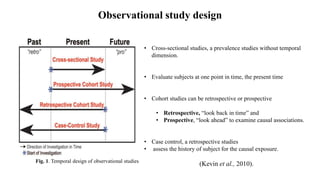
Fig. 1. Temporal design of observational studies
• Cross-sectional studies, a prevalence studies without temporal
dimension.
• Evaluate subjects at one point in time, the present time
• Cohort studies can be retrospective or prospective
• Retrospective, “look back in time” and
• Prospective, “look ahead” to examine causal associations.
• Case control, a retrospective studies
• assess the history of subject for the causal exposure.
(Kevin et al., 2010).
Cohort studies: Origin
• “Cohort” has military roots, originate from Latin word “cohors”, (Sung and Chung,
2010).
• First appeared in medical literature in 1930s in an article by epidemiologist W.H. Frost,
(Doll, 2001).
• The modern epidemiologic definition:
• Group of people with defined characteristics followed-up to determine incidence,
causes and outcomes, (Merril and Timmreck, 2004).
• Measure the outcomes in their chronological order,
Cohort study cont’d
• Used to distinguish between cause and effect,
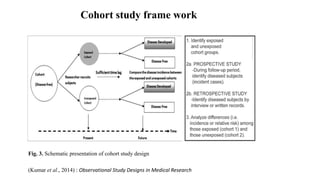
• Cohort study is of two types, “Retrospective” and “Prospective”, (Kumar et al., 2014).
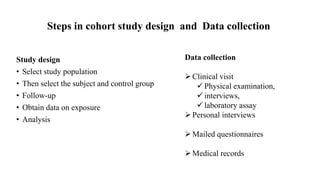
Steps in cohort study design and Data collection
Study design
• Select study population
• Then select the subject and control group
• Follow-up
• Obtain data on exposure
• Analysis
Data collection
Clinical visit
 Physical examination,
 interviews,
 laboratory assay
Personal interviews
Mailed questionnaires
Medical records
Fig. 2. Levels of subject selection. (Adapted from Elwood M. Critical Appraisal of Epidemiological Studies and Clinical Trials. 3rd ed. Oxford: Oxford University Press; 2007:1–570.
COHORT STUDY: SELECTION PROCESSES
criteria
Cohort study frame work
Fig. 3. Schematic presentation of cohort study design
(Kumar et al., 2014) : Observational Study Designs in Medical Research
Advantages and Disadvantages of cohort study
Advantages
• Calculate the relative risk directly
• Study a range of possible risk factors
• Incidence can be directly calculated
• Hypothesis testing
• Several possible outcomes can be
studied,
• Retrospective is cheap and quick
Disadvantages
• Requires large cohort of patients
• Not suitable for rear diseases
• Very expensive
• Time consuming
• Differential loss to follow up can
introduce bias,
(Kumar et al., 2014)
Case-control studies
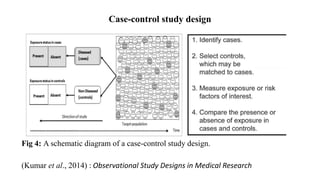
• Compare two groups retrospectively
• Identify people with disease (case patients), people with out disease (controls) and ask
everyone about past exposures
• Help to investigate the disease etiologies through the detailed histories and examination of
patient, (Paneth et al., 2002).
• Measures exposure and outcome and study association,
• Aim to identify predictors outcome and useful for hypothesis generation.
• Only practicable method for identifying risk factors for rare diseases, (Mann, 2012).
Case-control study design
Fig 4: A schematic diagram of a case-control study design.
(Kumar et al., 2014) : Observational Study Designs in Medical Research
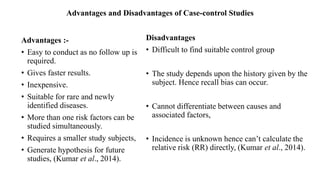
Advantages and Disadvantages of Case-control Studies
Advantages :-
• Easy to conduct as no follow up is
required.
• Gives faster results.
• Inexpensive.
• Suitable for rare and newly
identified diseases.
• More than one risk factors can be
studied simultaneously.
• Requires a smaller study subjects,
• Generate hypothesis for future
studies, (Kumar et al., 2014).
Disadvantages
• Difficult to find suitable control group
• The study depends upon the history given by the
subject. Hence recall bias can occur.
• Cannot differentiate between causes and
associated factors,
• Incidence is unknown hence can’t calculate the
relative risk (RR) directly, (Kumar et al., 2014).
Cross sectional studies
• Used to study the prevalence at a given point in time,
• Group with or without the outcome of interest are used (Mann, 2012).
• Only one group is used and data is collected only once,
• Can study multiple outcomes but do not differentiate between cause and effect.
• Done using questionnaire or interview.
• Formulate a research question and choose a study population (Kevin et al., 2010).
Cross sectional studies cont’d
• Decide what variable of the study population relevant to the questions (Mann, 2012)
• Method for contacting subject must be devised and implemented,
• Then the data are collected and analyzed (Mann, 2012).
• Quick, cheap and no follow-up required
• Required fewer resources to run the study,
References
Concato J, Shah N, Horwitz RI. (2000). Randomized, controlled trials, observational studies, and the hierarchy of research designs. N
Engl J Med.;342:1887–1892.
Doll R., (2001). Cohort studies: history of the method. I. Prospective cohort studies. Soz Präventivmed.;46(2):75-86.
Grimes D.A., Schulz K.F., (2002). Cohort studies: marching towards outcomes. Lancet.;359(9303):341-5.
Kumar R., Khan A.M., Chatterjee P., (2014). Types of observational studies in medical research. Astrocyte;1:154-9.
Kevin C. Chung, M.D., M.S. (2010). Observational Studies: Cohort and Case-Control Studies, Section of Plastic Surgery, 126: 2234,
Mann C.J. (2003). Observational research methods. Research design II: Cohort, cross sectional, and case-control studies. Emerg. Med.
J. 20:54-60.
Merril RM, Timmreck TC. (2006). Introduction to Epidemiology. 4th ed. Sudbury, Mass: Jones and Bartlett Publishers;1–352. 7.
Paneth N., Susser E., Susser M., (2002). Origins and early development of the case–control study: part 1, early evolution. Soz
Präventivmed.; 47(5):282-8.
Song J.W, Chung K.C., (2010). Observational studies: cohort and case–control studies. Plast Reconstr Surg.;126(6):2234-42.
Chen Yu, Graziano J, Parvez F, et al., Arsenic exposure from drinking water and mortality from cardiovascular disease in Bangladesh.
BMJ 2011;342:2431.
Short P, Lipworth S, Elder D, et al. Effect of B Blockers in treatment of chronic obstructive pulmonary disease: a retrospective cohort
study. BMJ 2011;342:d2549
Morabia A. A History of Epidemiologic Methods and Concepts. Basel: Birkhaeuser Verlag; 2004:1–405.
Mann, C. J. (2012). Observational research methods –– Cohort studies , cross sectional studies , and case – control studies ´ thodes des
e ´ tudes d ’ observation – Etudes de cohorte , Me ´ tudes transversales , e ´ moins e. African Journal of Emergency Medicine, 2(1), 38–
46. https://doi.org/10.1016/j.afjem.2011.12.004

Observational Studies.pptx

  • 1.
    OBSERVATIONAL STUDIES (COHORTAND CASE-CONTROL STUDIES) PRESENTATION BY BELLO LAWAL DANCHADI AT CENTRE FOR ADVANCED MEDICAL RESEARCH AND TRAINING, (CAMRET). USMANU DANFODIYO UNIVERSITY, SOKOTO.
  • 2.
    Outline • Introduction • Observationalstudies • Cohort studies • Case-control studies • Cross sectional studies • Advantages and disadvantages each
  • 3.
    Introduction Observational studies • Alsocalled epidemiologic studies, • It is a study that is designed to study the following: • Etiology • Natural history • Treatment of rare conditions • Instances where randomized controlled trial might be unethical, (mann, 2003). • The researcher does not intervene but rather “observes”, (Concato, et al., 2000). • Types are: Cohort, Case-conrtol and Cross-sectional studies.
  • 4.
    Observational study design Fig.1. Temporal design of observational studies • Cross-sectional studies, a prevalence studies without temporal dimension. • Evaluate subjects at one point in time, the present time • Cohort studies can be retrospective or prospective • Retrospective, “look back in time” and • Prospective, “look ahead” to examine causal associations. • Case control, a retrospective studies • assess the history of subject for the causal exposure. (Kevin et al., 2010).
  • 5.
    Cohort studies: Origin •“Cohort” has military roots, originate from Latin word “cohors”, (Sung and Chung, 2010). • First appeared in medical literature in 1930s in an article by epidemiologist W.H. Frost, (Doll, 2001). • The modern epidemiologic definition: • Group of people with defined characteristics followed-up to determine incidence, causes and outcomes, (Merril and Timmreck, 2004). • Measure the outcomes in their chronological order,
  • 6.
    Cohort study cont’d •Used to distinguish between cause and effect, • Cohort study is of two types, “Retrospective” and “Prospective”, (Kumar et al., 2014).
  • 7.
    Steps in cohortstudy design and Data collection Study design • Select study population • Then select the subject and control group • Follow-up • Obtain data on exposure • Analysis Data collection Clinical visit  Physical examination,  interviews,  laboratory assay Personal interviews Mailed questionnaires Medical records
  • 8.
    Fig. 2. Levelsof subject selection. (Adapted from Elwood M. Critical Appraisal of Epidemiological Studies and Clinical Trials. 3rd ed. Oxford: Oxford University Press; 2007:1–570. COHORT STUDY: SELECTION PROCESSES criteria
  • 9.
    Cohort study framework Fig. 3. Schematic presentation of cohort study design (Kumar et al., 2014) : Observational Study Designs in Medical Research
  • 10.
    Advantages and Disadvantagesof cohort study Advantages • Calculate the relative risk directly • Study a range of possible risk factors • Incidence can be directly calculated • Hypothesis testing • Several possible outcomes can be studied, • Retrospective is cheap and quick Disadvantages • Requires large cohort of patients • Not suitable for rear diseases • Very expensive • Time consuming • Differential loss to follow up can introduce bias, (Kumar et al., 2014)
  • 11.
    Case-control studies • Comparetwo groups retrospectively • Identify people with disease (case patients), people with out disease (controls) and ask everyone about past exposures • Help to investigate the disease etiologies through the detailed histories and examination of patient, (Paneth et al., 2002). • Measures exposure and outcome and study association, • Aim to identify predictors outcome and useful for hypothesis generation. • Only practicable method for identifying risk factors for rare diseases, (Mann, 2012).
  • 12.
    Case-control study design Fig4: A schematic diagram of a case-control study design. (Kumar et al., 2014) : Observational Study Designs in Medical Research
  • 13.
    Advantages and Disadvantagesof Case-control Studies Advantages :- • Easy to conduct as no follow up is required. • Gives faster results. • Inexpensive. • Suitable for rare and newly identified diseases. • More than one risk factors can be studied simultaneously. • Requires a smaller study subjects, • Generate hypothesis for future studies, (Kumar et al., 2014). Disadvantages • Difficult to find suitable control group • The study depends upon the history given by the subject. Hence recall bias can occur. • Cannot differentiate between causes and associated factors, • Incidence is unknown hence can’t calculate the relative risk (RR) directly, (Kumar et al., 2014).
  • 14.
    Cross sectional studies •Used to study the prevalence at a given point in time, • Group with or without the outcome of interest are used (Mann, 2012). • Only one group is used and data is collected only once, • Can study multiple outcomes but do not differentiate between cause and effect. • Done using questionnaire or interview. • Formulate a research question and choose a study population (Kevin et al., 2010).
  • 15.
    Cross sectional studiescont’d • Decide what variable of the study population relevant to the questions (Mann, 2012) • Method for contacting subject must be devised and implemented, • Then the data are collected and analyzed (Mann, 2012). • Quick, cheap and no follow-up required • Required fewer resources to run the study,
  • 16.
    References Concato J, ShahN, Horwitz RI. (2000). Randomized, controlled trials, observational studies, and the hierarchy of research designs. N Engl J Med.;342:1887–1892. Doll R., (2001). Cohort studies: history of the method. I. Prospective cohort studies. Soz Präventivmed.;46(2):75-86. Grimes D.A., Schulz K.F., (2002). Cohort studies: marching towards outcomes. Lancet.;359(9303):341-5. Kumar R., Khan A.M., Chatterjee P., (2014). Types of observational studies in medical research. Astrocyte;1:154-9. Kevin C. Chung, M.D., M.S. (2010). Observational Studies: Cohort and Case-Control Studies, Section of Plastic Surgery, 126: 2234, Mann C.J. (2003). Observational research methods. Research design II: Cohort, cross sectional, and case-control studies. Emerg. Med. J. 20:54-60. Merril RM, Timmreck TC. (2006). Introduction to Epidemiology. 4th ed. Sudbury, Mass: Jones and Bartlett Publishers;1–352. 7. Paneth N., Susser E., Susser M., (2002). Origins and early development of the case–control study: part 1, early evolution. Soz Präventivmed.; 47(5):282-8. Song J.W, Chung K.C., (2010). Observational studies: cohort and case–control studies. Plast Reconstr Surg.;126(6):2234-42. Chen Yu, Graziano J, Parvez F, et al., Arsenic exposure from drinking water and mortality from cardiovascular disease in Bangladesh. BMJ 2011;342:2431. Short P, Lipworth S, Elder D, et al. Effect of B Blockers in treatment of chronic obstructive pulmonary disease: a retrospective cohort study. BMJ 2011;342:d2549 Morabia A. A History of Epidemiologic Methods and Concepts. Basel: Birkhaeuser Verlag; 2004:1–405. Mann, C. J. (2012). Observational research methods –– Cohort studies , cross sectional studies , and case – control studies ´ thodes des e ´ tudes d ’ observation – Etudes de cohorte , Me ´ tudes transversales , e ´ moins e. African Journal of Emergency Medicine, 2(1), 38– 46. https://doi.org/10.1016/j.afjem.2011.12.004