SAMPLING TECHNIQUES
PRESENTATION
BY
BELLO LAWAL DANCHADI
AT
CENTRE FOR ADVANCED MEDICAL RESEARCH AND TRAINING, (CAMRET).
USMANU DANFODIYO UNIVERSITY, SOKOTO.
Outlines
• Introduction
• Sampling design processes
• Types of sampling
• Advantages and disadvantages
• Summary
• References
Introduction
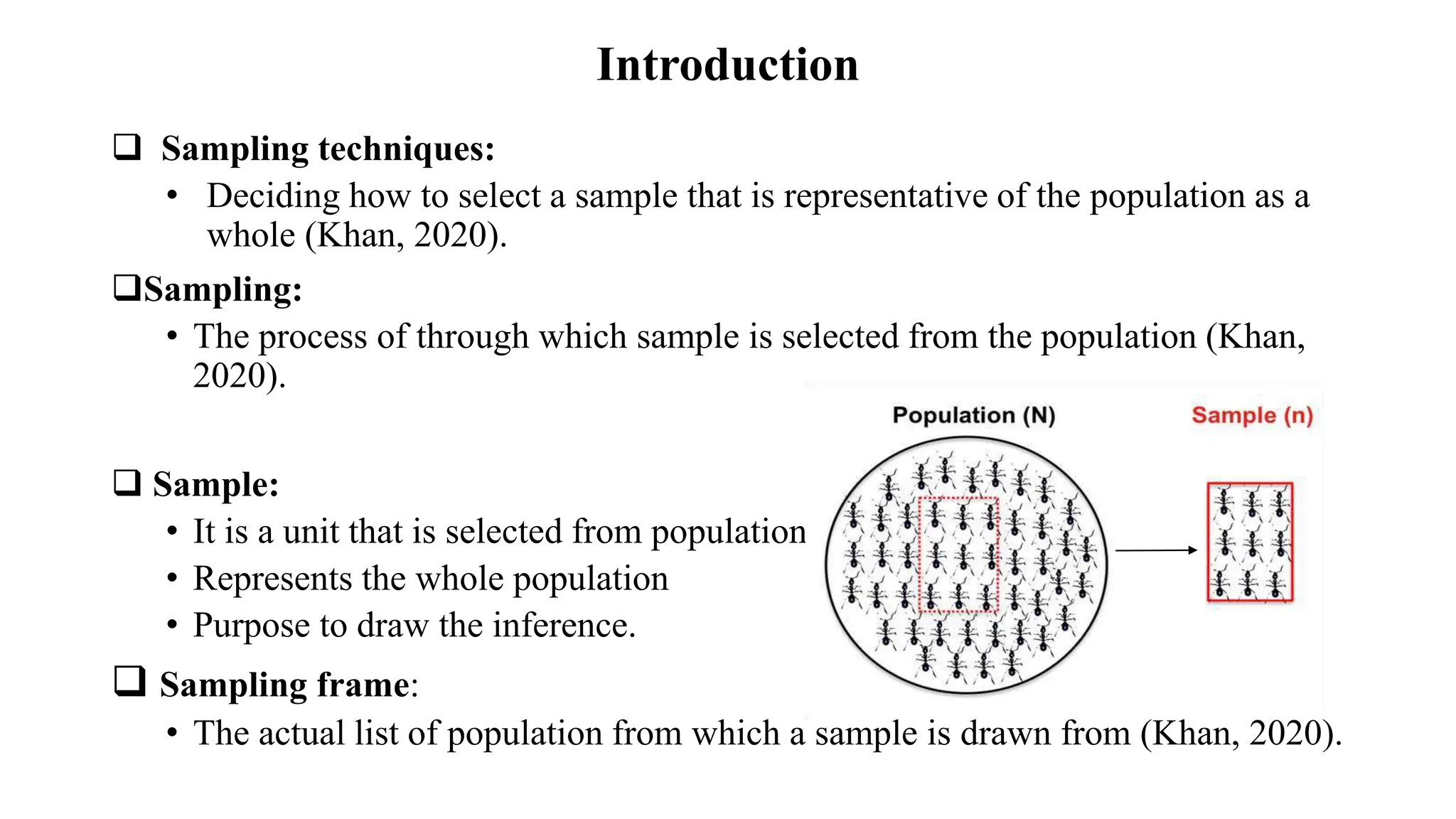
 Sampling techniques:
• Deciding how to select a sample that is representative of the population as a
whole (Khan, 2020).
Sampling:
• The process of through which sample is selected from the population (Khan,
2020).
 Sample:
• It is a unit that is selected from population
• Represents the whole population
• Purpose to draw the inference.
 Sampling frame:
• The actual list of population from which a sample is drawn from (Khan, 2020).
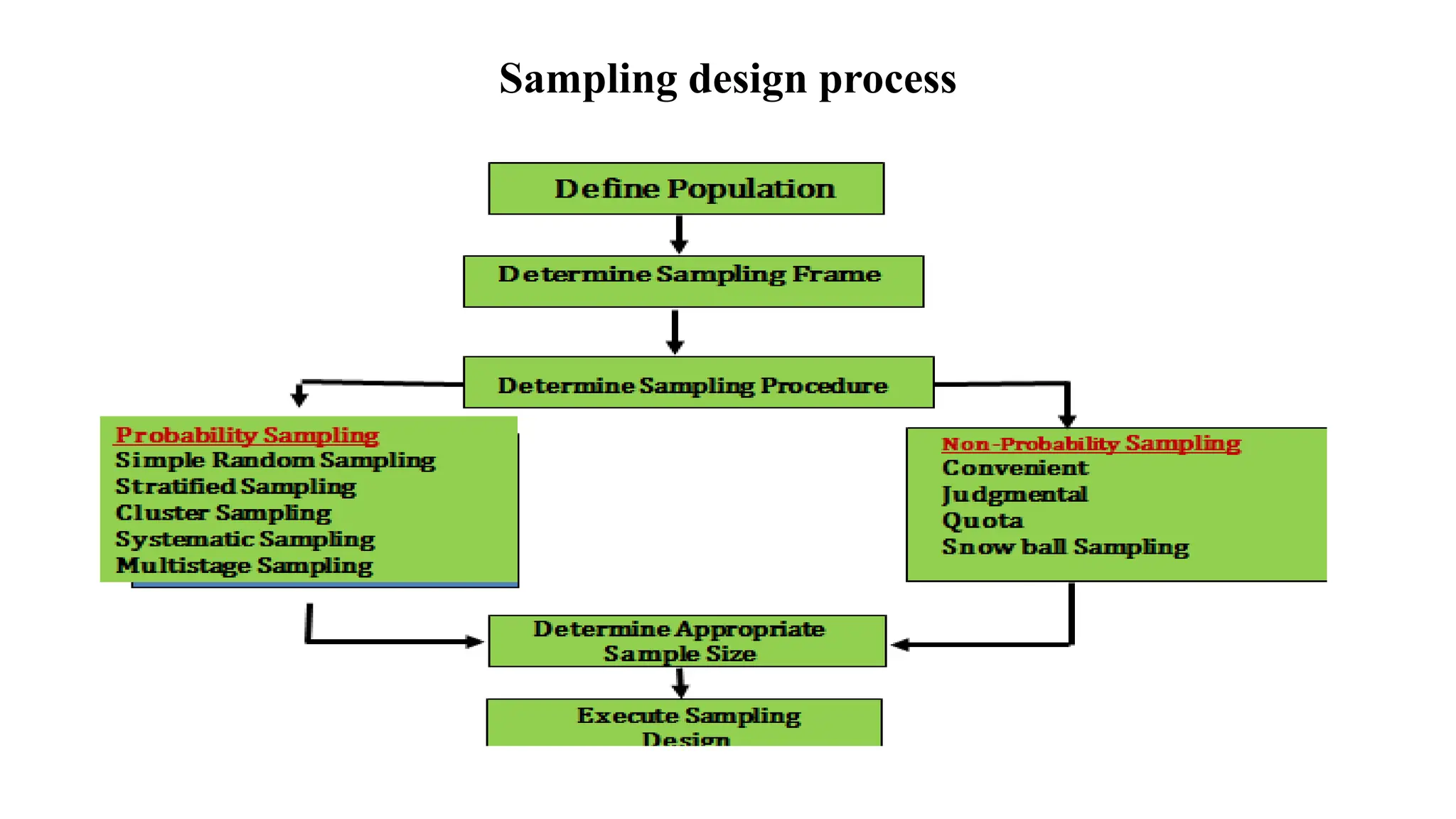
Sampling
Sampling design process
Probability sampling
Advantages:
• Minimal knowledge of population
needed
• Easy to analyze data
• Involves the random selection,
• Allow a researcher to make a strong statistical inference about the whole population
• Every member of the population has a chance of being selected.
• It is mainly used in quantitative research (Mccombesa, 2023).
1. Simple random sampling
• All subsets of the frame are given an equal probability.
• Equal chance of being selected
• It can be done using a random number generators
• It provides unbiased results but can be time-consuming.
Disadvantages:
• Low frequency of use
• Does not use researchers’ expertise
• Larger risk of random error
2. Systematic sampling
• Alphabetically, order all units in the sampling frame
• Then every nth number on the list is selected
• n = sampling Interval
• After randomly selecting a starting point.
• It is straightforward to implement but may introduce bias if there is a pattern in the
data.
Advantages:
• Moderate cost; moderate usage
• Simple to draw sample
• Easy to verify
Disadvantages:
• Periodic ordering required (McCombesa, 2023)
3. Stratified sampling
• Population is divided into two or more groups called strata.
• Based on the relevant traits (e.g., gender identity, age range, income, Job role).
• Subsamples are randomly/systematically selected from each strata.
• Subgroups are properly represented in the sample.
(Tam and Woo, 2020).
• Advantages:
• Assures representation of all groups in sample population
• Characteristics of each stratum can be estimated and comparisons made
• Disadvantages:
• Requires accurate information on proportions of each stratum
• Stratified lists costly to prepare (Tam and Woo, 2020).
4. Cluster sampling:
• The population is divided into subgroups (clusters) like families.
• A random selection of clusters is chosen.
• A simple random sample is taken from each cluster.
• It is useful when the population is geographically dispersed,
• But it may lead to less precision compared to other techniques. (Peven et al., 2019)
5. Cluster sampling
Advantages:
• Can estimate characteristics of both cluster and population
Disadvantages:
• The cost to reach an element to sample is very high
• Each stage in cluster sampling introduces sampling error,
• The more stages there are, the more error there tends to be.
5. Multistage sampling
• The population is divided into different stages, and a sample is selected at each stage.
• It starts with selecting larger clusters or groups from the population in the first stage.
• Then, within each selected cluster, smaller clusters or units are chosen in the second stage,
• This process may continue through several stages until the final sample units are selected.
• The final sample units can be individuals, households, or any other relevant units.
• Useful when the target population is large, geographically dispersed, or difficult to access.
Advantages:
• More Accurate
• More Effective
(McCombesa, 2023)
Disadvantages:
• Costly
• Each stage in sampling introduces sampling error
• The more stages there are, the more error there tends to be
Non probability sampling
• Individuals are selected based on non-random criteria, and not every individual
has a chance of being included.
• Often used in qualitative research (McCombesa, 2023).
• Units of the sample are chosen on the basis of personal judgment or convenience.
1. Snowball sampling
• The research starts with a key person and introduce the next one to become a chain
Advantages
• Low cost
• Useful in specific circumstances & for locating rare populations
Disadvantages
• Not independent
• Projecting data beyond sample not justified, (Elfil and Negida, 2017).
2. Convenience sampling
• The process of including whoever happens to be available at the time…called
“accidental” or “haphazard” sampling.
• But there is no way to tell if the sample is representative of the population
(McCombesa, 2023).
Advantages
• Very low cost
• Extensively used/understood
Disadvantages
• Variability and bias cannot be measured or controlled
• Projecting data beyond sample not justified
• It can’t produce generalizable results.
3. Purposive sampling
• Involves the researcher using their expertise to select a sample that is
most useful to the purposes of the research.
• Also called “judgmental” sampling.
Advantages
• There is a assurance of Quality response
• Meet the specific objective.
Disadvantages
• Bias selection of sample may occur
• Time consuming process. (McCombesa, 2023)
4. Quota sampling
• The process whereby a researcher gathers data from individuals possessing
identified characteristics and quotas.
• You first divide the population into mutually exclusive subgroups (called strata)
and then recruit sample units until you reach your quota. (Omair, 2014).
• These units share specific characteristics, determined by you prior to forming your
strata.
• The aim of quota sampling is to control what or who makes up your sample.
Advantages
• Used when research budget is limited
• Very extensively used/understood
• No need for list of population elements.
(McCombesa, 2023).
Disadvantages
• Variability and bias cannot be
measured/controlled
• Time Consuming
• Projecting data beyond sample not
justified.
5. Self-selection sampling
• It occurs when you allow each case usually individuals, to identify their desire to
take part in the research.
• Instead of the researcher choosing participants and directly contacting them,
people volunteer themselves (e.g. by responding to a public online survey).
Advantages
• More accurate
• Useful in specific circumstances to serve the purpose.
Disadvantages
• More costly due to Advertising
• Mass are left. (McCombesa, 2023)
References
• Elfil, M., & Negida, A. (2017). Sampling methods in clinical research: An educational review. Emergency,
5 (1), Article e52, 1–3.
• Firchow, P., & MacGinty, R. (2020). Including hard-to-access pop- ulations using mobile phone surveys
and participatory indica- tors. Sociological Methods & Research, 49(1), 133–160. Magnani, R., Sabin, K.,
Saidel, T., & Heckathorn, D. (2005). Review of sampling hard-to-reach and hidden populations for HIV
surveillance. AIDS, 19 (Suppl. 2), S67–S72.
• Omair, A. (2014). Sample size estimation and sampling techniques for selecting a representative sample.
Journal of Health Specialties, 2(4), 142–147.
• Peven, K., Purssell, E., Taylor, C., Bick, D., and Lopez, V. K. (2019). Breastfeeding support in low and
middle-income countries: Secondary analysis of national survey data, Midwifery, 82.
https://doi.org/10.1016/j.midw.2019.102601 Shorten, A., & Moorley, C. (2014). Selecting the sample.
Evidence Based Nursing, 17(2), 32–33.
• Tam, W., Lo, K., and Woo, B. (2020). Reporting sample size cal- culations for randomized controlled trials
published in nurs- ing journals: A cross-sectional study. International Journal of Nursing Studies, 102.
https://doi.org/10.1016/j.ijnurstu.2019 .1034
• McCombes, S. (2023). Sampling Methods | Types, Techniques & Examples. Scribbr. Retrieved July 9,
2023, from https://www.scribbr.com/methodology/sampling-methods/

SAMPLING TECHNIQUES AND HOW TO SELECT.pptx

  • 1.
    SAMPLING TECHNIQUES PRESENTATION BY BELLO LAWALDANCHADI AT CENTRE FOR ADVANCED MEDICAL RESEARCH AND TRAINING, (CAMRET). USMANU DANFODIYO UNIVERSITY, SOKOTO.
  • 2.
    Outlines • Introduction • Samplingdesign processes • Types of sampling • Advantages and disadvantages • Summary • References
  • 3.
    Introduction  Sampling techniques: •Deciding how to select a sample that is representative of the population as a whole (Khan, 2020). Sampling: • The process of through which sample is selected from the population (Khan, 2020).  Sample: • It is a unit that is selected from population • Represents the whole population • Purpose to draw the inference.  Sampling frame: • The actual list of population from which a sample is drawn from (Khan, 2020).
  • 4.
  • 5.
  • 6.
    Probability sampling Advantages: • Minimalknowledge of population needed • Easy to analyze data • Involves the random selection, • Allow a researcher to make a strong statistical inference about the whole population • Every member of the population has a chance of being selected. • It is mainly used in quantitative research (Mccombesa, 2023). 1. Simple random sampling • All subsets of the frame are given an equal probability. • Equal chance of being selected • It can be done using a random number generators • It provides unbiased results but can be time-consuming. Disadvantages: • Low frequency of use • Does not use researchers’ expertise • Larger risk of random error
  • 7.
    2. Systematic sampling •Alphabetically, order all units in the sampling frame • Then every nth number on the list is selected • n = sampling Interval • After randomly selecting a starting point. • It is straightforward to implement but may introduce bias if there is a pattern in the data. Advantages: • Moderate cost; moderate usage • Simple to draw sample • Easy to verify Disadvantages: • Periodic ordering required (McCombesa, 2023)
  • 8.
    3. Stratified sampling •Population is divided into two or more groups called strata. • Based on the relevant traits (e.g., gender identity, age range, income, Job role). • Subsamples are randomly/systematically selected from each strata. • Subgroups are properly represented in the sample. (Tam and Woo, 2020).
  • 9.
    • Advantages: • Assuresrepresentation of all groups in sample population • Characteristics of each stratum can be estimated and comparisons made • Disadvantages: • Requires accurate information on proportions of each stratum • Stratified lists costly to prepare (Tam and Woo, 2020). 4. Cluster sampling: • The population is divided into subgroups (clusters) like families. • A random selection of clusters is chosen. • A simple random sample is taken from each cluster. • It is useful when the population is geographically dispersed, • But it may lead to less precision compared to other techniques. (Peven et al., 2019)
  • 10.
    5. Cluster sampling Advantages: •Can estimate characteristics of both cluster and population Disadvantages: • The cost to reach an element to sample is very high • Each stage in cluster sampling introduces sampling error, • The more stages there are, the more error there tends to be.
  • 11.
    5. Multistage sampling •The population is divided into different stages, and a sample is selected at each stage. • It starts with selecting larger clusters or groups from the population in the first stage. • Then, within each selected cluster, smaller clusters or units are chosen in the second stage, • This process may continue through several stages until the final sample units are selected. • The final sample units can be individuals, households, or any other relevant units. • Useful when the target population is large, geographically dispersed, or difficult to access. Advantages: • More Accurate • More Effective (McCombesa, 2023) Disadvantages: • Costly • Each stage in sampling introduces sampling error • The more stages there are, the more error there tends to be
  • 12.
    Non probability sampling •Individuals are selected based on non-random criteria, and not every individual has a chance of being included. • Often used in qualitative research (McCombesa, 2023). • Units of the sample are chosen on the basis of personal judgment or convenience. 1. Snowball sampling • The research starts with a key person and introduce the next one to become a chain Advantages • Low cost • Useful in specific circumstances & for locating rare populations Disadvantages • Not independent • Projecting data beyond sample not justified, (Elfil and Negida, 2017).
  • 13.
    2. Convenience sampling •The process of including whoever happens to be available at the time…called “accidental” or “haphazard” sampling. • But there is no way to tell if the sample is representative of the population (McCombesa, 2023). Advantages • Very low cost • Extensively used/understood Disadvantages • Variability and bias cannot be measured or controlled • Projecting data beyond sample not justified • It can’t produce generalizable results.
  • 14.
    3. Purposive sampling •Involves the researcher using their expertise to select a sample that is most useful to the purposes of the research. • Also called “judgmental” sampling. Advantages • There is a assurance of Quality response • Meet the specific objective. Disadvantages • Bias selection of sample may occur • Time consuming process. (McCombesa, 2023)
  • 15.
    4. Quota sampling •The process whereby a researcher gathers data from individuals possessing identified characteristics and quotas. • You first divide the population into mutually exclusive subgroups (called strata) and then recruit sample units until you reach your quota. (Omair, 2014). • These units share specific characteristics, determined by you prior to forming your strata. • The aim of quota sampling is to control what or who makes up your sample. Advantages • Used when research budget is limited • Very extensively used/understood • No need for list of population elements. (McCombesa, 2023). Disadvantages • Variability and bias cannot be measured/controlled • Time Consuming • Projecting data beyond sample not justified.
  • 16.
    5. Self-selection sampling •It occurs when you allow each case usually individuals, to identify their desire to take part in the research. • Instead of the researcher choosing participants and directly contacting them, people volunteer themselves (e.g. by responding to a public online survey). Advantages • More accurate • Useful in specific circumstances to serve the purpose. Disadvantages • More costly due to Advertising • Mass are left. (McCombesa, 2023)
  • 17.
    References • Elfil, M.,& Negida, A. (2017). Sampling methods in clinical research: An educational review. Emergency, 5 (1), Article e52, 1–3. • Firchow, P., & MacGinty, R. (2020). Including hard-to-access pop- ulations using mobile phone surveys and participatory indica- tors. Sociological Methods & Research, 49(1), 133–160. Magnani, R., Sabin, K., Saidel, T., & Heckathorn, D. (2005). Review of sampling hard-to-reach and hidden populations for HIV surveillance. AIDS, 19 (Suppl. 2), S67–S72. • Omair, A. (2014). Sample size estimation and sampling techniques for selecting a representative sample. Journal of Health Specialties, 2(4), 142–147. • Peven, K., Purssell, E., Taylor, C., Bick, D., and Lopez, V. K. (2019). Breastfeeding support in low and middle-income countries: Secondary analysis of national survey data, Midwifery, 82. https://doi.org/10.1016/j.midw.2019.102601 Shorten, A., & Moorley, C. (2014). Selecting the sample. Evidence Based Nursing, 17(2), 32–33. • Tam, W., Lo, K., and Woo, B. (2020). Reporting sample size cal- culations for randomized controlled trials published in nurs- ing journals: A cross-sectional study. International Journal of Nursing Studies, 102. https://doi.org/10.1016/j.ijnurstu.2019 .1034 • McCombes, S. (2023). Sampling Methods | Types, Techniques & Examples. Scribbr. Retrieved July 9, 2023, from https://www.scribbr.com/methodology/sampling-methods/

Editor's Notes

  • #7 To produce a results that are representative of the whole population, probability sampling techniques are the most valid choice.