Universidad Católica de la Ssma Concepción
Facultad de Educación.
English Teaching Programme
Teaching Experience I
Names: Tania Contreras Novoa.
Katherine Jofre Novoa.
OBSERVATION TASK 4
TEACHING SKILLS AND STRATEGIES
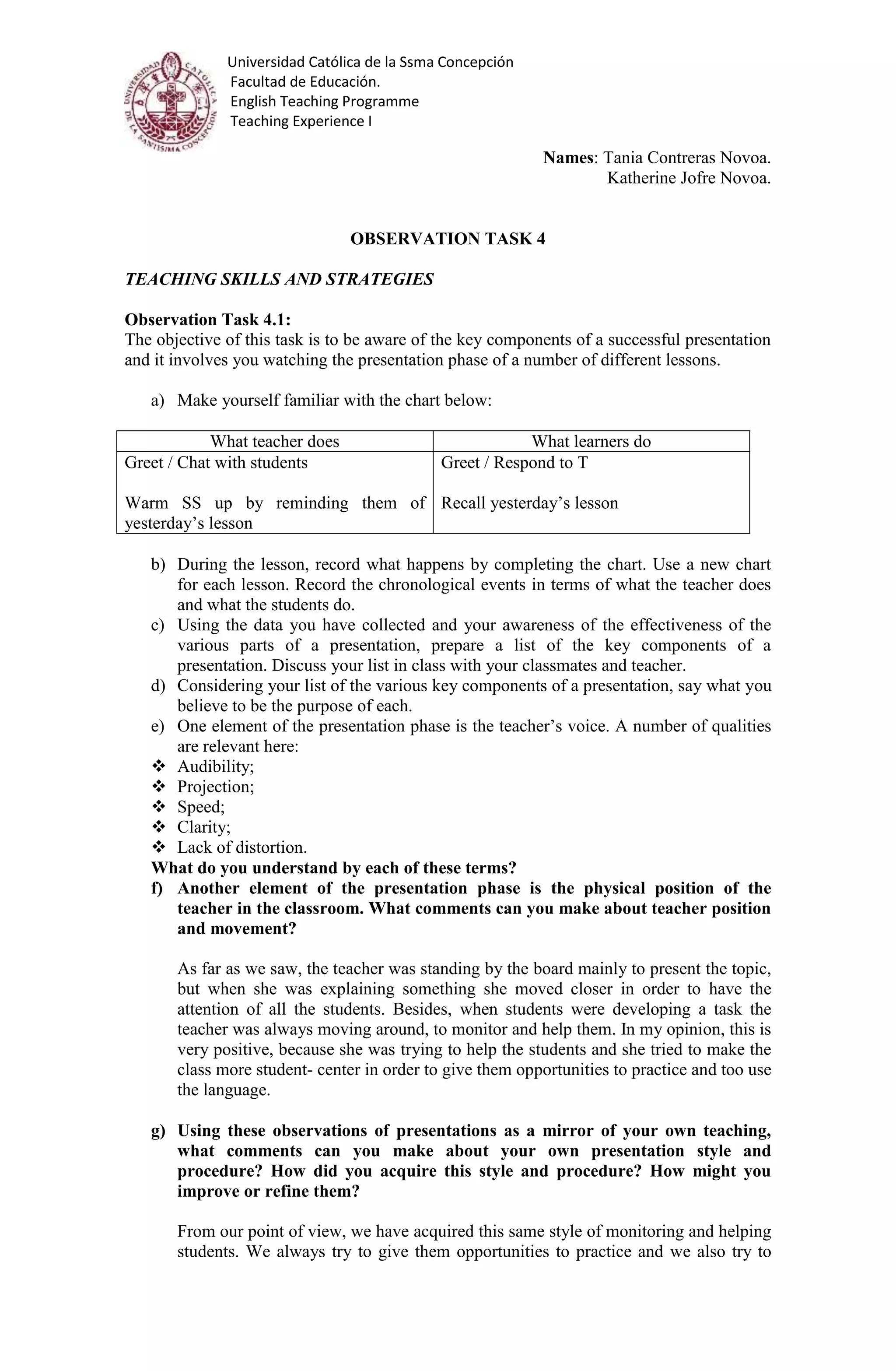
Observation Task 4.1:
The objective of this task is to be aware of the key components of a successful presentation
and it involves you watching the presentation phase of a number of different lessons.
a) Make yourself familiar with the chart below:
What teacher does What learners do
Greet / Chat with students
Warm SS up by reminding them of
yesterday’s lesson
Greet / Respond to T
Recall yesterday’s lesson
b) During the lesson, record what happens by completing the chart. Use a new chart
for each lesson. Record the chronological events in terms of what the teacher does
and what the students do.
c) Using the data you have collected and your awareness of the effectiveness of the
various parts of a presentation, prepare a list of the key components of a
presentation. Discuss your list in class with your classmates and teacher.
d) Considering your list of the various key components of a presentation, say what you
believe to be the purpose of each.
e) One element of the presentation phase is the teacher’s voice. A number of qualities
are relevant here:
 Audibility;
 Projection;
 Speed;
 Clarity;
 Lack of distortion.
What do you understand by each of these terms?
f) Another element of the presentation phase is the physical position of the
teacher in the classroom. What comments can you make about teacher position
and movement?
As far as we saw, the teacher was standing by the board mainly to present the topic,
but when she was explaining something she moved closer in order to have the
attention of all the students. Besides, when students were developing a task the
teacher was always moving around, to monitor and help them. In my opinion, this is
very positive, because she was trying to help the students and she tried to make the
class more student- center in order to give them opportunities to practice and too use
the language.
g) Using these observations of presentations as a mirror of your own teaching,
what comments can you make about your own presentation style and
procedure? How did you acquire this style and procedure? How might you
improve or refine them?
From our point of view, we have acquired this same style of monitoring and helping
students. We always try to give them opportunities to practice and we also try to
Universidad Católica de la Ssma Concepción
Facultad de Educación.
English Teaching Programme
Teaching Experience I
address all my student’s needs. Moreover, we feel that we can improve in terms of
confidence, but this is just with practice.
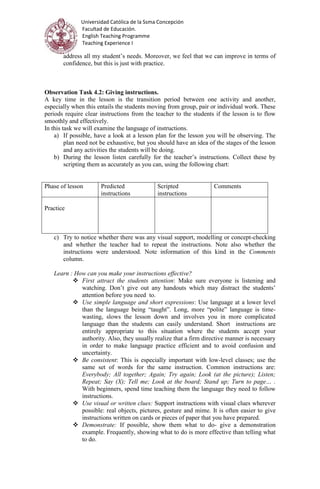
Observation Task 4.2: Giving instructions.
A key time in the lesson is the transition period between one activity and another,
especially when this entails the students moving from group, pair or individual work. These
periods require clear instructions from the teacher to the students if the lesson is to flow
smoothly and effectively.
In this task we will examine the language of instructions.
a) If possible, have a look at a lesson plan for the lesson you will be observing. The
plan need not be exhaustive, but you should have an idea of the stages of the lesson
and any activities the students will be doing.
b) During the lesson listen carefully for the teacher’s instructions. Collect these by
scripting them as accurately as you can, using the following chart:
Phase of lesson Predicted
instructions
Scripted
instructions
Comments
Practice
c) Try to notice whether there was any visual support, modelling or concept-checking
and whether the teacher had to repeat the instructions. Note also whether the
instructions were understood. Note information of this kind in the Comments
column.
Learn : How can you make your instructions effective?
 First attract the students attention: Make sure everyone is listening and
watching. Don’t give out any handouts which may distract the students’
attention before you need to.
 Use simple language and short expressions: Use language at a lower level
than the language being “taught”. Long, more “polite” language is time-
wasting, slows the lesson down and involves you in more complicated
language than the students can easily understand. Short instructions are
entirely appropriate to this situation where the students accept your
authority. Also, they usually realize that a firm directive manner is necessary
in order to make language practice efficient and to avoid confusion and
uncertainty.
 Be consistent: This is especially important with low-level classes; use the
same set of words for the same instruction. Common instructions are:
Everybody; All together; Again; Try again; Look (at the picture); Listen;
Repeat; Say (X); Tell me; Look at the board; Stand up; Turn to page… .
With beginners, spend time teaching them the language they need to follow
instructions.
 Use visual or written clues: Support instructions with visual clues wherever
possible: real objects, pictures, gesture and mime. It is often easier to give
instructions written on cards or pieces of paper that you have prepared.
 Demonstrate: If possible, show them what to do- give a demonstration
example. Frequently, showing what to do is more effective than telling what
to do.
Universidad Católica de la Ssma Concepción
Facultad de Educación.
English Teaching Programme
Teaching Experience I
 Break the instructions down: If the instruction requires a series of steps,
each requiring instruction, give simple instructions in segments and check
understanding as you go along, rather than giving out all the instructions in
one go.
 Target your instructions: Sometimes, instead of giving complete instructions
to the whole class when the instructions don’t concern everyone, you might
give each student a number, a letter, or some kind of symbol. In which case
it might be the number fives, or the Cs only who listen for what they should
do.
 Be decisive: Use a signal, like the words Right or Listen, which students will
learn to recognize as a cue for an instruction. Make sure the students know
when to begin an activity; for example, say something like Everyone. Start!
–perhaps accompanied by a downward hand gesture or a clap of the hands.
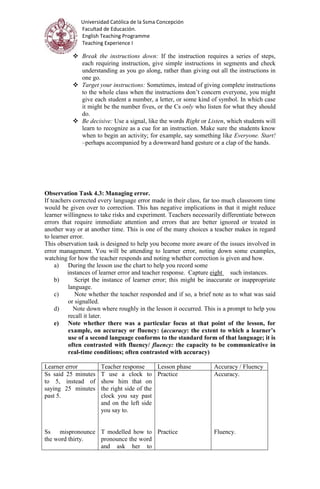
Observation Task 4.3: Managing error.
If teachers corrected every language error made in their class, far too much classroom time
would be given over to correction. This has negative implications in that it might reduce
learner willingness to take risks and experiment. Teachers necessarily differentiate between
errors that require immediate attention and errors that are better ignored or treated in
another way or at another time. This is one of the many choices a teacher makes in regard
to learner error.
This observation task is designed to help you become more aware of the issues involved in
error management. You will be attending to learner error, noting down some examples,
watching for how the teacher responds and noting whether correction is given and how.
a) During the lesson use the chart to help you record some
instances of learner error and teacher response. Capture eight such instances.
b) Script the instance of learner error; this might be inaccurate or inappropriate
language.
c) Note whether the teacher responded and if so, a brief note as to what was said
or signalled.
d) Note down where roughly in the lesson it occurred. This is a prompt to help you
recall it later.
e) Note whether there was a particular focus at that point of the lesson, for
example, on accuracy or fluency: (accuracy: the extent to which a learner’s
use of a second language conforms to the standard form of that language; it is
often contrasted with fluency/ fluency: the capacity to be communicative in
real-time conditions; often contrasted with accuracy)
Learner error Teacher response Lesson phase Accuracy / Fluency
Ss said 25 minutes
to 5, instead of
saying 25 minutes
past 5.
Ss mispronounce
the word thirty.
T use a clock to
show him that on
the right side of the
clock you say past
and on the left side
you say to.
T modelled how to
pronounce the word
and ask her to
Practice
Practice
Accuracy.
Fluency.
Universidad Católica de la Ssma Concepción
Facultad de Educación.
English Teaching Programme
Teaching Experience I
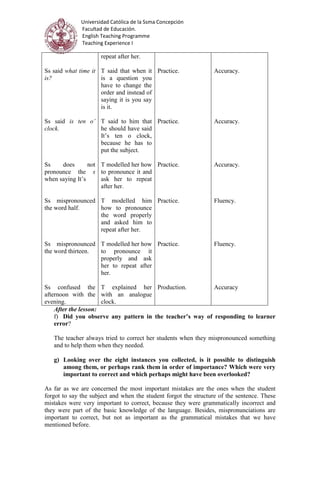
Ss said what time it
is?
Ss said is ten o’
clock.
Ss does not
pronounce the s
when saying It’s
Ss mispronounced
the word half.
Ss mispronounced
the word thirteen.
Ss confused the
afternoon with the
evening.
repeat after her.
T said that when it
is a question you
have to change the
order and instead of
saying it is you say
is it.
T said to him that
he should have said
It’s ten o clock,
because he has to
put the subject.
T modelled her how
to pronounce it and
ask her to repeat
after her.
T modelled him
how to pronounce
the word properly
and asked him to
repeat after her.
T modelled her how
to pronounce it
properly and ask
her to repeat after
her.
T explained her
with an analogue
clock.
Practice.
Practice.
Practice.
Practice.
Practice.
Production.
Accuracy.
Accuracy.
Accuracy.
Fluency.
Fluency.
Accuracy
After the lesson:
f) Did you observe any pattern in the teacher’s way of responding to learner
error?
The teacher always tried to correct her students when they mispronounced something
and to help them when they needed.
g) Looking over the eight instances you collected, is it possible to distinguish
among them, or perhaps rank them in order of importance? Which were very
important to correct and which perhaps might have been overlooked?
As far as we are concerned the most important mistakes are the ones when the student
forgot to say the subject and when the student forgot the structure of the sentence. These
mistakes were very important to correct, because they were grammatically incorrect and
they were part of the basic knowledge of the language. Besides, mispronunciations are
important to correct, but not as important as the grammatical mistakes that we have
mentioned before.
Universidad Católica de la Ssma Concepción
Facultad de Educación.
English Teaching Programme
Teaching Experience I
h) How did other students respond to a student’s error and to the teacher’s
response? Was there any peer correction, or peer interaction , or discussion of
the error? If so, what did the teacher say or do to encourage this?
According what we have observed, there is no much peer correction there are just few
students who sometimes corrected their classmates. Moreover, there are very few occasions
in which the students discuss their mistakes and when they do so, they do mostly with the
teacher and no with their classmates.
i) Were there any opportunities for the students to self-correct? If so, do you
recall anything the teacher said or did to encourage self-correction?
Yes, there were some opportunities when the students corrected their own mistakes and the
teacher leaded them to do it, because when they made mistakes she tried to explain them
again in order to make the students correct themselves and say the answer appropriately.
Besides, the teacher also encouraged self-correction a couple of times by asking are you
sure? This also works with students, because when the teacher asks this question they
monitor themselves and correct their mistakes.
j) When the focus of the lesson is on fluency there may be ways in which a
teacher can avoid interrupting the flow of the students’ language. Is error
correction necessary at such times in a lesson?
When the lesson is focused on fluency the teacher needs to avoid interrupting students
while they are speaking, because they need to produce the language. Moreover, when
the purpose of the lesson is to develop or improve fluency, the teacher also needs to
correct the student’s errors, but at the end when the activity had finished she needs to
provide her students with feedback to make them aware of their strengths and
weaknesses. Consequently, the students will make an effort to improve their
weaknesses.
k) Is it possible to correct in a non-obstrusive way?
Reflection:
Yes, it is. As we said before in the previous questions a- non obstrusive way for
correction would be correcting the student’s mistakes when they finished the task,
because they would feel comfortable while they are speaking, but they also will receive
feedback at the end in order to improve their performance.
 What experience do you have of being corrected when speaking a second or
foreign language? Do you think this has influenced your teaching?
From our experience, some teachers have corrected our mistakes at the moment of
speaking, but this is mainly for accuracy when studying grammar, methology and these
kinds of subjects. On the other hand, in our English classes when the focus is to produce the
language teachers let us make mistakes, but they monitor and take notes of our mistakes
and when the task is done they provide us with feedback and sometimes with tips to
improve our mistakes.

Obs task 4 (1)

  • 1.
    Universidad Católica dela Ssma Concepción Facultad de Educación. English Teaching Programme Teaching Experience I Names: Tania Contreras Novoa. Katherine Jofre Novoa. OBSERVATION TASK 4 TEACHING SKILLS AND STRATEGIES Observation Task 4.1: The objective of this task is to be aware of the key components of a successful presentation and it involves you watching the presentation phase of a number of different lessons. a) Make yourself familiar with the chart below: What teacher does What learners do Greet / Chat with students Warm SS up by reminding them of yesterday’s lesson Greet / Respond to T Recall yesterday’s lesson b) During the lesson, record what happens by completing the chart. Use a new chart for each lesson. Record the chronological events in terms of what the teacher does and what the students do. c) Using the data you have collected and your awareness of the effectiveness of the various parts of a presentation, prepare a list of the key components of a presentation. Discuss your list in class with your classmates and teacher. d) Considering your list of the various key components of a presentation, say what you believe to be the purpose of each. e) One element of the presentation phase is the teacher’s voice. A number of qualities are relevant here:  Audibility;  Projection;  Speed;  Clarity;  Lack of distortion. What do you understand by each of these terms? f) Another element of the presentation phase is the physical position of the teacher in the classroom. What comments can you make about teacher position and movement? As far as we saw, the teacher was standing by the board mainly to present the topic, but when she was explaining something she moved closer in order to have the attention of all the students. Besides, when students were developing a task the teacher was always moving around, to monitor and help them. In my opinion, this is very positive, because she was trying to help the students and she tried to make the class more student- center in order to give them opportunities to practice and too use the language. g) Using these observations of presentations as a mirror of your own teaching, what comments can you make about your own presentation style and procedure? How did you acquire this style and procedure? How might you improve or refine them? From our point of view, we have acquired this same style of monitoring and helping students. We always try to give them opportunities to practice and we also try to
  • 2.
    Universidad Católica dela Ssma Concepción Facultad de Educación. English Teaching Programme Teaching Experience I address all my student’s needs. Moreover, we feel that we can improve in terms of confidence, but this is just with practice. Observation Task 4.2: Giving instructions. A key time in the lesson is the transition period between one activity and another, especially when this entails the students moving from group, pair or individual work. These periods require clear instructions from the teacher to the students if the lesson is to flow smoothly and effectively. In this task we will examine the language of instructions. a) If possible, have a look at a lesson plan for the lesson you will be observing. The plan need not be exhaustive, but you should have an idea of the stages of the lesson and any activities the students will be doing. b) During the lesson listen carefully for the teacher’s instructions. Collect these by scripting them as accurately as you can, using the following chart: Phase of lesson Predicted instructions Scripted instructions Comments Practice c) Try to notice whether there was any visual support, modelling or concept-checking and whether the teacher had to repeat the instructions. Note also whether the instructions were understood. Note information of this kind in the Comments column. Learn : How can you make your instructions effective?  First attract the students attention: Make sure everyone is listening and watching. Don’t give out any handouts which may distract the students’ attention before you need to.  Use simple language and short expressions: Use language at a lower level than the language being “taught”. Long, more “polite” language is time- wasting, slows the lesson down and involves you in more complicated language than the students can easily understand. Short instructions are entirely appropriate to this situation where the students accept your authority. Also, they usually realize that a firm directive manner is necessary in order to make language practice efficient and to avoid confusion and uncertainty.  Be consistent: This is especially important with low-level classes; use the same set of words for the same instruction. Common instructions are: Everybody; All together; Again; Try again; Look (at the picture); Listen; Repeat; Say (X); Tell me; Look at the board; Stand up; Turn to page… . With beginners, spend time teaching them the language they need to follow instructions.  Use visual or written clues: Support instructions with visual clues wherever possible: real objects, pictures, gesture and mime. It is often easier to give instructions written on cards or pieces of paper that you have prepared.  Demonstrate: If possible, show them what to do- give a demonstration example. Frequently, showing what to do is more effective than telling what to do.
  • 3.
    Universidad Católica dela Ssma Concepción Facultad de Educación. English Teaching Programme Teaching Experience I  Break the instructions down: If the instruction requires a series of steps, each requiring instruction, give simple instructions in segments and check understanding as you go along, rather than giving out all the instructions in one go.  Target your instructions: Sometimes, instead of giving complete instructions to the whole class when the instructions don’t concern everyone, you might give each student a number, a letter, or some kind of symbol. In which case it might be the number fives, or the Cs only who listen for what they should do.  Be decisive: Use a signal, like the words Right or Listen, which students will learn to recognize as a cue for an instruction. Make sure the students know when to begin an activity; for example, say something like Everyone. Start! –perhaps accompanied by a downward hand gesture or a clap of the hands. Observation Task 4.3: Managing error. If teachers corrected every language error made in their class, far too much classroom time would be given over to correction. This has negative implications in that it might reduce learner willingness to take risks and experiment. Teachers necessarily differentiate between errors that require immediate attention and errors that are better ignored or treated in another way or at another time. This is one of the many choices a teacher makes in regard to learner error. This observation task is designed to help you become more aware of the issues involved in error management. You will be attending to learner error, noting down some examples, watching for how the teacher responds and noting whether correction is given and how. a) During the lesson use the chart to help you record some instances of learner error and teacher response. Capture eight such instances. b) Script the instance of learner error; this might be inaccurate or inappropriate language. c) Note whether the teacher responded and if so, a brief note as to what was said or signalled. d) Note down where roughly in the lesson it occurred. This is a prompt to help you recall it later. e) Note whether there was a particular focus at that point of the lesson, for example, on accuracy or fluency: (accuracy: the extent to which a learner’s use of a second language conforms to the standard form of that language; it is often contrasted with fluency/ fluency: the capacity to be communicative in real-time conditions; often contrasted with accuracy) Learner error Teacher response Lesson phase Accuracy / Fluency Ss said 25 minutes to 5, instead of saying 25 minutes past 5. Ss mispronounce the word thirty. T use a clock to show him that on the right side of the clock you say past and on the left side you say to. T modelled how to pronounce the word and ask her to Practice Practice Accuracy. Fluency.
  • 4.
    Universidad Católica dela Ssma Concepción Facultad de Educación. English Teaching Programme Teaching Experience I Ss said what time it is? Ss said is ten o’ clock. Ss does not pronounce the s when saying It’s Ss mispronounced the word half. Ss mispronounced the word thirteen. Ss confused the afternoon with the evening. repeat after her. T said that when it is a question you have to change the order and instead of saying it is you say is it. T said to him that he should have said It’s ten o clock, because he has to put the subject. T modelled her how to pronounce it and ask her to repeat after her. T modelled him how to pronounce the word properly and asked him to repeat after her. T modelled her how to pronounce it properly and ask her to repeat after her. T explained her with an analogue clock. Practice. Practice. Practice. Practice. Practice. Production. Accuracy. Accuracy. Accuracy. Fluency. Fluency. Accuracy After the lesson: f) Did you observe any pattern in the teacher’s way of responding to learner error? The teacher always tried to correct her students when they mispronounced something and to help them when they needed. g) Looking over the eight instances you collected, is it possible to distinguish among them, or perhaps rank them in order of importance? Which were very important to correct and which perhaps might have been overlooked? As far as we are concerned the most important mistakes are the ones when the student forgot to say the subject and when the student forgot the structure of the sentence. These mistakes were very important to correct, because they were grammatically incorrect and they were part of the basic knowledge of the language. Besides, mispronunciations are important to correct, but not as important as the grammatical mistakes that we have mentioned before.
  • 5.
    Universidad Católica dela Ssma Concepción Facultad de Educación. English Teaching Programme Teaching Experience I h) How did other students respond to a student’s error and to the teacher’s response? Was there any peer correction, or peer interaction , or discussion of the error? If so, what did the teacher say or do to encourage this? According what we have observed, there is no much peer correction there are just few students who sometimes corrected their classmates. Moreover, there are very few occasions in which the students discuss their mistakes and when they do so, they do mostly with the teacher and no with their classmates. i) Were there any opportunities for the students to self-correct? If so, do you recall anything the teacher said or did to encourage self-correction? Yes, there were some opportunities when the students corrected their own mistakes and the teacher leaded them to do it, because when they made mistakes she tried to explain them again in order to make the students correct themselves and say the answer appropriately. Besides, the teacher also encouraged self-correction a couple of times by asking are you sure? This also works with students, because when the teacher asks this question they monitor themselves and correct their mistakes. j) When the focus of the lesson is on fluency there may be ways in which a teacher can avoid interrupting the flow of the students’ language. Is error correction necessary at such times in a lesson? When the lesson is focused on fluency the teacher needs to avoid interrupting students while they are speaking, because they need to produce the language. Moreover, when the purpose of the lesson is to develop or improve fluency, the teacher also needs to correct the student’s errors, but at the end when the activity had finished she needs to provide her students with feedback to make them aware of their strengths and weaknesses. Consequently, the students will make an effort to improve their weaknesses. k) Is it possible to correct in a non-obstrusive way? Reflection: Yes, it is. As we said before in the previous questions a- non obstrusive way for correction would be correcting the student’s mistakes when they finished the task, because they would feel comfortable while they are speaking, but they also will receive feedback at the end in order to improve their performance.  What experience do you have of being corrected when speaking a second or foreign language? Do you think this has influenced your teaching? From our experience, some teachers have corrected our mistakes at the moment of speaking, but this is mainly for accuracy when studying grammar, methology and these kinds of subjects. On the other hand, in our English classes when the focus is to produce the language teachers let us make mistakes, but they monitor and take notes of our mistakes and when the task is done they provide us with feedback and sometimes with tips to improve our mistakes.