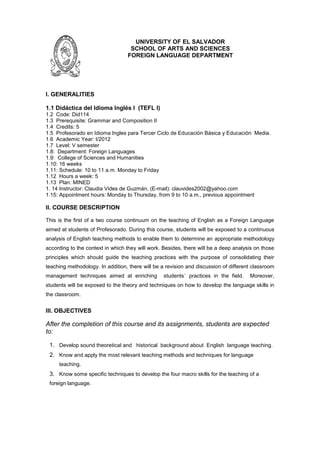
UNIVERSITY OF EL SALVADOR
                                   SCHOOL OF ARTS AND SCIENCES
                                  FOREIGN LANGUAGE DEPARTMENT


I. GENERALITIES

1.1 Didáctica del Idioma Inglés I (TEFL I)
1.2 Code: Did114
1.3 Prerequisite: Grammar and Composition II
1.4 Credits: 5
1.5 Profesorado en Idioma Ingles para Tercer Ciclo de Educación Básica y Educación Media.
1.6 Academic Year: I/2012
1.7 Level: V semester
1.8: Department: Foreign Languages
1.9: College of Sciences and Humanities
1.10: 16 weeks
1.11: Schedule: 10 to 11 a.m. Monday to Friday
1.12 Hours a week: 5
1.13 Plan: MINED
1. 14 Instructor: Claudia Vides de Guzmán, (E-mail): clauvides2002@yahoo.com
1.15: Appointment hours: Monday to Thursday, from 9 to 10 a.m., previous appointment

II. COURSE DESCRIPTION

This is the first of a two course continuum on the teaching of English as a Foreign Language
aimed at students of Profesorado. During this course, students will be exposed to a continuous
analysis of English teaching methods to enable them to determine an appropriate methodology
according to the context in which they will work. Besides, there will be a deep analysis on those
principles which should guide the teaching practices with the purpose of consolidating their
teaching methodology. In addition, there will be a revision and discussion of different classroom
management techniques aimed at enriching          students´ practices in the field.   Moreover,
students will be exposed to the theory and techniques on how to develop the language skills in
the classroom.


III. OBJECTIVES

After the completion of this course and its assignments, students are expected
to:

 1. Develop sound theoretical and historical background about English language teaching.
 2. Know and apply the most relevant teaching methods and techniques for language
     teaching.
 3. Know some specific techniques to develop the four macro skills for the teaching of a
 foreign language.
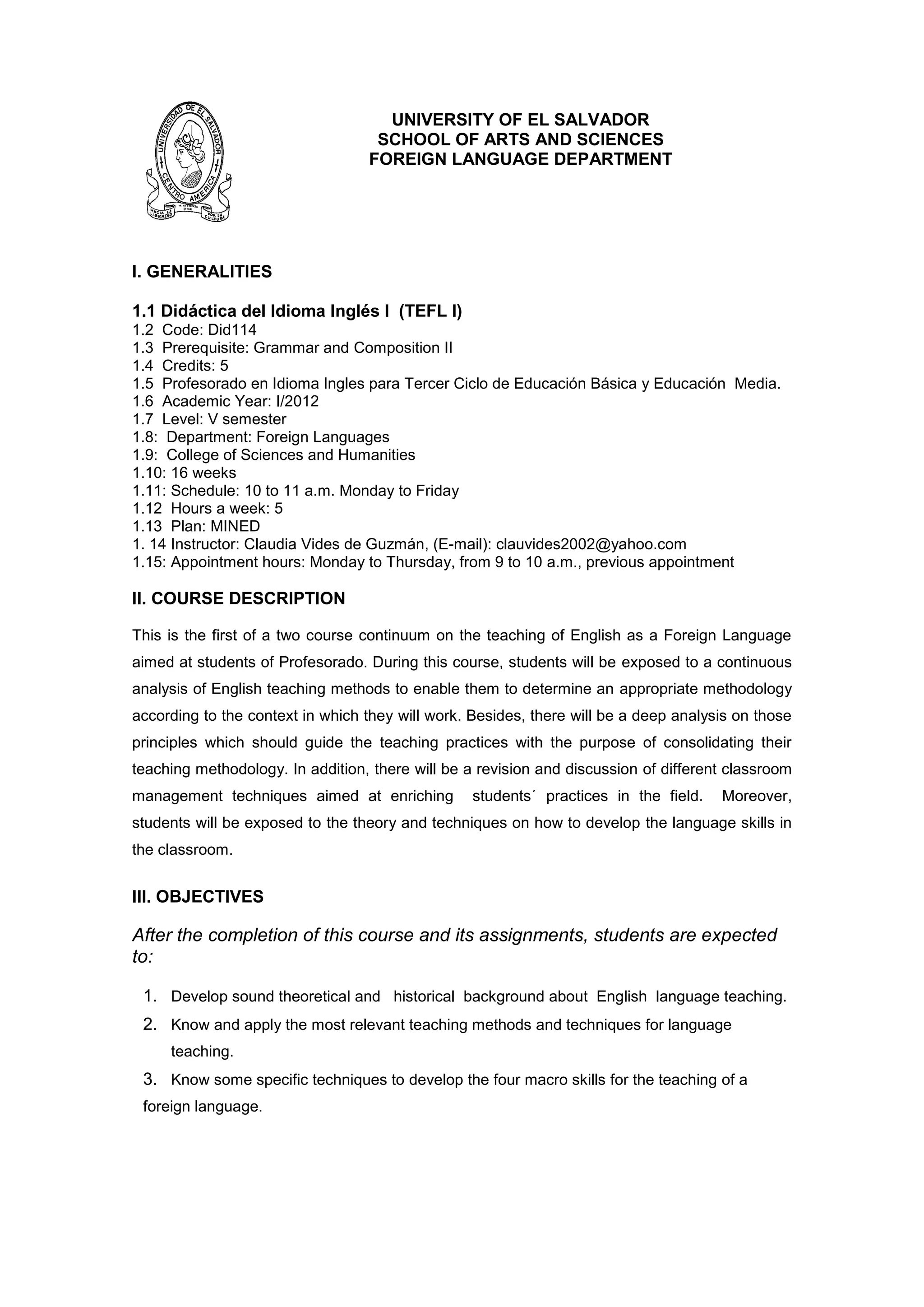
IV. METHODOLOGY


TEFL I will be developed through continuous analytical discussions, short class lectures which
require from the students to be active participants in their teaching-learning process in and out
of the classroom. There will also be reading quizzes, oral presentations, written reports and
microteaching. This course will allow the students to develop their critical thinking in order to
become reflective practitioners, being able to analyze and evaluate their performance in the
teaching field. During this course, the students will be engaged in individual, pair and group
work inside and outside of the class to fulfill the different assignments such as oral
presentations and different tasks that will be assigned. They will also participate in plenty of
exercises using the different skills practiced in the classroom. Moreover, students will be asked
to keep a glossary of the concepts they find in the material being studied which are related to
the teaching field.


VIII. CONTENTS OF THE COURSE


UNIT I: INTRODUCTION TO THE COURSE


From        Historical       and       Theoretical   3 weeks
February    Background
20th to
March       Chapter 5. Harmer                        Quiz
15th        Chapter 6. Harmer
            “A        methodical”   history     of
            Language        Teaching     (Douglas
            Brown).
            “ An informed approach”
            (Douglas Brown).


From    Unit 2 Classroom Management                  Quiz
March
19th to
May     Mistakes and Feedback                        3 weeks
17th    Harmer Chapter 7.
            Grouping Students Chapter 8.
            Problem Behavior and What to do
            about it. Chapter 9.
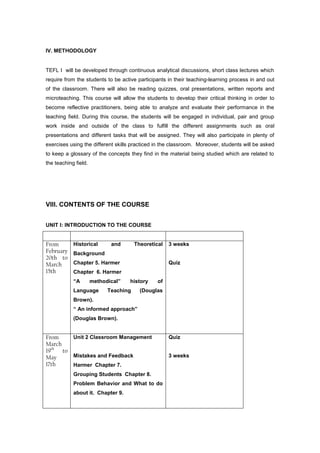
From               Unit 3. Teaching Receptive Skills.
              st
May 21             Reading and Listening
to        June     Chapters 14 / 15 / 16 ( Harmer)
     th
14
From      Unit 4 Teaching Productive Skills
June 25th Writing and Speaking
to June 17/ 18/ 19 ( Harmer)
28th


 IX. EVALUATION SYSTEM
 Oral presentations                                                            10%
 Microteaching                                                                 15%
 Tasks                                                                  20%
 Mid-Term Exam                                                                 25%
Reading Quizzes                                                         30%


VII. COURSE REQUIREMENTS
For the fulfilment of the course requirements, it is necessary that students take into account the
following:
          1. Students are expected to come to class everyday and on time.
          2. The course material must be purchased on time and read before coming to class.
          3. Students need to be ready to discuss any topic which is assigned by the teacher.
          4. It is important that students hand in the homework assigned by the teacher in the
              allotted time.
          5. There will be evaluations at any time during the course.
          6. Mutual respect with peers and teacher must be practiced at any time in and out of the
              classroom.
          7. Students have to justify if any evaluation or homework is missed throughout the
              semester.
          8. The following practices will not be permitted in the class: eating, answering phones,
              talking while students or teacher is talking, making fun of other students, coming and
              going in and out of the classroom.
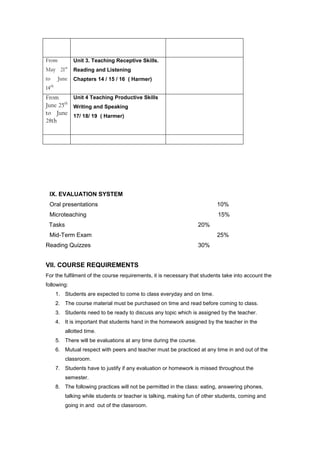
Hand in assignments according to the guidelines given by the teacher


 DESCRIPTION OF EVALUATIONS AND WORKS IN AND OUT OF THE
 CLASS:


                Oral Presentations: students will be in charge of preparing some individual and
         group presentations on a specific topic. A written report might be handed in the day of
         the presentation.


         Microteaching: an innovative activity will be designed by students based on the
         guidelines provided previously which they will share will the class.


         Tasks: throughout the semester, students will be asked to keep a vocabulary log to
         keep the new concepts seen in class (50 words). They will also be requested to
         present a dossier about language skills.


       Mid-term Exam: it will be an objective test which will measure what students will have
       achieved in the middle of the course.


         Quizzes: reading quizzes will be administered every now and then when the material
         to be studied allows that.

       Procedures for Classroom investigation in Teaching:

                Surveys and questionnaires. Activities such as administering a
                 questionnaire or completing a survey, designed to collect information on a
                 particular aspect of teaching or learning.
                Observation: Tasks completed by a student teacher observing a cooperating
                 teacher´s class, or peer observation (i.e., tasks completed by a teacher visiting
                 a colleague´s class)
                Action Research. Implementation of an action plan designed to bring about
                 change in some aspect of the teacher´s class with subsequent monitoring of
                 the effects of the innovation.

VII. BIBLIOGRAPHY


Brown, H. Douglas. (1987) Principles of Language Learning and Teaching.
Second Eition. Prentice Hall, Inc.1987.

Brown, H. Douglas. (1994) Teaching by Principles. An Interactive Approach to
Language Pedagogy.Prentice Hall Regents. New Jersey.
Doff, A. (1988). Teach English: Trainers handbook and workbook, Cambridge University
Press, New York.

Glower de Alvarado, Ana María. Guides for ESL Didactics I.Universidad de El Salvador,
2008.

Hadley, A.O 2001, Teaching Language in Context, 3rd edition, Heinle&Heinle, Boston.

Harmer, Jeremy (1991).The practice of English Language Teaching, Longman group, UK.

Larsen-Freeman (1986).Techniques and Principles in Language Teaching, Oxford
University Press, New York, USA.

Omaggio, Alice. (1993). Teaching Language in Context: Proficiency Oriented Instruction.
HH Publications, Boston, MA.

Richards, Jack C. (2002). Methodology in Language Teaching.An Anthology of Current
Practice.Cambridge University Press.New York.

.

Programa didactica1 prof

  • 1.
    UNIVERSITY OF ELSALVADOR SCHOOL OF ARTS AND SCIENCES FOREIGN LANGUAGE DEPARTMENT I. GENERALITIES 1.1 Didáctica del Idioma Inglés I (TEFL I) 1.2 Code: Did114 1.3 Prerequisite: Grammar and Composition II 1.4 Credits: 5 1.5 Profesorado en Idioma Ingles para Tercer Ciclo de Educación Básica y Educación Media. 1.6 Academic Year: I/2012 1.7 Level: V semester 1.8: Department: Foreign Languages 1.9: College of Sciences and Humanities 1.10: 16 weeks 1.11: Schedule: 10 to 11 a.m. Monday to Friday 1.12 Hours a week: 5 1.13 Plan: MINED 1. 14 Instructor: Claudia Vides de Guzmán, (E-mail): clauvides2002@yahoo.com 1.15: Appointment hours: Monday to Thursday, from 9 to 10 a.m., previous appointment II. COURSE DESCRIPTION This is the first of a two course continuum on the teaching of English as a Foreign Language aimed at students of Profesorado. During this course, students will be exposed to a continuous analysis of English teaching methods to enable them to determine an appropriate methodology according to the context in which they will work. Besides, there will be a deep analysis on those principles which should guide the teaching practices with the purpose of consolidating their teaching methodology. In addition, there will be a revision and discussion of different classroom management techniques aimed at enriching students´ practices in the field. Moreover, students will be exposed to the theory and techniques on how to develop the language skills in the classroom. III. OBJECTIVES After the completion of this course and its assignments, students are expected to: 1. Develop sound theoretical and historical background about English language teaching. 2. Know and apply the most relevant teaching methods and techniques for language teaching. 3. Know some specific techniques to develop the four macro skills for the teaching of a foreign language.
  • 2.
    IV. METHODOLOGY TEFL Iwill be developed through continuous analytical discussions, short class lectures which require from the students to be active participants in their teaching-learning process in and out of the classroom. There will also be reading quizzes, oral presentations, written reports and microteaching. This course will allow the students to develop their critical thinking in order to become reflective practitioners, being able to analyze and evaluate their performance in the teaching field. During this course, the students will be engaged in individual, pair and group work inside and outside of the class to fulfill the different assignments such as oral presentations and different tasks that will be assigned. They will also participate in plenty of exercises using the different skills practiced in the classroom. Moreover, students will be asked to keep a glossary of the concepts they find in the material being studied which are related to the teaching field. VIII. CONTENTS OF THE COURSE UNIT I: INTRODUCTION TO THE COURSE From Historical and Theoretical 3 weeks February Background 20th to March Chapter 5. Harmer Quiz 15th Chapter 6. Harmer “A methodical” history of Language Teaching (Douglas Brown). “ An informed approach” (Douglas Brown). From Unit 2 Classroom Management Quiz March 19th to May Mistakes and Feedback 3 weeks 17th Harmer Chapter 7. Grouping Students Chapter 8. Problem Behavior and What to do about it. Chapter 9.
  • 3.
    From Unit 3. Teaching Receptive Skills. st May 21 Reading and Listening to June Chapters 14 / 15 / 16 ( Harmer) th 14 From Unit 4 Teaching Productive Skills June 25th Writing and Speaking to June 17/ 18/ 19 ( Harmer) 28th IX. EVALUATION SYSTEM Oral presentations 10% Microteaching 15% Tasks 20% Mid-Term Exam 25% Reading Quizzes 30% VII. COURSE REQUIREMENTS For the fulfilment of the course requirements, it is necessary that students take into account the following: 1. Students are expected to come to class everyday and on time. 2. The course material must be purchased on time and read before coming to class. 3. Students need to be ready to discuss any topic which is assigned by the teacher. 4. It is important that students hand in the homework assigned by the teacher in the allotted time. 5. There will be evaluations at any time during the course. 6. Mutual respect with peers and teacher must be practiced at any time in and out of the classroom. 7. Students have to justify if any evaluation or homework is missed throughout the semester. 8. The following practices will not be permitted in the class: eating, answering phones, talking while students or teacher is talking, making fun of other students, coming and going in and out of the classroom.
  • 4.
    Hand in assignmentsaccording to the guidelines given by the teacher DESCRIPTION OF EVALUATIONS AND WORKS IN AND OUT OF THE CLASS: Oral Presentations: students will be in charge of preparing some individual and group presentations on a specific topic. A written report might be handed in the day of the presentation. Microteaching: an innovative activity will be designed by students based on the guidelines provided previously which they will share will the class. Tasks: throughout the semester, students will be asked to keep a vocabulary log to keep the new concepts seen in class (50 words). They will also be requested to present a dossier about language skills. Mid-term Exam: it will be an objective test which will measure what students will have achieved in the middle of the course. Quizzes: reading quizzes will be administered every now and then when the material to be studied allows that. Procedures for Classroom investigation in Teaching:  Surveys and questionnaires. Activities such as administering a questionnaire or completing a survey, designed to collect information on a particular aspect of teaching or learning.  Observation: Tasks completed by a student teacher observing a cooperating teacher´s class, or peer observation (i.e., tasks completed by a teacher visiting a colleague´s class)  Action Research. Implementation of an action plan designed to bring about change in some aspect of the teacher´s class with subsequent monitoring of the effects of the innovation. VII. BIBLIOGRAPHY Brown, H. Douglas. (1987) Principles of Language Learning and Teaching. Second Eition. Prentice Hall, Inc.1987. Brown, H. Douglas. (1994) Teaching by Principles. An Interactive Approach to Language Pedagogy.Prentice Hall Regents. New Jersey.
  • 5.
    Doff, A. (1988).Teach English: Trainers handbook and workbook, Cambridge University Press, New York. Glower de Alvarado, Ana María. Guides for ESL Didactics I.Universidad de El Salvador, 2008. Hadley, A.O 2001, Teaching Language in Context, 3rd edition, Heinle&Heinle, Boston. Harmer, Jeremy (1991).The practice of English Language Teaching, Longman group, UK. Larsen-Freeman (1986).Techniques and Principles in Language Teaching, Oxford University Press, New York, USA. Omaggio, Alice. (1993). Teaching Language in Context: Proficiency Oriented Instruction. HH Publications, Boston, MA. Richards, Jack C. (2002). Methodology in Language Teaching.An Anthology of Current Practice.Cambridge University Press.New York. .