Universidad Católica de la Santísima Concepción 
Facultad de Educación 
English Teaching Programme 
Teaching Experience I 
OBSERVATION TASK 1: Focus on the learner. 
Carolina Rojas 
Teaching experience 1 
Maria Lagos 
Rocio Muñoz 
Concepcion, September 2014.
OBSERVATION TASK 1: 
Whiteboard 
The Learner: 
a) Observe an English lesson. 
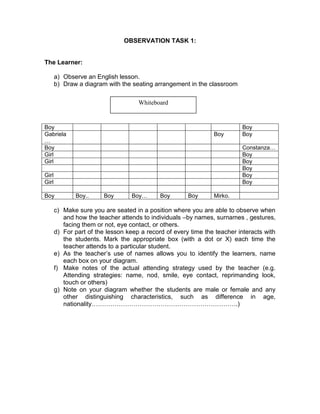
b) Draw a diagram with the seating arrangement in the classroom 
Boy Boy 
Gabriela 
Boy Boy 
… 
Boy Constanza… 
Girl Boy 
Girl Boy 
Boy 
Girl Boy 
Girl Boy 
Boy Boy.. Boy Boy… Boy Boy Mirko. 
c) Make sure you are seated in a position where you are able to observe when 
and how the teacher attends to individuals –by names, surnames , gestures, 
facing them or not, eye contact, or others. 
d) For part of the lesson keep a record of every time the teacher interacts with 
the students. Mark the appropriate box (with a dot or X) each time the 
teacher attends to a particular student. 
e) As the teacher’s use of names allows you to identify the learners, name 
each box on your diagram. 
f) Make notes of the actual attending strategy used by the teacher (e.g. 
Attending strategies: name, nod, smile, eye contact, reprimanding look, 
touch or others) 
g) Note on your diagram whether the students are male or female and any 
other distinguishing characteristics, such as difference in age, 
nationality…………………………………………………………….)
After the lesson: 
a) Reflect on your findings. 
b) Note the teacher’s position and movement. 
- When and where does s/he sit? 
The teacher never sat down. 
- When and where does s/he stand? 
Most of the time, she was standing in the middle of the classroom, or she 
was moving around the classroom. 
- How near does s/he approach the learners at different parts of the 
lesson? 
She had a close relation with students; she was very kind when she 
corrected their mistakes. Also, she was not rude toward Ss’ answers, 
even though they answered mostly in Spanish. 
- When does s/he move around? 
While she was monitoring Ss’ work she was constantly moving around 
the classroom. 
- Does s/he project to all the learners? 
Yes she did, she was standing in the middle of the classroom. That is 
why all the students could hear and see her. 
- Can s/he be heard and seen clearly by all the students? 
Yes she was heard and seen by all the students. 
- Does s/he make eye contact with individual learners? 
Most of the time she asked open questions without asking anyone in 
particular, but when someone asked something or gave an answer she 
always made eye contact with the students. 
c) What have you learned from this observation that you could apply to your 
own teaching? 
Something that caught our attention was the variety of activities that the teacher 
had prepared. As she mentioned, when students do not have too much interest in
the subject the key is to get them engage by doing different activities, specially 
short activities to Ss practice the target language as much as they can.

Observation task 1

  • 1.
    Universidad Católica dela Santísima Concepción Facultad de Educación English Teaching Programme Teaching Experience I OBSERVATION TASK 1: Focus on the learner. Carolina Rojas Teaching experience 1 Maria Lagos Rocio Muñoz Concepcion, September 2014.
  • 2.
    OBSERVATION TASK 1: Whiteboard The Learner: a) Observe an English lesson. b) Draw a diagram with the seating arrangement in the classroom Boy Boy Gabriela Boy Boy … Boy Constanza… Girl Boy Girl Boy Boy Girl Boy Girl Boy Boy Boy.. Boy Boy… Boy Boy Mirko. c) Make sure you are seated in a position where you are able to observe when and how the teacher attends to individuals –by names, surnames , gestures, facing them or not, eye contact, or others. d) For part of the lesson keep a record of every time the teacher interacts with the students. Mark the appropriate box (with a dot or X) each time the teacher attends to a particular student. e) As the teacher’s use of names allows you to identify the learners, name each box on your diagram. f) Make notes of the actual attending strategy used by the teacher (e.g. Attending strategies: name, nod, smile, eye contact, reprimanding look, touch or others) g) Note on your diagram whether the students are male or female and any other distinguishing characteristics, such as difference in age, nationality…………………………………………………………….)
  • 3.
    After the lesson: a) Reflect on your findings. b) Note the teacher’s position and movement. - When and where does s/he sit? The teacher never sat down. - When and where does s/he stand? Most of the time, she was standing in the middle of the classroom, or she was moving around the classroom. - How near does s/he approach the learners at different parts of the lesson? She had a close relation with students; she was very kind when she corrected their mistakes. Also, she was not rude toward Ss’ answers, even though they answered mostly in Spanish. - When does s/he move around? While she was monitoring Ss’ work she was constantly moving around the classroom. - Does s/he project to all the learners? Yes she did, she was standing in the middle of the classroom. That is why all the students could hear and see her. - Can s/he be heard and seen clearly by all the students? Yes she was heard and seen by all the students. - Does s/he make eye contact with individual learners? Most of the time she asked open questions without asking anyone in particular, but when someone asked something or gave an answer she always made eye contact with the students. c) What have you learned from this observation that you could apply to your own teaching? Something that caught our attention was the variety of activities that the teacher had prepared. As she mentioned, when students do not have too much interest in
  • 4.
    the subject thekey is to get them engage by doing different activities, specially short activities to Ss practice the target language as much as they can.