The Imperfect TenseChapter 4
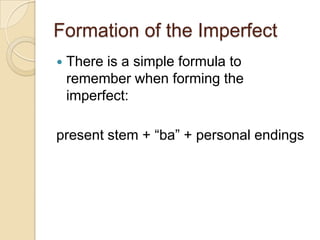
Formation of the ImperfectThere is a simple formula to remember when forming the imperfect:present stem + “ba” + personal endings
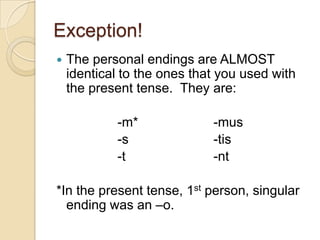
Exception!The personal endings are ALMOST identical to the ones that you used with the present tense.  They are:		-m*			-mus		-s			-tis		-t			-nt*In the present tense, 1st person, singular ending was an –o.
ExamplesStep 1:  Find the present stem by taking the –re off the infinitive.amo, amare, amavi	Present stem= ama
Step 2Add “ba” to the present stem:
Step 3:Add the personal endings.
3rd –io verbs and 4thPlease note that verbs whose first principal parts end in –iowill have an “ie” before the “ba.”Example:  audio, audire, audivi
TranslationThe imperfect tense is used for incomplete action in the past.Translate it with “was,” “were,” or “used to.”“Amabat” could be translated as “he was loving” or “he used to love.”
Imperfect of “to be.”Because the verb “to be” is irregular, you will have to memorize the imperfect forms just as you did for the present.Notice that the endings are still the same, though!
Imperfect of “to be.”eram - I was		eramus- we wereeras - you were	eratis- you wereerat - he was	erant- they were

Chapter 4 The Imperfect Tense

  • 1.
  • 2.
    Formation of theImperfectThere is a simple formula to remember when forming the imperfect:present stem + “ba” + personal endings
  • 3.
    Exception!The personal endingsare ALMOST identical to the ones that you used with the present tense. They are: -m* -mus -s -tis -t -nt*In the present tense, 1st person, singular ending was an –o.
  • 4.
    ExamplesStep 1: Find the present stem by taking the –re off the infinitive.amo, amare, amavi Present stem= ama
  • 5.
    Step 2Add “ba”to the present stem:
  • 6.
    Step 3:Add thepersonal endings.
  • 7.
    3rd –io verbsand 4thPlease note that verbs whose first principal parts end in –iowill have an “ie” before the “ba.”Example: audio, audire, audivi
  • 8.
    TranslationThe imperfect tenseis used for incomplete action in the past.Translate it with “was,” “were,” or “used to.”“Amabat” could be translated as “he was loving” or “he used to love.”
  • 9.
    Imperfect of “tobe.”Because the verb “to be” is irregular, you will have to memorize the imperfect forms just as you did for the present.Notice that the endings are still the same, though!
  • 10.
    Imperfect of “tobe.”eram - I was eramus- we wereeras - you were eratis- you wereerat - he was erant- they were