Page 199 Realidades 2 Indirect Object Pronouns
¿Qué  son?   An indirect object pronoun is used to indicate  to whom   or  for whom   an action occurs.
Indirect Objects I bought that skirt for her.  I gave those shoes to him. What is the subject, the verb, the direct object and the indirect object?
Indirect Objects I bought that skirt for her. subject verb direct object indirect object
Indirect Objects I gave those shoes to him. subject verb direct object indirect object
Indirect Object Pronouns Indirect object  pronouns  tell  to whom the action is being done . Remember that we use pronouns to keep from being repetitive.
Indirect Object Pronouns They mean the same thing in English as do the direct object pronouns, only they add the words “to or for”.  For example, “to you, for me, ect.”
Indirect Object Pronouns (English) (to or for) me (to or for) you (to or for) him, her, it (to or for) us (to or for) them
Indirect Object Pronouns (Spanish) me te le nos les
Placement of Indirect Object Pronouns Indirect Object Pronouns, me, te, le, nos, os, and les are placed either  before a conjugated verb  or  attached to the end of an infinitive.
Before the Conjugated Verb: Le  va a dar el libro  a Elena ? Nos  vio hace cinco días  a nosotros .
Before the Conjugated Verb A él,  le  gustan los libros? Sí,  le  interesan mucho.
Before the verb or after the infinitive: Before the verb : Le  vas a dar el libro  a Elena ? Sí,  le  voy a dar el libro  a Elena . After the infinitive : Vas a dar le  el libro  a Elena ? Sí, voy a dar le  el libro  a Elena .
Indirect Object Pronouns These are the “me, te, le, nos and les that you see before “gustar, interesar, faltar, fascinar, etc.” For example:
Indirect Object Pronouns A ella  le gustan  las faldas? Sí,  le fascinan ! A ellos  les encanta  la comida? Sí,  les encanta !
Indirect Object Pronouns Sometimes we use  a  +  a pronoun or a person’s name for emphasis or to make it clear who we are referring to.
Indirect Object Pronouns Me  duelen los pies. Y  a ti , qué  te  duele? A Pablo le  duelen los pies. A Ud. le  duelen los pies, no?
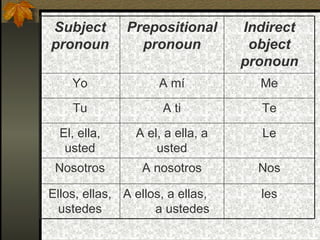
les A ellos, a ellas,  a ustedes Ellos, ellas, ustedes Nos A nosotros Nosotros Le A el, a ella, a usted El, ella, usted Te A ti Tu Me A m í Yo Indirect object pronoun Prepositional pronoun Subject pronoun

Indirect Object Pronouns Notes

  • 1.
    Page 199 Realidades2 Indirect Object Pronouns
  • 2.
    ¿Qué son? An indirect object pronoun is used to indicate to whom or for whom an action occurs.
  • 3.
    Indirect Objects Ibought that skirt for her. I gave those shoes to him. What is the subject, the verb, the direct object and the indirect object?
  • 4.
    Indirect Objects Ibought that skirt for her. subject verb direct object indirect object
  • 5.
    Indirect Objects Igave those shoes to him. subject verb direct object indirect object
  • 6.
    Indirect Object PronounsIndirect object pronouns tell to whom the action is being done . Remember that we use pronouns to keep from being repetitive.
  • 7.
    Indirect Object PronounsThey mean the same thing in English as do the direct object pronouns, only they add the words “to or for”. For example, “to you, for me, ect.”
  • 8.
    Indirect Object Pronouns(English) (to or for) me (to or for) you (to or for) him, her, it (to or for) us (to or for) them
  • 9.
    Indirect Object Pronouns(Spanish) me te le nos les
  • 10.
    Placement of IndirectObject Pronouns Indirect Object Pronouns, me, te, le, nos, os, and les are placed either before a conjugated verb or attached to the end of an infinitive.
  • 11.
    Before the ConjugatedVerb: Le va a dar el libro a Elena ? Nos vio hace cinco días a nosotros .
  • 12.
    Before the ConjugatedVerb A él, le gustan los libros? Sí, le interesan mucho.
  • 13.
    Before the verbor after the infinitive: Before the verb : Le vas a dar el libro a Elena ? Sí, le voy a dar el libro a Elena . After the infinitive : Vas a dar le el libro a Elena ? Sí, voy a dar le el libro a Elena .
  • 14.
    Indirect Object PronounsThese are the “me, te, le, nos and les that you see before “gustar, interesar, faltar, fascinar, etc.” For example:
  • 15.
    Indirect Object PronounsA ella le gustan las faldas? Sí, le fascinan ! A ellos les encanta la comida? Sí, les encanta !
  • 16.
    Indirect Object PronounsSometimes we use a + a pronoun or a person’s name for emphasis or to make it clear who we are referring to.
  • 17.
    Indirect Object PronounsMe duelen los pies. Y a ti , qué te duele? A Pablo le duelen los pies. A Ud. le duelen los pies, no?
  • 18.
    les A ellos,a ellas, a ustedes Ellos, ellas, ustedes Nos A nosotros Nosotros Le A el, a ella, a usted El, ella, usted Te A ti Tu Me A m í Yo Indirect object pronoun Prepositional pronoun Subject pronoun