The Object
PREPARED BY JULIA MIKHNEVA
21-A GROUP
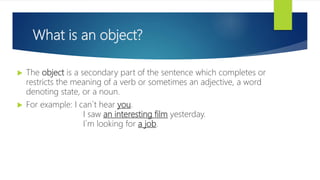
What is an object?
 The object is a secondary part of the sentence which completes or
restricts the meaning of a verb or sometimes an adjective, a word
denoting state, or a noun.
 For example: I can`t hear you.
I saw an interesting film yesterday.
I`m looking for a job.
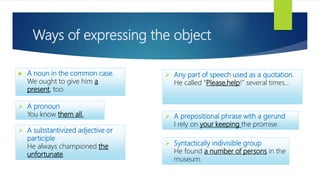
Ways of expressing the object
 A noun in the common case.
We ought to give him a
present, too.
 A pronoun
You know them all.
 A substantivized adjective or
participle
He always championed the
unfortunate.
 Any part of speech used as a quotation.
He called “Please,help!” several times...
 A prepositional phrase with a gerund
I rely on your keeping the promise.
 Syntactically indivisible group
He found a number of persons in the
museum.
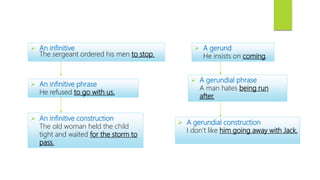
 An infinitive
The sergeant ordered his men to stop.
 An infinitive phrase
He refused to go with us.
 An infinitive construction
The old woman held the child
tight and waited for the storm to
pass.
 A gerund
He insists on coming.
 A gerundial phrase
A man hates being run
after.
 A gerundial construction
I don’t like him going away with Jack.
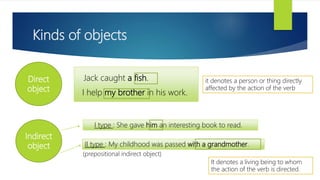
Kinds of objects
Direct
object
it denotes a person or thing directly
affected by the action of the verb
Jack caught a fish.
I help my brother in his work.
Indirect
object
It denotes a living being to whom
the action of the verb is directed.
I type : She gave him an interesting book to read.
II type : My childhood was passed with a grandmother.
(prepositional indirect object)
Kinds of objects
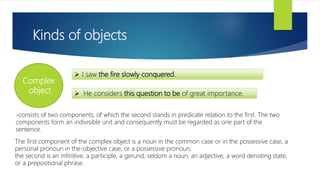
Complex
object
-consists of two components, of which the second stands in predicate relation to the first. The two
components form an indivisible unit and consequently must be regarded as one part of the
sentence.
 I saw the fire slowly conquered.
 He considers this question to be of great importance.
The first component of the complex object is a noun in the common case or in the possessive case, a
personal pronoun in the-objective case, or a possessive pronoun;
the second is an infinitive, a participle, a gerund, seldom a noun, an adjective, a word denoting state,
or a prepositional phrase.
Kinds of objects
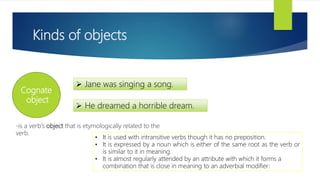
Cognate
object
-is a verb's object that is etymologically related to the
verb.
 Jane was singing a song.
 He dreamed a horrible dream.
• It is used with intransitive verbs though it has no preposition.
• It is expressed by a noun which is either of the same root as the verb or
is similar to it in meaning.
• It is almost regularly attended by an attribute with which it forms a
combination that is close in meaning to an adverbial modifier:

Object

  • 1.
    The Object PREPARED BYJULIA MIKHNEVA 21-A GROUP
  • 2.
    What is anobject?  The object is a secondary part of the sentence which completes or restricts the meaning of a verb or sometimes an adjective, a word denoting state, or a noun.  For example: I can`t hear you. I saw an interesting film yesterday. I`m looking for a job.
  • 3.
    Ways of expressingthe object  A noun in the common case. We ought to give him a present, too.  A pronoun You know them all.  A substantivized adjective or participle He always championed the unfortunate.  Any part of speech used as a quotation. He called “Please,help!” several times...  A prepositional phrase with a gerund I rely on your keeping the promise.  Syntactically indivisible group He found a number of persons in the museum.
  • 4.
     An infinitive Thesergeant ordered his men to stop.  An infinitive phrase He refused to go with us.  An infinitive construction The old woman held the child tight and waited for the storm to pass.  A gerund He insists on coming.  A gerundial phrase A man hates being run after.  A gerundial construction I don’t like him going away with Jack.
  • 5.
    Kinds of objects Direct object itdenotes a person or thing directly affected by the action of the verb Jack caught a fish. I help my brother in his work. Indirect object It denotes a living being to whom the action of the verb is directed. I type : She gave him an interesting book to read. II type : My childhood was passed with a grandmother. (prepositional indirect object)
  • 6.
    Kinds of objects Complex object -consistsof two components, of which the second stands in predicate relation to the first. The two components form an indivisible unit and consequently must be regarded as one part of the sentence.  I saw the fire slowly conquered.  He considers this question to be of great importance. The first component of the complex object is a noun in the common case or in the possessive case, a personal pronoun in the-objective case, or a possessive pronoun; the second is an infinitive, a participle, a gerund, seldom a noun, an adjective, a word denoting state, or a prepositional phrase.
  • 7.
    Kinds of objects Cognate object -isa verb's object that is etymologically related to the verb.  Jane was singing a song.  He dreamed a horrible dream. • It is used with intransitive verbs though it has no preposition. • It is expressed by a noun which is either of the same root as the verb or is similar to it in meaning. • It is almost regularly attended by an attribute with which it forms a combination that is close in meaning to an adverbial modifier: