Managers and Management
Dr. G C Mohanta, BE, MSc(Engg), MBA, PhD(Mgt)
Professor
1-2
What is Management?
 Management is getting things done through others
 All managers work in organizations
 Organizations are collections of people who work
together
 Management is the coordination of their actions to
achieve the goals of the organisation
 Management is planning, organizing, leading and
controlling of human & other resources to achieve
organizational goals effectively and efficiently
1-3
What are Resources?
 Resources include people, skills, know-how & experience,
machinery, raw materials, computers & IT, patents,
financial capital, loyal customers and employees
1-4
Managers
Managers –
 The people responsible for supervising the use
of an organization’s resources to meet its goals
Questions
 Who are the persons responsible for supervising the
use of an organization’s resources to meet its goals?
A. Team leader
B. Manager
C. President
D. Resource allocator
Management Functions
 Planning- Includes defining goals, establishing
strategy, and developing plans to coordinate activities.
 Organizing- Determining what tasks are to be done,
who is to do them, how are tasks to be grouped, who
reports to whom and where decisions are to be made.
 Leading- Includes motivating subordinates, directing
others, selecting the most effective communication
channels, and resolving conflicts.
 Controlling- Monitoring activities to ensure they are
being accomplished as planned and correcting any
significant deviations.
1-7
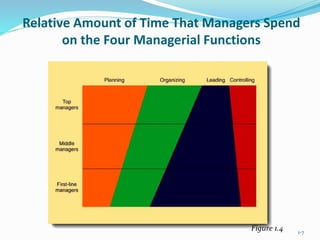
Relative Amount of Time That Managers Spend
on the Four Managerial Functions
Figure 1.4
1-8
Organizational Structure
A formal system of task and reporting relationships
that coordinates and motivates members so that
they work together to achieve organizational goals
1-9
What is Organizational Performance
A measure of how efficiently and effectively managers
use available resources to satisfy customers and
achieve organizational goals
1-10
Factors Affecting Organizational
Performance
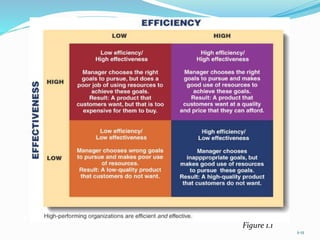
Efficiency
 A measure of how well or how productively resources
are used to achieve a goal
Effectiveness
 A measure of the appropriateness of the goals an
organization is pursuing and the degree to which they
are achieved.
1-11
Figure 1.1
1-12
Areas of Managers
Department
 A group of managers and employees who work
together and possess
similar skills
or use the same
knowledge, tools,
or techniques
1-13
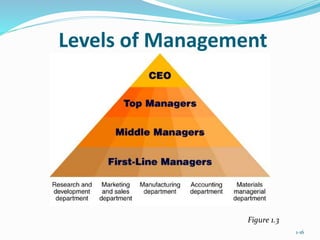
Levels of Management
• First line managers - Responsible for daily
supervision of the non-managerial employees who
perform many of the specific activities necessary to
produce goods and services
• Middle managers - Supervise first-line managers.
Responsible for finding the best way to organize
human and other resources to achieve organizational
goals
1-14
Levels of Management
• Top managers –
 Responsible for the performance of all departments
and have cross-departmental responsibility.
 Establish organizational goals and monitor middle
managers
 Decide how different departments should interact
 Ultimately responsible for the success or failure of an
organization
1-15
Levels of Management
 Chief executive officer (CEO) is company’s most
senior and important manager
 Central concern is creation of a smoothly functioning
top-management team
 CEO, COO, Department heads
1-16
Levels of Management
Figure 1.3
1-17
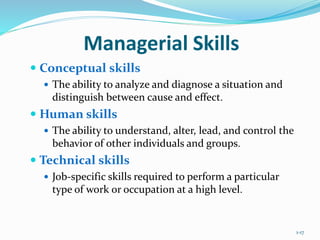
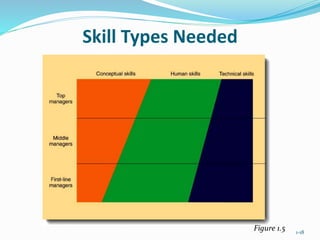
Managerial Skills
 Conceptual skills
 The ability to analyze and diagnose a situation and
distinguish between cause and effect.
 Human skills
 The ability to understand, alter, lead, and control the
behavior of other individuals and groups.
 Technical skills
 Job-specific skills required to perform a particular
type of work or occupation at a high level.
1-18
Skill Types Needed
Figure 1.5

Manager and management

  • 1.
    Managers and Management Dr.G C Mohanta, BE, MSc(Engg), MBA, PhD(Mgt) Professor
  • 2.
    1-2 What is Management? Management is getting things done through others  All managers work in organizations  Organizations are collections of people who work together  Management is the coordination of their actions to achieve the goals of the organisation  Management is planning, organizing, leading and controlling of human & other resources to achieve organizational goals effectively and efficiently
  • 3.
    1-3 What are Resources? Resources include people, skills, know-how & experience, machinery, raw materials, computers & IT, patents, financial capital, loyal customers and employees
  • 4.
    1-4 Managers Managers –  Thepeople responsible for supervising the use of an organization’s resources to meet its goals
  • 5.
    Questions  Who arethe persons responsible for supervising the use of an organization’s resources to meet its goals? A. Team leader B. Manager C. President D. Resource allocator
  • 6.
    Management Functions  Planning-Includes defining goals, establishing strategy, and developing plans to coordinate activities.  Organizing- Determining what tasks are to be done, who is to do them, how are tasks to be grouped, who reports to whom and where decisions are to be made.  Leading- Includes motivating subordinates, directing others, selecting the most effective communication channels, and resolving conflicts.  Controlling- Monitoring activities to ensure they are being accomplished as planned and correcting any significant deviations.
  • 7.
    1-7 Relative Amount ofTime That Managers Spend on the Four Managerial Functions Figure 1.4
  • 8.
    1-8 Organizational Structure A formalsystem of task and reporting relationships that coordinates and motivates members so that they work together to achieve organizational goals
  • 9.
    1-9 What is OrganizationalPerformance A measure of how efficiently and effectively managers use available resources to satisfy customers and achieve organizational goals
  • 10.
    1-10 Factors Affecting Organizational Performance Efficiency A measure of how well or how productively resources are used to achieve a goal Effectiveness  A measure of the appropriateness of the goals an organization is pursuing and the degree to which they are achieved.
  • 11.
  • 12.
    1-12 Areas of Managers Department A group of managers and employees who work together and possess similar skills or use the same knowledge, tools, or techniques
  • 13.
    1-13 Levels of Management •First line managers - Responsible for daily supervision of the non-managerial employees who perform many of the specific activities necessary to produce goods and services • Middle managers - Supervise first-line managers. Responsible for finding the best way to organize human and other resources to achieve organizational goals
  • 14.
    1-14 Levels of Management •Top managers –  Responsible for the performance of all departments and have cross-departmental responsibility.  Establish organizational goals and monitor middle managers  Decide how different departments should interact  Ultimately responsible for the success or failure of an organization
  • 15.
    1-15 Levels of Management Chief executive officer (CEO) is company’s most senior and important manager  Central concern is creation of a smoothly functioning top-management team  CEO, COO, Department heads
  • 16.
  • 17.
    1-17 Managerial Skills  Conceptualskills  The ability to analyze and diagnose a situation and distinguish between cause and effect.  Human skills  The ability to understand, alter, lead, and control the behavior of other individuals and groups.  Technical skills  Job-specific skills required to perform a particular type of work or occupation at a high level.
  • 18.