NVIS
NVIS
   What is NVIS ?
   Means Near-Vertical Incidence Skywave
   Opposite of DX (long – distance)
   Local - to - Medium Distance (0 – 250 mls)
‘Ordinary’ Propagation
                         Illustration courtesy of Barrett Communications Pty
‘Ordinary’ Propagation

   To travel a long distance, the signal must
    take off at a LOW angle from the antenna
    – 30 degrees or less
   This is so that it can travel the maximum
    distance before it first arrives at the Ionosphere
   Long gap before signal returns to earth – the
    part in between this and the end of the ground
    wave is the so-called Skip (or Dead) Zone
‘Ordinary’ Propagation
                         Illustration courtesy of Barrett Communications Pty
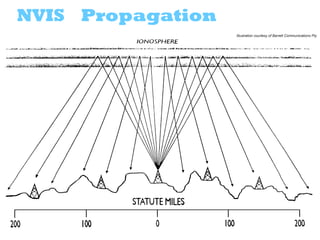
NVIS Propagation
                   Illustration courtesy of Barrett Communications Pty
NVIS Propagation

   To travel a local - medium distance, the
    signal must take off at a HIGH angle from
    the antenna – typically 60 – 90 degrees
   This returns from the Ionosphere at a
    similar angle, covering 0 – 250 mls
   It thus fills in the Skip (or Dead) Zone –
    like taking a hose and spraying it into an
    umbrella !
NVIS Propagation
                   Illustration courtesy of Barrett Communications Pty
Using NVIS
       successfully
   HIGH angle of radiation from antenna
   Minimise ground wave, as it will interfere
    with the returning skywave
   Most importantly, CHOOSE THE
    CORRECT FREQUENCY BAND – go too
    high in frequency and your signal will pass
    through straight into space!
Choosing the right frequency
   The Ionosphere – D, E, F1 & F2 layers
   D and to a lesser extent, E layers attenuate
    and absorb signal
   Best returns from F2 layer
   At any one time we need to know the
    frequency of the F2 layer – The Critical
    Frequency or foF2
   Optimum frequency for NVIS work around
    10% below this
The Ionosphere


                 Illustration courtesy of the University of Ulster Communications Centre
NVIS - Frequency and Time

   ‘Higher’ frequency band during day,
    ‘Middle’ frequencies afternoon/evening,
    ‘Lower’ frequencies at night
   Frequencies also affected by time of year
    and period of sunspot cycle
   For best results, three different frequency
    ‘bands’ are required
NVIS – The Antenna Side
   Need high angle (60-90°) radiation for NVIS
   Vertical no use – predominantly low angle
   Half wave dipole at ‘text book’ height – 0.5
    wavelength produces low angle radiation, BUT,
    if lowered to 0.25 wavelength or below,
    produces high angle radiation !
   Not too low, though – some earth losses. A
    reflector wire or earth mat can reduce this
‘Tone’ Burst’s View of NVIS


                       RSGB Radio Today Sept 2000
Questions?

Nvis

  • 1.
  • 2.
    NVIS  What is NVIS ?  Means Near-Vertical Incidence Skywave  Opposite of DX (long – distance)  Local - to - Medium Distance (0 – 250 mls)
  • 3.
    ‘Ordinary’ Propagation Illustration courtesy of Barrett Communications Pty
  • 4.
    ‘Ordinary’ Propagation  To travel a long distance, the signal must take off at a LOW angle from the antenna – 30 degrees or less  This is so that it can travel the maximum distance before it first arrives at the Ionosphere  Long gap before signal returns to earth – the part in between this and the end of the ground wave is the so-called Skip (or Dead) Zone
  • 5.
    ‘Ordinary’ Propagation Illustration courtesy of Barrett Communications Pty
  • 6.
    NVIS Propagation Illustration courtesy of Barrett Communications Pty
  • 7.
    NVIS Propagation  To travel a local - medium distance, the signal must take off at a HIGH angle from the antenna – typically 60 – 90 degrees  This returns from the Ionosphere at a similar angle, covering 0 – 250 mls  It thus fills in the Skip (or Dead) Zone – like taking a hose and spraying it into an umbrella !
  • 8.
    NVIS Propagation Illustration courtesy of Barrett Communications Pty
  • 9.
    Using NVIS successfully  HIGH angle of radiation from antenna  Minimise ground wave, as it will interfere with the returning skywave  Most importantly, CHOOSE THE CORRECT FREQUENCY BAND – go too high in frequency and your signal will pass through straight into space!
  • 10.
    Choosing the rightfrequency  The Ionosphere – D, E, F1 & F2 layers  D and to a lesser extent, E layers attenuate and absorb signal  Best returns from F2 layer  At any one time we need to know the frequency of the F2 layer – The Critical Frequency or foF2  Optimum frequency for NVIS work around 10% below this
  • 11.
    The Ionosphere Illustration courtesy of the University of Ulster Communications Centre
  • 12.
    NVIS - Frequencyand Time  ‘Higher’ frequency band during day, ‘Middle’ frequencies afternoon/evening, ‘Lower’ frequencies at night  Frequencies also affected by time of year and period of sunspot cycle  For best results, three different frequency ‘bands’ are required
  • 13.
    NVIS – TheAntenna Side  Need high angle (60-90°) radiation for NVIS  Vertical no use – predominantly low angle  Half wave dipole at ‘text book’ height – 0.5 wavelength produces low angle radiation, BUT, if lowered to 0.25 wavelength or below, produces high angle radiation !  Not too low, though – some earth losses. A reflector wire or earth mat can reduce this
  • 14.
    ‘Tone’ Burst’s Viewof NVIS RSGB Radio Today Sept 2000
  • 15.