International Federation
of Red Cross and Red Crescent Societies


 INDUCTION TRAINING COURSE


      CODE OF CONDUCT FOR THE INTERNATIONAL RED
        CROSS AND RED CRESCENT MOVEMENT
International Federation
of Red Cross and Red Crescent Societies


Code of conduct
  Agreed upon by 7 International Humanitarian Agencies: IFRC,
   ICRC, Caritas International, International Save the Children,
   Lutheran World Federation, Oxfam and World Council of Churches;
  Seeks to guard the standards of behavior of International
   Humanitarian Agency and Humanitarian Aid workers as well as to
   maintain the high standards of independence, effectiveness and
   impact to humanitarian activities;
  Adopted by Federation through General Assembly and The Council
   of Delegates (Birmingham, 1993) and International Conference
   (Geneva, 1995);
International Federation
of Red Cross and Red Crescent Societies


Code of conduct


   Consist of 10 (ten) fundamental principles related to Humanitarian
    Relief Operation and 3 (three) Annex that regulatory with
    governments of affected countries, donor governments and
    intergovernmental organizations;
International Federation
  of Red Cross and Red Crescent Societies


     Code of conduct
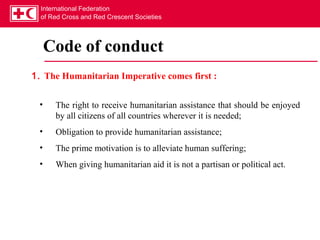
1. The Humanitarian Imperative comes first :


 •    The right to receive humanitarian assistance that should be enjoyed
      by all citizens of all countries wherever it is needed;
 •    Obligation to provide humanitarian assistance;
 •    The prime motivation is to alleviate human suffering;
 •    When giving humanitarian aid it is not a partisan or political act.
International Federation
      of Red Cross and Red Crescent Societies


       Code of conduct
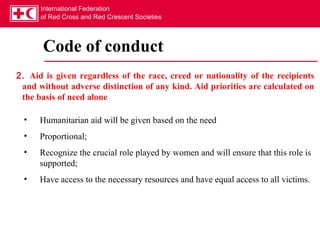
2. Aid is given regardless of the race, creed or nationality of the recipients
 and without adverse distinction of any kind. Aid priorities are calculated on
 the basis of need alone

 •    Humanitarian aid will be given based on the need
 •    Proportional;
 •    Recognize the crucial role played by women and will ensure that this role is
      supported;
 •    Have access to the necessary resources and have equal access to all victims.
International Federation
         of Red Cross and Red Crescent Societies


         Code of conduct
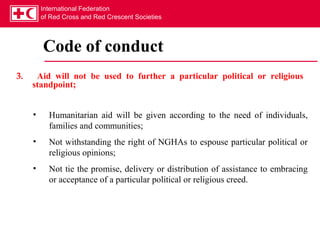
3.    Aid will not be used to further a particular political or religious
     standpoint;


     •     Humanitarian aid will be given according to the need of individuals,
           families and communities;
     •     Not withstanding the right of NGHAs to espouse particular political or
           religious opinions;
     •     Not tie the promise, delivery or distribution of assistance to embracing
           or acceptance of a particular political or religious creed.
International Federation
         of Red Cross and Red Crescent Societies


         Code of conduct
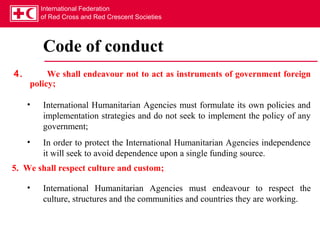
4.        We shall endeavour not to act as instruments of government foreign
     policy;

     •   International Humanitarian Agencies must formulate its own policies and
         implementation strategies and do not seek to implement the policy of any
         government;
     •   In order to protect the International Humanitarian Agencies independence
         it will seek to avoid dependence upon a single funding source.
5. We shall respect culture and custom;

     •   International Humanitarian Agencies must endeavour to respect the
         culture, structures and the communities and countries they are working.
International Federation
         of Red Cross and Red Crescent Societies


         Code of conduct
6. We shall attempt to built disaster response on local capacities
     •     We will strengthen the capacities by employing local staff, purchasing
           local material and trading with local companies;
     •     We will work through local NGOs as partners in planning and
           implementation, and the proper co-operate with local government
           structures where appropriate;
     •     Place a high priority on the proper co-ordination.
7.   Ways shall be found to involve programme beneficiaries in the
     management of relief aid;
     •      We will Strive to achieve full community participation in our relief and
            rehabilitation programmes.
International Federation
      of Red Cross and Red Crescent Societies


       Code of conduct
8. Relief must strive to reduce future vulnerabilities to disaster as well as
 meeting basic need;

 •   Strive to implement relief programmes which actively reduce the
     beneficiaries’ vulnerability to future and help create sustainable lifestyles;
 •   Pay particular attention to environmental concerns in the design and
     management of relief programmes;
 •   Endeavour to minimize the negative impact of humanitarian assistance,
     seeking to avoid long-term beneficiary dependence upon external aid.
International Federation
    of Red Cross and Red Crescent Societies


    Code of conduct
9. We hold ourselves accountable to both those we seek to assist and
 those from whom we accept resources;

•   All our dealings with donors and beneficiaries shall reflect an attitude of
    openness and transparency;
•   Need to report on the activities, both from a financial perspective and the
    perspective of effectiveness;
•   Recognize the obligation to ensure appropriate monitoring of aid
    distributions and to carry out regular assessments of the impact of
    assistance.
International Federation
     of Red Cross and Red Crescent Societies


     Code of conduct
10. In our information, publicity and advertising activities, we shall
 recognize disaster victims as dignified humans, not object of pity;
 •   Respect for the victims
 •   In our public information we shall portray an objective image of the
     disaster situation where the capacities and aspirations of victims are
     highlighted and not just their vulnerabilities;
 •   While we will cooperate with the media in order to enhance public
     response, we will not allow external or internal demands for publicity to
     take precedence over the principle of maximizing overall relief assistance;
 •   We will avoid competing with other response agencies for media coverage
     in situations where such coverage may be to the detriment of the service
     provided to the beneficiaries or to the security of our staff or beneficiaries.
International Federation
of Red Cross and Red Crescent Societies

Code of conduct(english)

  • 1.
    International Federation of RedCross and Red Crescent Societies INDUCTION TRAINING COURSE CODE OF CONDUCT FOR THE INTERNATIONAL RED CROSS AND RED CRESCENT MOVEMENT
  • 2.
    International Federation of RedCross and Red Crescent Societies Code of conduct  Agreed upon by 7 International Humanitarian Agencies: IFRC, ICRC, Caritas International, International Save the Children, Lutheran World Federation, Oxfam and World Council of Churches;  Seeks to guard the standards of behavior of International Humanitarian Agency and Humanitarian Aid workers as well as to maintain the high standards of independence, effectiveness and impact to humanitarian activities;  Adopted by Federation through General Assembly and The Council of Delegates (Birmingham, 1993) and International Conference (Geneva, 1995);
  • 3.
    International Federation of RedCross and Red Crescent Societies Code of conduct  Consist of 10 (ten) fundamental principles related to Humanitarian Relief Operation and 3 (three) Annex that regulatory with governments of affected countries, donor governments and intergovernmental organizations;
  • 4.
    International Federation of Red Cross and Red Crescent Societies Code of conduct 1. The Humanitarian Imperative comes first : • The right to receive humanitarian assistance that should be enjoyed by all citizens of all countries wherever it is needed; • Obligation to provide humanitarian assistance; • The prime motivation is to alleviate human suffering; • When giving humanitarian aid it is not a partisan or political act.
  • 5.
    International Federation of Red Cross and Red Crescent Societies Code of conduct 2. Aid is given regardless of the race, creed or nationality of the recipients and without adverse distinction of any kind. Aid priorities are calculated on the basis of need alone • Humanitarian aid will be given based on the need • Proportional; • Recognize the crucial role played by women and will ensure that this role is supported; • Have access to the necessary resources and have equal access to all victims.
  • 6.
    International Federation of Red Cross and Red Crescent Societies Code of conduct 3. Aid will not be used to further a particular political or religious standpoint; • Humanitarian aid will be given according to the need of individuals, families and communities; • Not withstanding the right of NGHAs to espouse particular political or religious opinions; • Not tie the promise, delivery or distribution of assistance to embracing or acceptance of a particular political or religious creed.
  • 7.
    International Federation of Red Cross and Red Crescent Societies Code of conduct 4. We shall endeavour not to act as instruments of government foreign policy; • International Humanitarian Agencies must formulate its own policies and implementation strategies and do not seek to implement the policy of any government; • In order to protect the International Humanitarian Agencies independence it will seek to avoid dependence upon a single funding source. 5. We shall respect culture and custom; • International Humanitarian Agencies must endeavour to respect the culture, structures and the communities and countries they are working.
  • 8.
    International Federation of Red Cross and Red Crescent Societies Code of conduct 6. We shall attempt to built disaster response on local capacities • We will strengthen the capacities by employing local staff, purchasing local material and trading with local companies; • We will work through local NGOs as partners in planning and implementation, and the proper co-operate with local government structures where appropriate; • Place a high priority on the proper co-ordination. 7. Ways shall be found to involve programme beneficiaries in the management of relief aid; • We will Strive to achieve full community participation in our relief and rehabilitation programmes.
  • 9.
    International Federation of Red Cross and Red Crescent Societies Code of conduct 8. Relief must strive to reduce future vulnerabilities to disaster as well as meeting basic need; • Strive to implement relief programmes which actively reduce the beneficiaries’ vulnerability to future and help create sustainable lifestyles; • Pay particular attention to environmental concerns in the design and management of relief programmes; • Endeavour to minimize the negative impact of humanitarian assistance, seeking to avoid long-term beneficiary dependence upon external aid.
  • 10.
    International Federation of Red Cross and Red Crescent Societies Code of conduct 9. We hold ourselves accountable to both those we seek to assist and those from whom we accept resources; • All our dealings with donors and beneficiaries shall reflect an attitude of openness and transparency; • Need to report on the activities, both from a financial perspective and the perspective of effectiveness; • Recognize the obligation to ensure appropriate monitoring of aid distributions and to carry out regular assessments of the impact of assistance.
  • 11.
    International Federation of Red Cross and Red Crescent Societies Code of conduct 10. In our information, publicity and advertising activities, we shall recognize disaster victims as dignified humans, not object of pity; • Respect for the victims • In our public information we shall portray an objective image of the disaster situation where the capacities and aspirations of victims are highlighted and not just their vulnerabilities; • While we will cooperate with the media in order to enhance public response, we will not allow external or internal demands for publicity to take precedence over the principle of maximizing overall relief assistance; • We will avoid competing with other response agencies for media coverage in situations where such coverage may be to the detriment of the service provided to the beneficiaries or to the security of our staff or beneficiaries.
  • 12.
    International Federation of RedCross and Red Crescent Societies

Editor's Notes