Hiatal hernia
MURAD A’AMAR
HASHEMITE UNIVERSITY
What is hiatal hernia?
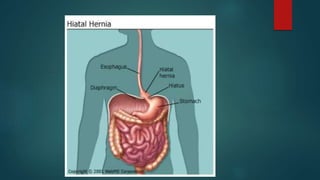
 The hiatus is an opening in the diaphragm -- the muscular wall
separating the chest cavity from the abdomen.
 Normally, the esophagus (food pipe) goes through the hiatus and
attaches to the stomach. In a hiatal hernia (also called hiatus
hernia) the stomach bulges up into the chest through that opening
Types of hiatal hernia:
 There are two main types of hiatal hernias:
 1- sliding and,
 2- paraesophageal (next to the esophagus).
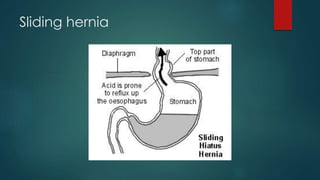
Sliding hernia:
 In a sliding hiatal hernia, the stomach and the section of the
esophagus that joins the stomach slide up into the chest through the
hiatus.
 This is the more common type of hernia.
Sliding hernia
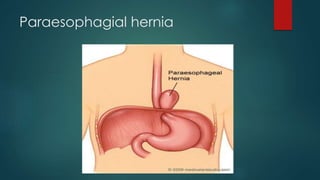
Paraoesophageal hernia:
 The paraesophageal hernia is less common,
 The esophagus and stomach stay in their normal locations, but part
of the stomach squeezes through the hiatus,
 landing it next to the esophagus.
Paraesophagial hernia
Paraesophagial hernia:
 Although you can have this type of hernia without any symptoms,
 the danger is that the stomach can become "strangled," or have
its blood supply shut off.
 Many people with hiatal hernia have no symptoms,
 but others may have heartburn related to gastroesophageal reflux
disease, or GERD.
 Although there appears to be a link, one condition does not seem
to cause the other, because many people have a hiatal hernia
without having GERD, and others have GERD without having a
hiatal hernia.
 People with heartburn may experience chest pain that can easily
be confused with the pain of a heart attack.
What causes hiatal hernia?
 Most of the time, the cause is not known.
 A person may be born with a larger hiatal opening.
 Increased pressure in the abdomen such as from
pregnancy, obesity, coughing, or straining during bowel movements
may also play a role.
Who is at risk of hiatal hernia?
 Hiatal hernias occur more often in women,
 people who are overweight,
 and people older than 50
How it is diagnosed?
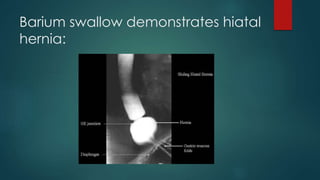
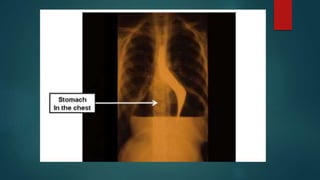
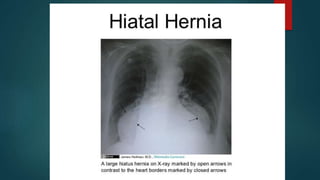
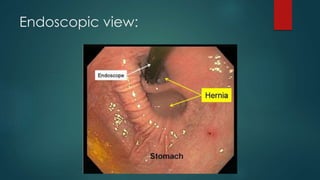
 A hiatal hernia can be diagnosed with a specialized X-ray (using a
barium swallow) that allows a doctor to see the esophagus,
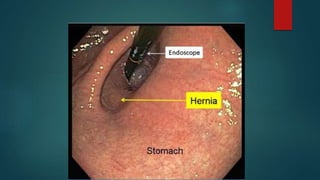
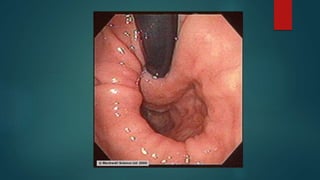
 or with endoscopy.
Barium swallow demonstrates hiatal
hernia:
Endoscopic view:
Medical Treatment:
 When symptoms are due to GERD, the goals of treatment include prevention of
reflux of gastric contents, improved esophageal clearance, and reduction in
acid production. This is achieved in the majority of patients by a combination of
the following:
 Modifying lifestyle factors, STOP SMOKING
 Neutralizing acid or inhibiting acid production by antacids and PPI
 Enhancing esophageal and gastric motility:
 -Domperidone (Motilium®)
 -Metoclopromide (Reglan®, Maxeran®)
 -Levosulpiride (Levobren®, Levopraid®,)
 -Erythromycin
Surgical approaches:
 Nissen fundoplication: This procedure involves a 360° fundic wrap
around the gastroesophageal junction. The diaphragmatic hiatus
also is repaired
 Belsey fundoplication: This operation involves a 270° wrap in an
attempt to reduce the incidence of gas bloating and postoperative
dysphagia. It also is preferred when minimal esophageal dysmotility
is suspected.
 Hill repair: the cardia of the stomach is anchored to the posterior
abdominal areas.
Hiatal hernia

Hiatal hernia

  • 1.
  • 2.
    What is hiatalhernia?  The hiatus is an opening in the diaphragm -- the muscular wall separating the chest cavity from the abdomen.  Normally, the esophagus (food pipe) goes through the hiatus and attaches to the stomach. In a hiatal hernia (also called hiatus hernia) the stomach bulges up into the chest through that opening
  • 3.
    Types of hiatalhernia:  There are two main types of hiatal hernias:  1- sliding and,  2- paraesophageal (next to the esophagus).
  • 5.
    Sliding hernia:  Ina sliding hiatal hernia, the stomach and the section of the esophagus that joins the stomach slide up into the chest through the hiatus.  This is the more common type of hernia.
  • 6.
  • 7.
    Paraoesophageal hernia:  Theparaesophageal hernia is less common,  The esophagus and stomach stay in their normal locations, but part of the stomach squeezes through the hiatus,  landing it next to the esophagus.
  • 8.
  • 9.
    Paraesophagial hernia:  Althoughyou can have this type of hernia without any symptoms,  the danger is that the stomach can become "strangled," or have its blood supply shut off.
  • 10.
     Many peoplewith hiatal hernia have no symptoms,  but others may have heartburn related to gastroesophageal reflux disease, or GERD.  Although there appears to be a link, one condition does not seem to cause the other, because many people have a hiatal hernia without having GERD, and others have GERD without having a hiatal hernia.  People with heartburn may experience chest pain that can easily be confused with the pain of a heart attack.
  • 11.
    What causes hiatalhernia?  Most of the time, the cause is not known.  A person may be born with a larger hiatal opening.  Increased pressure in the abdomen such as from pregnancy, obesity, coughing, or straining during bowel movements may also play a role.
  • 12.
    Who is atrisk of hiatal hernia?  Hiatal hernias occur more often in women,  people who are overweight,  and people older than 50
  • 13.
    How it isdiagnosed?  A hiatal hernia can be diagnosed with a specialized X-ray (using a barium swallow) that allows a doctor to see the esophagus,  or with endoscopy.
  • 14.
  • 18.
  • 21.
    Medical Treatment:  Whensymptoms are due to GERD, the goals of treatment include prevention of reflux of gastric contents, improved esophageal clearance, and reduction in acid production. This is achieved in the majority of patients by a combination of the following:  Modifying lifestyle factors, STOP SMOKING  Neutralizing acid or inhibiting acid production by antacids and PPI  Enhancing esophageal and gastric motility:  -Domperidone (Motilium®)  -Metoclopromide (Reglan®, Maxeran®)  -Levosulpiride (Levobren®, Levopraid®,)  -Erythromycin
  • 22.
    Surgical approaches:  Nissenfundoplication: This procedure involves a 360° fundic wrap around the gastroesophageal junction. The diaphragmatic hiatus also is repaired  Belsey fundoplication: This operation involves a 270° wrap in an attempt to reduce the incidence of gas bloating and postoperative dysphagia. It also is preferred when minimal esophageal dysmotility is suspected.  Hill repair: the cardia of the stomach is anchored to the posterior abdominal areas.