NUTRITIONAL ASSESSMENT AND BODY
COMPOSITION OF KARATE STUDENTS ( AGE)
Submitted by
Ms. Neha Bhagwat Mali
Under the guidance of
Mrs. Anuradha Shekar
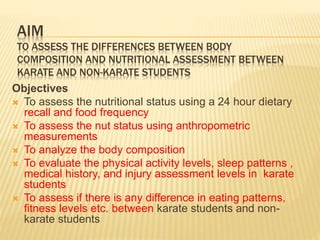
AIM
TO ASSESS THE DIFFERENCES BETWEEN BODY
COMPOSITION AND NUTRITIONAL ASSESSMENT BETWEEN
KARATE AND NON-KARATE STUDENTS
Objectives
 To assess the nutritional status using a 24 hour dietary
recall and food frequency
 To assess the nut status using anthropometric
measurements
 To analyze the body composition
 To evaluate the physical activity levels, sleep patterns ,
medical history, and injury assessment levels in karate
students
 To assess if there is any difference in eating patterns,
fitness levels etc. between karate students and non-
karate students
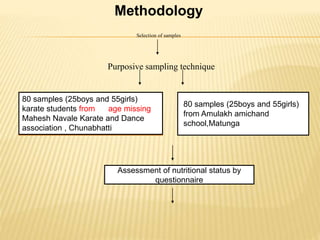
Selection of samples
Purposive sampling technique
Methodology
80 samples (25boys and 55girls)
karate students from age missing
Mahesh Navale Karate and Dance
association , Chunabhatti
80 samples (25boys and 55girls)
from Amulakh amichand
school,Matunga
Assessment of nutritional status by
questionnaire
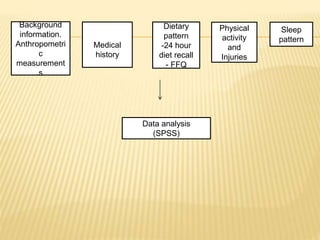
Background
information.
Anthropometri
c
measurement
s
Medical
history
Dietary
pattern
-24 hour
diet recall
- FFQ
Physical
activity
and
Injuries
Sleep
pattern
Data analysis
(SPSS)
RESULT AND DISCUSSION
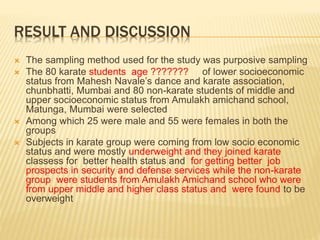
 The sampling method used for the study was purposive sampling
 The 80 karate students age ??????? of lower socioeconomic
status from Mahesh Navale’s dance and karate association,
chunbhatti, Mumbai and 80 non-karate students of middle and
upper socioeconomic status from Amulakh amichand school,
Matunga, Mumbai were selected
 Among which 25 were male and 55 were females in both the
groups
 Subjects in karate group were coming from low socio economic
status and were mostly underweight and they joined karate
classess for better health status and for getting better job
prospects in security and defense services while the non-karate
group were students from Amulakh Amichand school who were
from upper middle and higher class status and were found to be
overweight
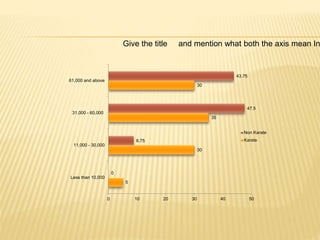
5
30
35
30
0
8.75
47.5
43.75
0 10 20 30 40 50
Less than 10,000
11,000 - 30,000
31,000 - 60,000
61,000 and above
Non Karate
Karate
Give the title and mention what both the axis mean In
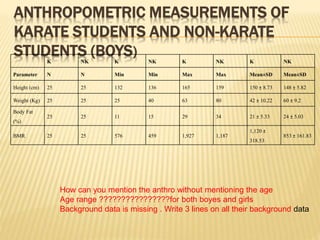
ANTHROPOMETRIC MEASUREMENTS OF
KARATE STUDENTS AND NON-KARATE
STUDENTS (BOYS)
K NK K NK K NK K NK
Parameter N N Min Min Max Max Mean±SD Mean±SD
Height (cm) 25 25 132 136 165 159 150 ± 8.73 148 ± 5.82
Weight (Kg) 25 25 25 40 63 80 42 ± 10.22 60 ± 9.2
Body Fat
(%)
25 25 11 15 29 34 21 ± 5.33 24 ± 5.03
BMR 25 25 576 459 1,927 1,187
1,120 ±
318.53
853 ± 161.83
How can you mention the anthro without mentioning the age
Age range ????????????????for both boyes and girls
Background data is missing . Write 3 lines on all their background data
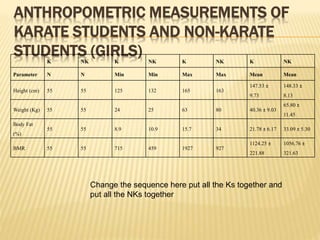
ANTHROPOMETRIC MEASUREMENTS OF
KARATE STUDENTS AND NON-KARATE
STUDENTS (GIRLS)K NK K NK K NK K NK
Parameter N N Min Min Max Max Mean Mean
Height (cm) 55 55 125 132 165 163
147.53 ±
9.73
148.33 ±
8.13
Weight (Kg) 55 55 24 25 63 80 40.36 ± 9.03
65.80 ±
11.45
Body Fat
(%)
55 55 8.9 10.9 15.7 34 21.78 ± 6.17 33.09 ± 5.30
BMR 55 55 715 459 1927 927
1124.25 ±
221.88
1056.76 ±
321.63
Change the sequence here put all the Ks together and
put all the NKs together
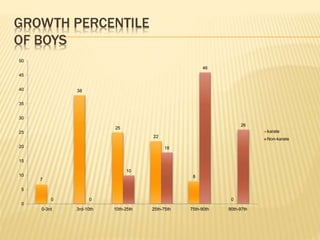
GROWTH PERCENTILE
OF BOYS
7
38
25
22
8
00 0
10
18
46
26
0
5
10
15
20
25
30
35
40
45
50
0-3rd 3rd-10th 10th-25th 25th-75th 75th-90th 90th-97th
karate
Non-karate
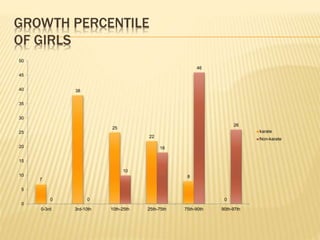
GROWTH PERCENTILE
OF GIRLS
7
38
25
22
8
00 0
10
18
46
26
0
5
10
15
20
25
30
35
40
45
50
0-3rd 3rd-10th 10th-25th 25th-75th 75th-90th 90th-97th
karate
Non-karate
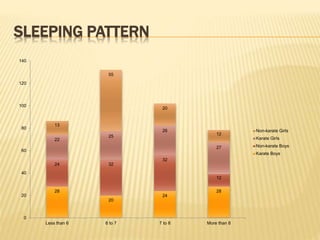
SLEEPING PATTERN
28
20
24
28
24 32
32
12
22
25
26
27
13
55
20
12
0
20
40
60
80
100
120
140
Less than 6 6 to 7 7 to 8 More than 8
Non-karate Girls
Karate Girls
Non-karate Boys
Karate Boys
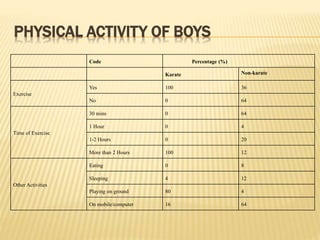
PHYSICAL ACTIVITY OF BOYS
Code Percentage (%)
Karate Non-karate
Exercise
Yes 100 36
No 0 64
Time of Exercise
30 mins 0 64
1 Hour 0 4
1-2 Hours 0 20
More than 2 Hours 100 12
Other Activities
Eating 0 8
Sleeping 4 12
Playing on ground 80 4
On mobile/computer 16 64
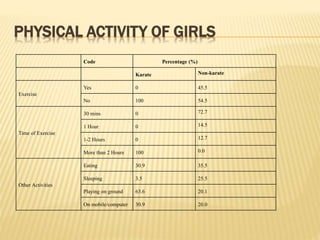
PHYSICAL ACTIVITY OF GIRLS
Code Percentage (%)
Karate Non-karate
Exercise
Yes 0 45.5
No 100 54.5
Time of Exercise
30 mins 0 72.7
1 Hour 0 14.5
1-2 Hours 0 12.7
More than 2 Hours 100 0.0
Other Activities
Eating 30.9 35.5
Sleeping 3.5 25.5
Playing on ground 63.6 20.1
On mobile/computer 30.9 20.0
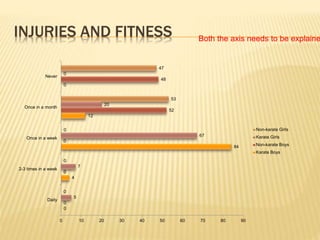
INJURIES AND FITNESS
0
4
84
12
0
0
0
0
52
48
5
7
67
20
0
0
0
0
53
47
0 10 20 30 40 50 60 70 80 90
Daily
2-3 times in a week
Once in a week
Once in a month
Never
Non-karate Girls
Karate Girls
Non-karate Boys
Karate Boys
Both the axis needs to be explaine
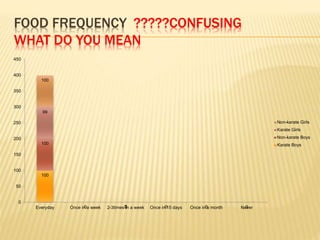
FOOD FREQUENCY ?????CONFUSING
WHAT DO YOU MEAN
100
0 0 0 0 0
100
0 0 0 0 0
99
0 1 0 0 0
100
0 0 0 0 0
0
50
100
150
200
250
300
350
400
450
Everyday Once in a week 2-3times in a week Once in 15 days Once in a month Never
Non-karate Girls
Karate Girls
Non-karate Boys
Karate Boys
SIGNIFICANCE AND CORRELATIONS
COMPARISON OF NUTRIENTS INTAKE OF BOYS
Variables Groups t value p value
Calories
Karate
-1.953 0.057*
Non-karate
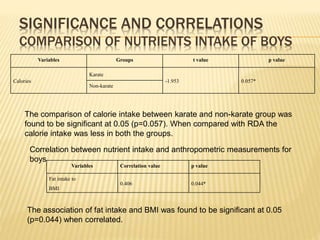
The comparison of calorie intake between karate and non-karate group was
found to be significant at 0.05 (p=0.057). When compared with RDA the
calorie intake was less in both the groups.
Correlation between nutrient intake and anthropometric measurements for
boys
Variables Correlation value p value
Fat intake to
BMI
0.406 0.044*
The association of fat intake and BMI was found to be significant at 0.05
(p=0.044) when correlated.
CORRELATION BETWEEN NUTRIENT INTAKE AND
ANTHROPOMETRIC MEASUREMENTS FOR GIRLS
Variables Correlation value p value
Proteins intake to
BMI
0.037 0.039*
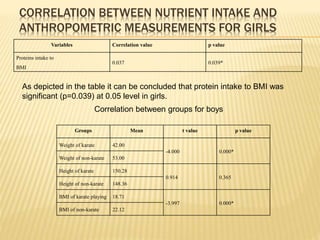
As depicted in the table it can be concluded that protein intake to BMI was
significant (p=0.039) at 0.05 level in girls.
Correlation between groups for boys
Groups Mean t value p value
Weight of karate 42.00
-4.000 0.000*
Weight of non-karate 53.00
Height of karate 150.28
0.914 0.365
Height of non-karate 148.36
BMI of karate playing 18.71
-3.997 0.000*
BMI of non-karate 22.12
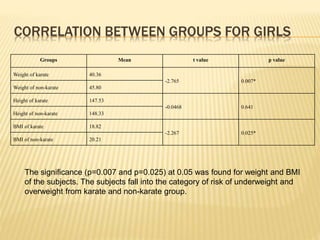
CORRELATION BETWEEN GROUPS FOR GIRLS
Groups Mean t value p value
Weight of karate 40.36
-2.765 0.007*
Weight of non-karate 45.80
Height of karate 147.53
-0.0468 0.641
Height of non-karate 148.33
BMI of karate 18.82
-2.267 0.025*
BMI of non-karate 20.21
The significance (p=0.007 and p=0.025) at 0.05 was found for weight and BMI
of the subjects. The subjects fall into the category of risk of underweight and
overweight from karate and non-karate group.
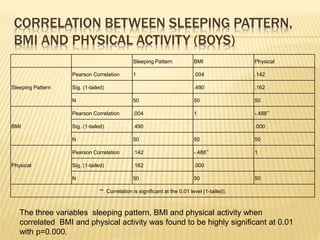
CORRELATION BETWEEN SLEEPING PATTERN,
BMI AND PHYSICAL ACTIVITY (BOYS)
Sleeping Pattern BMI Physical
Sleeping Pattern
Pearson Correlation 1 .004 .142
Sig. (1-tailed) .490 .162
N 50 50 50
BMI
Pearson Correlation .004 1 -.488**
Sig. (1-tailed) .490 .000
N 50 50 50
Physical
Pearson Correlation .142 -.488** 1
Sig. (1-tailed) .162 .000
N 50 50 50
**. Correlation is significant at the 0.01 level (1-tailed).
The three variables sleeping pattern, BMI and physical activity when
correlated BMI and physical activity was found to be highly significant at 0.01
with p=0.000.
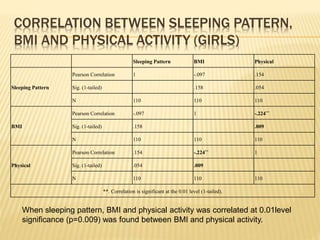
CORRELATION BETWEEN SLEEPING PATTERN,
BMI AND PHYSICAL ACTIVITY (GIRLS)
Sleeping Pattern BMI Physical
Sleeping Pattern
Pearson Correlation 1 -.097 .154
Sig. (1-tailed) .158 .054
N 110 110 110
BMI
Pearson Correlation -.097 1 -.224**
Sig. (1-tailed) .158 .009
N 110 110 110
Physical
Pearson Correlation .154 -.224** 1
Sig. (1-tailed) .054 .009
N 110 110 110
**. Correlation is significant at the 0.01 level (1-tailed).
When sleeping pattern, BMI and physical activity was correlated at 0.01level
significance (p=0.009) was found between BMI and physical activity.
SUMMARY
 The study showed that subjects in karate group were coming from low socio
economic status and were mostly underweight (3rd to 10th percentile) or at
risk of underweight (10th to 25th percentile) and were participating in game
so that they will have better health and that will help them for getting the
jobs in security and defense services
 Majority of the girl subjects were from Mahesh Navale dance and karate
association which offers free of cost training for needy girls as learning self
defense is very important for girls now a days while the non-karate group
studying in Amulakh Amichand school belong to the upper middle and high
class society and were found to be overweight (90th to 97th percentile)
 It was observed that nutrient intakes of both the karate and non-karate
groups were deficient but 13-15years group were more deficient than 16-
17years among them girls were found to be more vulnerable.
 Only the fat intake s were found to be higher when compared with RDA ,
could be due to daily habit of eating junk and fast food. Even though both
the groups had a habit of eating out the type of junk and fast food eaten
differed. Karate students had the cheapest choice of foods due to their poor
financial condition while non-karate students were eating pizza, pasta,
noodles.
 Karate students were more vulnerable due to their inadequate
intakes and poor family background in spite of vigorous physical
activity for future benefits while on the other side non-karate
students were also not able to meet their daily nutrient requirements
by diet because of their eating habits, type and choice of food and
absence of physical activity
CONCLUSION
 Karate students had very poor body composition because of
their financial status and girls seem to be more affected than
boys while in non-karate group both were having junk and fast
food and even though deficient in nutrients they were
overweight because of their food choices
 Due to daily vigorous physical activity karate group were
prone to injuries and falling sick often and had sleep
disturbances
 There was a significant correlation seen between weight and
BMI of both the groups. Also significance was found between
physical activity and BMI
 Both the groups were deficient in macronutrient and
micronutrient intake but karate group was more deficient and
especially girls were mainly lacking for all the nutrients
 You have not given the nutrient intake tables
to show intakes of macro amd nmicro
nutrients
 Injuries table has not been shown have not
been shown
 You need to show your data
 Please correct it

Nutritional assessment

  • 1.
    NUTRITIONAL ASSESSMENT ANDBODY COMPOSITION OF KARATE STUDENTS ( AGE) Submitted by Ms. Neha Bhagwat Mali Under the guidance of Mrs. Anuradha Shekar
  • 2.
    AIM TO ASSESS THEDIFFERENCES BETWEEN BODY COMPOSITION AND NUTRITIONAL ASSESSMENT BETWEEN KARATE AND NON-KARATE STUDENTS Objectives  To assess the nutritional status using a 24 hour dietary recall and food frequency  To assess the nut status using anthropometric measurements  To analyze the body composition  To evaluate the physical activity levels, sleep patterns , medical history, and injury assessment levels in karate students  To assess if there is any difference in eating patterns, fitness levels etc. between karate students and non- karate students
  • 3.
    Selection of samples Purposivesampling technique Methodology 80 samples (25boys and 55girls) karate students from age missing Mahesh Navale Karate and Dance association , Chunabhatti 80 samples (25boys and 55girls) from Amulakh amichand school,Matunga Assessment of nutritional status by questionnaire
  • 4.
  • 5.
    RESULT AND DISCUSSION The sampling method used for the study was purposive sampling  The 80 karate students age ??????? of lower socioeconomic status from Mahesh Navale’s dance and karate association, chunbhatti, Mumbai and 80 non-karate students of middle and upper socioeconomic status from Amulakh amichand school, Matunga, Mumbai were selected  Among which 25 were male and 55 were females in both the groups  Subjects in karate group were coming from low socio economic status and were mostly underweight and they joined karate classess for better health status and for getting better job prospects in security and defense services while the non-karate group were students from Amulakh Amichand school who were from upper middle and higher class status and were found to be overweight
  • 6.
    5 30 35 30 0 8.75 47.5 43.75 0 10 2030 40 50 Less than 10,000 11,000 - 30,000 31,000 - 60,000 61,000 and above Non Karate Karate Give the title and mention what both the axis mean In
  • 7.
    ANTHROPOMETRIC MEASUREMENTS OF KARATESTUDENTS AND NON-KARATE STUDENTS (BOYS) K NK K NK K NK K NK Parameter N N Min Min Max Max Mean±SD Mean±SD Height (cm) 25 25 132 136 165 159 150 ± 8.73 148 ± 5.82 Weight (Kg) 25 25 25 40 63 80 42 ± 10.22 60 ± 9.2 Body Fat (%) 25 25 11 15 29 34 21 ± 5.33 24 ± 5.03 BMR 25 25 576 459 1,927 1,187 1,120 ± 318.53 853 ± 161.83 How can you mention the anthro without mentioning the age Age range ????????????????for both boyes and girls Background data is missing . Write 3 lines on all their background data
  • 8.
    ANTHROPOMETRIC MEASUREMENTS OF KARATESTUDENTS AND NON-KARATE STUDENTS (GIRLS)K NK K NK K NK K NK Parameter N N Min Min Max Max Mean Mean Height (cm) 55 55 125 132 165 163 147.53 ± 9.73 148.33 ± 8.13 Weight (Kg) 55 55 24 25 63 80 40.36 ± 9.03 65.80 ± 11.45 Body Fat (%) 55 55 8.9 10.9 15.7 34 21.78 ± 6.17 33.09 ± 5.30 BMR 55 55 715 459 1927 927 1124.25 ± 221.88 1056.76 ± 321.63 Change the sequence here put all the Ks together and put all the NKs together
  • 9.
    GROWTH PERCENTILE OF BOYS 7 38 25 22 8 000 10 18 46 26 0 5 10 15 20 25 30 35 40 45 50 0-3rd 3rd-10th 10th-25th 25th-75th 75th-90th 90th-97th karate Non-karate
  • 10.
    GROWTH PERCENTILE OF GIRLS 7 38 25 22 8 000 10 18 46 26 0 5 10 15 20 25 30 35 40 45 50 0-3rd 3rd-10th 10th-25th 25th-75th 75th-90th 90th-97th karate Non-karate
  • 11.
    SLEEPING PATTERN 28 20 24 28 24 32 32 12 22 25 26 27 13 55 20 12 0 20 40 60 80 100 120 140 Lessthan 6 6 to 7 7 to 8 More than 8 Non-karate Girls Karate Girls Non-karate Boys Karate Boys
  • 12.
    PHYSICAL ACTIVITY OFBOYS Code Percentage (%) Karate Non-karate Exercise Yes 100 36 No 0 64 Time of Exercise 30 mins 0 64 1 Hour 0 4 1-2 Hours 0 20 More than 2 Hours 100 12 Other Activities Eating 0 8 Sleeping 4 12 Playing on ground 80 4 On mobile/computer 16 64
  • 13.
    PHYSICAL ACTIVITY OFGIRLS Code Percentage (%) Karate Non-karate Exercise Yes 0 45.5 No 100 54.5 Time of Exercise 30 mins 0 72.7 1 Hour 0 14.5 1-2 Hours 0 12.7 More than 2 Hours 100 0.0 Other Activities Eating 30.9 35.5 Sleeping 3.5 25.5 Playing on ground 63.6 20.1 On mobile/computer 30.9 20.0
  • 14.
    INJURIES AND FITNESS 0 4 84 12 0 0 0 0 52 48 5 7 67 20 0 0 0 0 53 47 010 20 30 40 50 60 70 80 90 Daily 2-3 times in a week Once in a week Once in a month Never Non-karate Girls Karate Girls Non-karate Boys Karate Boys Both the axis needs to be explaine
  • 15.
    FOOD FREQUENCY ?????CONFUSING WHATDO YOU MEAN 100 0 0 0 0 0 100 0 0 0 0 0 99 0 1 0 0 0 100 0 0 0 0 0 0 50 100 150 200 250 300 350 400 450 Everyday Once in a week 2-3times in a week Once in 15 days Once in a month Never Non-karate Girls Karate Girls Non-karate Boys Karate Boys
  • 16.
    SIGNIFICANCE AND CORRELATIONS COMPARISONOF NUTRIENTS INTAKE OF BOYS Variables Groups t value p value Calories Karate -1.953 0.057* Non-karate The comparison of calorie intake between karate and non-karate group was found to be significant at 0.05 (p=0.057). When compared with RDA the calorie intake was less in both the groups. Correlation between nutrient intake and anthropometric measurements for boys Variables Correlation value p value Fat intake to BMI 0.406 0.044* The association of fat intake and BMI was found to be significant at 0.05 (p=0.044) when correlated.
  • 17.
    CORRELATION BETWEEN NUTRIENTINTAKE AND ANTHROPOMETRIC MEASUREMENTS FOR GIRLS Variables Correlation value p value Proteins intake to BMI 0.037 0.039* As depicted in the table it can be concluded that protein intake to BMI was significant (p=0.039) at 0.05 level in girls. Correlation between groups for boys Groups Mean t value p value Weight of karate 42.00 -4.000 0.000* Weight of non-karate 53.00 Height of karate 150.28 0.914 0.365 Height of non-karate 148.36 BMI of karate playing 18.71 -3.997 0.000* BMI of non-karate 22.12
  • 18.
    CORRELATION BETWEEN GROUPSFOR GIRLS Groups Mean t value p value Weight of karate 40.36 -2.765 0.007* Weight of non-karate 45.80 Height of karate 147.53 -0.0468 0.641 Height of non-karate 148.33 BMI of karate 18.82 -2.267 0.025* BMI of non-karate 20.21 The significance (p=0.007 and p=0.025) at 0.05 was found for weight and BMI of the subjects. The subjects fall into the category of risk of underweight and overweight from karate and non-karate group.
  • 19.
    CORRELATION BETWEEN SLEEPINGPATTERN, BMI AND PHYSICAL ACTIVITY (BOYS) Sleeping Pattern BMI Physical Sleeping Pattern Pearson Correlation 1 .004 .142 Sig. (1-tailed) .490 .162 N 50 50 50 BMI Pearson Correlation .004 1 -.488** Sig. (1-tailed) .490 .000 N 50 50 50 Physical Pearson Correlation .142 -.488** 1 Sig. (1-tailed) .162 .000 N 50 50 50 **. Correlation is significant at the 0.01 level (1-tailed). The three variables sleeping pattern, BMI and physical activity when correlated BMI and physical activity was found to be highly significant at 0.01 with p=0.000.
  • 20.
    CORRELATION BETWEEN SLEEPINGPATTERN, BMI AND PHYSICAL ACTIVITY (GIRLS) Sleeping Pattern BMI Physical Sleeping Pattern Pearson Correlation 1 -.097 .154 Sig. (1-tailed) .158 .054 N 110 110 110 BMI Pearson Correlation -.097 1 -.224** Sig. (1-tailed) .158 .009 N 110 110 110 Physical Pearson Correlation .154 -.224** 1 Sig. (1-tailed) .054 .009 N 110 110 110 **. Correlation is significant at the 0.01 level (1-tailed). When sleeping pattern, BMI and physical activity was correlated at 0.01level significance (p=0.009) was found between BMI and physical activity.
  • 21.
    SUMMARY  The studyshowed that subjects in karate group were coming from low socio economic status and were mostly underweight (3rd to 10th percentile) or at risk of underweight (10th to 25th percentile) and were participating in game so that they will have better health and that will help them for getting the jobs in security and defense services  Majority of the girl subjects were from Mahesh Navale dance and karate association which offers free of cost training for needy girls as learning self defense is very important for girls now a days while the non-karate group studying in Amulakh Amichand school belong to the upper middle and high class society and were found to be overweight (90th to 97th percentile)  It was observed that nutrient intakes of both the karate and non-karate groups were deficient but 13-15years group were more deficient than 16- 17years among them girls were found to be more vulnerable.  Only the fat intake s were found to be higher when compared with RDA , could be due to daily habit of eating junk and fast food. Even though both the groups had a habit of eating out the type of junk and fast food eaten differed. Karate students had the cheapest choice of foods due to their poor financial condition while non-karate students were eating pizza, pasta, noodles.
  • 22.
     Karate studentswere more vulnerable due to their inadequate intakes and poor family background in spite of vigorous physical activity for future benefits while on the other side non-karate students were also not able to meet their daily nutrient requirements by diet because of their eating habits, type and choice of food and absence of physical activity
  • 23.
    CONCLUSION  Karate studentshad very poor body composition because of their financial status and girls seem to be more affected than boys while in non-karate group both were having junk and fast food and even though deficient in nutrients they were overweight because of their food choices  Due to daily vigorous physical activity karate group were prone to injuries and falling sick often and had sleep disturbances  There was a significant correlation seen between weight and BMI of both the groups. Also significance was found between physical activity and BMI  Both the groups were deficient in macronutrient and micronutrient intake but karate group was more deficient and especially girls were mainly lacking for all the nutrients
  • 24.
     You havenot given the nutrient intake tables to show intakes of macro amd nmicro nutrients  Injuries table has not been shown have not been shown  You need to show your data  Please correct it