NUTRITION AND
ATHLETIC
PERFORMANCE
BASIC PRINCIPLES OF
HEALTHY EATING
 Regular meals & snacks
 No skipping meals!
 3 meals plus snacks (eating every 3-4 hours)
 Eat from all 4 food groups
 Variety
 Balance
 Mindful eating/appetite awareness (listen to your body)
 Include treats in moderation
MACRO AND MICRO
NUTRIENTS
 Macronutrients-provide energy (Calories)
1. Carbohydrates
2. Proteins
3. Fats
MICRONUTRIENTS
1. Vitamins
2. Minerals
MICRO-NUTRIENTS
Some are especially important for teens and athletes…
Iron
 Carries oxygen through the body
 Sources include meat, poultry, fish, whole grains, nuts, seeds, soy, eggs
 Vitamin C (citrus, strawberries, kiwi, green/red bell pepper, broccoli, etc.) helps with
absorption of iron
 Coffee, tea and calcium interfere with iron absorption
B VITAMINS
 Help release energy in the body (metabolism)
 Help build & repair tissues and blood cells
 Eating foods from all 4 food groups & getting enough calories will ensure that you meet
your needs
 Vitamin B-12 is only found in foods of animal origin (meat, eggs, dairy)
MICRO-NUTRIENTS
Calcium
 Important for healthy bones and teeth
 Up to age 19 years, you need 1300mg/day
 250ml milk or fortified alternative beverage, ¾ cup yogurt or
50g (1.5oz) cheese all provide 300mg
 Various other foods provide small amounts
Vitamin D
 Helps your body absorb calcium & keeps your immune
system strong
 Limited sources…Fortified milk & alternative beverages,
fortified margarine, egg yolks & fatty fish such as salmon,
mackerel & tuna
CANADA’S FOOD GUIDE
One of many tools to teach nutrition & guide our choices
KEEP IT BALANCED
Another tool is the ¼ Plate Method of Meal Planning
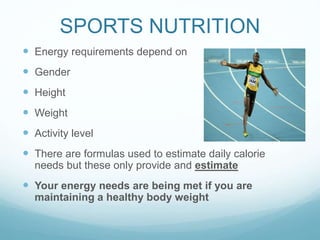
SPORTS NUTRITION
 Energy requirements depend on
 Gender
 Height
 Weight
 Activity level
 There are formulas used to estimate daily calorie
needs but these only provide and estimate
 Your energy needs are being met if you are
maintaining a healthy body weight
PROTEIN REQUIREMENTS
 Protein is needed to build & repair muscle & is used for
energy
 Daily need is based on body weight
 General population 0.8-1.0g protein/kg
 Endurance athletes 1.2-1.4g protein/kg body weight
 Strength athletes 1.2-1.7g protein/kg body weight
Example: 165 pound athlete
165lbs ÷ 2.2 =75kg
75kg x1.4g protein/kg=105gprotein/day
Also looked at as a percentage of daily calories
RDA is 10-30% of daily calories from protein
PROTEIN SOURCES
 Meat, poultry, fish or shellfish
 Beans, peas
 1 egg
 Cheese, cottage cheese, nuts, seeds, hummus, milk
 Yogurt, greek yogurt
CARBOHYDRATE
REQUIREMENTS
 Carbs provide energy for muscles & brain, especially during
physical activity
 High carb diets are associated with:
 Greater endurance, faster time trial performances, lower
rates of perceived exertion
 Daily need is based on body weight: 6-10g/kg of body
weight
 Also looked at as a % of daily calories 45-65%
 Example:165lb (75kg) athlete
 75kg x 6g = 450 g carb/day
CARBOHYDRATE
SOURCES
 1 slice of bread, ½ cup rice, pasta, ½ cup corn or
mashed potato
 ½ a potato, 3 cups popcorn, ¼ large bagel
 ½ hamburger or hotdog bun, 1 cup milk
 1 piece of fruit, 1 cup blueberries, 2 cups strawberries,
¼ cup dried fruit, ½ cup juice
FAT REQUIREMENTS
 Fat is essential in the diet for both health & athletic
performance
 Fats provide energy
 The brain is nearly 60% fat
 Fats are a component of hormones & cell membranes
 Percentage of daily calories: 25-35%
 Don’t need to pay special attention to daily fat intake
 Instead, eat from all food groups, include added fats & eat
enough to maintain a healthy weight
FAT SOURCES
 Meat, eggs, nuts, seeds, peanut & almond butter, soy
products, milk (except skim), yogurt, cheese
 Added fats such as butter, margarine, oil, salad
dressing, mayonnaise, sour cream, etc.
SAMPLE MEAL PLAN
BREAKFAST: 2 slices toast with peanut butter
250ml 1%milk, 1 banana
LUNCH: wrap with turkey, cheese, lettuce, tomato,
Ranch, 1 apple, 1 juice box
SNACK: 100g yogurt, ½ cup berries, 1/3 cup granola
DINNER:1 cup pasta with alfredo sauce, 6oz chicken ,
1/2cup broccoli, 1 cup salad with dressing,
250ml milk
SNACK: 250ml milk & 2 cookies
WHAT TO EAT BEFORE
EXERCISE
 Size & timing of a meal or snack before exercise depends
on individual needs and tolerance
 2-4 hours before exercise: drink plenty of fluids, eat a meal
rich in carbs & relatively low in fat, protein & fibre
 The goal is to provide energy without leaving an excess of
food in the stomach, which may cause gastrointestinal
distress
 Some people experience stomach upset if they eat too close
to exercise-fluids such a s smoothies or sports drinks are a
good option in this case
 A pre-competition meal should always be tried in training
before competition
WHAT TO EAT BEFORE
EXERCISE
Meal/snack ideas:
 Cereal with milk ( avoid very high fibre types)
 Fruit & yogurt
 Bread or bagel
 Pasta
 Oatmeal with a banana & milk
 Granola or sports bars
 Smoothie with milk/yogurt & fruit
CARBOHYDRATE LOADING
 Done for competitive, intense activities that last longer than 90
minutes
 This builds extra carbohydrate energy stores (glycogen) in
muscles & the liver
 Involves intake of 8-11g carb/kg body weight combined with
tapering from exercise for 1-3 days before competition
 May not offer any benefit to athletes who:
 Regularly consume a moderate to high carb diet
 Consume a carbohydrate-rich meal or snack pre-competition and
consume carbs during the exercise
WHAT TO EAT DURING
EXERCISE
Endurance Exercise:
 Eat carbs & fluids during intense exercise that lasts longer
that 1 hour
 Carbs will extend time to exhaustion & improve performance
 Consume 30-70g carb/hour in small amounts, every 15-20
minutes
 Start shortly after exercise begins
 Should include different sources of carbs
 Sports drinks or gels are common & convenient
WHAT TO EAT DURING
EXERCISE
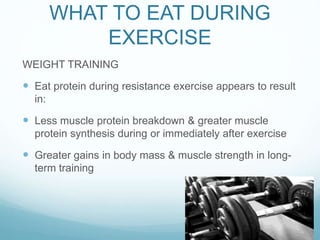
WEIGHT TRAINING
 Eat protein during resistance exercise appears to result
in:
 Less muscle protein breakdown & greater muscle
protein synthesis during or immediately after exercise
 Greater gains in body mass & muscle strength in long-
term training
WHAT TO EAT AFTER
EXERCISE
 Need carbs to replenish glycogen stores, protein to repair
muscle and fluid to rehydrate
Carbohydrates
 Consume 1-1.5g carb/kg body weight during the first 30
minutes after exercise & again every 2 hours for 4-6 hours
Approx. 75-112g of carb
 This is especially important for athletes who compete, train
or exercise more than once a day or who do not have a full
day to recover
Protein
Consume 10-20g of high quality protein (dairy, eggs, meat) in
the early recovery period
HYDRATION
 Stay well hydrated by drinking before, during & after
exercise to replace sweat losses
 The amount and color of your urine is a good indicator
of your hydration status
 Larger signs of pale yellow urine is a sign you are well
hydrated
 A small amount of dark yellow urine indicated
dehydration
SPORTS DRINKS
 Sports drinks provide:
 Fluids to cool the body down & replace fluids lost in sweat
 Carbs for quick energy
 Sodium & potassium (electrolytes) to replace minerals lost in
sweat
 Drink Sports drinks when:
 The exercise in intense, the activity lasts longer than 1 hour,
you sweat a lot, you wear protective equipment, the weather
is hot & humid, your fluid needs to be quickly replaced (
during a tournament etc.)
CHOOSING A SPORTS
DRINK
 What to look for in a sports drink
 No carbonation
 Carb content: 30-60g/litre,
 Sodium 460-690mg/litre or at least 70mg/250ml
 Potassium: 78-195mg/litre
SPORTS SUPPLEMENTS
 Many performance enhancing agents are banned (
refer to the Canadian Centre for Ethics in Sport)
 Nutritional supplements are considered “natural health
products” & are given a “natural product number”
(NPN)
 As opposed to medications which are given a “drug
identification number” (DIN)
 NPN’S & DIN’S are regulated by Health Canada but
with different standards & procedures
 NHP’s include: vitamins, minerals, herbal remedies,
homeopathic medicines, probiotics
NUTRITIONAL
SUPPLEMENTS
 Concerns with these products include lack of testing &
contamination with dangerous or banned substances
 Common Supplements
1. Caffeine: a stimulant which may help increase energy &
improve endurance & reaction time
Moderate amounts of caffeine (3mg/kg body weight) can have
performance benefits
Urinary thresholds set in IOC and National Collegiate Athletic
Association
Too much caffeine can result in anxiety, nervousness,
increased heart rate, insomnia and stomach upset
NUTRITIONAL
SUPPLEMENTS
2. Energy Drinks: not recommended, various ingredients
include caffeine, taurine, B-vitamins, antioxidants herbals
such as ginseng etc
Adverse effects include dehydration, high blood pressure,
arrhythmias, seizures, mood changes
3. Protein powder: many athletes do not really need it but may
be beneficial for some (high protein needs, food
preferences, convenience)
Check ingredients list to be sure it is not contaminated with
other supplements (no palm kernnal oil in protein bars, clogs
arteries)
1 scoop of protein powder usually = 25g of protein
NUTRITIONAL
SUPPLEMENTS
4. Creatine: increases energy through adenosine
triphosphate (ATP) production in muscle, enhances
performance in short-duration, high intensity exercise,
long-term benefits & risks are not well studied
5. Glucocorticoids: Alter glucose metabolism & have anti-
inflammatory & pain-relieving properties, usually
prohibited in competition, use & efficacy is not well
documented, short-term use may cause high blood
sugars, fluid retention, & mood changes: long-term
side effects are worse

nutrition and athletic performance presentation

  • 1.
  • 2.
    BASIC PRINCIPLES OF HEALTHYEATING  Regular meals & snacks  No skipping meals!  3 meals plus snacks (eating every 3-4 hours)  Eat from all 4 food groups  Variety  Balance  Mindful eating/appetite awareness (listen to your body)  Include treats in moderation
  • 3.
    MACRO AND MICRO NUTRIENTS Macronutrients-provide energy (Calories) 1. Carbohydrates 2. Proteins 3. Fats MICRONUTRIENTS 1. Vitamins 2. Minerals
  • 4.
    MICRO-NUTRIENTS Some are especiallyimportant for teens and athletes… Iron  Carries oxygen through the body  Sources include meat, poultry, fish, whole grains, nuts, seeds, soy, eggs  Vitamin C (citrus, strawberries, kiwi, green/red bell pepper, broccoli, etc.) helps with absorption of iron  Coffee, tea and calcium interfere with iron absorption B VITAMINS  Help release energy in the body (metabolism)  Help build & repair tissues and blood cells  Eating foods from all 4 food groups & getting enough calories will ensure that you meet your needs  Vitamin B-12 is only found in foods of animal origin (meat, eggs, dairy)
  • 5.
    MICRO-NUTRIENTS Calcium  Important forhealthy bones and teeth  Up to age 19 years, you need 1300mg/day  250ml milk or fortified alternative beverage, ¾ cup yogurt or 50g (1.5oz) cheese all provide 300mg  Various other foods provide small amounts Vitamin D  Helps your body absorb calcium & keeps your immune system strong  Limited sources…Fortified milk & alternative beverages, fortified margarine, egg yolks & fatty fish such as salmon, mackerel & tuna
  • 6.
    CANADA’S FOOD GUIDE Oneof many tools to teach nutrition & guide our choices
  • 7.
    KEEP IT BALANCED Anothertool is the ¼ Plate Method of Meal Planning
  • 8.
    SPORTS NUTRITION  Energyrequirements depend on  Gender  Height  Weight  Activity level  There are formulas used to estimate daily calorie needs but these only provide and estimate  Your energy needs are being met if you are maintaining a healthy body weight
  • 9.
    PROTEIN REQUIREMENTS  Proteinis needed to build & repair muscle & is used for energy  Daily need is based on body weight  General population 0.8-1.0g protein/kg  Endurance athletes 1.2-1.4g protein/kg body weight  Strength athletes 1.2-1.7g protein/kg body weight Example: 165 pound athlete 165lbs ÷ 2.2 =75kg 75kg x1.4g protein/kg=105gprotein/day Also looked at as a percentage of daily calories RDA is 10-30% of daily calories from protein
  • 10.
    PROTEIN SOURCES  Meat,poultry, fish or shellfish  Beans, peas  1 egg  Cheese, cottage cheese, nuts, seeds, hummus, milk  Yogurt, greek yogurt
  • 12.
    CARBOHYDRATE REQUIREMENTS  Carbs provideenergy for muscles & brain, especially during physical activity  High carb diets are associated with:  Greater endurance, faster time trial performances, lower rates of perceived exertion  Daily need is based on body weight: 6-10g/kg of body weight  Also looked at as a % of daily calories 45-65%  Example:165lb (75kg) athlete  75kg x 6g = 450 g carb/day
  • 13.
    CARBOHYDRATE SOURCES  1 sliceof bread, ½ cup rice, pasta, ½ cup corn or mashed potato  ½ a potato, 3 cups popcorn, ¼ large bagel  ½ hamburger or hotdog bun, 1 cup milk  1 piece of fruit, 1 cup blueberries, 2 cups strawberries, ¼ cup dried fruit, ½ cup juice
  • 15.
    FAT REQUIREMENTS  Fatis essential in the diet for both health & athletic performance  Fats provide energy  The brain is nearly 60% fat  Fats are a component of hormones & cell membranes  Percentage of daily calories: 25-35%  Don’t need to pay special attention to daily fat intake  Instead, eat from all food groups, include added fats & eat enough to maintain a healthy weight
  • 16.
    FAT SOURCES  Meat,eggs, nuts, seeds, peanut & almond butter, soy products, milk (except skim), yogurt, cheese  Added fats such as butter, margarine, oil, salad dressing, mayonnaise, sour cream, etc.
  • 17.
    SAMPLE MEAL PLAN BREAKFAST:2 slices toast with peanut butter 250ml 1%milk, 1 banana LUNCH: wrap with turkey, cheese, lettuce, tomato, Ranch, 1 apple, 1 juice box SNACK: 100g yogurt, ½ cup berries, 1/3 cup granola DINNER:1 cup pasta with alfredo sauce, 6oz chicken , 1/2cup broccoli, 1 cup salad with dressing, 250ml milk SNACK: 250ml milk & 2 cookies
  • 18.
    WHAT TO EATBEFORE EXERCISE  Size & timing of a meal or snack before exercise depends on individual needs and tolerance  2-4 hours before exercise: drink plenty of fluids, eat a meal rich in carbs & relatively low in fat, protein & fibre  The goal is to provide energy without leaving an excess of food in the stomach, which may cause gastrointestinal distress  Some people experience stomach upset if they eat too close to exercise-fluids such a s smoothies or sports drinks are a good option in this case  A pre-competition meal should always be tried in training before competition
  • 19.
    WHAT TO EATBEFORE EXERCISE Meal/snack ideas:  Cereal with milk ( avoid very high fibre types)  Fruit & yogurt  Bread or bagel  Pasta  Oatmeal with a banana & milk  Granola or sports bars  Smoothie with milk/yogurt & fruit
  • 20.
    CARBOHYDRATE LOADING  Donefor competitive, intense activities that last longer than 90 minutes  This builds extra carbohydrate energy stores (glycogen) in muscles & the liver  Involves intake of 8-11g carb/kg body weight combined with tapering from exercise for 1-3 days before competition  May not offer any benefit to athletes who:  Regularly consume a moderate to high carb diet  Consume a carbohydrate-rich meal or snack pre-competition and consume carbs during the exercise
  • 21.
    WHAT TO EATDURING EXERCISE Endurance Exercise:  Eat carbs & fluids during intense exercise that lasts longer that 1 hour  Carbs will extend time to exhaustion & improve performance  Consume 30-70g carb/hour in small amounts, every 15-20 minutes  Start shortly after exercise begins  Should include different sources of carbs  Sports drinks or gels are common & convenient
  • 22.
    WHAT TO EATDURING EXERCISE WEIGHT TRAINING  Eat protein during resistance exercise appears to result in:  Less muscle protein breakdown & greater muscle protein synthesis during or immediately after exercise  Greater gains in body mass & muscle strength in long- term training
  • 23.
    WHAT TO EATAFTER EXERCISE  Need carbs to replenish glycogen stores, protein to repair muscle and fluid to rehydrate Carbohydrates  Consume 1-1.5g carb/kg body weight during the first 30 minutes after exercise & again every 2 hours for 4-6 hours Approx. 75-112g of carb  This is especially important for athletes who compete, train or exercise more than once a day or who do not have a full day to recover Protein Consume 10-20g of high quality protein (dairy, eggs, meat) in the early recovery period
  • 24.
    HYDRATION  Stay wellhydrated by drinking before, during & after exercise to replace sweat losses  The amount and color of your urine is a good indicator of your hydration status  Larger signs of pale yellow urine is a sign you are well hydrated  A small amount of dark yellow urine indicated dehydration
  • 25.
    SPORTS DRINKS  Sportsdrinks provide:  Fluids to cool the body down & replace fluids lost in sweat  Carbs for quick energy  Sodium & potassium (electrolytes) to replace minerals lost in sweat  Drink Sports drinks when:  The exercise in intense, the activity lasts longer than 1 hour, you sweat a lot, you wear protective equipment, the weather is hot & humid, your fluid needs to be quickly replaced ( during a tournament etc.)
  • 26.
    CHOOSING A SPORTS DRINK What to look for in a sports drink  No carbonation  Carb content: 30-60g/litre,  Sodium 460-690mg/litre or at least 70mg/250ml  Potassium: 78-195mg/litre
  • 27.
    SPORTS SUPPLEMENTS  Manyperformance enhancing agents are banned ( refer to the Canadian Centre for Ethics in Sport)  Nutritional supplements are considered “natural health products” & are given a “natural product number” (NPN)  As opposed to medications which are given a “drug identification number” (DIN)  NPN’S & DIN’S are regulated by Health Canada but with different standards & procedures  NHP’s include: vitamins, minerals, herbal remedies, homeopathic medicines, probiotics
  • 28.
    NUTRITIONAL SUPPLEMENTS  Concerns withthese products include lack of testing & contamination with dangerous or banned substances  Common Supplements 1. Caffeine: a stimulant which may help increase energy & improve endurance & reaction time Moderate amounts of caffeine (3mg/kg body weight) can have performance benefits Urinary thresholds set in IOC and National Collegiate Athletic Association Too much caffeine can result in anxiety, nervousness, increased heart rate, insomnia and stomach upset
  • 29.
    NUTRITIONAL SUPPLEMENTS 2. Energy Drinks:not recommended, various ingredients include caffeine, taurine, B-vitamins, antioxidants herbals such as ginseng etc Adverse effects include dehydration, high blood pressure, arrhythmias, seizures, mood changes 3. Protein powder: many athletes do not really need it but may be beneficial for some (high protein needs, food preferences, convenience) Check ingredients list to be sure it is not contaminated with other supplements (no palm kernnal oil in protein bars, clogs arteries) 1 scoop of protein powder usually = 25g of protein
  • 30.
    NUTRITIONAL SUPPLEMENTS 4. Creatine: increasesenergy through adenosine triphosphate (ATP) production in muscle, enhances performance in short-duration, high intensity exercise, long-term benefits & risks are not well studied 5. Glucocorticoids: Alter glucose metabolism & have anti- inflammatory & pain-relieving properties, usually prohibited in competition, use & efficacy is not well documented, short-term use may cause high blood sugars, fluid retention, & mood changes: long-term side effects are worse