







CARBOHYDRATECARBOHYDRATE
LOADINGLOADING
Dr Nishank Verma
MPT-Sports
Jamia Millia Islamia
 Carbohydrate loading or GlycogenCarbohydrate loading or Glycogen
loadingloading is a concept derived fromis a concept derived from
research published in Sweden byresearch published in Sweden by
Drs. Saltin and Hermanson in 1967.Drs. Saltin and Hermanson in 1967.
What is carbohydrate loading?What is carbohydrate loading?
 Carbohydrate loading is a strategyCarbohydrate loading is a strategy
involving changes to training andinvolving changes to training and
nutrition that can maximize musclenutrition that can maximize muscle
glycogen (carbohydrate) stores priorglycogen (carbohydrate) stores prior
to endurance competition.to endurance competition.
 The technique was originallyThe technique was originally
developed in the late 1960's.developed in the late 1960's.
 Typically involved a 3-4 dayTypically involved a 3-4 day
'depletion phase' and a 3-4 day'depletion phase' and a 3-4 day
'loading phase'.'loading phase'.
Does carbohydrate loadingDoes carbohydrate loading
improve performance?improve performance?
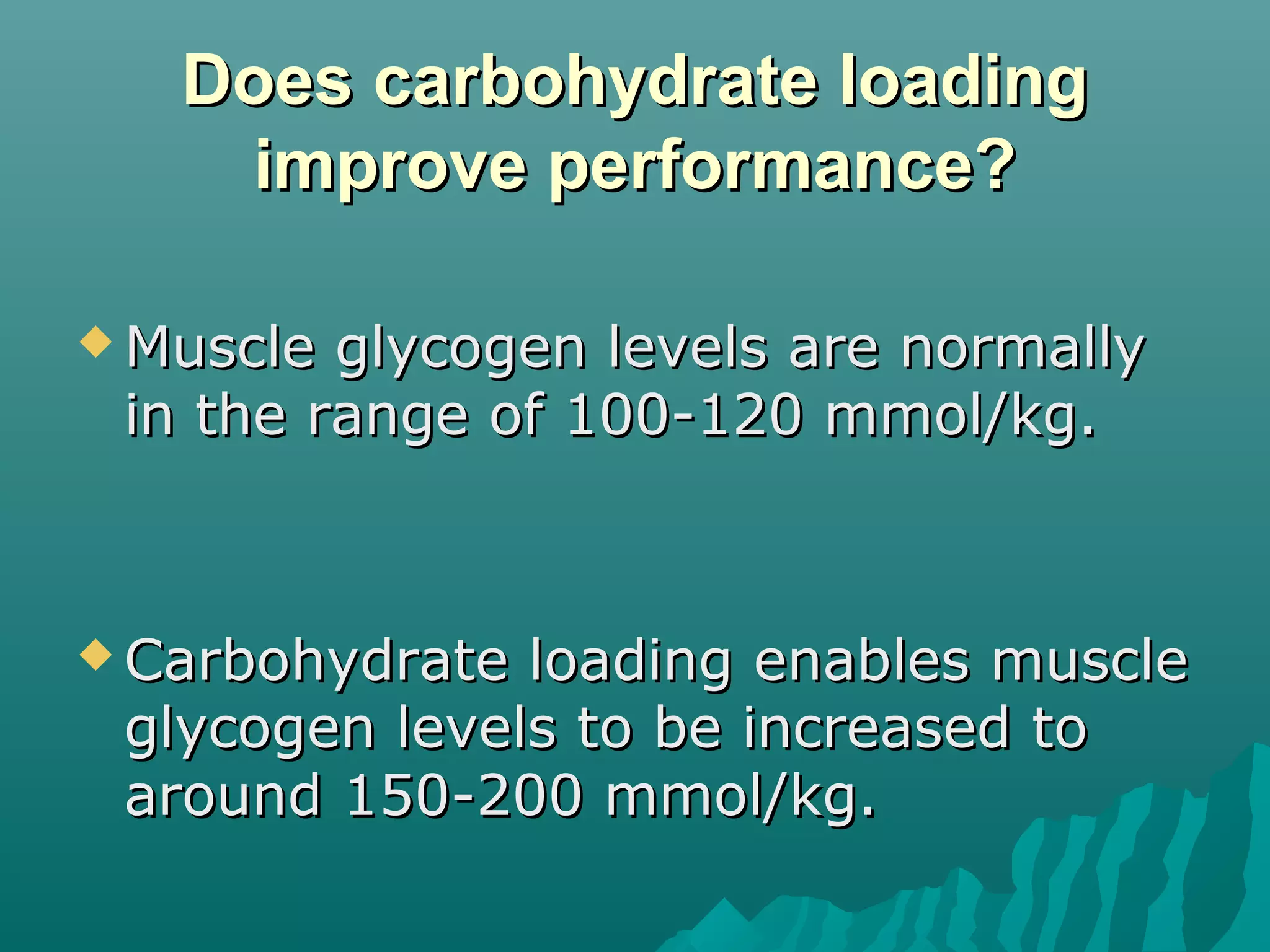
 Muscle glycogen levels are normallyMuscle glycogen levels are normally
in the range of 100-120 mmol/kg.in the range of 100-120 mmol/kg.
 Carbohydrate loading enables muscleCarbohydrate loading enables muscle
glycogen levels to be increased toglycogen levels to be increased to
around 150-200 mmol/kg.around 150-200 mmol/kg.
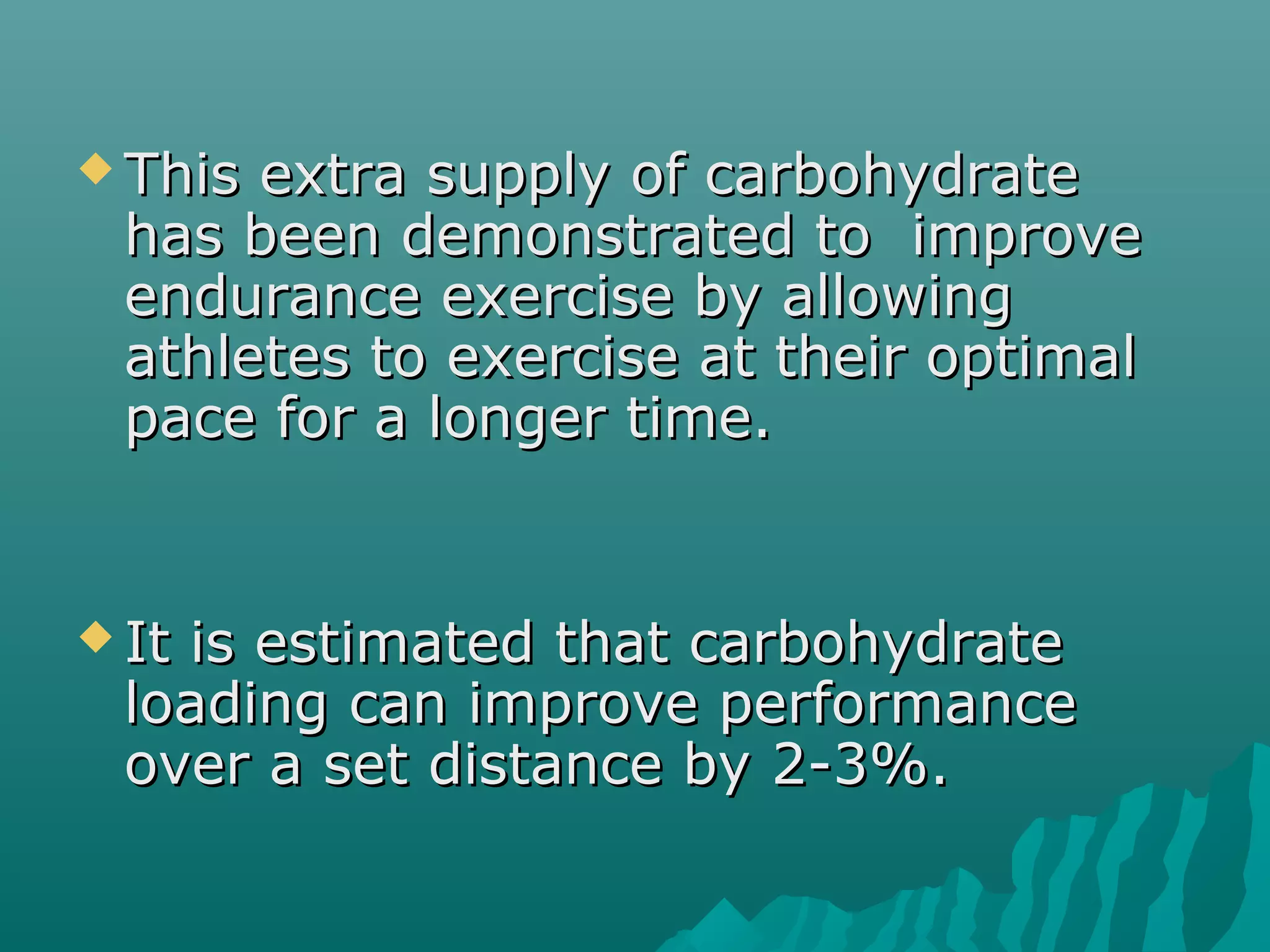
 This extra supply of carbohydrateThis extra supply of carbohydrate
has been demonstrated to improvehas been demonstrated to improve
endurance exercise by allowingendurance exercise by allowing
athletes to exercise at their optimalathletes to exercise at their optimal
pace for a longer time.pace for a longer time.
 It is estimated that carbohydrateIt is estimated that carbohydrate
loading can improve performanceloading can improve performance
over a set distance by 2-3%.over a set distance by 2-3%.
Who should load carbohydrate?Who should load carbohydrate?
 Anyone exercising continuously forAnyone exercising continuously for
90 minutes or longer is likely to90 minutes or longer is likely to
benefit from carbohydrate loading.benefit from carbohydrate loading.
 Typically, sports such as cycling,Typically, sports such as cycling,
marathon running, longer distancemarathon running, longer distance
triathlon, cross-country skiing andtriathlon, cross-country skiing and
endurance swimming benefit fromendurance swimming benefit from
carbohydrate loadingcarbohydrate loading..
 Shorter term exercise is unlikely toShorter term exercise is unlikely to
benefit as the body's usualbenefit as the body's usual
carbohydrate stores are adequate.carbohydrate stores are adequate.
 Carbohydrate loading is generally notCarbohydrate loading is generally not
practical to achieve in team sportspractical to achieve in team sports
where games are played every 3-4where games are played every 3-4
days.days.
How was carbohydrate loadingHow was carbohydrate loading
originally achieved?originally achieved?
 Originally, carbohydrate loadingOriginally, carbohydrate loading
involved a depletion phase.involved a depletion phase.
 This required 3-4 hard training daysThis required 3-4 hard training days
plus a low carbohydrate diet.plus a low carbohydrate diet.
 The depletion phase was thought toThe depletion phase was thought to
be necessary to stimulate thebe necessary to stimulate the
enzyme glycogen synthase.enzyme glycogen synthase.
 The depletion phase was followed byThe depletion phase was followed by
a loading phase which involved 3-4a loading phase which involved 3-4
days of rest combined with a highdays of rest combined with a high
carbohydrate diet.carbohydrate diet.
 The extra carbohydrate combinedThe extra carbohydrate combined
with the now-activated glycogenwith the now-activated glycogen
synthase was shown to boostsynthase was shown to boost
carbohydrate stores beyond theircarbohydrate stores beyond their
usual resting levels.usual resting levels.
 The carbohydrate loading regimensThe carbohydrate loading regimens
combines tapered training with acombines tapered training with a
high carbohydrate diet.high carbohydrate diet.
 During the first three days, you eat aDuring the first three days, you eat a
normal diet providing about 5 gramsnormal diet providing about 5 grams
of carbohydrate per kilogram per dayof carbohydrate per kilogram per day
(about 2.5 grams of carbohydrate(about 2.5 grams of carbohydrate
per pound).per pound).
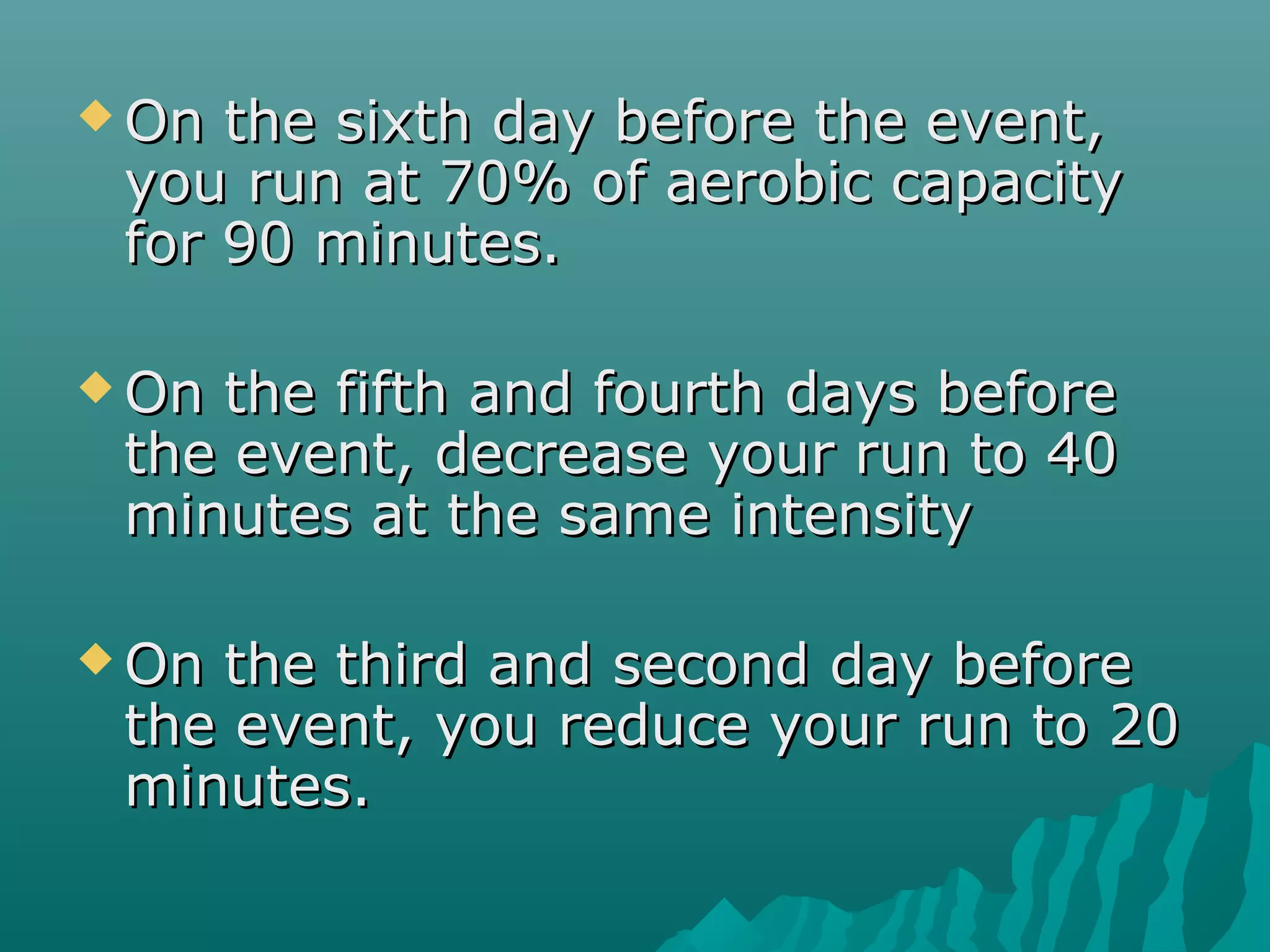
 On the sixth day before the event,On the sixth day before the event,
you run at 70% of aerobic capacityyou run at 70% of aerobic capacity
for 90 minutes.for 90 minutes.
 On the fifth and fourth days beforeOn the fifth and fourth days before
the event, decrease your run to 40the event, decrease your run to 40
minutes at the same intensityminutes at the same intensity
 On the third and second day beforeOn the third and second day before
the event, you reduce your run to 20the event, you reduce your run to 20
minutes.minutes.
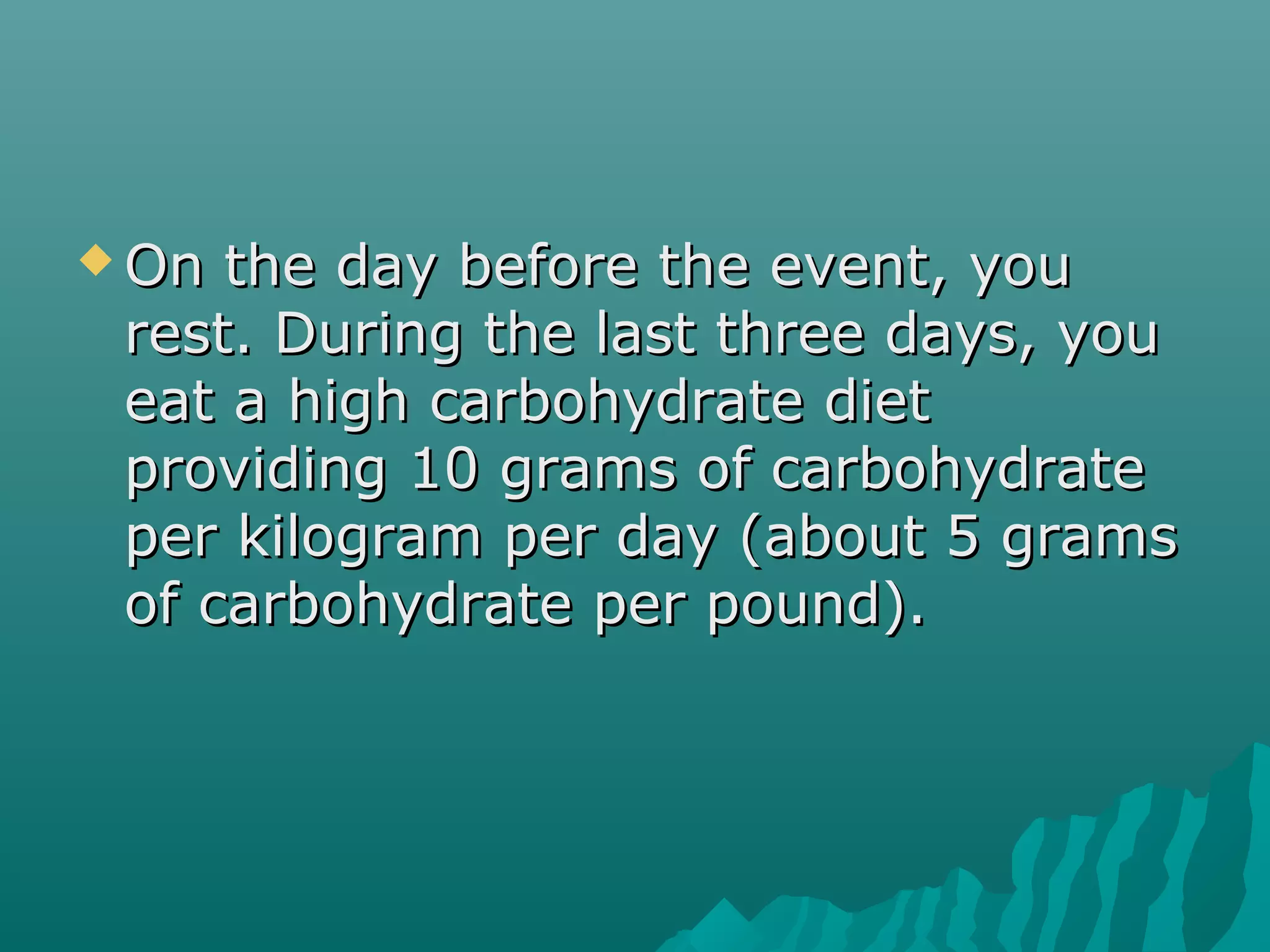
 On the day before the event, youOn the day before the event, you
rest. During the last three days, yourest. During the last three days, you
eat a high carbohydrate dieteat a high carbohydrate diet
providing 10 grams of carbohydrateproviding 10 grams of carbohydrate
per kilogram per day (about 5 gramsper kilogram per day (about 5 grams
of carbohydrate per pound).of carbohydrate per pound).
How do modern-day athletesHow do modern-day athletes
carbohydrate load?carbohydrate load?
 Today's endurance athletes use aToday's endurance athletes use a
modified carbohydrate loadingmodified carbohydrate loading
method.method.
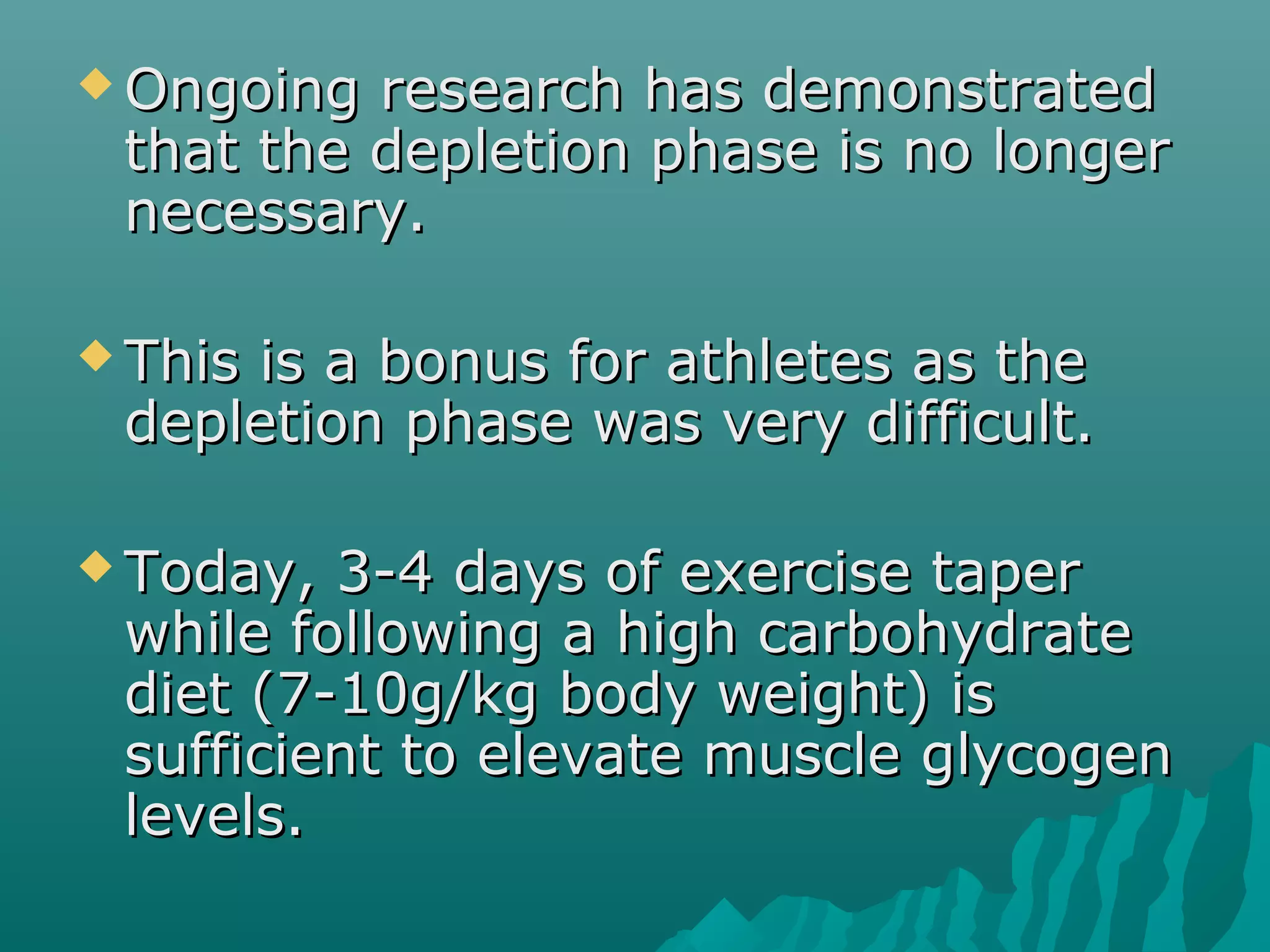
 Ongoing research has demonstratedOngoing research has demonstrated
that the depletion phase is no longerthat the depletion phase is no longer
necessary.necessary.
 This is a bonus for athletes as theThis is a bonus for athletes as the
depletion phase was very difficult.depletion phase was very difficult.
 Today, 3-4 days of exercise taperToday, 3-4 days of exercise taper
while following a high carbohydratewhile following a high carbohydrate
diet (7-10g/kg body weight) isdiet (7-10g/kg body weight) is
sufficient to elevate muscle glycogensufficient to elevate muscle glycogen
levels.levels.
What does a high carbohydrateWhat does a high carbohydrate
diet look like?diet look like?
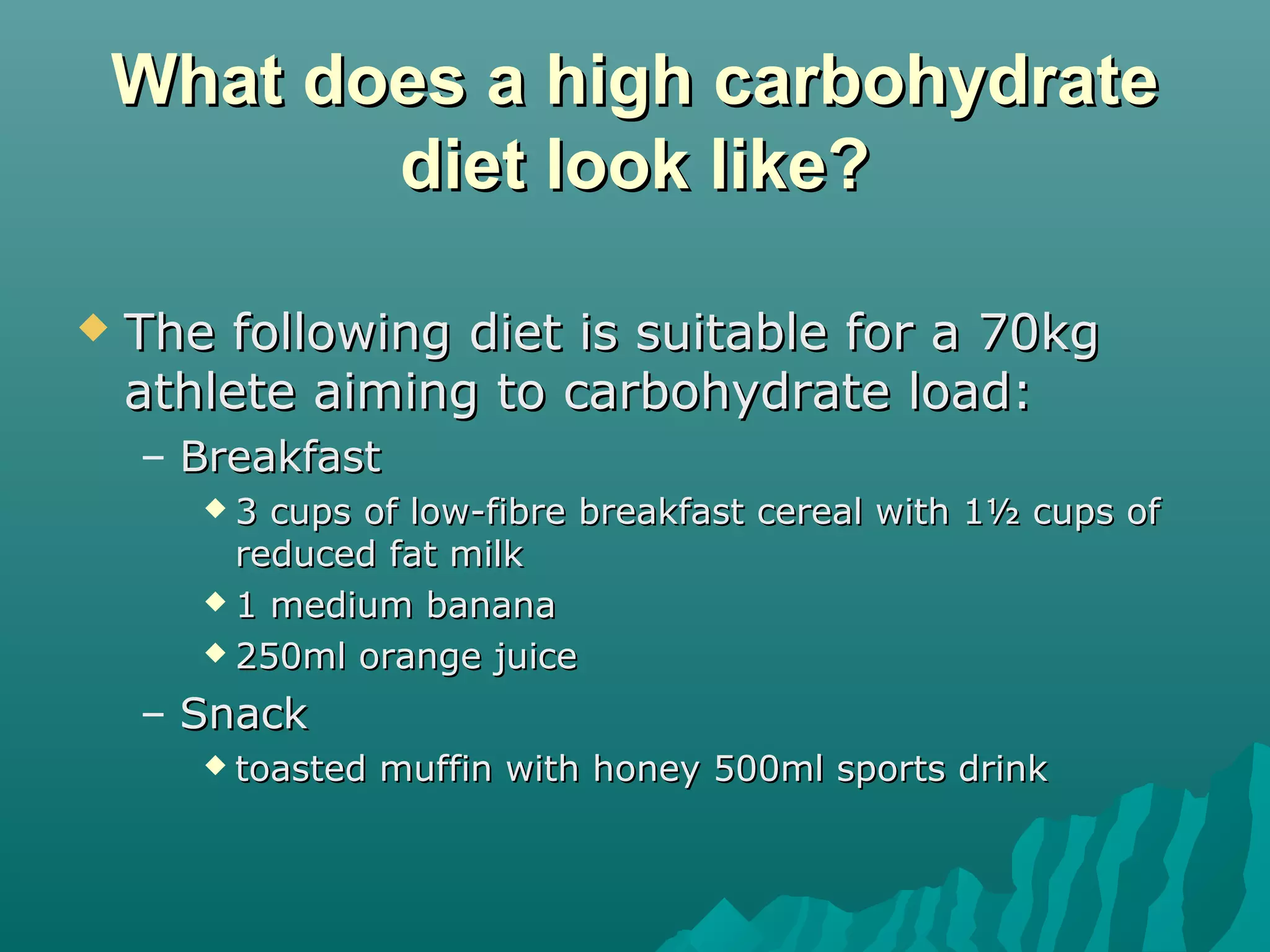
 The following diet is suitable for a 70kgThe following diet is suitable for a 70kg
athlete aiming to carbohydrate load:athlete aiming to carbohydrate load:
– BreakfastBreakfast
 3 cups of low-fibre breakfast cereal with 1½ cups of3 cups of low-fibre breakfast cereal with 1½ cups of
reduced fat milkreduced fat milk
 1 medium banana1 medium banana
 250ml orange juice250ml orange juice
– SnackSnack
 toasted muffin with honey 500ml sports drinktoasted muffin with honey 500ml sports drink
– LunchLunch
 2 sandwiches (4 slices of bread) with filling as2 sandwiches (4 slices of bread) with filling as
desireddesired
 200g tub of low-fat fruit yoghurt200g tub of low-fat fruit yoghurt
 375ml can of soft drink375ml can of soft drink
– SnackSnack
 banana smoothie made with low-fat milk,banana smoothie made with low-fat milk,
 banana and honey cereal barbanana and honey cereal bar
– DinnerDinner
 1 cup of pasta sauce with 2 cups of cooked pasta1 cup of pasta sauce with 2 cups of cooked pasta
 3 slices of garlic Bread3 slices of garlic Bread
– LateLate
 Snack toasted muffin and jam 500ml sports drinkSnack toasted muffin and jam 500ml sports drink
 This sample carbohydrate loadingThis sample carbohydrate loading
meal plan provides roughly 14,200meal plan provides roughly 14,200
kJ, 590 grams of carbohydrate, 125kJ, 590 grams of carbohydrate, 125
grams of protein and 60 grams ofgrams of protein and 60 grams of
fat.fat.
What are the common mistakesWhat are the common mistakes
made when carbohydrate loading?made when carbohydrate loading?
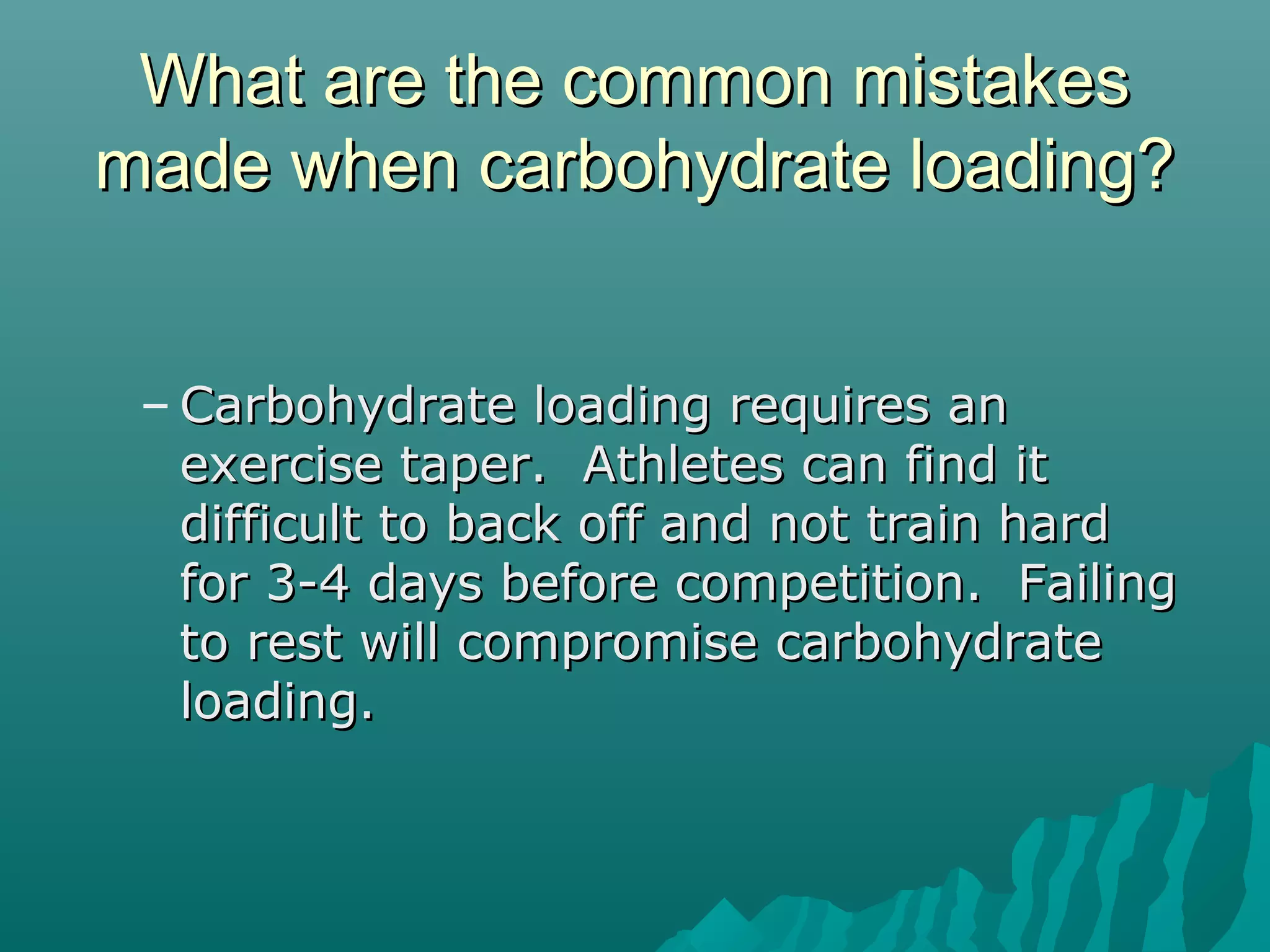
– Carbohydrate loading requires anCarbohydrate loading requires an
exercise taper. Athletes can find itexercise taper. Athletes can find it
difficult to back off and not train harddifficult to back off and not train hard
for 3-4 days before competition. Failingfor 3-4 days before competition. Failing
to rest will compromise carbohydrateto rest will compromise carbohydrate
loading.loading.
– Many athletes fail to eat enoughMany athletes fail to eat enough
carbohydrate. It sounds easy tocarbohydrate. It sounds easy to
increase your carbohydrate intake butincrease your carbohydrate intake but
many athletes fall short of the mark. Itmany athletes fall short of the mark. It
seems athletes don't have a goodseems athletes don't have a good
understanding of the amount of foodunderstanding of the amount of food
required to carbohydrate load. Workingrequired to carbohydrate load. Working
with awith a sports dietitiansports dietitian or using aor using a
carbohydrate countercarbohydrate counter can be useful.can be useful.
– In order to consume the necessaryIn order to consume the necessary
amount of carbohydrate, it is necessaryamount of carbohydrate, it is necessary
to cut back on fibre and make use ofto cut back on fibre and make use of
compact sources of carbohydrate suchcompact sources of carbohydrate such
as sugar, cordial, soft drink, sportsas sugar, cordial, soft drink, sports
drink, jam, honey, jelly and tinneddrink, jam, honey, jelly and tinned
fruit. Athletes who include too manyfruit. Athletes who include too many
high fibre foods in their carbohydratehigh fibre foods in their carbohydrate
loading menu may suffer stomach upsetloading menu may suffer stomach upset
or find the food too bulky to consume.or find the food too bulky to consume.
– Carbohydrate loading will most likelyCarbohydrate loading will most likely
cause body mass to increase bycause body mass to increase by
approximately 2kg. This extra weight isapproximately 2kg. This extra weight is
due to extra muscle glycogen anddue to extra muscle glycogen and
water. For some athletes, a fear ofwater. For some athletes, a fear of
weight gain may prevent them fromweight gain may prevent them from
carbohydrate loading adequately.carbohydrate loading adequately.
SIDE EFFECTSSIDE EFFECTS
 There are several side effects ofThere are several side effects of
carbohydrate loading that may make itcarbohydrate loading that may make it
inappropriate for some people. For eachinappropriate for some people. For each
gram of glycogen stored, additional watergram of glycogen stored, additional water
is stored.is stored.
 Some people note a feeling of stiffnessSome people note a feeling of stiffness
and heaviness associated with theand heaviness associated with the
increased glycogen storage. Once youincreased glycogen storage. Once you
start exercising, however, thesestart exercising, however, these
sensations will work out.sensations will work out.
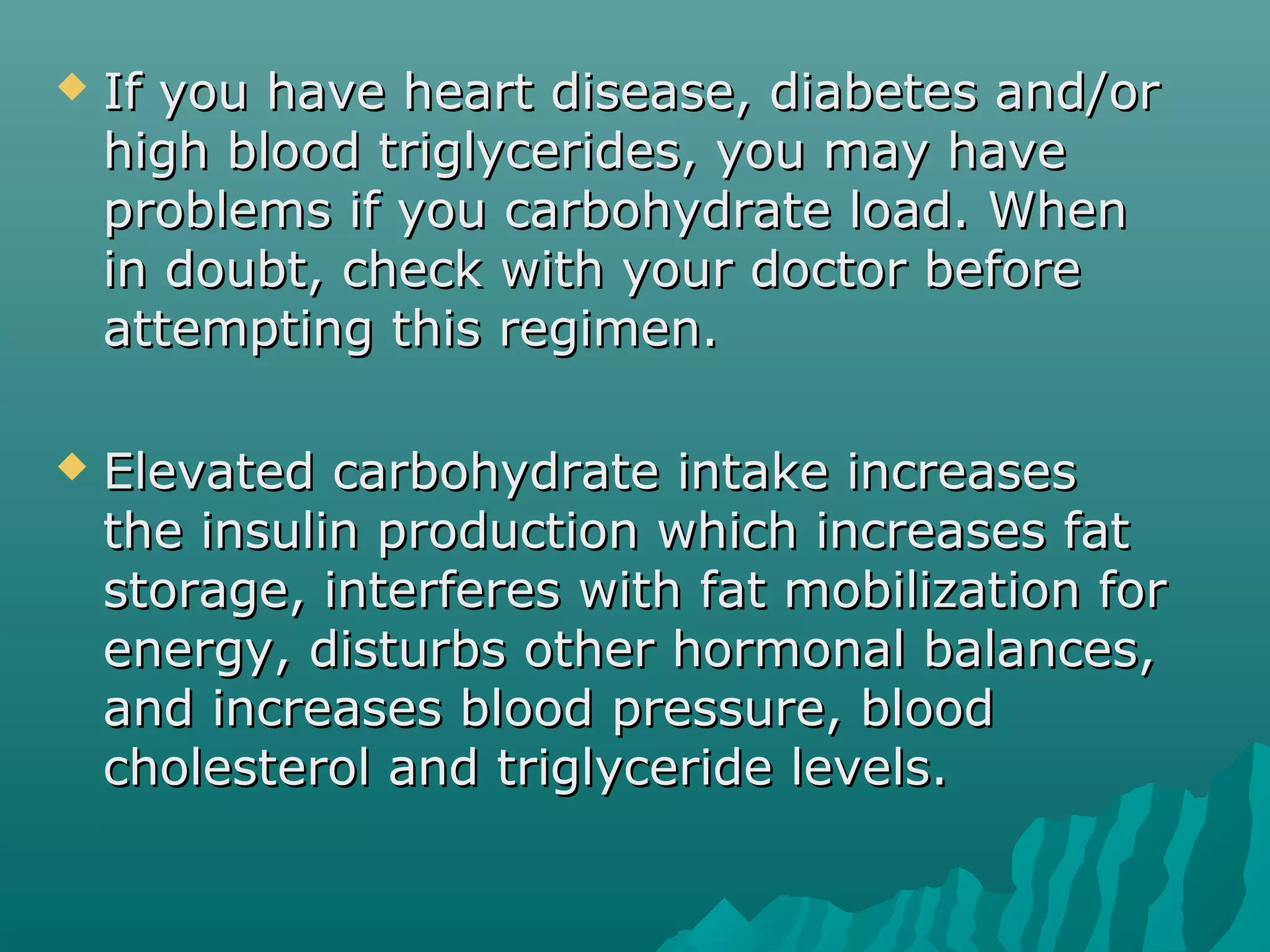
 If you have heart disease, diabetes and/orIf you have heart disease, diabetes and/or
high blood triglycerides, you may havehigh blood triglycerides, you may have
problems if you carbohydrate load. Whenproblems if you carbohydrate load. When
in doubt, check with your doctor beforein doubt, check with your doctor before
attempting this regimen.attempting this regimen.
 Elevated carbohydrate intake increasesElevated carbohydrate intake increases
the insulin production which increases fatthe insulin production which increases fat
storage, interferes with fat mobilization forstorage, interferes with fat mobilization for
energy, disturbs other hormonal balances,energy, disturbs other hormonal balances,
and increases blood pressure, bloodand increases blood pressure, blood
cholesterol and triglyceride levels.cholesterol and triglyceride levels.

Charbohydrate Loading In Sports

  • 1.
  • 2.
     Carbohydrate loadingor GlycogenCarbohydrate loading or Glycogen loadingloading is a concept derived fromis a concept derived from research published in Sweden byresearch published in Sweden by Drs. Saltin and Hermanson in 1967.Drs. Saltin and Hermanson in 1967.
  • 3.
    What is carbohydrateloading?What is carbohydrate loading?  Carbohydrate loading is a strategyCarbohydrate loading is a strategy involving changes to training andinvolving changes to training and nutrition that can maximize musclenutrition that can maximize muscle glycogen (carbohydrate) stores priorglycogen (carbohydrate) stores prior to endurance competition.to endurance competition.
  • 4.
     The techniquewas originallyThe technique was originally developed in the late 1960's.developed in the late 1960's.  Typically involved a 3-4 dayTypically involved a 3-4 day 'depletion phase' and a 3-4 day'depletion phase' and a 3-4 day 'loading phase'.'loading phase'.
  • 5.
    Does carbohydrate loadingDoescarbohydrate loading improve performance?improve performance?  Muscle glycogen levels are normallyMuscle glycogen levels are normally in the range of 100-120 mmol/kg.in the range of 100-120 mmol/kg.  Carbohydrate loading enables muscleCarbohydrate loading enables muscle glycogen levels to be increased toglycogen levels to be increased to around 150-200 mmol/kg.around 150-200 mmol/kg.
  • 6.
     This extrasupply of carbohydrateThis extra supply of carbohydrate has been demonstrated to improvehas been demonstrated to improve endurance exercise by allowingendurance exercise by allowing athletes to exercise at their optimalathletes to exercise at their optimal pace for a longer time.pace for a longer time.  It is estimated that carbohydrateIt is estimated that carbohydrate loading can improve performanceloading can improve performance over a set distance by 2-3%.over a set distance by 2-3%.
  • 7.
    Who should loadcarbohydrate?Who should load carbohydrate?  Anyone exercising continuously forAnyone exercising continuously for 90 minutes or longer is likely to90 minutes or longer is likely to benefit from carbohydrate loading.benefit from carbohydrate loading.  Typically, sports such as cycling,Typically, sports such as cycling, marathon running, longer distancemarathon running, longer distance triathlon, cross-country skiing andtriathlon, cross-country skiing and endurance swimming benefit fromendurance swimming benefit from carbohydrate loadingcarbohydrate loading..
  • 8.
     Shorter termexercise is unlikely toShorter term exercise is unlikely to benefit as the body's usualbenefit as the body's usual carbohydrate stores are adequate.carbohydrate stores are adequate.  Carbohydrate loading is generally notCarbohydrate loading is generally not practical to achieve in team sportspractical to achieve in team sports where games are played every 3-4where games are played every 3-4 days.days.
  • 9.
    How was carbohydrateloadingHow was carbohydrate loading originally achieved?originally achieved?  Originally, carbohydrate loadingOriginally, carbohydrate loading involved a depletion phase.involved a depletion phase.  This required 3-4 hard training daysThis required 3-4 hard training days plus a low carbohydrate diet.plus a low carbohydrate diet.  The depletion phase was thought toThe depletion phase was thought to be necessary to stimulate thebe necessary to stimulate the enzyme glycogen synthase.enzyme glycogen synthase.
  • 10.
     The depletionphase was followed byThe depletion phase was followed by a loading phase which involved 3-4a loading phase which involved 3-4 days of rest combined with a highdays of rest combined with a high carbohydrate diet.carbohydrate diet.  The extra carbohydrate combinedThe extra carbohydrate combined with the now-activated glycogenwith the now-activated glycogen synthase was shown to boostsynthase was shown to boost carbohydrate stores beyond theircarbohydrate stores beyond their usual resting levels.usual resting levels.
  • 11.
     The carbohydrateloading regimensThe carbohydrate loading regimens combines tapered training with acombines tapered training with a high carbohydrate diet.high carbohydrate diet.  During the first three days, you eat aDuring the first three days, you eat a normal diet providing about 5 gramsnormal diet providing about 5 grams of carbohydrate per kilogram per dayof carbohydrate per kilogram per day (about 2.5 grams of carbohydrate(about 2.5 grams of carbohydrate per pound).per pound).
  • 12.
     On thesixth day before the event,On the sixth day before the event, you run at 70% of aerobic capacityyou run at 70% of aerobic capacity for 90 minutes.for 90 minutes.  On the fifth and fourth days beforeOn the fifth and fourth days before the event, decrease your run to 40the event, decrease your run to 40 minutes at the same intensityminutes at the same intensity  On the third and second day beforeOn the third and second day before the event, you reduce your run to 20the event, you reduce your run to 20 minutes.minutes.
  • 13.
     On theday before the event, youOn the day before the event, you rest. During the last three days, yourest. During the last three days, you eat a high carbohydrate dieteat a high carbohydrate diet providing 10 grams of carbohydrateproviding 10 grams of carbohydrate per kilogram per day (about 5 gramsper kilogram per day (about 5 grams of carbohydrate per pound).of carbohydrate per pound).
  • 14.
    How do modern-dayathletesHow do modern-day athletes carbohydrate load?carbohydrate load?  Today's endurance athletes use aToday's endurance athletes use a modified carbohydrate loadingmodified carbohydrate loading method.method.
  • 15.
     Ongoing researchhas demonstratedOngoing research has demonstrated that the depletion phase is no longerthat the depletion phase is no longer necessary.necessary.  This is a bonus for athletes as theThis is a bonus for athletes as the depletion phase was very difficult.depletion phase was very difficult.  Today, 3-4 days of exercise taperToday, 3-4 days of exercise taper while following a high carbohydratewhile following a high carbohydrate diet (7-10g/kg body weight) isdiet (7-10g/kg body weight) is sufficient to elevate muscle glycogensufficient to elevate muscle glycogen levels.levels.
  • 16.
    What does ahigh carbohydrateWhat does a high carbohydrate diet look like?diet look like?  The following diet is suitable for a 70kgThe following diet is suitable for a 70kg athlete aiming to carbohydrate load:athlete aiming to carbohydrate load: – BreakfastBreakfast  3 cups of low-fibre breakfast cereal with 1½ cups of3 cups of low-fibre breakfast cereal with 1½ cups of reduced fat milkreduced fat milk  1 medium banana1 medium banana  250ml orange juice250ml orange juice – SnackSnack  toasted muffin with honey 500ml sports drinktoasted muffin with honey 500ml sports drink
  • 17.
    – LunchLunch  2sandwiches (4 slices of bread) with filling as2 sandwiches (4 slices of bread) with filling as desireddesired  200g tub of low-fat fruit yoghurt200g tub of low-fat fruit yoghurt  375ml can of soft drink375ml can of soft drink – SnackSnack  banana smoothie made with low-fat milk,banana smoothie made with low-fat milk,  banana and honey cereal barbanana and honey cereal bar – DinnerDinner  1 cup of pasta sauce with 2 cups of cooked pasta1 cup of pasta sauce with 2 cups of cooked pasta  3 slices of garlic Bread3 slices of garlic Bread – LateLate  Snack toasted muffin and jam 500ml sports drinkSnack toasted muffin and jam 500ml sports drink
  • 18.
     This samplecarbohydrate loadingThis sample carbohydrate loading meal plan provides roughly 14,200meal plan provides roughly 14,200 kJ, 590 grams of carbohydrate, 125kJ, 590 grams of carbohydrate, 125 grams of protein and 60 grams ofgrams of protein and 60 grams of fat.fat.
  • 19.
    What are thecommon mistakesWhat are the common mistakes made when carbohydrate loading?made when carbohydrate loading? – Carbohydrate loading requires anCarbohydrate loading requires an exercise taper. Athletes can find itexercise taper. Athletes can find it difficult to back off and not train harddifficult to back off and not train hard for 3-4 days before competition. Failingfor 3-4 days before competition. Failing to rest will compromise carbohydrateto rest will compromise carbohydrate loading.loading.
  • 20.
    – Many athletesfail to eat enoughMany athletes fail to eat enough carbohydrate. It sounds easy tocarbohydrate. It sounds easy to increase your carbohydrate intake butincrease your carbohydrate intake but many athletes fall short of the mark. Itmany athletes fall short of the mark. It seems athletes don't have a goodseems athletes don't have a good understanding of the amount of foodunderstanding of the amount of food required to carbohydrate load. Workingrequired to carbohydrate load. Working with awith a sports dietitiansports dietitian or using aor using a carbohydrate countercarbohydrate counter can be useful.can be useful.
  • 21.
    – In orderto consume the necessaryIn order to consume the necessary amount of carbohydrate, it is necessaryamount of carbohydrate, it is necessary to cut back on fibre and make use ofto cut back on fibre and make use of compact sources of carbohydrate suchcompact sources of carbohydrate such as sugar, cordial, soft drink, sportsas sugar, cordial, soft drink, sports drink, jam, honey, jelly and tinneddrink, jam, honey, jelly and tinned fruit. Athletes who include too manyfruit. Athletes who include too many high fibre foods in their carbohydratehigh fibre foods in their carbohydrate loading menu may suffer stomach upsetloading menu may suffer stomach upset or find the food too bulky to consume.or find the food too bulky to consume.
  • 22.
    – Carbohydrate loadingwill most likelyCarbohydrate loading will most likely cause body mass to increase bycause body mass to increase by approximately 2kg. This extra weight isapproximately 2kg. This extra weight is due to extra muscle glycogen anddue to extra muscle glycogen and water. For some athletes, a fear ofwater. For some athletes, a fear of weight gain may prevent them fromweight gain may prevent them from carbohydrate loading adequately.carbohydrate loading adequately.
  • 23.
    SIDE EFFECTSSIDE EFFECTS There are several side effects ofThere are several side effects of carbohydrate loading that may make itcarbohydrate loading that may make it inappropriate for some people. For eachinappropriate for some people. For each gram of glycogen stored, additional watergram of glycogen stored, additional water is stored.is stored.  Some people note a feeling of stiffnessSome people note a feeling of stiffness and heaviness associated with theand heaviness associated with the increased glycogen storage. Once youincreased glycogen storage. Once you start exercising, however, thesestart exercising, however, these sensations will work out.sensations will work out.
  • 24.
     If youhave heart disease, diabetes and/orIf you have heart disease, diabetes and/or high blood triglycerides, you may havehigh blood triglycerides, you may have problems if you carbohydrate load. Whenproblems if you carbohydrate load. When in doubt, check with your doctor beforein doubt, check with your doctor before attempting this regimen.attempting this regimen.  Elevated carbohydrate intake increasesElevated carbohydrate intake increases the insulin production which increases fatthe insulin production which increases fat storage, interferes with fat mobilization forstorage, interferes with fat mobilization for energy, disturbs other hormonal balances,energy, disturbs other hormonal balances, and increases blood pressure, bloodand increases blood pressure, blood cholesterol and triglyceride levels.cholesterol and triglyceride levels.