Symplectic Elements –Article Metrics
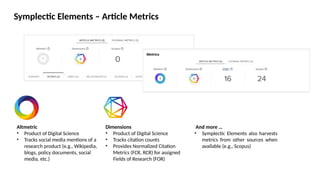
Altmetric
• Product of Digital Science
• Tracks social media mentions of a
research product (e.g., Wikipedia,
blogs, policy documents, social
media, etc.)
Dimensions
• Product of Digital Science
• Tracks citation counts
• Provides Normalized Citation
Metrics (FCR, RCR) for assigned
Fields of Research (FOR)
And more …
• Symplectic Elements also harvests
metrics from other sources when
available (e.g., Scopus)
2.
Symplectic Elements –Journal Metrics
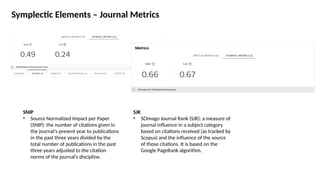
SNIP
• Source Normalized Impact per Paper
(SNIP): the number of citations given in
the journal's present year to publications
in the past three years divided by the
total number of publications in the past
three years adjusted to the citation
norms of the journal's discipline.
SJR
• SCImago Journal Rank (SJR): a measure of
journal influence in a subject category
based on citations received (as tracked by
Scopus) and the influence of the source
of those citations. It is based on the
Google PageRank algorithm.
3.
Symplectic Elements –Author Metrics*
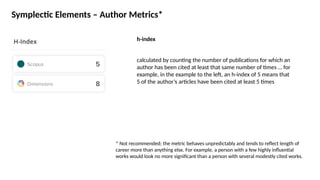
h-index
* Not recommended; the metric behaves unpredictably and tends to reflect length of
career more than anything else. For example, a person with a few highly influential
works would look no more significant than a person with several modestly cited works.
calculated by counting the number of publications for which an
author has been cited at least that same number of times … for
example, in the example to the left, an h-index of 5 means that
5 of the author’s articles have been cited at least 5 times
4.
• A startingplace to collect metrics about your
scholarly works
• Altmetric provides links to mentions of your work
that may demonstrate broader social impact
(news coverage, policy works, etc.)
• Dimensions includes several useful citation-based
metrics about your work:
o Total citations per work
o Field Citation Ratio (FCR): a normalized citation
metric that enables comparison of how your work
is cited with other works published in that year and
in the same field
o Relative Citation Ratio (RCR): similar to FCR, but
limited to articles funded by the NIH
o These metrics can demonstrate the specific impact
of your work independent of perceived journal
prestige
• Not all publications are tracked by citation
databases (e.g. Scopus, Dimensions, etc.)
• It takes time for a work to be cited
• Citation counts vary depending on the source
used. Dimensions is larger that most databases,
but Google Scholar will often report a higher
citation count.
• The mentions reported by Altmetric are more
meaningful that the calculated Altmetric Attention
score.
• Similar to the Journal Impact Factor (JIF), SJR and
SNIP are journal-level metrics. These speak to the
relative influence of the journal and may not
reflect the value of your article. Learn more:
https://researchmetrics.indianapolis.iu.edu/resour
ces.html
Limitations
Uses
Editor's Notes
#1 Talking points:
Discuss how article metrics appear in SE (when inputting data and on the public profile)
Discuss Altmetrics, Dimensions, and other metrics briefly
#2 Talking points:
Discuss how journal metrics appear in SE (when inputting data and on the public profile)
Discuss SNIP and SJR metrics briefly
Mention gaps in Scopus coverage
#3 Talking points:
Discuss how author metrics appear in SE (when inputing data … does not appear on the public profile (but you’ll need to confirm this because in the pilot site it doesn’t…))
Discuss h-index briefly