UNIVERSITY OF RWANDA
CMHS
DEPARTMENTS OF PHYSIOTHERAPY
MODULE: SPORTS PHYSIOTHERAPY
LEVEL FOUR
ACADEMIC YEAR:2019-2020
GROUP II MEMBERS
217119050
217209483
217206425
217271278
217003982
ASSIGNMENT 2
EXERCISE IN COLD
CONTENT
introduction to exercise in cold
generation of body heat
body heat loss
factors that help in minimizing heat loss
how the body perceives cold
measurement of the body temperature
hypothermia
effects of hypothermia
clinical features of hypothermia
general principles of managing hypothermia
rules for exercising in the cold
EXERCISE IN COLD
• Human exposure to extreme cold produces significant
physiologic and psychologic challenges (William.D, et al
2010).
• The biggest concern to exercising in cold is hypothermia
and how much heat will your body lose during exercise(
American council on exercise,2019).
•Activities in which cold injuries are likely to occur
includes those involving water immersion (e.g:
swimming, scuba diving, boating, triathlons), those
commonly performed in alpine environments (e.g.
skiing), and those that require prolonged activity (e.g:
marathons, ultra endurance events).
Hypothermia
A central or core temperature of 35oc (95OF), or lower.
It occurs when the body loses more heat than it generates.
GENERATION OF BODY HEAT
• Humans body function optimally in a relatively narrow temperature
range. At ambient air temperature above 28oc or (82OF) heat
produced by basal metabolism maintains a core body temperature at
37oc.
• In conditions below this temperature 28oc ,the body must produce
additional heat to remain thermo-neutral.
Heat production can be achieved by:
Greater physical activity
Automatically mediated shivering
Physiological response of health individuals in a moderate
environment.
SHIVERING
Shivering: it is the involuntary muscle contraction in response
to cold and the use of energy store quickly.
• Shivering capacity decreases as local glycogen stores are
depleted.
• Shivering intensity is generally related to the rate of change
of temperature.
• Shivering results in decreased muscular co-ordination and
therefore impairs sporting performance.
• Non-shivering thermogenesis occurs in young children
because of metabolism of brown fats but this mechanism is
not available to adults because of little brown fats.
BOBY HEAT LOSS
Heat transfer occurs mainly from the skin and is therefore regulated by
circulation, the amount of insulation, and perspiration. Heat loss occurs
through: conduction, convection, radiation, evaporation
1. Conduction: refers to direct contact with cold object or air.
Conductivity of water is 23 times that of air, as air has low thermal
conductance . Conduction may be important when lying on cold wet
ground.
2. Convection: this relates to movement of air close to the body.
3. Radiation: it involves the emission of heat energy to nearby objects.
This occurs from uncovered skin and is the greatest source of heat loss
under normal condition.
4. Evaporation: this refers to heat loss as sweat on the external
skin or clothing is converted from liquid to gas by evaporation.
Evaporation is increased in dry, windy conditions and may go
unnoticed, heat is also lost through faeces, urine and
respiration.
FACTORS THAT HELP IN MINIMIZING HEAT LOSS
Peripheral vasoconstriction which increases thickness of
insulation.
Clothing
Keeping still also prevent heat loss
METHOD OF CONTROLLING HEAT LOSS
Insulation; consisting of body fat plus clothing
Environmental factors; including temperature, wind and whether
you’re exercising in the air or in the water. Each of these factors plays
a role in the body’s ability to maintain a comfortable temperature
during exercise.
How the body perceives cold
• The body has central and peripheral mechanisms for cold perception.
heat sensors in the central hypothalamus receive input from the skin,
central arteries, and the viscera.
• It also affected by the stages of menstrual cycle. Cutaneous sensory
nerve endings respond maximally to the rate of change of
temperature rather than the actual temperature.
• After sensory input, the brain response by increased metabolic rate,
shivering and vasoconstriction
Measurement of the body temperature
• Direct measurement of core temperature is not practical.
Thus ,indirect measures are made at the skin or mouth.
Measuring low temperatures requires a low reading
thermometer (below 32oC(90OF).
• Oral temperature is unreliable as it may be affected by wind,
rain, eternal temperature and recent ingested food. It may
be a useful screening exercise as the core temperature will
never be lower than the oral temperature.
• Measurement of axillary temperature is also not reliable as it
may be affected by skin temperature. Axillary Temperature is
usually (1-1.5oC) below the core temperature and this makes
it less reliable in cold conditions.
• Rectal temperature is the most commonly and reliable
HYPOTHERMIA
Hypothermia :reduced core body temperature (below 36oC)
Measurement of rectal temperature is the most commonly
performed procedure to assess hypothermia.
EFFECTS OF HYPOTHERMIA
Cardiovascular effects
Vasoconstriction which leads to fluid shifts by increasing central
blood volume and thus causing a cold diuresis.
Decreased circulatory volume.
Decreased cardiac output.
Decreased heart rate
Atrial fibrillation may occur
Ventricular fibrillation may also occur and be refractory to treatment
at very low temperature.
Respiratory effects
This results in hyperventilation with resultant respiratory heat and
water loss.
Dehydration and bronchospasms
Reduction in airways protective mechanisms
Subsequent increased risk of aspiration.
Other effects
• Delayed nerve conduction and neuromuscular transmission causes
numbness and impaired coordination. This may persist for some
hours or even days after the core temperature returns to normal.
• Muscle stiffness and muscle weakness associated with hypothermia
which may increase the risk of muscle tear
• Excessive shivering may lead to poor voluntary muscle control and
increased fatigue.
• Hypothermia may inhibit glycolysis and fat metabolism.
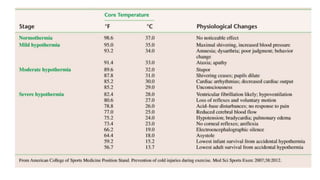
•Core Temperature and Associated Physiological
Changes that Occur as Core Temperature Falls;
Individuals Respond Differently at Each Level of
Core Temperature
CLINICAL FEATURES OF HYPOTHERMIA
• The clinical features of hypothermia vary depending on the degree of
reduction in core temperature.
1. Mild (33oC-35oC,[91OF-95OF])
 Cold extremities
 shivering
 Tachycardia
 Tachypnea
 Urinary urgency
 Slightly inco-ordination
2. Moderate (31-32oC[88OF-90OF])
 Increased inco-ordination and clumsiness
 Fatigue
 Reduced shivering
 Slurred speech and amnesia
 Weakness and drowsiness
 Apathy, poor judgement
 Dehydration
3. Severe (<31oC,<88OF)
• Total loss of shivering
• Inappropriate behavior
• Reduced level of consciousness
• Muscle rigidity
• Hypotension and bradycardia
• Pulmonary edema
• Cardiac arrhythmias
General principles of managing hypothermia
• Management of hypothermic athletes requires:
• Recognition of the problem
• Removal from cold , windy, or wet conditions
• Gentle and minimal handling.
• Measurement of the core temperature
• Insulation to prevent further heat loss.
• Provision of nutritional and fluid support
• Assessment for the presence of other conditions. E.g: frostbite.
• Possible passive or active rewarming
• Possible transportation to a medical facility.
TREATMENT OF HYPOTHERMIA
The risk of hypothermia in athletes is increased by;
• the lack of knowledge,
• lack of communication
• pushing one self to exhaustion
• ignoring early warning signs
• Poor psychological and physical preparation
• Inadequate protection from weather
Treatment of mild hypothermia(33oC-35oC)
• Immediate removal from cold
• Insulating appropriately
• Giving a warm , sweet drink
• Person should continually be monitored until rectal temperature close
35oC
Treatment of moderate hypothermia(31oC-32oC)
• Immediate removal from cold
• Insulating appropriately
• In field setting ,the patient should not be rewarmed actively until
rectal temperature rising and above 34oC
• Intravenous rehydration
Treatment of severe hypothermia<30oC
• Patient should be transferred to the hospital equipped with an
intensive care unit
• CPR
• At hospital the active rewarming can be given
Prevention of cold injuries
General guidelines
1. Adequate planning
2. Communicate plans to others
3. Avoid activity inappropriate for fitness level
4. Avoid activity to exhaustion
5. Avoid dehydration
6. Ensure adequate nutrition
7. Warm up appropriately
8. Wear appropriate clothing for weather condition( cover head, ears
9. Cancel activity or seek shelter if appropriate
Children and Cold Stress
• Cold water provides an exceptionally stressful thermoregulatory
environment for children
• Non-shivering thermogenesis occurs in young children because of
metabolism of brown fats
• During exercise in the less stressful cold-air environment, children rely
on two mechanisms to compensate for their relatively large body
surface area.
1. Augmented energy metabolism
2. More effective peripheral vasoconstriction in the limbs
ACCLIMATIZATION;
Human bodies possess much less capacity for adaptation to long term
cold exposure than to prolonged heat exposure.
ACCLIMATION; Human bodies possess capacity for adaptation
to short term cold exposure
RULES FOR EXERCISING IN THE COLD
• Check the temperature and wind conditions before you go out and do
not exercise if conditions are dangerous.
• Keep your head, hands and feet warm.
• Dress in layers that can provide a trapped layer of dry air near the skin
(avoid cotton sweats and other similar materials).
• Warm the air you are breathing if temperatures are below your
comfort level (usually around 0° F).
Effects of Cold on Exercise Performance
• Compromise of exercise performance in the cold is dependent on a
multitude of factors, such as air temperature, wind chill, clothing
selection, body composition, and type of exercise
• Generally exercise performance will not be compromised, unless a
significant amount of energy is expended on shivering, which can
significantly increase oxygen consumption during exercise
• That is particularly the case during swimming, where heat is removed
from the body more rapidly through conduction in the water (about
25 times faster than air).
• Exercise in cold water produces greater oxygen consumption than
exercise of identical intensity in warmer water.
• Heat loss via convection is also increased during swimming, as water
molecules in contact with the skin are continually being replaced as
the individual moves through the water.
• Moderate intensity land-based exercise typically generates enough
heat to maintain the body’s core temperature in environmental
temperatures as low as -30˚C (-22˚F), without the need for excessive
heavy clothing, or increased shivering
• Individuals who posses a higher amount of body fat will retain a
greater amount of body heat than leaner individuals.
• leaner individuals will typically require greater insulation in the form of
clothing than those with a greater degree of body fat.
• In addition to the issue of heat loss, during cold weather exercise, a
significant water loss can be incurred through sweating, and
respiration.
• Air is very dry in the winter months, and this air is warmed and
humidified in the bronchial passages during inspiration.
• Wearing a scarf or facemask over the nose and mouth during exercise
will trap heat and water vapor in the fibers during exhalation, which
will in turn serve to assist in warming and humidifying the next
incoming breath
THANK YOU

exercise in cold

  • 1.
    UNIVERSITY OF RWANDA CMHS DEPARTMENTSOF PHYSIOTHERAPY MODULE: SPORTS PHYSIOTHERAPY LEVEL FOUR ACADEMIC YEAR:2019-2020 GROUP II MEMBERS 217119050 217209483 217206425 217271278 217003982
  • 2.
  • 3.
    CONTENT introduction to exercisein cold generation of body heat body heat loss factors that help in minimizing heat loss how the body perceives cold measurement of the body temperature hypothermia effects of hypothermia clinical features of hypothermia general principles of managing hypothermia rules for exercising in the cold
  • 4.
    EXERCISE IN COLD •Human exposure to extreme cold produces significant physiologic and psychologic challenges (William.D, et al 2010). • The biggest concern to exercising in cold is hypothermia and how much heat will your body lose during exercise( American council on exercise,2019).
  • 5.
    •Activities in whichcold injuries are likely to occur includes those involving water immersion (e.g: swimming, scuba diving, boating, triathlons), those commonly performed in alpine environments (e.g. skiing), and those that require prolonged activity (e.g: marathons, ultra endurance events).
  • 6.
    Hypothermia A central orcore temperature of 35oc (95OF), or lower. It occurs when the body loses more heat than it generates.
  • 7.
    GENERATION OF BODYHEAT • Humans body function optimally in a relatively narrow temperature range. At ambient air temperature above 28oc or (82OF) heat produced by basal metabolism maintains a core body temperature at 37oc. • In conditions below this temperature 28oc ,the body must produce additional heat to remain thermo-neutral.
  • 8.
    Heat production canbe achieved by: Greater physical activity Automatically mediated shivering Physiological response of health individuals in a moderate environment.
  • 9.
    SHIVERING Shivering: it isthe involuntary muscle contraction in response to cold and the use of energy store quickly. • Shivering capacity decreases as local glycogen stores are depleted. • Shivering intensity is generally related to the rate of change of temperature. • Shivering results in decreased muscular co-ordination and therefore impairs sporting performance. • Non-shivering thermogenesis occurs in young children because of metabolism of brown fats but this mechanism is not available to adults because of little brown fats.
  • 10.
    BOBY HEAT LOSS Heattransfer occurs mainly from the skin and is therefore regulated by circulation, the amount of insulation, and perspiration. Heat loss occurs through: conduction, convection, radiation, evaporation 1. Conduction: refers to direct contact with cold object or air. Conductivity of water is 23 times that of air, as air has low thermal conductance . Conduction may be important when lying on cold wet ground. 2. Convection: this relates to movement of air close to the body. 3. Radiation: it involves the emission of heat energy to nearby objects. This occurs from uncovered skin and is the greatest source of heat loss under normal condition.
  • 11.
    4. Evaporation: thisrefers to heat loss as sweat on the external skin or clothing is converted from liquid to gas by evaporation. Evaporation is increased in dry, windy conditions and may go unnoticed, heat is also lost through faeces, urine and respiration.
  • 12.
    FACTORS THAT HELPIN MINIMIZING HEAT LOSS Peripheral vasoconstriction which increases thickness of insulation. Clothing Keeping still also prevent heat loss
  • 13.
    METHOD OF CONTROLLINGHEAT LOSS Insulation; consisting of body fat plus clothing Environmental factors; including temperature, wind and whether you’re exercising in the air or in the water. Each of these factors plays a role in the body’s ability to maintain a comfortable temperature during exercise.
  • 14.
    How the bodyperceives cold • The body has central and peripheral mechanisms for cold perception. heat sensors in the central hypothalamus receive input from the skin, central arteries, and the viscera. • It also affected by the stages of menstrual cycle. Cutaneous sensory nerve endings respond maximally to the rate of change of temperature rather than the actual temperature. • After sensory input, the brain response by increased metabolic rate, shivering and vasoconstriction
  • 15.
    Measurement of thebody temperature • Direct measurement of core temperature is not practical. Thus ,indirect measures are made at the skin or mouth. Measuring low temperatures requires a low reading thermometer (below 32oC(90OF). • Oral temperature is unreliable as it may be affected by wind, rain, eternal temperature and recent ingested food. It may be a useful screening exercise as the core temperature will never be lower than the oral temperature.
  • 16.
    • Measurement ofaxillary temperature is also not reliable as it may be affected by skin temperature. Axillary Temperature is usually (1-1.5oC) below the core temperature and this makes it less reliable in cold conditions. • Rectal temperature is the most commonly and reliable
  • 17.
    HYPOTHERMIA Hypothermia :reduced corebody temperature (below 36oC) Measurement of rectal temperature is the most commonly performed procedure to assess hypothermia.
  • 18.
    EFFECTS OF HYPOTHERMIA Cardiovasculareffects Vasoconstriction which leads to fluid shifts by increasing central blood volume and thus causing a cold diuresis. Decreased circulatory volume. Decreased cardiac output. Decreased heart rate Atrial fibrillation may occur Ventricular fibrillation may also occur and be refractory to treatment at very low temperature.
  • 19.
    Respiratory effects This resultsin hyperventilation with resultant respiratory heat and water loss. Dehydration and bronchospasms Reduction in airways protective mechanisms Subsequent increased risk of aspiration.
  • 20.
    Other effects • Delayednerve conduction and neuromuscular transmission causes numbness and impaired coordination. This may persist for some hours or even days after the core temperature returns to normal. • Muscle stiffness and muscle weakness associated with hypothermia which may increase the risk of muscle tear • Excessive shivering may lead to poor voluntary muscle control and increased fatigue. • Hypothermia may inhibit glycolysis and fat metabolism.
  • 21.
    •Core Temperature andAssociated Physiological Changes that Occur as Core Temperature Falls; Individuals Respond Differently at Each Level of Core Temperature
  • 23.
    CLINICAL FEATURES OFHYPOTHERMIA • The clinical features of hypothermia vary depending on the degree of reduction in core temperature. 1. Mild (33oC-35oC,[91OF-95OF])  Cold extremities  shivering  Tachycardia  Tachypnea  Urinary urgency  Slightly inco-ordination
  • 24.
    2. Moderate (31-32oC[88OF-90OF]) Increased inco-ordination and clumsiness  Fatigue  Reduced shivering  Slurred speech and amnesia  Weakness and drowsiness  Apathy, poor judgement  Dehydration
  • 25.
    3. Severe (<31oC,<88OF) •Total loss of shivering • Inappropriate behavior • Reduced level of consciousness • Muscle rigidity • Hypotension and bradycardia • Pulmonary edema • Cardiac arrhythmias
  • 26.
    General principles ofmanaging hypothermia • Management of hypothermic athletes requires: • Recognition of the problem • Removal from cold , windy, or wet conditions • Gentle and minimal handling. • Measurement of the core temperature • Insulation to prevent further heat loss. • Provision of nutritional and fluid support • Assessment for the presence of other conditions. E.g: frostbite.
  • 27.
    • Possible passiveor active rewarming • Possible transportation to a medical facility.
  • 28.
    TREATMENT OF HYPOTHERMIA Therisk of hypothermia in athletes is increased by; • the lack of knowledge, • lack of communication • pushing one self to exhaustion • ignoring early warning signs • Poor psychological and physical preparation • Inadequate protection from weather
  • 29.
    Treatment of mildhypothermia(33oC-35oC) • Immediate removal from cold • Insulating appropriately • Giving a warm , sweet drink • Person should continually be monitored until rectal temperature close 35oC
  • 30.
    Treatment of moderatehypothermia(31oC-32oC) • Immediate removal from cold • Insulating appropriately • In field setting ,the patient should not be rewarmed actively until rectal temperature rising and above 34oC • Intravenous rehydration
  • 31.
    Treatment of severehypothermia<30oC • Patient should be transferred to the hospital equipped with an intensive care unit • CPR • At hospital the active rewarming can be given
  • 32.
    Prevention of coldinjuries General guidelines 1. Adequate planning 2. Communicate plans to others 3. Avoid activity inappropriate for fitness level 4. Avoid activity to exhaustion 5. Avoid dehydration 6. Ensure adequate nutrition 7. Warm up appropriately 8. Wear appropriate clothing for weather condition( cover head, ears 9. Cancel activity or seek shelter if appropriate
  • 33.
    Children and ColdStress • Cold water provides an exceptionally stressful thermoregulatory environment for children • Non-shivering thermogenesis occurs in young children because of metabolism of brown fats • During exercise in the less stressful cold-air environment, children rely on two mechanisms to compensate for their relatively large body surface area. 1. Augmented energy metabolism 2. More effective peripheral vasoconstriction in the limbs
  • 34.
    ACCLIMATIZATION; Human bodies possessmuch less capacity for adaptation to long term cold exposure than to prolonged heat exposure. ACCLIMATION; Human bodies possess capacity for adaptation to short term cold exposure
  • 35.
    RULES FOR EXERCISINGIN THE COLD • Check the temperature and wind conditions before you go out and do not exercise if conditions are dangerous. • Keep your head, hands and feet warm. • Dress in layers that can provide a trapped layer of dry air near the skin (avoid cotton sweats and other similar materials). • Warm the air you are breathing if temperatures are below your comfort level (usually around 0° F).
  • 36.
    Effects of Coldon Exercise Performance • Compromise of exercise performance in the cold is dependent on a multitude of factors, such as air temperature, wind chill, clothing selection, body composition, and type of exercise • Generally exercise performance will not be compromised, unless a significant amount of energy is expended on shivering, which can significantly increase oxygen consumption during exercise
  • 37.
    • That isparticularly the case during swimming, where heat is removed from the body more rapidly through conduction in the water (about 25 times faster than air). • Exercise in cold water produces greater oxygen consumption than exercise of identical intensity in warmer water. • Heat loss via convection is also increased during swimming, as water molecules in contact with the skin are continually being replaced as the individual moves through the water.
  • 38.
    • Moderate intensityland-based exercise typically generates enough heat to maintain the body’s core temperature in environmental temperatures as low as -30˚C (-22˚F), without the need for excessive heavy clothing, or increased shivering • Individuals who posses a higher amount of body fat will retain a greater amount of body heat than leaner individuals. • leaner individuals will typically require greater insulation in the form of clothing than those with a greater degree of body fat.
  • 39.
    • In additionto the issue of heat loss, during cold weather exercise, a significant water loss can be incurred through sweating, and respiration. • Air is very dry in the winter months, and this air is warmed and humidified in the bronchial passages during inspiration. • Wearing a scarf or facemask over the nose and mouth during exercise will trap heat and water vapor in the fibers during exhalation, which will in turn serve to assist in warming and humidifying the next incoming breath
  • 40.