Objectives
- List at least two food sources of given
minerals.
- List functions of given minerals.
- Describe the recommended method of
avoiding mineral deficiencies.
Minerals
- Are inorganic elements necessary to
- build tissues
- regulate body fluids
- assist in various body functions.
- Are soluble in water.
- Minerals represent 4% of body weight.
- Minerals are essential for good health.
- Found in all body tissues
- Cannot provide energy by themselves but
contribute to production of energy within
the body
Classification of minerals
1- Major minerals
Required in amounts greater than 100
mg/ day
2- Trace minerals
Needed in amounts smaller than 100 mg
/day
Electrolytes:
is a substance that ionizes when dissolved
in suitable ionizing solvents such as water
Ions:
Electrically charged atoms resulting from
mineral salts dissolved in water
Continue (Ions)
- Its named (cations) if are positively
charged.
- Its named (Anions) if are negatively
charged.
- Must be balanced within the body.
- These ions are known as electrolytes
Function of electrolytes
- Maintain the body’s fluid balance
- Contribute to electrical balance
- Assist in transmission of nerve impulses
and contraction of muscles
- Help regulate the body’s acid-base
balance
Toxicity from electrolytes (minerals)
- Toxicity occurs when concentrated forms
of minerals are taken regularly over time.
- An excessive amount of one mineral can
lead to deficiency of another mineral.
- Changes in nearly all tissues may result.
- Concentrated minerals should be used
only if prescribed.
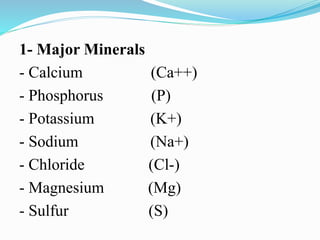
1- Major Minerals
- Calcium (Ca++)
- Phosphorus (P)
- Potassium (K+)
- Sodium (Na+)
- Chloride (Cl-)
- Magnesium (Mg)
- Sulfur (S)
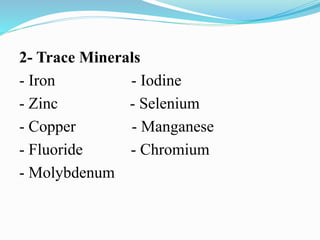
2- Trace Minerals
- Iron - Iodine
- Zinc - Selenium
- Copper - Manganese
- Fluoride - Chromium
- Molybdenum
Calcium (Ca)
- Human body contains more calcium than
any other mineral
- In combination with phosphorus, gives
strength and hardness to bones and teeth
- Bones provide storage for calcium.
Calcium (Ca) needed by the body for:
- Normal nerve and muscle action
- Blood clotting
- Heart function
- And cell metabolism
Calcium Regulation
- Hormonal system regulates delivery of
calcium to cells.
- Parathyroid glands are very sensitive to
serum calcium levels and release a
hormone (PTH) telling the kidneys to
retrieve calcium before it is excreted
when blood calcium levels drop.
- Parathyroid hormone also increased
release of calcium from bones by
stimulating activity of osteoclasts if the
blood calcium decrease.
- Both actions increase blood calcium
levels.
Calcium Sources
- Milk and milk products
- Dark green, leafy vegetables
- When vegetables contain oxalic acid,
as spinach the calcium remains
unavailable because the oxalic acid
binds it and prevents it from being
absorbed.
- Also when the intake of fiber exceeds
35 g a day, calcium will also bind with
phytates (phosphorus compounds
found in some high-fiber cereals),
which also limits its absorption.
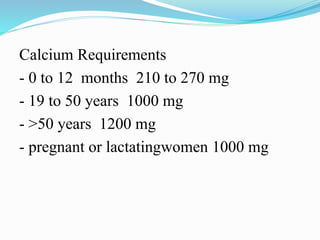
Calcium Requirements
- 0 to 12 months 210 to 270 mg
- 19 to 50 years 1000 mg
- ˃50 years 1200 mg
- pregnant or lactatingwomen 1000 mg
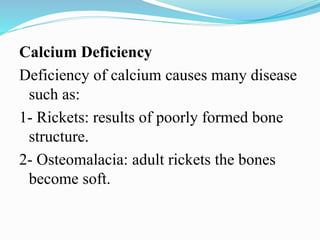
Calcium Deficiency
Deficiency of calcium causes many disease
such as:
1- Rickets: results of poorly formed bone
structure.
2- Osteomalacia: adult rickets the bones
become soft.
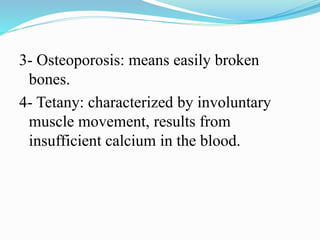
3- Osteoporosis: means easily broken
bones.
4- Tetany: characterized by involuntary
muscle movement, results from
insufficient calcium in the blood.
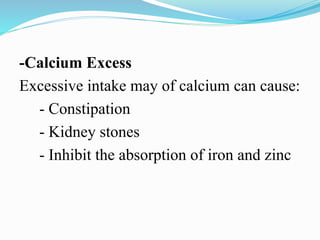
-Calcium Excess
Excessive intake may of calcium can cause:
- Constipation
- Kidney stones
- Inhibit the absorption of iron and zinc
Thank

Minerals 0

  • 2.
    Objectives - List atleast two food sources of given minerals. - List functions of given minerals. - Describe the recommended method of avoiding mineral deficiencies.
  • 3.
    Minerals - Are inorganicelements necessary to - build tissues - regulate body fluids - assist in various body functions. - Are soluble in water.
  • 4.
    - Minerals represent4% of body weight. - Minerals are essential for good health. - Found in all body tissues - Cannot provide energy by themselves but contribute to production of energy within the body
  • 5.
    Classification of minerals 1-Major minerals Required in amounts greater than 100 mg/ day 2- Trace minerals Needed in amounts smaller than 100 mg /day
  • 6.
    Electrolytes: is a substancethat ionizes when dissolved in suitable ionizing solvents such as water Ions: Electrically charged atoms resulting from mineral salts dissolved in water
  • 7.
    Continue (Ions) - Itsnamed (cations) if are positively charged. - Its named (Anions) if are negatively charged. - Must be balanced within the body. - These ions are known as electrolytes
  • 8.
    Function of electrolytes -Maintain the body’s fluid balance - Contribute to electrical balance - Assist in transmission of nerve impulses and contraction of muscles - Help regulate the body’s acid-base balance
  • 9.
    Toxicity from electrolytes(minerals) - Toxicity occurs when concentrated forms of minerals are taken regularly over time. - An excessive amount of one mineral can lead to deficiency of another mineral. - Changes in nearly all tissues may result. - Concentrated minerals should be used only if prescribed.
  • 10.
    1- Major Minerals -Calcium (Ca++) - Phosphorus (P) - Potassium (K+) - Sodium (Na+) - Chloride (Cl-) - Magnesium (Mg) - Sulfur (S)
  • 11.
    2- Trace Minerals -Iron - Iodine - Zinc - Selenium - Copper - Manganese - Fluoride - Chromium - Molybdenum
  • 12.
    Calcium (Ca) - Humanbody contains more calcium than any other mineral - In combination with phosphorus, gives strength and hardness to bones and teeth - Bones provide storage for calcium.
  • 13.
    Calcium (Ca) neededby the body for: - Normal nerve and muscle action - Blood clotting - Heart function - And cell metabolism
  • 14.
    Calcium Regulation - Hormonalsystem regulates delivery of calcium to cells. - Parathyroid glands are very sensitive to serum calcium levels and release a hormone (PTH) telling the kidneys to retrieve calcium before it is excreted when blood calcium levels drop.
  • 15.
    - Parathyroid hormonealso increased release of calcium from bones by stimulating activity of osteoclasts if the blood calcium decrease. - Both actions increase blood calcium levels.
  • 16.
    Calcium Sources - Milkand milk products - Dark green, leafy vegetables - When vegetables contain oxalic acid, as spinach the calcium remains unavailable because the oxalic acid binds it and prevents it from being absorbed.
  • 17.
    - Also whenthe intake of fiber exceeds 35 g a day, calcium will also bind with phytates (phosphorus compounds found in some high-fiber cereals), which also limits its absorption.
  • 18.
    Calcium Requirements - 0to 12 months 210 to 270 mg - 19 to 50 years 1000 mg - ˃50 years 1200 mg - pregnant or lactatingwomen 1000 mg
  • 19.
    Calcium Deficiency Deficiency ofcalcium causes many disease such as: 1- Rickets: results of poorly formed bone structure. 2- Osteomalacia: adult rickets the bones become soft.
  • 20.
    3- Osteoporosis: meanseasily broken bones. 4- Tetany: characterized by involuntary muscle movement, results from insufficient calcium in the blood.
  • 21.
    -Calcium Excess Excessive intakemay of calcium can cause: - Constipation - Kidney stones - Inhibit the absorption of iron and zinc
  • 22.