MANAGING WATER FOR TOMORROW’S AGRICULTURE
Nutrient loss reduction potential of
drainage water recycling systems based on
on-farm water storage size
Ben Reinhart, Project Manager
Jane Frankenberger, Project Director
Agricultural and Biological Engineering, Purdue University
MANAGING WATER FOR TOMORROW’S AGRICULTURE
Water storage
and management
in the Midwest
• Improve
drainage to
support
production
• Tile drains
increase loss of
nitrate (and
phosphorus) Outlet
(i.e. stream)
MANAGING WATER FOR TOMORROW’S AGRICULTURE
Options for
reducing
nutrient loads
• Reduction
efficiencies are
highly variable
across practices
Source: Iowa Nutrient Reduction Strategy Science Assessment
Nitrogen Reduction Target = 41%
MANAGING WATER FOR TOMORROW’S AGRICULTURE
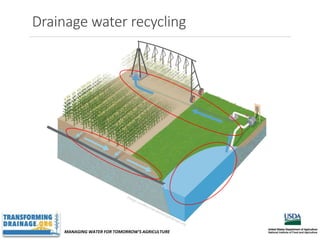
Drainage water recycling
MANAGING WATER FOR TOMORROW’S AGRICULTURE
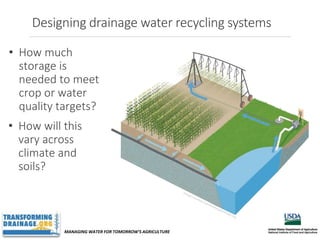
• How will this
vary across
climate and
soils?
• How much
storage is
needed to meet
crop or water
quality targets?
Designing drainage water recycling systems
MANAGING WATER FOR TOMORROW’S AGRICULTURE
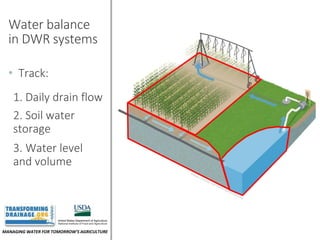
Water balance
in DWR systems
• Track:
1. Daily drain flow
3. Water level
and volume
2. Soil water
storage
MANAGING WATER FOR TOMORROW’S AGRICULTURE
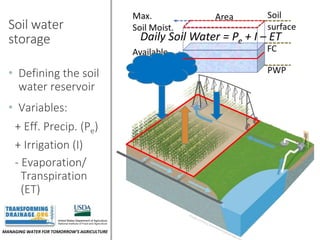
Soil water
storage
• Defining the soil
water reservoir
• Variables:
+ Eff. Precip. (Pe)
+ Irrigation (I)
- Evaporation/
Transpiration
(ET)
Daily Soil Water = Pe + I – ET
MANAGING WATER FOR TOMORROW’S AGRICULTURE
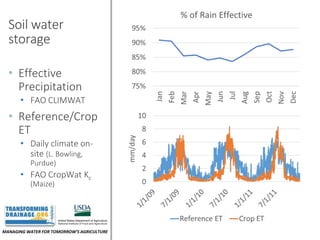
Soil water
storage
• Effective
Precipitation
• FAO CLIMWAT
• Reference/Crop
ET
• Daily climate on-
site (L. Bowling,
Purdue)
• FAO CropWat Kc
(Maize)
MANAGING WATER FOR TOMORROW’S AGRICULTURE
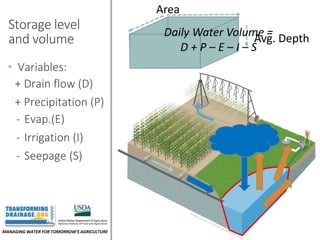
Storage level
and volume Avg. Depth
Area
• Variables:
+ Drain flow (D)
+ Precipitation (P)
- Evap.(E)
- Irrigation (I)
- Seepage (S)
Daily Water Volume =
D + P – E – I – S
MANAGING WATER FOR TOMORROW’S AGRICULTURE
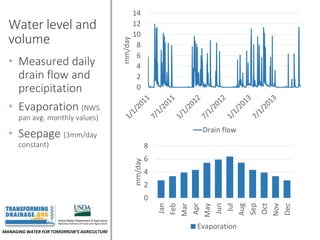
Water level and
volume
• Measured daily
drain flow and
precipitation
• Evaporation (NWS
pan avg. monthly values)
• Seepage (3mm/day
constant)
0
2
4
6
8
Jan
Feb
Mar
Apr
May
Jun
Jul
Aug
Sep
Oct
Nov
Dec
mm/day
Evaporation
0
2
4
6
8
10
12
14
mm/day Drain flow
MANAGING WATER FOR TOMORROW’S AGRICULTURE
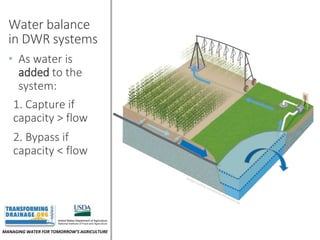
Water balance
in DWR systems
• As water is
added to the
system:
1. Capture if
capacity > flow
2. Bypass if
capacity < flow
MANAGING WATER FOR TOMORROW’S AGRICULTURE
Water balance
in DWR systems
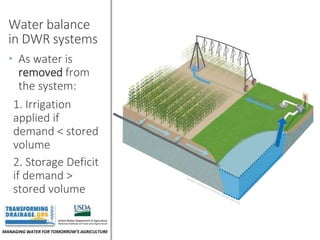
• As water is
removed from
the system:
1. Irrigation
applied if
demand < stored
volume
2. Storage Deficit
if demand >
stored volume
MANAGING WATER FOR TOMORROW’S AGRICULTURE
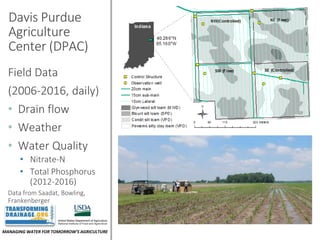
Davis Purdue
Agriculture
Center (DPAC)
Field Data
(2006-2016, daily)
• Drain flow
• Weather
• Water Quality
• Nitrate-N
• Total Phosphorus
(2012-2016)
Data from Saadat, Bowling,
Frankenberger
MANAGING WATER FOR TOMORROW’S AGRICULTURE
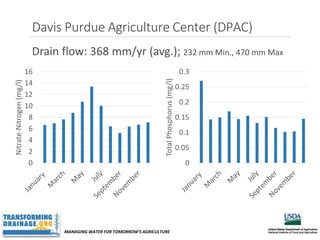
Davis Purdue Agriculture Center (DPAC)
Drain flow: 368 mm/yr (avg.); 232 mm Min., 470 mm Max
0
2
4
6
8
10
12
14
16
Nitrate-Nitrogen(mg/l)
0
0.05
0.1
0.15
0.2
0.25
0.3
TotalPhosphorus(mg/l)
MANAGING WATER FOR TOMORROW’S AGRICULTURE
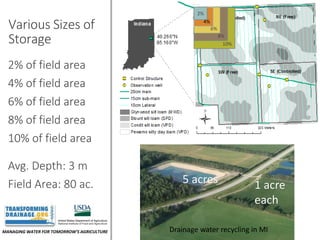
Various Sizes of
Storage
2% of field area
4% of field area
6% of field area
8% of field area
10% of field area
Avg. Depth: 3 m
Field Area: 80 ac.
10%
8%
6%
4%
2%
Drainage water recycling in MI
5 acres 1 acre
each
MANAGING WATER FOR TOMORROW’S AGRICULTURE
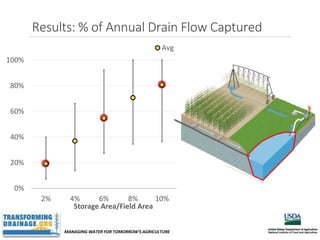
Results: % of Annual Drain Flow Captured
0%
20%
40%
60%
80%
100%
2% 4% 6% 8% 10%
Storage Area/Field Area
Avg
MANAGING WATER FOR TOMORROW’S AGRICULTURE
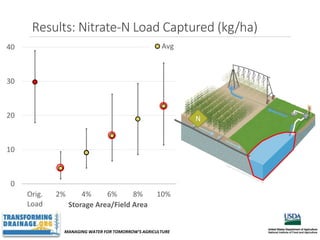
0
10
20
30
40
Orig.
Load
2% 4% 6% 8% 10%
Storage Area/Field Area
Avg
Results: Nitrate-N Load Captured (kg/ha)
N
MANAGING WATER FOR TOMORROW’S AGRICULTURE
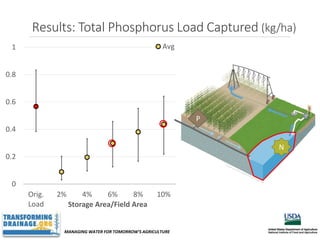
0
0.2
0.4
0.6
0.8
1
Orig.
Load
2% 4% 6% 8% 10%
Storage Area/Field Area
Avg
Results: Total Phosphorus Load Captured (kg/ha)
N
P
MANAGING WATER FOR TOMORROW’S AGRICULTURE
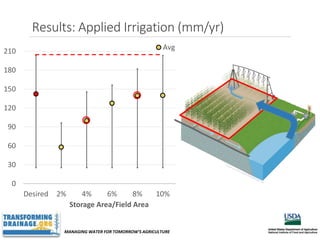
0
30
60
90
120
150
180
210
Desired 2% 4% 6% 8% 10%
Storage Area/Field Area
Avg
Results: Applied Irrigation (mm/yr)
MANAGING WATER FOR TOMORROW’S AGRICULTURE
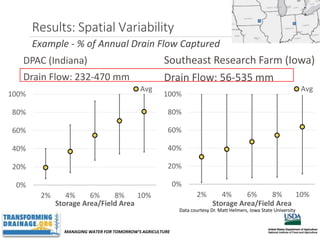
Results: Spatial Variability
DPAC (Indiana)
Drain Flow: 232-470 mm
Southeast Research Farm (Iowa)
Drain Flow: 56-535 mm
0%
20%
40%
60%
80%
100%
2% 4% 6% 8% 10%
Storage Area/Field Area
Avg
0%
20%
40%
60%
80%
100%
2% 4% 6% 8% 10%
Storage Area/Field Area
Avg
Data courtesy Dr. Matt Helmers, Iowa State University
Example - % of Annual Drain Flow Captured
MANAGING WATER FOR TOMORROW’S AGRICULTURE
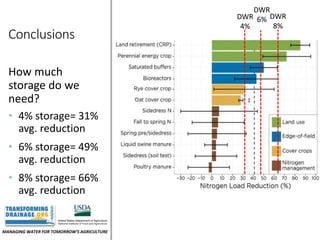
Conclusions
How much
storage do we
need?
• 4% storage= 31%
avg. reduction
• 6% storage= 49%
avg. reduction
• 8% storage= 66%
avg. reduction
DWR
4%
DWR
6% DWR
8%
MANAGING WATER FOR TOMORROW’S AGRICULTURE
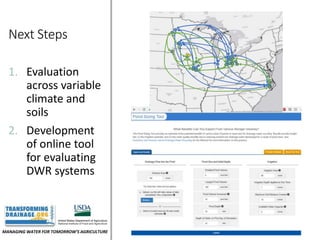
Next Steps
1. Evaluation
across variable
climate and
soils
2. Development
of online tool
for evaluating
DWR systems
THIS MATERIAL IS BASED UPON WORK THAT IS SUPPORTED BY THE NATIONAL INSTITUTE OF FOOD AND AGRICULTURE, U.S. DEPARTMENT OF AGRICULTURE,
UNDER AWARD NUMBER 2015-68007-23193, ā€œMANAGING WATER FOR INCREASED RESILIENCY OF DRAINED AGRICULTURAL LANDSCAPESā€,
HTTP://TRANSFORMINGDRAINAGE.ORG. ANY OPINIONS, FINDINGS, CONCLUSIONS, OR RECOMMENDATIONS EXPRESSED IN THIS PUBLICATION ARE THOSE OF
THE AUTHOR(S) AND DO NOT NECESSARILY REFLECT THE VIEW OF THE U.S. DEPARTMENT OF AGRICULTURE.
University of Missouri
MANAGING WATER FOR TOMORROW’S AGRICULTURE
Managing Water for Increased
Resiliency of Drained Agricultural
Landscapes

Nutrient loss reduction potential

  • 1.
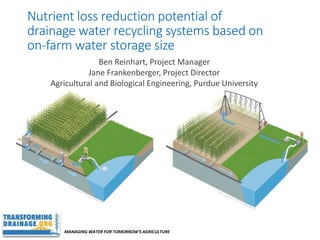
    MANAGING WATER FORTOMORROW’S AGRICULTURE Nutrient loss reduction potential of drainage water recycling systems based on on-farm water storage size Ben Reinhart, Project Manager Jane Frankenberger, Project Director Agricultural and Biological Engineering, Purdue University
  • 2.
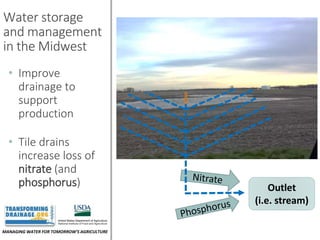
    MANAGING WATER FORTOMORROW’S AGRICULTURE Water storage and management in the Midwest • Improve drainage to support production • Tile drains increase loss of nitrate (and phosphorus) Outlet (i.e. stream)
  • 3.
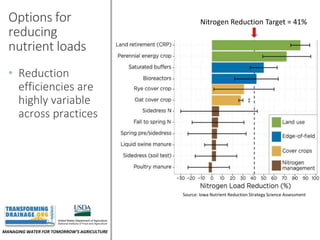
    MANAGING WATER FORTOMORROW’S AGRICULTURE Options for reducing nutrient loads • Reduction efficiencies are highly variable across practices Source: Iowa Nutrient Reduction Strategy Science Assessment Nitrogen Reduction Target = 41%
  • 4.
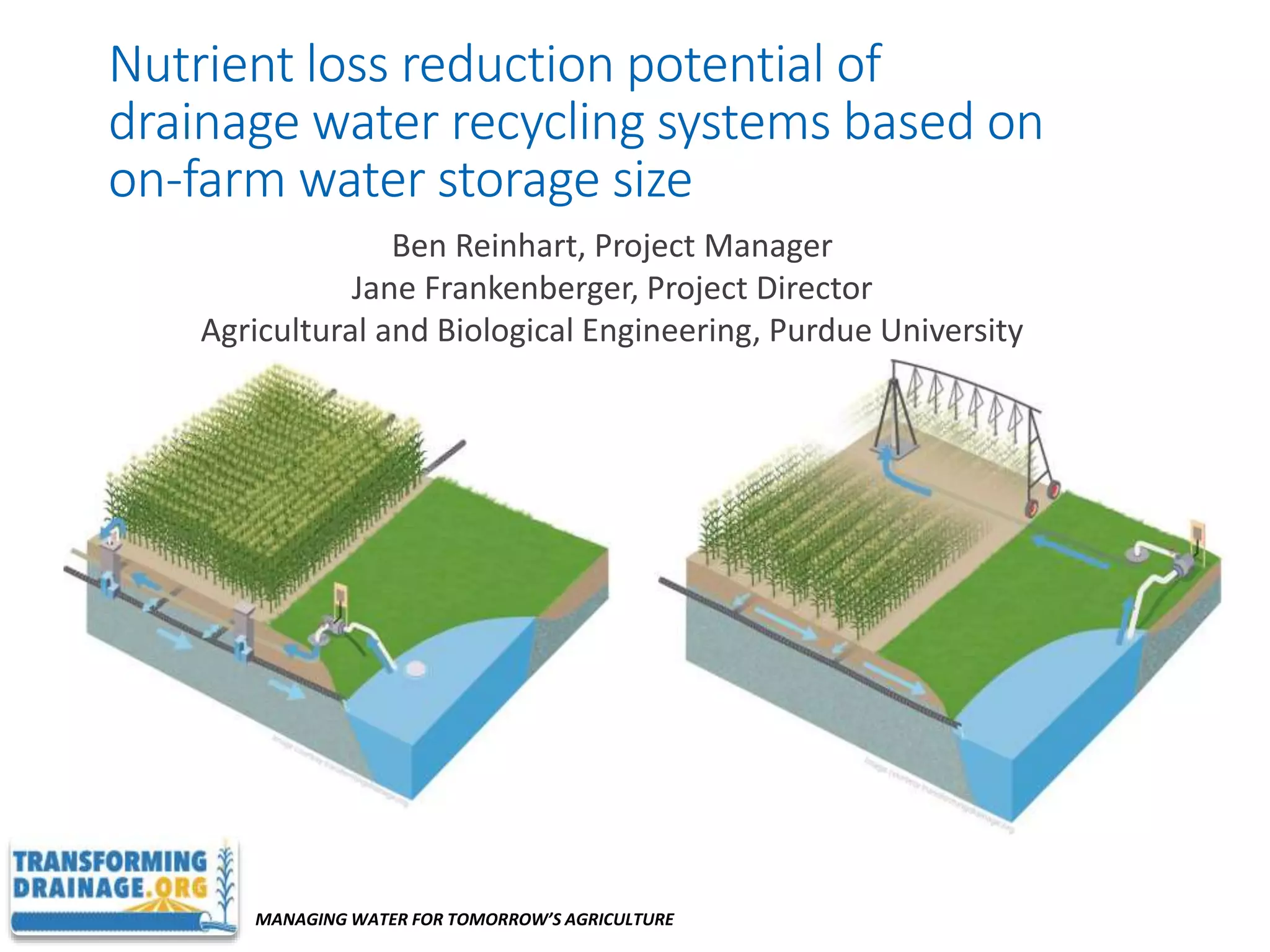
    MANAGING WATER FORTOMORROW’S AGRICULTURE Drainage water recycling
  • 5.
    MANAGING WATER FORTOMORROW’S AGRICULTURE • How will this vary across climate and soils? • How much storage is needed to meet crop or water quality targets? Designing drainage water recycling systems
  • 6.
    MANAGING WATER FORTOMORROW’S AGRICULTURE Water balance in DWR systems • Track: 1. Daily drain flow 3. Water level and volume 2. Soil water storage
  • 7.
    MANAGING WATER FORTOMORROW’S AGRICULTURE Soil water storage • Defining the soil water reservoir • Variables: + Eff. Precip. (Pe) + Irrigation (I) - Evaporation/ Transpiration (ET) Daily Soil Water = Pe + I – ET
  • 8.
    MANAGING WATER FORTOMORROW’S AGRICULTURE Soil water storage • Effective Precipitation • FAO CLIMWAT • Reference/Crop ET • Daily climate on- site (L. Bowling, Purdue) • FAO CropWat Kc (Maize)
  • 9.
    MANAGING WATER FORTOMORROW’S AGRICULTURE Storage level and volume Avg. Depth Area • Variables: + Drain flow (D) + Precipitation (P) - Evap.(E) - Irrigation (I) - Seepage (S) Daily Water Volume = D + P – E – I – S
  • 10.
    MANAGING WATER FORTOMORROW’S AGRICULTURE Water level and volume • Measured daily drain flow and precipitation • Evaporation (NWS pan avg. monthly values) • Seepage (3mm/day constant) 0 2 4 6 8 Jan Feb Mar Apr May Jun Jul Aug Sep Oct Nov Dec mm/day Evaporation 0 2 4 6 8 10 12 14 mm/day Drain flow
  • 11.
    MANAGING WATER FORTOMORROW’S AGRICULTURE Water balance in DWR systems • As water is added to the system: 1. Capture if capacity > flow 2. Bypass if capacity < flow
  • 12.
    MANAGING WATER FORTOMORROW’S AGRICULTURE Water balance in DWR systems • As water is removed from the system: 1. Irrigation applied if demand < stored volume 2. Storage Deficit if demand > stored volume
  • 13.
    MANAGING WATER FORTOMORROW’S AGRICULTURE Davis Purdue Agriculture Center (DPAC) Field Data (2006-2016, daily) • Drain flow • Weather • Water Quality • Nitrate-N • Total Phosphorus (2012-2016) Data from Saadat, Bowling, Frankenberger
  • 14.
    MANAGING WATER FORTOMORROW’S AGRICULTURE Davis Purdue Agriculture Center (DPAC) Drain flow: 368 mm/yr (avg.); 232 mm Min., 470 mm Max 0 2 4 6 8 10 12 14 16 Nitrate-Nitrogen(mg/l) 0 0.05 0.1 0.15 0.2 0.25 0.3 TotalPhosphorus(mg/l)
  • 15.
    MANAGING WATER FORTOMORROW’S AGRICULTURE Various Sizes of Storage 2% of field area 4% of field area 6% of field area 8% of field area 10% of field area Avg. Depth: 3 m Field Area: 80 ac. 10% 8% 6% 4% 2% Drainage water recycling in MI 5 acres 1 acre each
  • 16.
    MANAGING WATER FORTOMORROW’S AGRICULTURE Results: % of Annual Drain Flow Captured 0% 20% 40% 60% 80% 100% 2% 4% 6% 8% 10% Storage Area/Field Area Avg
  • 17.
    MANAGING WATER FORTOMORROW’S AGRICULTURE 0 10 20 30 40 Orig. Load 2% 4% 6% 8% 10% Storage Area/Field Area Avg Results: Nitrate-N Load Captured (kg/ha) N
  • 18.
    MANAGING WATER FORTOMORROW’S AGRICULTURE 0 0.2 0.4 0.6 0.8 1 Orig. Load 2% 4% 6% 8% 10% Storage Area/Field Area Avg Results: Total Phosphorus Load Captured (kg/ha) N P
  • 19.
    MANAGING WATER FORTOMORROW’S AGRICULTURE 0 30 60 90 120 150 180 210 Desired 2% 4% 6% 8% 10% Storage Area/Field Area Avg Results: Applied Irrigation (mm/yr)
  • 20.
    MANAGING WATER FORTOMORROW’S AGRICULTURE Results: Spatial Variability DPAC (Indiana) Drain Flow: 232-470 mm Southeast Research Farm (Iowa) Drain Flow: 56-535 mm 0% 20% 40% 60% 80% 100% 2% 4% 6% 8% 10% Storage Area/Field Area Avg 0% 20% 40% 60% 80% 100% 2% 4% 6% 8% 10% Storage Area/Field Area Avg Data courtesy Dr. Matt Helmers, Iowa State University Example - % of Annual Drain Flow Captured
  • 21.
    MANAGING WATER FORTOMORROW’S AGRICULTURE Conclusions How much storage do we need? • 4% storage= 31% avg. reduction • 6% storage= 49% avg. reduction • 8% storage= 66% avg. reduction DWR 4% DWR 6% DWR 8%
  • 22.
    MANAGING WATER FORTOMORROW’S AGRICULTURE Next Steps 1. Evaluation across variable climate and soils 2. Development of online tool for evaluating DWR systems
  • 23.
    THIS MATERIAL ISBASED UPON WORK THAT IS SUPPORTED BY THE NATIONAL INSTITUTE OF FOOD AND AGRICULTURE, U.S. DEPARTMENT OF AGRICULTURE, UNDER AWARD NUMBER 2015-68007-23193, ā€œMANAGING WATER FOR INCREASED RESILIENCY OF DRAINED AGRICULTURAL LANDSCAPESā€, HTTP://TRANSFORMINGDRAINAGE.ORG. ANY OPINIONS, FINDINGS, CONCLUSIONS, OR RECOMMENDATIONS EXPRESSED IN THIS PUBLICATION ARE THOSE OF THE AUTHOR(S) AND DO NOT NECESSARILY REFLECT THE VIEW OF THE U.S. DEPARTMENT OF AGRICULTURE. University of Missouri MANAGING WATER FOR TOMORROW’S AGRICULTURE Managing Water for Increased Resiliency of Drained Agricultural Landscapes

Editor's Notes

  • #7Ā Don’t focus on the tool but rather the activity of tracking water balances and nutrient reductions
  • #21Ā Include a map