Modeling social media in groups, communities, and networks Vance Stevens Petroleum Institute, Abu Dhabi, UAE Prepared for the TESOL Arabia conference  March 12, 2010 Zayad University, Dubai These slides posted at  http://slideshare.net/vances Presentation recording:  http://tinyurl.com/100312vance-dubai Nurturing your PLN for everyone’s  ongoing professional development
Where to begin? From Stephen Downes, Learning the Web 2.0 Way http://www.slideshare.net/Downes/personal-learning-the-web-20-way Vance Stevens - TESOL Arabia 2010 And  … to TEACH is to LEARN  -  Vance
Knowledge Attribution:  http://www.kelvybird.com/facilitation/scribing/workingknowledge.html Vance Stevens - TESOL Arabia 2010
How did you learn about Creative Commons? http://creativecommons.org/ Vance Stevens - TESOL Arabia 2010
Heard it through the grapevine? http://delicious.com/vancestevens/art Attribution:  http://www.flickr.com/photos/jonastherkildsen/122881874 / Vance Stevens - TESOL Arabia 2010
How did you LEARN how to find Creative Commons Images? Vance Stevens - TESOL Arabia 2010
One State of Knowledge http://www.wblut.com/constructs/cyclic/
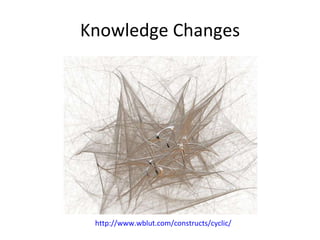
Knowledge Changes http://www.wblut.com/constructs/cyclic/
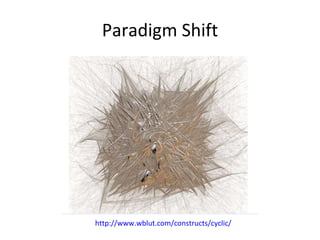
Paradigm Shift http://www.wblut.com/constructs/cyclic/
Paradigm Shifts in Education http://prosites-vstevens.homestead.com/files/efi/papers/2007alexandria/web20arabia.htm Vance Stevens - TESOL Arabia 2010
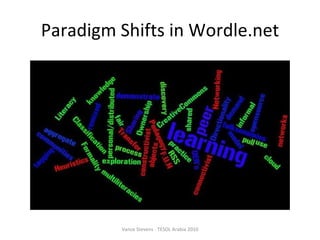
10 Aspects of Paradigm Shift Pedagogy :  Didactic --> constructivist Modeling :  Do as I say --> AND as I do Transfer :  Technology enjoyed at leisure is F.U.N. --> also, applied to professional practice Trepidation : Will they find out? -->  ok to say “I don’t know!” Literacy :  Print literacy --> multiliteracies Heuristics :  Client server -->  peer to peer Sharing :  Copyrighted -->  creative commons Classification :  Taxonomies --> folksonomies Directionality : Push --> pull Ownership : Proprietary -->  open source Vance Stevens - TESOL Arabia 2010
Paradigm Shifts in Wordle.net Vance Stevens - TESOL Arabia 2010
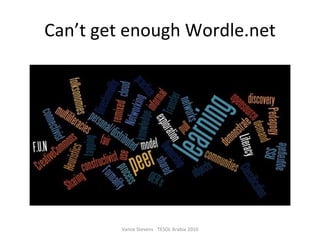
Can’t get enough Wordle.net Vance Stevens - TESOL Arabia 2010
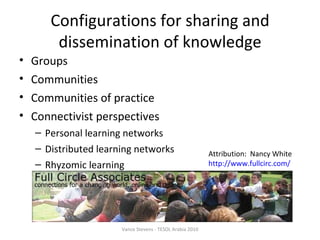
Configurations for sharing and dissemination of knowledge Groups Communities Communities of practice Connectivist perspectives Personal learning networks Distributed learning networks Rhyzomic learning Attribution:  Nancy White  http://www.fullcirc.com/ Vance Stevens - TESOL Arabia 2010
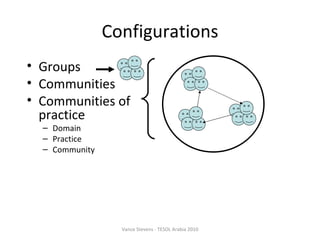
Configurations Groups Vance Stevens - TESOL Arabia 2010
Configurations Groups Communities Vance Stevens - TESOL Arabia 2010
Configurations Groups Communities Communities of  practice Domain Practice Community Vance Stevens - TESOL Arabia 2010
Configurations Groups Communities Communities of practice Networks can include  overlapping communities Vance Stevens - TESOL Arabia 2010
Configurations Groups Communities Communities of practice Networks and sample Connections Vance Stevens - TESOL Arabia 2010
Webheads started as EFL class in 1998 WiA formed as result of 2002 EVO sesson Educators who engage in  Helping each other pursue lifelong, just-in-time, informal learning Through experimentation in use of social-media and computer mediated communications tools Webheads in Action Online Convergence WiAOC 2005, 2007, 2009  http://wiaoc.org   Vance Stevens - TESOL Arabia 2010
Webheads: Group http://groups.yahoo.com/group/evonline2002_webheads/ Vance Stevens - TESOL Arabia 2010
Webheads: Community Attribution: http:// flickr.com/photos/94794165@N00/410359410/ Vance Stevens - TESOL Arabia 2010
Webheads: Community of Practice http://webheadsinaction.org/ Vance Stevens - TESOL Arabia 2010
Personal Learning Networks Scott Leslie's PLE (above) and more PLE diagrams:  http://edtechpost.wikispaces.com/PLE+Diagrams
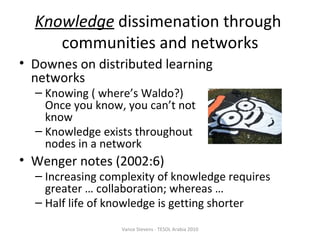
Knowledge  dissimenation through  communities and networks Downes on distributed learning networks Knowing ( where’s Waldo?)  Once you know, you can’t not know Knowledge exists throughout nodes in a network Wenger notes (2002:6) ‏ Increasing complexity of knowledge requires greater … collaboration; whereas … Half life of knowledge is getting shorter Vance Stevens - TESOL Arabia 2010
Characteristics of CoPs They promote  knowledge  of a  domain They revolve around a  practice Community  aspects They form spontaneously, voluntarily They have particularly defined community spaces in which they interact Most frequently understood to be defined by Etienne Wenger; e.g.  Vance Stevens TESOL 2009 Vance Stevens TESOL 2009
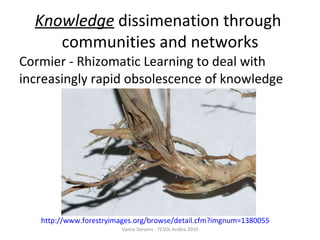
Cormier - Rhizomatic Learning to deal with increasingly rapid obsolescence of knowledge Knowledge  dissimenation through  communities and networks http://www.forestryimages.org/browse/detail.cfm?imgnum=1380055 Vance Stevens - TESOL Arabia 2010
Siemens – Connectivism stresses importance  of pipes over content Knowledge  dissimenation through  communities and networks Attribution:  http://commons.wikimedia.org/wiki/File:Venice_-_Piping.jpg Vance Stevens - TESOL Arabia 2010
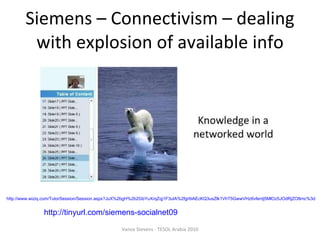
Siemens – Connectivism – dealing with explosion of available info http://www.wiziq.com/TutorSession/Session.aspx?JuX%2bgH%2b2GbYuXrqZqj1F3uIA%2fgrtIiAEcKQ3usZlk1VhT5GwwVHz6vferdj5MlOz5JOdRjZO8mc%3d http://tinyurl.com/siemens-socialnet09 Vance Stevens - TESOL Arabia 2010
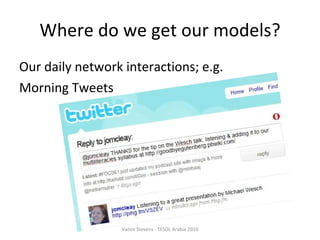
Where do we get our models? Our daily network interactions; e.g. Morning Tweets Vance Stevens - TESOL Arabia 2010
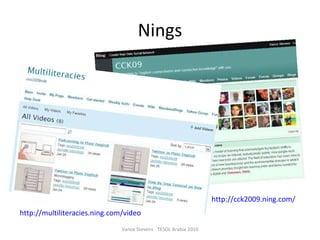
Nings http://cck2009.ning.com/ http://multiliteracies.ning.com/video Vance Stevens - TESOL Arabia 2010
Webcasts, Podcasts http://edtechtalk.com/live http://vance_stevens.podomatic.com/ Vance Stevens - TESOL Arabia 2010
Edmodo Modeled and demonstrated by Nicky Hockley, #Socialnet09 Vance Stevens - TESOL Arabia 2010
Waves Who are the  early pouncers ? http://wave.google.com Vance Stevens - TESOL Arabia 2010
Waves and Wikis http://webheadswave.wikispaces.com/ Vance Stevens - TESOL Arabia 2010
Future of Learning  in a Networked World http://flnw.wikispaces.com/Brazil Vance Stevens - TESOL Arabia 2010
Implications for Teacher Professional Development Jack Richards plenary Denver TESOL 2009 (March 27) ‏ About what teachers need to KNOW in order to practice effectively Research indicates that teachers tend to revert to traditional methods rather than activate what they are exposed to in training curricula Derick Wenmouth (also from NZ) mentioned similar research findings at K-12 Online 2008   http://k12onlineconference.org/?p=181 Vance Stevens - TESOL Arabia 2010
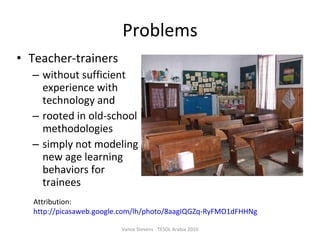
Problems Teacher-trainers  without sufficient experience with technology and  rooted in old-school methodologies simply not modeling new age learning behaviors for trainees Attribution:  http://picasaweb.google.com/lh/photo/8aagIQGZq-RyFMO1dFHHNg Vance Stevens - TESOL Arabia 2010
Problems Students and staff  love to learn but hate to be taught,  resent top-down approach forced on them by managers sometimes out of touch with actual needs of students and staff Attribution:  http://www.youtube.com/watch?v=RxHb5QVD7fo&feature=player_embedded Vance Stevens - TESOL Arabia 2010
Solutions Allow, facilitate, encourage networking in meetings, conferences, classrooms Offer workshops/projects bottom up, as something that staff/students organize themselves Create atmosphere encouraging formation of communities of practice where staff/students interact with peers in other institutions Vance Stevens - TESOL Arabia 2010
Models for professional and student skills development Encourage teams to organize training sessions that utilize synchronous and non-synchronous social media tools.  Call them something other than ‘training’ sessions Use Nings / Moodles / wikis / Google Wave / Jing / uTiPu / or other LMS/CMS to replace outmoded email attachment systems http://advanceducation.blogspot.com/2009/06/speedlifing.html Hold un-conferences and other grass roots events such as Bar camps LAN parties Speed-geeking Speed Lifing Vance Stevens - TESOL Arabia 2010
How EVO models social Networking Almost all start with an email list, usually  Yahoo Groups  –  http://yahoogroups.com   Many have  Nings  –  http://ning.com Most use  wikis ; e.g.  http://pbworks.com  or  http://docs.google.com   Many use  microblogging ; e.g.  http://twitter.com   Many  socially bookmark  URLs using  http://delicious.com  or  http://diigo.com   Most encourage reflective  blogs ; e.g.  http://blogger.com   Vance Stevens - TESOL Arabia 2010
Keep current, participate with peers around the world in: Social networks: Ning, TappedIn, EVO, WiAOC Social bookmarking: Delicious, Diigo Groups: YahooGroups and GoogleGroups Microblogging:  Twitter, Plurk Instant messaging: Yahoo Messenger, Skype Vance Stevens - TESOL Arabia 2010
Keep current, participate with peers around the world in: Blogging and podcasting:  keeping current via RSS Wikis: PBWiki, Wikispaces Aggregation: Technorati, Pageflakes, Netvibes, Protopages, iGoogle,  http://addictomatic.com ,  http://spezify.com   Vance Stevens - TESOL Arabia 2010
What is TESOL Arabia? A group? A community? A network? Vance Stevens - TESOL Arabia 2010
What is a conference? What is an appropriate metaphor for conference attendance? Group? Community? Network? Should teachers / students be cut off from  their networks? At school? Meetings? Conferences? Vance Stevens - TESOL Arabia 2010
Some givens: Growing numbers of teaching practitioners no longer focus professional development activities on annual conferences Professional development is done  daily (weekly, etc.) ‏ for free at individual's pace and convenience Via Twitter, Ning, Skype, YouTube, Facebook, YahooGroups, TappedIn, WiZiQ ... Vance Stevens - TESOL Arabia 2010
PD models  for Networked Interaction CALL-IS (1984) ‏ Electronic Village Online (EVO, since 2001) ‏ Webheads (1998, WiA since 2002) ‏ Steve Hargadon Classroom 2.0 Free online conferences George Siemens’s many conferences WiAOC  (Webheads in Action Online Convergences) K12 Online Conference Vance Stevens - TESOL Arabia 2010
CALL? Think SMALL … Social networking via social media is the new CALL Insinuating itself into our culture (Amazon, eBay) and work and social lives (Facebook) ‏ Denied as unhealthy; even dangerous by diminishing few Used and promoted for education by growing number of advocates Relatively untapped potential for learning and education  Now that the C in CALL is almost seamless, almost taken for granted,  Social networking is the new front-line SMALL? (Social media assisted LL?) ‏   (… enhanced … won’t work) Vance Stevens - TESOL Arabia 2010
Professional Development Ongoing PD requires connection to a network Conferences are good for face to face interaction and interpersonal networking But inefficient for sustained professional development Many conferences / schools etc require participants to leave their networks at the door Vance Stevens - TESOL Arabia 2010
Key to success in keeping current  Expanding productive contacts within a network  Attribute: d'arcy norman touchgraph:  http://www.flickr.com/photos/dnorman/436670816/ Vance Stevens - TESOL Arabia 2010
TESOL Arabia Conferences  and Chapter Events In future, successful conferences and professional organizations will combine  opportunities for interpersonal connection  with connectivity and  seamless interaction with distributed personal learning networks Those that do not will be decreasingly relevant If conferences are networked? Who benefits? Who loses? Vance Stevens - TESOL Arabia 2010
F2F conferences with rich networking potential Learning 2.0 (Jeff Utecht, set up in Ning, Podcast) ‏ IATEFL right now, getting better NECC  Educon 2.0 Model Conferences Vance Stevens - TESOL Arabia 2010 THINK SMALL
Modeling social media in groups, communities, and networks Vance Stevens Prepared for the TESOL Arabia conference  March 12, 2010 Zayad University, Dubai This has been More information here:  http://advanceducation.blogspot.com/2009/11/modeling-social-media-in-groups.html Nurturing your PLN for everyone’s  ongoing professional development These slides posted at  http://slideshare.net/vances Presentation recording:  http://tinyurl.com/100312vance-dubai

Nurturing your PLN for everyone’s ongoing professional development

  • 1.
    Modeling social mediain groups, communities, and networks Vance Stevens Petroleum Institute, Abu Dhabi, UAE Prepared for the TESOL Arabia conference March 12, 2010 Zayad University, Dubai These slides posted at http://slideshare.net/vances Presentation recording: http://tinyurl.com/100312vance-dubai Nurturing your PLN for everyone’s ongoing professional development
  • 2.
    Where to begin?From Stephen Downes, Learning the Web 2.0 Way http://www.slideshare.net/Downes/personal-learning-the-web-20-way Vance Stevens - TESOL Arabia 2010 And … to TEACH is to LEARN - Vance
  • 3.
    Knowledge Attribution: http://www.kelvybird.com/facilitation/scribing/workingknowledge.html Vance Stevens - TESOL Arabia 2010
  • 4.
    How did youlearn about Creative Commons? http://creativecommons.org/ Vance Stevens - TESOL Arabia 2010
  • 5.
    Heard it throughthe grapevine? http://delicious.com/vancestevens/art Attribution: http://www.flickr.com/photos/jonastherkildsen/122881874 / Vance Stevens - TESOL Arabia 2010
  • 6.
    How did youLEARN how to find Creative Commons Images? Vance Stevens - TESOL Arabia 2010
  • 7.
    One State ofKnowledge http://www.wblut.com/constructs/cyclic/
  • 8.
  • 9.
  • 10.
    Paradigm Shifts inEducation http://prosites-vstevens.homestead.com/files/efi/papers/2007alexandria/web20arabia.htm Vance Stevens - TESOL Arabia 2010
  • 11.
    10 Aspects ofParadigm Shift Pedagogy : Didactic --> constructivist Modeling : Do as I say --> AND as I do Transfer : Technology enjoyed at leisure is F.U.N. --> also, applied to professional practice Trepidation : Will they find out? --> ok to say “I don’t know!” Literacy : Print literacy --> multiliteracies Heuristics : Client server --> peer to peer Sharing : Copyrighted --> creative commons Classification : Taxonomies --> folksonomies Directionality : Push --> pull Ownership : Proprietary --> open source Vance Stevens - TESOL Arabia 2010
  • 12.
    Paradigm Shifts inWordle.net Vance Stevens - TESOL Arabia 2010
  • 13.
    Can’t get enoughWordle.net Vance Stevens - TESOL Arabia 2010
  • 14.
    Configurations for sharingand dissemination of knowledge Groups Communities Communities of practice Connectivist perspectives Personal learning networks Distributed learning networks Rhyzomic learning Attribution: Nancy White http://www.fullcirc.com/ Vance Stevens - TESOL Arabia 2010
  • 15.
    Configurations Groups VanceStevens - TESOL Arabia 2010
  • 16.
    Configurations Groups CommunitiesVance Stevens - TESOL Arabia 2010
  • 17.
    Configurations Groups CommunitiesCommunities of practice Domain Practice Community Vance Stevens - TESOL Arabia 2010
  • 18.
    Configurations Groups CommunitiesCommunities of practice Networks can include overlapping communities Vance Stevens - TESOL Arabia 2010
  • 19.
    Configurations Groups CommunitiesCommunities of practice Networks and sample Connections Vance Stevens - TESOL Arabia 2010
  • 20.
    Webheads started asEFL class in 1998 WiA formed as result of 2002 EVO sesson Educators who engage in Helping each other pursue lifelong, just-in-time, informal learning Through experimentation in use of social-media and computer mediated communications tools Webheads in Action Online Convergence WiAOC 2005, 2007, 2009 http://wiaoc.org Vance Stevens - TESOL Arabia 2010
  • 21.
  • 22.
    Webheads: Community Attribution:http:// flickr.com/photos/94794165@N00/410359410/ Vance Stevens - TESOL Arabia 2010
  • 23.
    Webheads: Community ofPractice http://webheadsinaction.org/ Vance Stevens - TESOL Arabia 2010
  • 24.
    Personal Learning NetworksScott Leslie's PLE (above) and more PLE diagrams: http://edtechpost.wikispaces.com/PLE+Diagrams
  • 25.
    Knowledge dissimenationthrough communities and networks Downes on distributed learning networks Knowing ( where’s Waldo?) Once you know, you can’t not know Knowledge exists throughout nodes in a network Wenger notes (2002:6) ‏ Increasing complexity of knowledge requires greater … collaboration; whereas … Half life of knowledge is getting shorter Vance Stevens - TESOL Arabia 2010
  • 26.
    Characteristics of CoPsThey promote knowledge of a domain They revolve around a practice Community aspects They form spontaneously, voluntarily They have particularly defined community spaces in which they interact Most frequently understood to be defined by Etienne Wenger; e.g. Vance Stevens TESOL 2009 Vance Stevens TESOL 2009
  • 27.
    Cormier - RhizomaticLearning to deal with increasingly rapid obsolescence of knowledge Knowledge dissimenation through communities and networks http://www.forestryimages.org/browse/detail.cfm?imgnum=1380055 Vance Stevens - TESOL Arabia 2010
  • 28.
    Siemens – Connectivismstresses importance of pipes over content Knowledge dissimenation through communities and networks Attribution: http://commons.wikimedia.org/wiki/File:Venice_-_Piping.jpg Vance Stevens - TESOL Arabia 2010
  • 29.
    Siemens – Connectivism– dealing with explosion of available info http://www.wiziq.com/TutorSession/Session.aspx?JuX%2bgH%2b2GbYuXrqZqj1F3uIA%2fgrtIiAEcKQ3usZlk1VhT5GwwVHz6vferdj5MlOz5JOdRjZO8mc%3d http://tinyurl.com/siemens-socialnet09 Vance Stevens - TESOL Arabia 2010
  • 30.
    Where do weget our models? Our daily network interactions; e.g. Morning Tweets Vance Stevens - TESOL Arabia 2010
  • 31.
  • 32.
    Webcasts, Podcasts http://edtechtalk.com/livehttp://vance_stevens.podomatic.com/ Vance Stevens - TESOL Arabia 2010
  • 33.
    Edmodo Modeled anddemonstrated by Nicky Hockley, #Socialnet09 Vance Stevens - TESOL Arabia 2010
  • 34.
    Waves Who arethe early pouncers ? http://wave.google.com Vance Stevens - TESOL Arabia 2010
  • 35.
    Waves and Wikishttp://webheadswave.wikispaces.com/ Vance Stevens - TESOL Arabia 2010
  • 36.
    Future of Learning in a Networked World http://flnw.wikispaces.com/Brazil Vance Stevens - TESOL Arabia 2010
  • 37.
    Implications for TeacherProfessional Development Jack Richards plenary Denver TESOL 2009 (March 27) ‏ About what teachers need to KNOW in order to practice effectively Research indicates that teachers tend to revert to traditional methods rather than activate what they are exposed to in training curricula Derick Wenmouth (also from NZ) mentioned similar research findings at K-12 Online 2008 http://k12onlineconference.org/?p=181 Vance Stevens - TESOL Arabia 2010
  • 38.
    Problems Teacher-trainers without sufficient experience with technology and rooted in old-school methodologies simply not modeling new age learning behaviors for trainees Attribution: http://picasaweb.google.com/lh/photo/8aagIQGZq-RyFMO1dFHHNg Vance Stevens - TESOL Arabia 2010
  • 39.
    Problems Students andstaff love to learn but hate to be taught, resent top-down approach forced on them by managers sometimes out of touch with actual needs of students and staff Attribution: http://www.youtube.com/watch?v=RxHb5QVD7fo&feature=player_embedded Vance Stevens - TESOL Arabia 2010
  • 40.
    Solutions Allow, facilitate,encourage networking in meetings, conferences, classrooms Offer workshops/projects bottom up, as something that staff/students organize themselves Create atmosphere encouraging formation of communities of practice where staff/students interact with peers in other institutions Vance Stevens - TESOL Arabia 2010
  • 41.
    Models for professionaland student skills development Encourage teams to organize training sessions that utilize synchronous and non-synchronous social media tools.  Call them something other than ‘training’ sessions Use Nings / Moodles / wikis / Google Wave / Jing / uTiPu / or other LMS/CMS to replace outmoded email attachment systems http://advanceducation.blogspot.com/2009/06/speedlifing.html Hold un-conferences and other grass roots events such as Bar camps LAN parties Speed-geeking Speed Lifing Vance Stevens - TESOL Arabia 2010
  • 42.
    How EVO modelssocial Networking Almost all start with an email list, usually Yahoo Groups – http://yahoogroups.com Many have Nings – http://ning.com Most use wikis ; e.g. http://pbworks.com or http://docs.google.com Many use microblogging ; e.g. http://twitter.com Many socially bookmark URLs using http://delicious.com or http://diigo.com Most encourage reflective blogs ; e.g. http://blogger.com Vance Stevens - TESOL Arabia 2010
  • 43.
    Keep current, participatewith peers around the world in: Social networks: Ning, TappedIn, EVO, WiAOC Social bookmarking: Delicious, Diigo Groups: YahooGroups and GoogleGroups Microblogging: Twitter, Plurk Instant messaging: Yahoo Messenger, Skype Vance Stevens - TESOL Arabia 2010
  • 44.
    Keep current, participatewith peers around the world in: Blogging and podcasting: keeping current via RSS Wikis: PBWiki, Wikispaces Aggregation: Technorati, Pageflakes, Netvibes, Protopages, iGoogle,  http://addictomatic.com , http://spezify.com Vance Stevens - TESOL Arabia 2010
  • 45.
    What is TESOLArabia? A group? A community? A network? Vance Stevens - TESOL Arabia 2010
  • 46.
    What is aconference? What is an appropriate metaphor for conference attendance? Group? Community? Network? Should teachers / students be cut off from their networks? At school? Meetings? Conferences? Vance Stevens - TESOL Arabia 2010
  • 47.
    Some givens: Growingnumbers of teaching practitioners no longer focus professional development activities on annual conferences Professional development is done daily (weekly, etc.) ‏ for free at individual's pace and convenience Via Twitter, Ning, Skype, YouTube, Facebook, YahooGroups, TappedIn, WiZiQ ... Vance Stevens - TESOL Arabia 2010
  • 48.
    PD models for Networked Interaction CALL-IS (1984) ‏ Electronic Village Online (EVO, since 2001) ‏ Webheads (1998, WiA since 2002) ‏ Steve Hargadon Classroom 2.0 Free online conferences George Siemens’s many conferences WiAOC (Webheads in Action Online Convergences) K12 Online Conference Vance Stevens - TESOL Arabia 2010
  • 49.
    CALL? Think SMALL… Social networking via social media is the new CALL Insinuating itself into our culture (Amazon, eBay) and work and social lives (Facebook) ‏ Denied as unhealthy; even dangerous by diminishing few Used and promoted for education by growing number of advocates Relatively untapped potential for learning and education Now that the C in CALL is almost seamless, almost taken for granted, Social networking is the new front-line SMALL? (Social media assisted LL?) ‏ (… enhanced … won’t work) Vance Stevens - TESOL Arabia 2010
  • 50.
    Professional Development OngoingPD requires connection to a network Conferences are good for face to face interaction and interpersonal networking But inefficient for sustained professional development Many conferences / schools etc require participants to leave their networks at the door Vance Stevens - TESOL Arabia 2010
  • 51.
    Key to successin keeping current Expanding productive contacts within a network Attribute: d'arcy norman touchgraph:  http://www.flickr.com/photos/dnorman/436670816/ Vance Stevens - TESOL Arabia 2010
  • 52.
    TESOL Arabia Conferences and Chapter Events In future, successful conferences and professional organizations will combine opportunities for interpersonal connection with connectivity and seamless interaction with distributed personal learning networks Those that do not will be decreasingly relevant If conferences are networked? Who benefits? Who loses? Vance Stevens - TESOL Arabia 2010
  • 53.
    F2F conferences withrich networking potential Learning 2.0 (Jeff Utecht, set up in Ning, Podcast) ‏ IATEFL right now, getting better NECC Educon 2.0 Model Conferences Vance Stevens - TESOL Arabia 2010 THINK SMALL
  • 54.
    Modeling social mediain groups, communities, and networks Vance Stevens Prepared for the TESOL Arabia conference March 12, 2010 Zayad University, Dubai This has been More information here: http://advanceducation.blogspot.com/2009/11/modeling-social-media-in-groups.html Nurturing your PLN for everyone’s ongoing professional development These slides posted at http://slideshare.net/vances Presentation recording: http://tinyurl.com/100312vance-dubai