NURSING PROCESS
RATHEESH R L
INTRODUCTION
The nursing process provides a useful description
of how nursing should be performed. Practice of
nursing is caring which is directed by the way the
nurses view the client, the client’s environment,
health and the purpose of nursing.
DEFINITION
 The nursing process is a professional nurses
approach to identify, diagnose, and treat human
response to health and illness.
American Nurses Association
 Nursing process is a systematic, rational method of
planning and providing individualized nursing care.
 The nursing process is a series of organized steps
designed for nurses to provide excellent care.
THE PURPOSE OF NURSING PROCESS
 To identify client’s health status, actual or potential
healthcare problems or need.
 To establish plans to meet the identified needs and to
deliver specific interventions to meet those needs.
 It provides a framework in which to practice nursing.
BENEFITS OF NURSING PROCESS
 Improves the quality of care that the client receives
 Ensures a high level of client participation together with
continuous evaluation designed to meet the client’s
unique needs
 Enables nurses to use time and resources efficiently to
both their own and their client’s benefit.
CHARACTERISTICS OF A NURSING PROCESS:
 Dynamic and cyclic
 Patient centered
 Goal directed
 Open and Flexible
 Problem Oriented
 Planned
 Universally accepted
 Interpersonal and collaborative
 Holistic
 Systematic
Dynamic and Cyclic
The dynamic nature involves continuous
assessment and evaluation of changing
client’s responses to nursing interventions
so as to achieve the outcomes.
Client-centered
The plan of care is organized in terms of
client problems rather than nursing goals.
The nurse-client relationship is shaped
around the needs of the client.
Planned and Goal-directed
Interventions are considered according to
the nursing diagnoses and are based on
scientific principles rather than tradition.
Universally Applicable
Nursing process can be used with clients
of any age, with any medical diagnosis,
and at any point on the wellness-illness
continuum.
Problem-oriented
Care plans are organized according to
client’s problems. Interventions are carried
out to eliminate the problems related to
any aspect of an individual.
Cognitive Process
Nursing process involves the use of
intellectual skills in making judgments,
decisions and eliminating client’s
problems.
FACTORS AFFECTING NURISNG
PROCESS
 Knowledge
 Skill
 Beliefs
Knowledge:
Nursing process is the application of the
nurses knowledge. As part of her/his
academic preparation nurse learns basic
concepts of biochemistry, biophysics,
microbiology, anatomy, physiology,
psychology, sociology, and nutrition.
 The knowledge of these sciences enables the
nurse to recognize the problem more clearly and
also determine how the client’s health is getting
disturbed.
 Skills:
Nurse uses technical and interpersonal skills to
collect information about the client. The effectiveness
of the nursing process depends on the intellectual
(cognitive) skills of the nurse that she uses in creative
and critical thinking, and decision making.
 Beliefs:
The nurse’s personal belief about nursing, health, the
client as an individual, as a health care consumer
forms the basis of nursing practice.
The nurse is also faced with a moral and ethical
dilemma of providing care to such a client and his
family members.
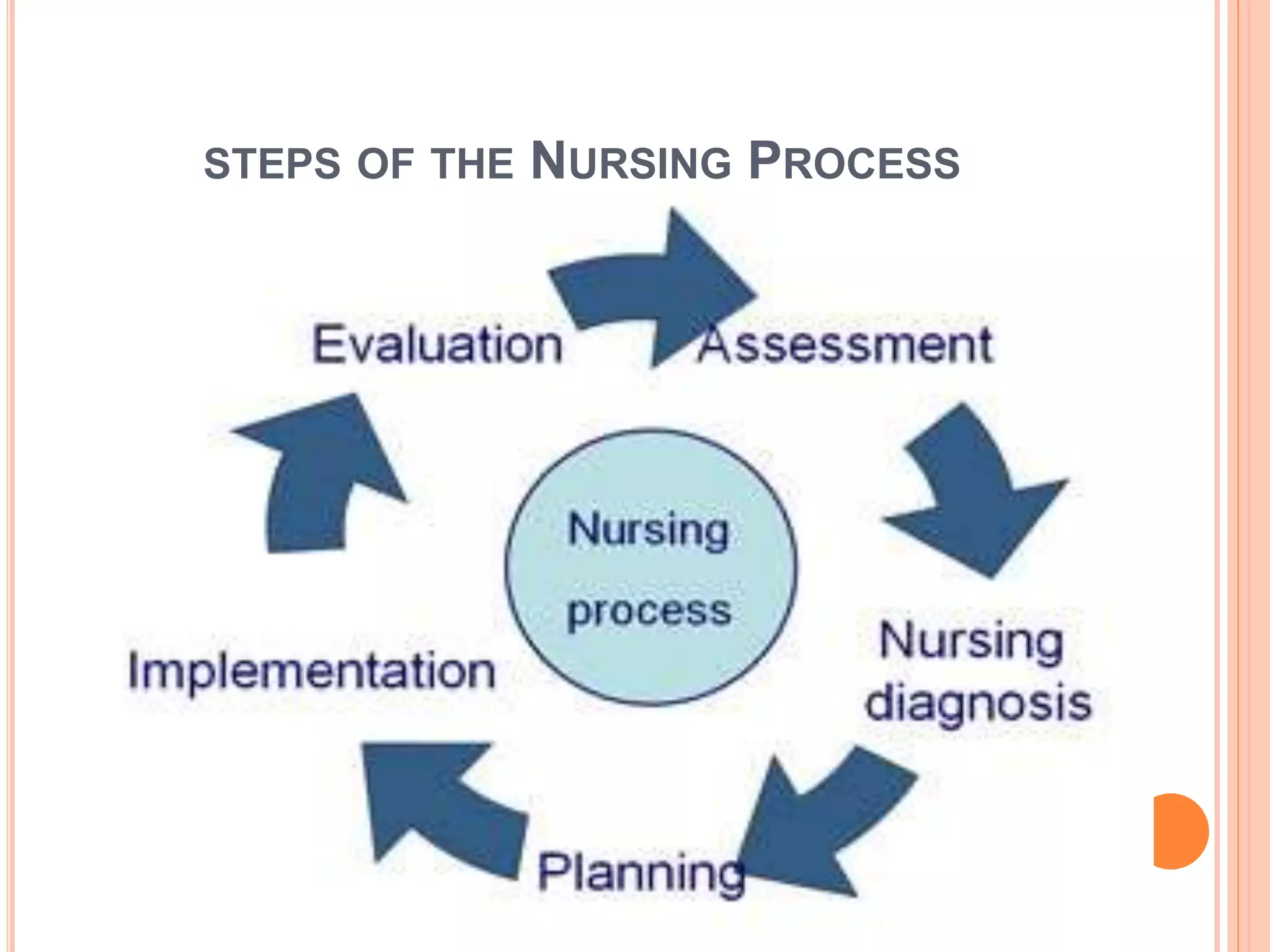
Components of Nursing Process
1. Assessment
2. Nursing Diagnosis
3. Planning
4. Implementation
5. Evaluation
STEPS OF THE NURSING PROCESS
ASSESSMENT
“Let me look at that.”
“Tell me about it.”
Assessment
Assessment is the deliberate and systemic collection
of data to determine client current and past health
status and copping pattern
ASSESSMENT
Assessment (Data
Collection)
= Observation +
Interview + Examination
Components of Assessment:
1. Collection of data
2. Verification of data
3. Organization of data
4. Recording of data
Types of Data
1. Subjective Data:
These are client’s perception about their health
problem. e.g. pain
2. Objective Data:
These data are observable and measurable by data
collector e.g. Vital signs
PRIMARY SOURCES
 Primary sources are usually defined as first
hand information or data that is generated by
witnesses or participants in past events.
SECONDARY DATA
 Secondary data is the data that have been already
collected by and readily available from other
sources.
Sources of data:
1. Primary Sources:
Client
2. Secondary sources:
 Family & significant others
 Health care team members
 Medical records
 Other records
 Literature review
 Nurses experience
METHOD OF DATA COLLECTION
1. Observation
2. Interview technique
It is a organized conversation with the client or
family members to obtain the current health
information regarding patient.
3. Physical examination
4. Laboratory tests
5. Review of the records, books & related
literature
OBSERVATION
 It is the action or process of closely observing or
monitoring something or someone.
Interview technique
It is a organized conversation with the client or family
members to obtain the current health information
regarding patient.
Phases of Interview:
1. Orientation phase
2. Working phase
3. Termination phase
1. Orientation phase
It begins with the nurse’s introduction with
client which includes the nurse’s name,
position and explanation of purpose of the
interview. The nurse client relationship is
enhanced by the professionalism and
competence conveyed by the nurse’s
attitude, manner & appearance
2. Working phase
During the working phase of the
interview the nurse gather information
about the client’s health status. Nurse use
variety of communication strategies such
as listening, paraphrasing, focusing,
summarizing & clarifying to facilitate
communication and ensure that nurse &
client clearly understood each other.
3. Termination phase
 This phase also require skill on the part of
the interview . The client should be given a
clue that the interview is coming to an end.
e.g. There are just two more questions or
We will be finished within 5 to 6 minutes
 This approach also gives the client an
opportunity to ask questions.
 The interview terminated in a friendly
manner
Elements for effective interview:
 Clear goal
 Aware about background of the client
 Self introduction
 Choose strategy
 Maintain rapport
 Confidentiality
 Recovery
 Closure
Types of Interview Technique:
1. Open ended questions:
It prompts clients to describe a situation in more
that one or two words. This questions give
chance to client to speak freely.
e.g. What do you know about your
condition?
How do you feel in hospital?
2. Close ended questions:
It prompts client to give answer in only one or more
words
e.g. Do you have pain?
How many time you go for toilet?
PHYSICAL EXAMINATION
 It is a medical examination to determine a person's
bodily fitness.
VALIDATION OF DATA
 Data validation to be done to ensure its accuracy
 Validation of collected data involves comparing the data
with other sources
ORGANIZATION OF DATA
 Clustering of data & arrangement in a systematic and
logical order which gives clue for nursing diagnosis
e.g. Anger is a cue for the diagnosis
for anxiety, fear
RECORDING/ DOCUMENTATION OF DATA
 Documentation should be concise, thorough and
accurate
 Documentation depends upon the institutional policy
 It is descriptive in nature
Nursing process assessment

Nursing process assessment

  • 1.
  • 2.
    INTRODUCTION The nursing processprovides a useful description of how nursing should be performed. Practice of nursing is caring which is directed by the way the nurses view the client, the client’s environment, health and the purpose of nursing.
  • 3.
    DEFINITION  The nursingprocess is a professional nurses approach to identify, diagnose, and treat human response to health and illness. American Nurses Association
  • 4.
     Nursing processis a systematic, rational method of planning and providing individualized nursing care.
  • 5.
     The nursingprocess is a series of organized steps designed for nurses to provide excellent care.
  • 6.
    THE PURPOSE OFNURSING PROCESS  To identify client’s health status, actual or potential healthcare problems or need.  To establish plans to meet the identified needs and to deliver specific interventions to meet those needs.  It provides a framework in which to practice nursing.
  • 7.
    BENEFITS OF NURSINGPROCESS  Improves the quality of care that the client receives  Ensures a high level of client participation together with continuous evaluation designed to meet the client’s unique needs  Enables nurses to use time and resources efficiently to both their own and their client’s benefit.
  • 8.
    CHARACTERISTICS OF ANURSING PROCESS:  Dynamic and cyclic  Patient centered  Goal directed  Open and Flexible  Problem Oriented  Planned  Universally accepted  Interpersonal and collaborative  Holistic  Systematic
  • 9.
    Dynamic and Cyclic Thedynamic nature involves continuous assessment and evaluation of changing client’s responses to nursing interventions so as to achieve the outcomes. Client-centered The plan of care is organized in terms of client problems rather than nursing goals. The nurse-client relationship is shaped around the needs of the client.
  • 10.
    Planned and Goal-directed Interventionsare considered according to the nursing diagnoses and are based on scientific principles rather than tradition. Universally Applicable Nursing process can be used with clients of any age, with any medical diagnosis, and at any point on the wellness-illness continuum.
  • 11.
    Problem-oriented Care plans areorganized according to client’s problems. Interventions are carried out to eliminate the problems related to any aspect of an individual. Cognitive Process Nursing process involves the use of intellectual skills in making judgments, decisions and eliminating client’s problems.
  • 12.
    FACTORS AFFECTING NURISNG PROCESS Knowledge  Skill  Beliefs
  • 13.
    Knowledge: Nursing process isthe application of the nurses knowledge. As part of her/his academic preparation nurse learns basic concepts of biochemistry, biophysics, microbiology, anatomy, physiology, psychology, sociology, and nutrition.
  • 14.
     The knowledgeof these sciences enables the nurse to recognize the problem more clearly and also determine how the client’s health is getting disturbed.
  • 15.
     Skills: Nurse usestechnical and interpersonal skills to collect information about the client. The effectiveness of the nursing process depends on the intellectual (cognitive) skills of the nurse that she uses in creative and critical thinking, and decision making.
  • 16.
     Beliefs: The nurse’spersonal belief about nursing, health, the client as an individual, as a health care consumer forms the basis of nursing practice. The nurse is also faced with a moral and ethical dilemma of providing care to such a client and his family members.
  • 17.
    Components of NursingProcess 1. Assessment 2. Nursing Diagnosis 3. Planning 4. Implementation 5. Evaluation
  • 18.
    STEPS OF THENURSING PROCESS
  • 19.
    ASSESSMENT “Let me lookat that.” “Tell me about it.”
  • 20.
    Assessment Assessment is thedeliberate and systemic collection of data to determine client current and past health status and copping pattern
  • 21.
  • 22.
    Components of Assessment: 1.Collection of data 2. Verification of data 3. Organization of data 4. Recording of data
  • 23.
    Types of Data 1.Subjective Data: These are client’s perception about their health problem. e.g. pain 2. Objective Data: These data are observable and measurable by data collector e.g. Vital signs
  • 24.
    PRIMARY SOURCES  Primarysources are usually defined as first hand information or data that is generated by witnesses or participants in past events.
  • 25.
    SECONDARY DATA  Secondarydata is the data that have been already collected by and readily available from other sources.
  • 26.
    Sources of data: 1.Primary Sources: Client 2. Secondary sources:  Family & significant others  Health care team members  Medical records  Other records  Literature review  Nurses experience
  • 27.
    METHOD OF DATACOLLECTION 1. Observation 2. Interview technique It is a organized conversation with the client or family members to obtain the current health information regarding patient. 3. Physical examination 4. Laboratory tests 5. Review of the records, books & related literature
  • 28.
    OBSERVATION  It isthe action or process of closely observing or monitoring something or someone.
  • 29.
    Interview technique It isa organized conversation with the client or family members to obtain the current health information regarding patient. Phases of Interview: 1. Orientation phase 2. Working phase 3. Termination phase
  • 30.
    1. Orientation phase Itbegins with the nurse’s introduction with client which includes the nurse’s name, position and explanation of purpose of the interview. The nurse client relationship is enhanced by the professionalism and competence conveyed by the nurse’s attitude, manner & appearance
  • 31.
    2. Working phase Duringthe working phase of the interview the nurse gather information about the client’s health status. Nurse use variety of communication strategies such as listening, paraphrasing, focusing, summarizing & clarifying to facilitate communication and ensure that nurse & client clearly understood each other.
  • 32.
    3. Termination phase This phase also require skill on the part of the interview . The client should be given a clue that the interview is coming to an end. e.g. There are just two more questions or We will be finished within 5 to 6 minutes  This approach also gives the client an opportunity to ask questions.  The interview terminated in a friendly manner
  • 33.
    Elements for effectiveinterview:  Clear goal  Aware about background of the client  Self introduction  Choose strategy  Maintain rapport  Confidentiality  Recovery  Closure
  • 34.
    Types of InterviewTechnique: 1. Open ended questions: It prompts clients to describe a situation in more that one or two words. This questions give chance to client to speak freely. e.g. What do you know about your condition? How do you feel in hospital?
  • 35.
    2. Close endedquestions: It prompts client to give answer in only one or more words e.g. Do you have pain? How many time you go for toilet?
  • 36.
    PHYSICAL EXAMINATION  Itis a medical examination to determine a person's bodily fitness.
  • 37.
    VALIDATION OF DATA Data validation to be done to ensure its accuracy  Validation of collected data involves comparing the data with other sources
  • 38.
    ORGANIZATION OF DATA Clustering of data & arrangement in a systematic and logical order which gives clue for nursing diagnosis e.g. Anger is a cue for the diagnosis for anxiety, fear
  • 39.
    RECORDING/ DOCUMENTATION OFDATA  Documentation should be concise, thorough and accurate  Documentation depends upon the institutional policy  It is descriptive in nature