

 The first step in successful vegetable production
is to raise healthy vigorous seedlings.
 Young plants whether propagated from seed or
vegetatively require a lot of care particularly
during the early stages of growth.
 They have to be protected from adverse
temperatures, heavy rains, drought, wind and a
variety of pests and diseases.
 If small seeded vegetables are sown directly in
the field, germination is often poor and the
young plants grow very slowly and require a
long time to mature.
 A vegetable nursery is a place where plants are
cared for during the early stages of growth,
providing optimum conditions for germination and
subsequent growth until they are strong enough to
be planted out in their permanent place.
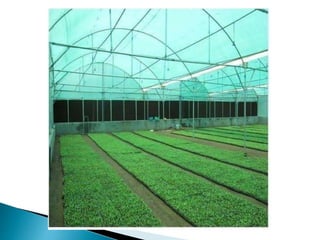
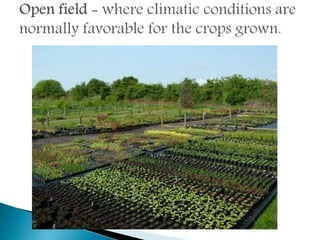
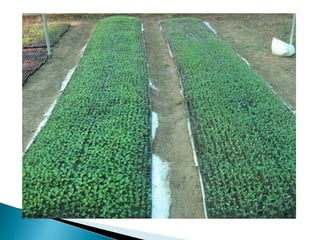
 A nursery can be as simple as a raised bed in an open field or
sophisticated as a glass-house with micro-sprinklers and an
automatic temperature control system. Although raising
seedlings in a nursery has advantages, some vegetables do not
transplant well, particularly root crops, and must be sown
directly in the field for optimum results.
 It has to be noted, however, that transplanting
seedlings interrupts their growth, which has the
potential to reduce their vigor.
 Although many vegetable seeds can be
sown directly in the field, experience has
shown that raising seedlings in a nursery has
a number of advantages as discussed below.
1. Intensive care - Seedlings receive better care
and protection (from animals, weeds and
pests) in the nursery.
2. Reduction of costs - Fewer seeds are used for
raising seedlings in the nursery than for
sowing directly in the field, because in the
latter seedlings have to be thinned to one,
which is wasteful. When expensive hybrid
seeds are used, transplants therefore become
more economically attractive. Pesticides and
labor are also reduced under nursery
conditions as compared to planting directly in
the field.
3. Opportunity for selection - Raising
seedlings in a nursery affords the grower
an opportunity to select well grown,
vigorous, uniform and disease free
seedlings.
4. Extend a short growing season for late
maturing crops - Seedlings can be raised
in a nursery under a protected
environment before conditions outside
become suitable for growth and
transplanted into the field when
conditions allow, thus reducing the
amount of time spent in the field.
5. Forced vegetable production for an early
market - Generally prices of
horticultural produce are attractive
when production or supply is low.
Vegetables can be grown ‘out-of-season’
in a nursery when conditions are not yet
favorable. Such crops will thus mature
earlier after transplanting and hence
stand to fetch a higher price in the
market.
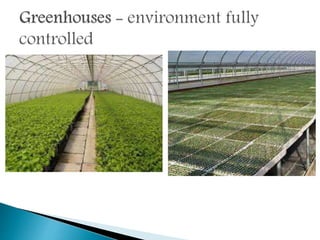
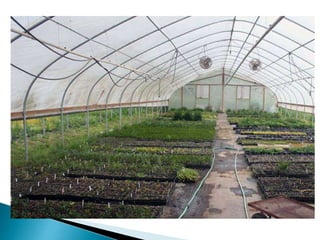
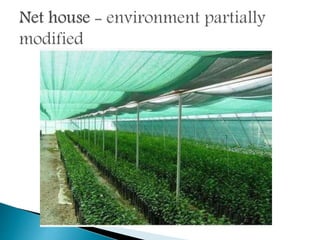
 There are three main facilities normally used
for raising seedlings in a nursery. The choice
of a particular one will depend on the
available resources and prevailing
environmental conditions.
Seedling Management
1.) Watering.
The seedbed or seed box should be
watered carefully with a fine stream of
water. After the plants are well established,
watering should be done thoroughly but not
too often. It is advisable to irrigate seedlings
in the morning and not in the afternoon as
the latter leaves the soil surface moist
overnight, a condition favoring damping off.
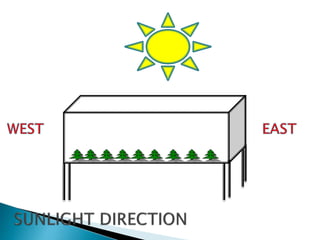
2.) Shading.
Shading should be done to protect the
young seedlings from high heat intensity
in sunny areas and also from heavy rain.
Shade can be provided by polythene nets
or even grass. The shade should be
removed some days before transplanting
to allow the seedlings to acclimatize to
field conditions.
3.) Thinning.
This is a way of regulating plant
density in rows and in holes. During
thinning, weak, diseased plants are
pulled out to allow healthy seedlings
to grow well. It is normally done
when seedlings have formed a few
true leaves.
4.) Insect pest and disease control.
This is a continuous process from seedling
emergence to transplanting. It is normally
done by physical means but chemicals can
also be used if the need arises.
5.) Weeding.
This is done by physical means when weeds
emerge.
6.) Hardening-off.
Transplants must be ‘hardened-off’ so that they
can withstand the transition from a relatively
sheltered and protected environment to a sometimes
harsh open situation.
7.) Transplanting.
This refers to the operation of lifting the
seedlings from the seedbeds or containers and
transferring them to the field where they will
grow and mature. The main aim during
transplanting should be to interrupt growth
as little as possible, and if the operation is not
carried out properly it can severely check
growth or in extreme cases cause death of
transplants.
Nursery management and_seedling_production

Nursery management and_seedling_production

  • 2.
     The firststep in successful vegetable production is to raise healthy vigorous seedlings.  Young plants whether propagated from seed or vegetatively require a lot of care particularly during the early stages of growth.  They have to be protected from adverse temperatures, heavy rains, drought, wind and a variety of pests and diseases.  If small seeded vegetables are sown directly in the field, germination is often poor and the young plants grow very slowly and require a long time to mature.
  • 3.
     A vegetablenursery is a place where plants are cared for during the early stages of growth, providing optimum conditions for germination and subsequent growth until they are strong enough to be planted out in their permanent place.
  • 4.
     A nurserycan be as simple as a raised bed in an open field or sophisticated as a glass-house with micro-sprinklers and an automatic temperature control system. Although raising seedlings in a nursery has advantages, some vegetables do not transplant well, particularly root crops, and must be sown directly in the field for optimum results.
  • 5.
     It hasto be noted, however, that transplanting seedlings interrupts their growth, which has the potential to reduce their vigor.
  • 7.
     Although manyvegetable seeds can be sown directly in the field, experience has shown that raising seedlings in a nursery has a number of advantages as discussed below. 1. Intensive care - Seedlings receive better care and protection (from animals, weeds and pests) in the nursery.
  • 8.
    2. Reduction ofcosts - Fewer seeds are used for raising seedlings in the nursery than for sowing directly in the field, because in the latter seedlings have to be thinned to one, which is wasteful. When expensive hybrid seeds are used, transplants therefore become more economically attractive. Pesticides and labor are also reduced under nursery conditions as compared to planting directly in the field.
  • 9.
    3. Opportunity forselection - Raising seedlings in a nursery affords the grower an opportunity to select well grown, vigorous, uniform and disease free seedlings.
  • 10.
    4. Extend ashort growing season for late maturing crops - Seedlings can be raised in a nursery under a protected environment before conditions outside become suitable for growth and transplanted into the field when conditions allow, thus reducing the amount of time spent in the field.
  • 11.
    5. Forced vegetableproduction for an early market - Generally prices of horticultural produce are attractive when production or supply is low. Vegetables can be grown ‘out-of-season’ in a nursery when conditions are not yet favorable. Such crops will thus mature earlier after transplanting and hence stand to fetch a higher price in the market.
  • 12.
     There arethree main facilities normally used for raising seedlings in a nursery. The choice of a particular one will depend on the available resources and prevailing environmental conditions.
  • 19.
  • 20.
    1.) Watering. The seedbedor seed box should be watered carefully with a fine stream of water. After the plants are well established, watering should be done thoroughly but not too often. It is advisable to irrigate seedlings in the morning and not in the afternoon as the latter leaves the soil surface moist overnight, a condition favoring damping off.
  • 21.
    2.) Shading. Shading shouldbe done to protect the young seedlings from high heat intensity in sunny areas and also from heavy rain. Shade can be provided by polythene nets or even grass. The shade should be removed some days before transplanting to allow the seedlings to acclimatize to field conditions.
  • 22.
    3.) Thinning. This isa way of regulating plant density in rows and in holes. During thinning, weak, diseased plants are pulled out to allow healthy seedlings to grow well. It is normally done when seedlings have formed a few true leaves.
  • 23.
    4.) Insect pestand disease control. This is a continuous process from seedling emergence to transplanting. It is normally done by physical means but chemicals can also be used if the need arises. 5.) Weeding. This is done by physical means when weeds emerge.
  • 24.
    6.) Hardening-off. Transplants mustbe ‘hardened-off’ so that they can withstand the transition from a relatively sheltered and protected environment to a sometimes harsh open situation.
  • 25.
    7.) Transplanting. This refersto the operation of lifting the seedlings from the seedbeds or containers and transferring them to the field where they will grow and mature. The main aim during transplanting should be to interrupt growth as little as possible, and if the operation is not carried out properly it can severely check growth or in extreme cases cause death of transplants.

Editor's Notes

  • #3 Paganay a step/sowaan para masuccess so kapamomolaan na so kapakatembad sa healthy mabager limpiyo a seedlings/robang. So watapen a pamomolaan na kinanglang on so kaalaga eron sii ko kaphakala eyan. Kailangan na protektahan tano siran ko phamakabinasa on sii ko pamomoloan a kaphakala eran lagid gira tanto ko mayaw a donya, mabager a n’do, uran, laon, odi na sii ko mga paold old Igira so mga ito a oniin/t’mbad na piyakaderetso sa field na phakalumbat so kaphakala eyan, na mathay a kapakatowa niyan
  • #8 The average garden soil is not an ideal medium for raising seedlings especially from the point of view of soil tilth. At an early stage of development most vegetable crops require special attention that is not possible in the main field. 1:1:1– soil:organic: crh
  • #10 Makaphamili ka ko piyamakatho ka ko mga pipiyaon, healthy ago lagi lagid sa kala ago naba zasakit
  • #11 Khapakay a khadelay nga so kaphakala eyan taman sa di makathakna odi na makapiya so environment sa liyo. Khalbatan so oras iyan sa field
  • #12 Pkhasulang ka so season a mala production a vegetable na mala a maphagarga eyan.
  • #25 Generally, hardening is imposed from about 1 to 2 weeks prior to transplanting seedlings, by gradually exposing them to higher (or lower) temperature and the higher light intensity prevailing in the field. It should, however, not involve any treatment that may reduce the rate of photosynthesis, such as nutrient stress. Care should be taken not to over-harden plants, as this may delay maturity and in some instances even reduce crop yields.