Cassava Crop
INTRODUCTION
• Cassava (Manihot esculenta ) is considered to be the
third most important source of calories in the tropics,
after rice and maize.
• The crop is grown mostly by low life communities
especially women and the crop also is grown almost
exclusively by smallholder farmers as the result it is
perceived as staple food for poor people.
• it is one of the few staple crops that can be produced
efficiently on a small scale, with no need for
mechanization or purchased inputs, and in marginal
areas with poor soils and unpredictable rainfall.
Introduction Cont……
• Its production has been increasing since year 2000 for
about 100 Millions tones which is influenced by great
demand from Asia where they demand for cassava.
• This Booming demand offers millions of cassava
growers in tropical countries the opportunity to
intensively produce cassava, earn higher incomes and
boost the food supply where it is most needed. But
how question on “How local farmers choose to
improve productivity” this should be of major concern
to policymakers on agriculture sector (FAO, .2013)
BOTANICAL CLASSFICATION AND
CHARACTERISTICS
• Botanical classification of Cassava.
Kingdom: Plantae
Division: Angiospermatophyta
Class: Eudiocots
Order: Malpighiales
Family: Euphorbiaceae
Genus: Manihot
Species: M. esculenta
Scientific name: Manihot esculenta Crantz
Common name: Cassava (English name) (IITS., 2011)
Botanical characteristics of Cassava
• The cassava plant is a woody perennial
shrub grown as annual, which grows
from 1 m to 5 m in height.
• Roots: Cassava roots are tuberous,
coned shape modified for starch
storage covered with papery barks and
pink to white homogeneous flesh
encased cortex detachable rind, about
1 mm thick.
• The flesh ranges from bright to soft
yellow
Botanical characteristics cont…..
• There are about more than 100
varieties of cassava with each
distinctive color and quality
adapted to different
environmental conditions.
• Cassava tubers are very rich in
starch, and contain significant
quantities of calcium
(50mg/100g), phosphorus
(40mg/100 g) and vitamin C
(25mg/100 g). However, they are
low in protein and other
nutrients.
Botanical characteristics cont…..
• Stems: The stem erects
and radiates from the
tuber and has milky
latex. As the plant
grows, the main stem
usually divides into
three branches, each of
which then divides in
the same way.
• Leaves: The leaves are large
and palmate (Hand- shaped)
and have five to seven lobes
borne on a long, slender
petiole. The leaves grow only
towards the end of the
branches. They are dark green
above and light green below
• Flowers and fruit: Male and female flowers are
arranged in loose plumes and are found on the same
plant meaning the plant is Monoecious ( Protogyny).
(FAO, .2013)
• Common Varieties in Tanzania are Makutupora,
Dodoma, Mkumba and Pwani varieties (released
2012), NDL 90/034, HBL 95/05, Kibaha, Kiroba and
Mumba and other varieties are I91/00063,
I91/0057, I91/0067, MM96/0876, MM96/3075B,
MM96/4619,
MM96/4684,MM96/5725,MM96/8233,
MM96/8450, SS4, and Kachaga (a local variety
showing good resistance toCMD)
(Mkamilo,. 2005) & (IITA,.2012)
• Note: The hardy and better able to tolerate drought and poor soil
conditions than other of many crop species. It is able to be grown
extremely poor, acidic soil because of its symbiotic association with
the soil fungi called mycorrhizae.
• The crop has high productivity on the piece of land due to its ability
to fast recover from lost in foliage and/ or damages caused by
diseases or pests.
• The plant is also unusual and infamous, because both roots and
leaves can somewhat be toxic when consumed. The toxic nature is
resulted from the Cyanogenic glucosides (glucose + Cyanide) with
produce the Hydrogen cyanide (HCN) which is potent toxin and this
happens to damaged plant tissues.
• All of Cassava varieties has the cynogenic glucose and there
by one can tell if the cassava is:
• Sweet : When the flesh of the crop contain less
concentration of the cynogenic glucose hence these types
require few processing techniques before consumption.
• Bitter : When the flesh of the crop contain high
concentration of the cynogenic glucose hence these types
require extensive processing techniques to reduce the toxic
compound before consumption. These techniques involves
Grating, Fermenting and Sun drying, all of these techniques
are aimed to damage the plant tissue hence reduce the
volatile HCN. This tells the effectiveness of the processing
and preparations are the ones determining the toxicity of
the cassava foods. (Alves et all,.1998)
CASSAVA AS AN ANNUAL CROP
• Cassava plant has shallow root system
• Limited ability to survive harsh environment
• Has fast growth and attain early maturity
• Has excessive demand for nutrients
• Also cassava has high multiplication rate
• Cassava plant are susceptible to pest and disease
• Also has short canopy architecture
Above factors proves cassava as annual crops
Cassava Crop Growth Stages
Crop stage No. of days Observation
Seedling 5-7
10-12
Adventitious roots
emerges .
First leaves emerges
Leaf beginning and root
system
30 Leaves starts to expand
and +Ve Photosythesis
is observed.
Fibrous roots starts to
grow.
Maturity Up to 8 months Cassava roots are said
to be matured enough
to be harvested.
Origin and geographical distribution
• Many studies indicate that cassava has multiple centres
of origin; others suggest that the cultivated species
originated on the southern edge of the Brazilian
Amazon where it is still grown today.
• In year 2013 Tanzania was the 12th largest cassava
producer in the world and the 6th largest in Africa after
Nigeria (top producer in the word), DRC, Ghana, Angola
and Mozambique.
• The main cassava producing
areas in Tanzania are the
Lake Victoria zone (Mwanza,
Mara, Kagera and Shinyanga
regions), the Southern
zone(Lindi and Mtwara
regions and Tunduru district
in Ruvuma region), the
Eastern zone (Morogoro,
Tanga, Coast, Dar es Salaam)
and Zanzibar (Pemba and
Unguja islands)
• (Mkamilo &Jeremiah, .2005).
ECONOMIC IMPORTANCE OF CASSAVA CROP
o Cassava is used as staple food, as source of
carbohydrate, crude protein, minerals, and vitamin
Example in Tabora- Tanzania, Nigeria, Ghana, China and in
Tamil Nandu- India
o Also used to produce alcoholic beverage.
Alcoholic bevarage made from cassava include
Inmpala(Mozambique, Masato (peruvian amazonia) China,
Tiquira (Brazil)
o Culinary
Sweet variety of cassava can be made into flour that is used to
make bread, cakes and cookies.
Economic importance…..
• It provides employment .
• It also acts as the source of Income.
Production Requirements for Cassava:
• Climatic requirements:
1) Temperature
• Cassava becomes more productive between 150North and
150 South latitudes. Generally, cassava crop requires a
warm, humid climate. Temperature as another factor is
very important, as at about 10 °C all growth activities
stops. The crop is typically grown in places which are frost-
free all year round.
• The highest tuber production can be expected in the
tropical lowlands, below an altitude of 150 m, where
temperatures average 25 °C - 29 °C, but some varieties
grow at altitudes of up to 1500 m from sea level
(FAO, 2006).
• 2) Water
Once established, cassava can grow in places that
receive just about 400 mm of average annual rainfall.
But assurance for water availability for the crop
ensures more productivity of the crop.
• . The root yields increased six fold when the quantity
of water supplied by supplementary drip irrigation
was equal to that of the season’s rainfall. Supplemental
irrigation that increased the total water supply by 20
percent almost doubled root yields (FAO, 2013).
• Edaphic Factors
• Cassava crop is able to be grown on a wide - range of
soil types but grows best on deep, free draining soils
with sufficient fertility levels. It is advised that a
farmer should avoid Shallow soils which may results to
restriction on tuber expansion.
• Cassava needs a sufficiently loose-textured soil to
facilitate initial root penetration and to allow for root
thickening. Therefore Cassava grows best on light,
sandy loams or on loamy sands which are moist, fertile
and deep, but it also does well on soils ranging in
texture from sands to clays and on soils of relatively
low fertility with pH range about 5.5-6.5
• ( University of Pretoria, .2010).
Crop management planting/sowing
• Site selection: For selecting good site for a cassava crop
production, one has to look for an area with dense vegetation
cover, deep loamy soils with medium soil fertility and good
drainage, and flat or gently sloping land; also examine the field
history to plan for plant protection measures(James et al.,
2000).
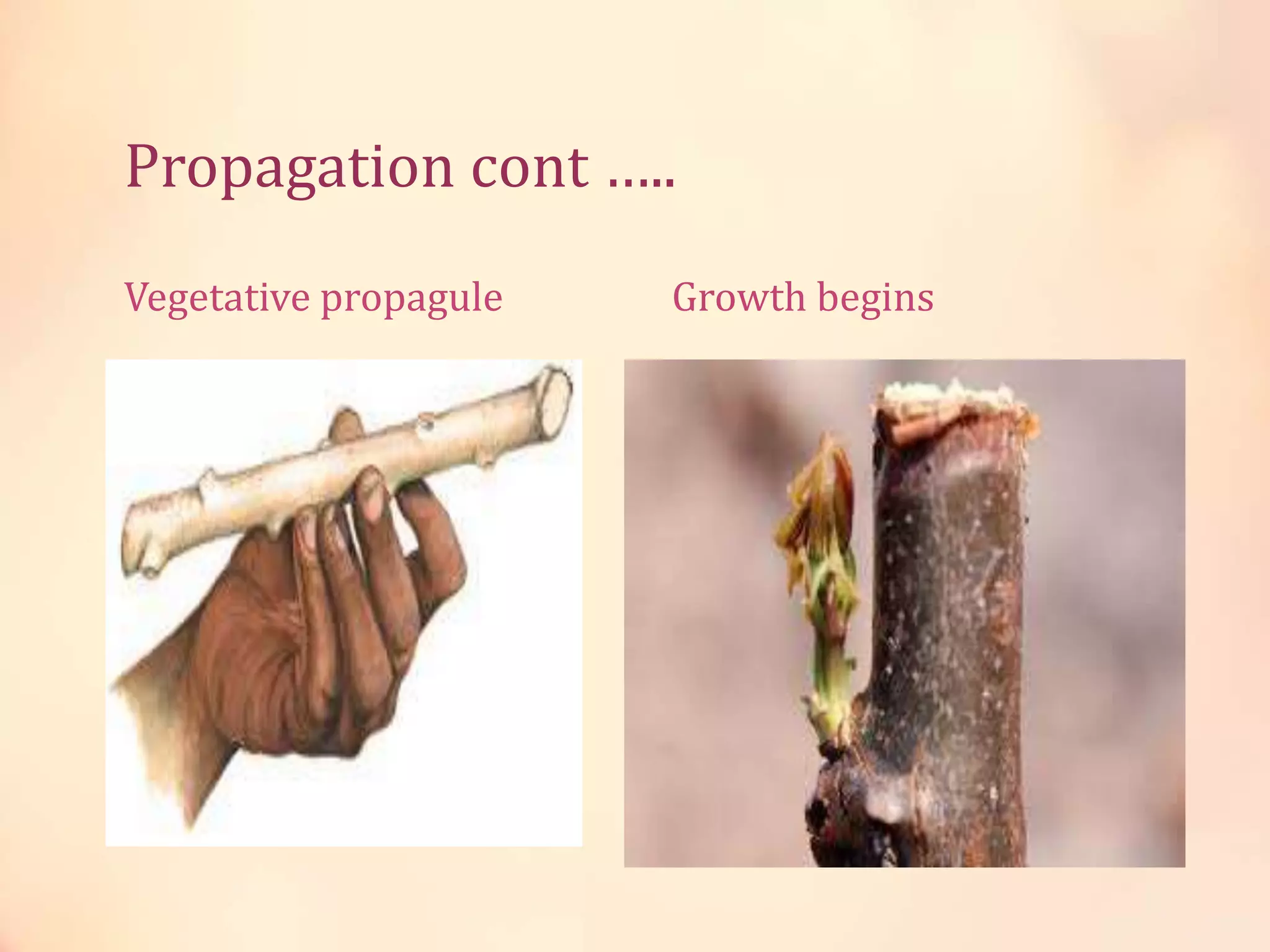
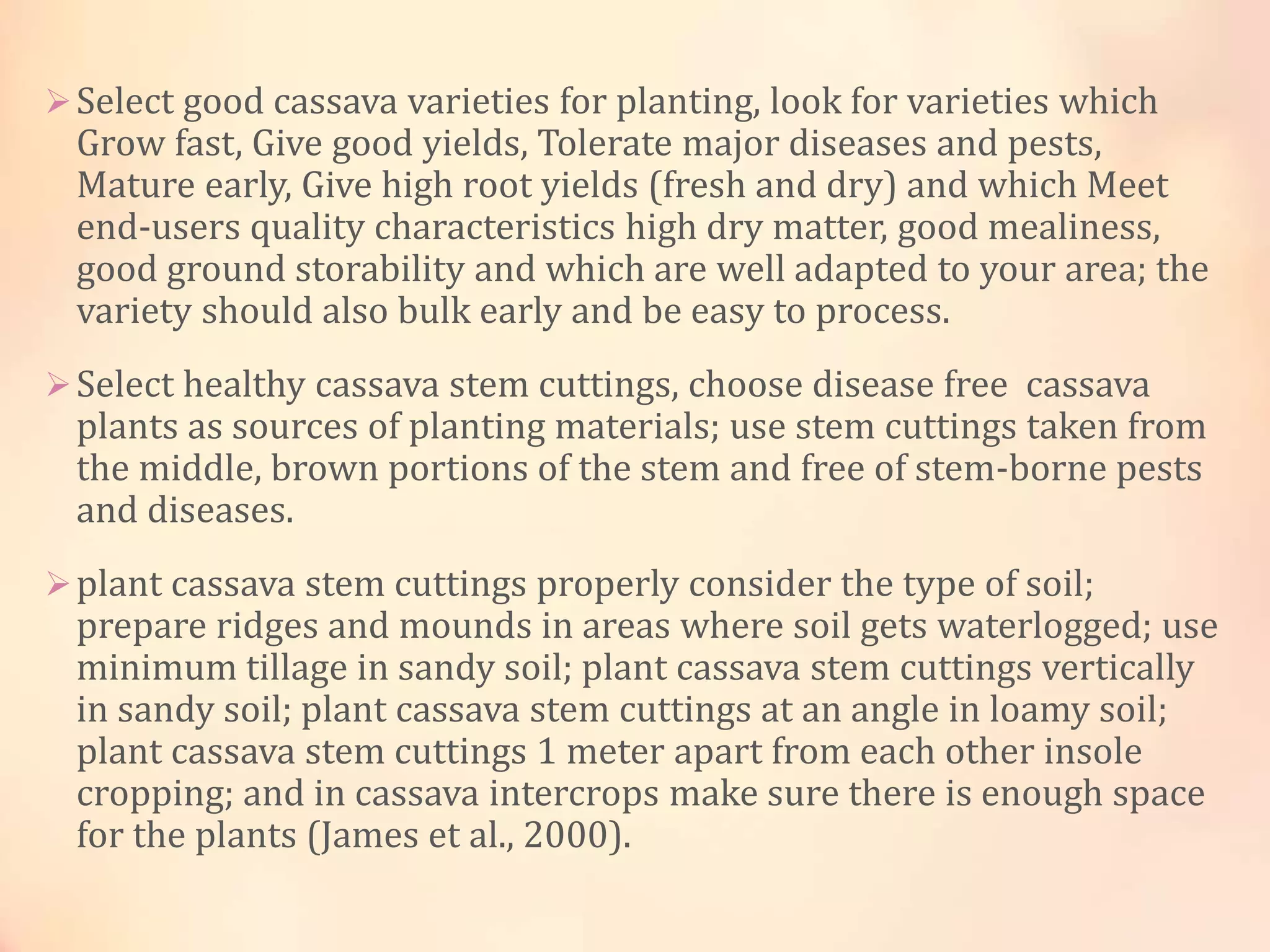
• Propagation: Cassava is propagated vegetatively using stem
cuttings. In Selecting cuttings one has to select them from the
middle stem portions, 30cm long with an average of 5–8nodes
Propagation cont …..
Vegetative propagule Growth begins
AGRONOMIC PRACTICES
1) Land preparation
• Ploughing: The method of land preparation depends on
soil type and depth of the water table. Practice minimum
tillage in sandy soil to conserve soil, organic matter,
moisture, and reduce soil erosion. Prepare land to improve
soil contact with stem cuttings. In shallow or hard soils,
increase topsoil volume per plant for better establishment.
Make ridges or mounds to reduce water logging in poorly
drained soils (James et al., 2000). .
• Planting: Plant cassava at the correct planting time to
ensure: Healthy sprouting and Good crop establishment.
Select good cassava varieties for planting, look for varieties which
Grow fast, Give good yields, Tolerate major diseases and pests,
Mature early, Give high root yields (fresh and dry) and which Meet
end-users quality characteristics high dry matter, good mealiness,
good ground storability and which are well adapted to your area; the
variety should also bulk early and be easy to process.
Select healthy cassava stem cuttings, choose disease free cassava
plants as sources of planting materials; use stem cuttings taken from
the middle, brown portions of the stem and free of stem-borne pests
and diseases.
plant cassava stem cuttings properly consider the type of soil;
prepare ridges and mounds in areas where soil gets waterlogged; use
minimum tillage in sandy soil; plant cassava stem cuttings vertically
in sandy soil; plant cassava stem cuttings at an angle in loamy soil;
plant cassava stem cuttings 1 meter apart from each other insole
cropping; and in cassava intercrops make sure there is enough space
for the plants (James et al., 2000).
• Spacing: Distances between cassava plants mainly
depend on the variety and on the cropping system.
• In Pure stands (with no intercropping), a
recommended spacing is 1.0 m * 0.9 m. When the crop
is intercropped, Interplant with a cover crop of beans
or groundnuts at a spacing of 50cm * 20cm. The
spacing is recommended to be 1.0 m * 4.0 m. This
combination of crops gives maximum yields of both
cassava and bean or groundnuts.(James et al., 2000).
Fertilizer Requirements
• A soil test should always be done to determine
fertilizer types and rates but if not done then the
following recommendations for fertilizing should be
followed:
• a) NPK fertilizer with the relative ratio as (12:24:12)
is to be applied at the rate of 336 kg/ha at 6 weeks
after planting and followed with 16:8:24 at 16 weeks
after planting
b) Average quantities to be applied should be one full
hand (85gm-113gm) of fertilizer per each plant at
each application.
• c) The fertilizer should be placed about 15cm to 45cm
from the base of the stem in drill holes. Drilled holes
should be 10cm to 15cm in depth. Placing fertilizer
into the drilled holes reduces fertilizer loss through
water runoff.
d) it was found that fertilizing plants 16 weeks after
planting enhances tuber bulking hence increase
productivity. (FAO,. 2006).
Gap filling and Pruning
• Gap filling to those stem cuttings to the cutting failed
to grow between 2 to 3 weeks. Pruning of the plants
should be done about 9 months after planting when
using high densities or if growth is excessive.
• Note that pruning can create wound entries for pests
and pathogens, and can spread them from one plot to
another by way of the cutting instrument and workers’
clothing. Dip cutting instruments in a detergent
solution between plots to destroy bacterial and viral
pathogens on the surface.
Weeding, Pests & Diseases and
Their Managements.
• Weed control (WEEDING)
• Ensure adequate control of weeds pre-emergence by
ploughing and harrowing the soil or applying pre-
emergence herbicides before planting and post
emergence with herbicide applications, inter-row
weeders or regular manual weeding intensively in first
three months after planting (Vegetative phase of the
crop ) until leaves form a canopy and weed growth is
suppressed because the leaves canopy will reduce the
growth of weeds by shading them. (FAO, 2006)
Pests control
Most of the times insect pests are not a huge threat to cassava
crop production but still one needs to have a very close
attention. The most notable Pests in Cassava include;
• The cassava mealybug, Phenacoccus
manihoti.
• occurs on cassava leaves, shoot tips,
petioles, and stems easily said as on
growing points of the plant.
• Cassava mealybug damage symptoms
include shortened internode lengths,
compression of terminal leaves together
into “bunchy tops”, distortion of stem
portions, defoliation, and “candlestick”
appearance of shoot tip, this is because
they affect the growing points hence leads
to stunt growth. The insects survive on
cassava stems and leaves and are easily
carried to new fields in this way.
Vertebrates pest of cassava
Red legged
sqirrel(Akande 1976)
Giant African rat
Diseases
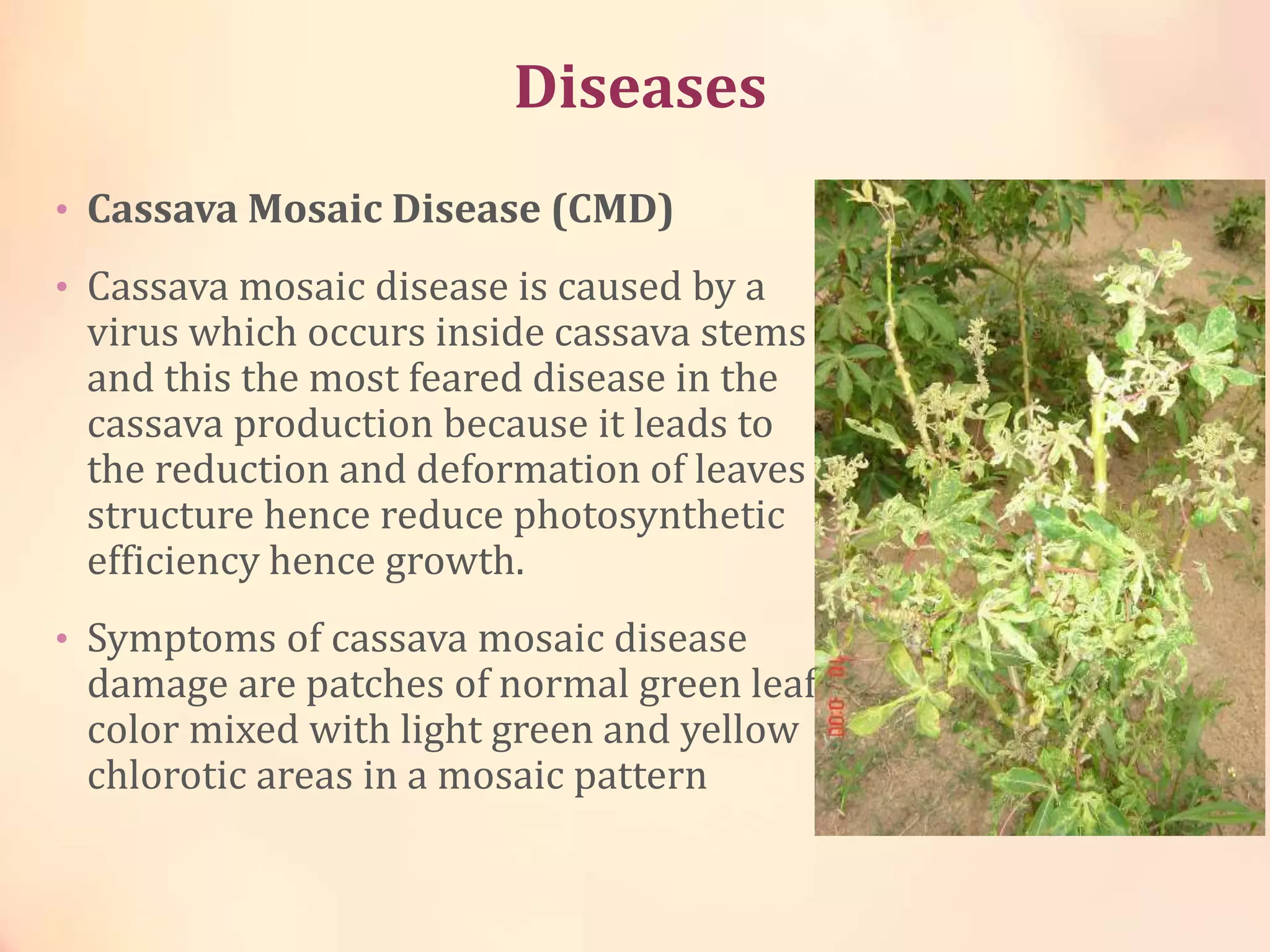
• Cassava Mosaic Disease (CMD)
• Cassava mosaic disease is caused by a
virus which occurs inside cassava stems
and this the most feared disease in the
cassava production because it leads to
the reduction and deformation of leaves
structure hence reduce photosynthetic
efficiency hence growth.
• Symptoms of cassava mosaic disease
damage are patches of normal green leaf
color mixed with light green and yellow
chlorotic areas in a mosaic pattern
Cassava Anthracnose Disease (CAD)
• Cassava anthracnose disease is
caused by a fungus which
occurs on the surface of
cassava stems.
• The disease damage symptoms
are cankers (“sores”) on the
stem and bases of leaf petioles.
The disease reduces the
sprouting ability of stem
cuttings.
(Fokunang et al., 2000)
Cassava Bud Necrosis
• Cassava bud necrosis is
caused by a fungus which
grows on the surface of
cassava stems covering the
axilliary buds or the “eyes”
of stem cuttings. The
affected buds die, and the
sprouting ability of stem
cuttings is reduced.
(James et al., 2000)
Cassava Brown Streak virus Disease
• It was first identified in 1936
in Tanzania, and has spread to
other coastal areas of East
Africa.
• CBSD is characterized by
severe chlorosis and necrosis
on infected leaves, giving them
a yellowish, mottled
appearance.
• (Ntawuruhunga& Legg,. 2007)
General Pest and Disease control
Select healthy planting material.
Treat cuttings with pesticides and fungicides before
planting, and the plants during the growth stage when
necessary.
Rogue and burn diseased plants regularly during the
growth season (if it does not compromise the survival of a
specific accession).
After harvest, destroy discarded stems and roots that have
disease symptoms or pest contamination
The use of IPM
The use of Natural enemies.
Harvesting
• Harvest as soon as the tubers are mature. Optimum time for
harvesting varies according to the variety, climate and soil factors.
Harvest early maturing varieties between 8–12 months after
planting. Harvest full season varieties between 12 and18 months
after planting. In cold environments, harvesting can be delayed until
18 and 24 months after planting. If the tubers are left in the ground,
the starch content increases with age until, at a certain point,
lignifications takes place, causing the tubers to become tough and
woody and making it more difficult to prepare them for
consumption and other uses.
• Yields may also vary depending on variety, soil type and
management practices. Average yields are 10 –30 tons/ha.
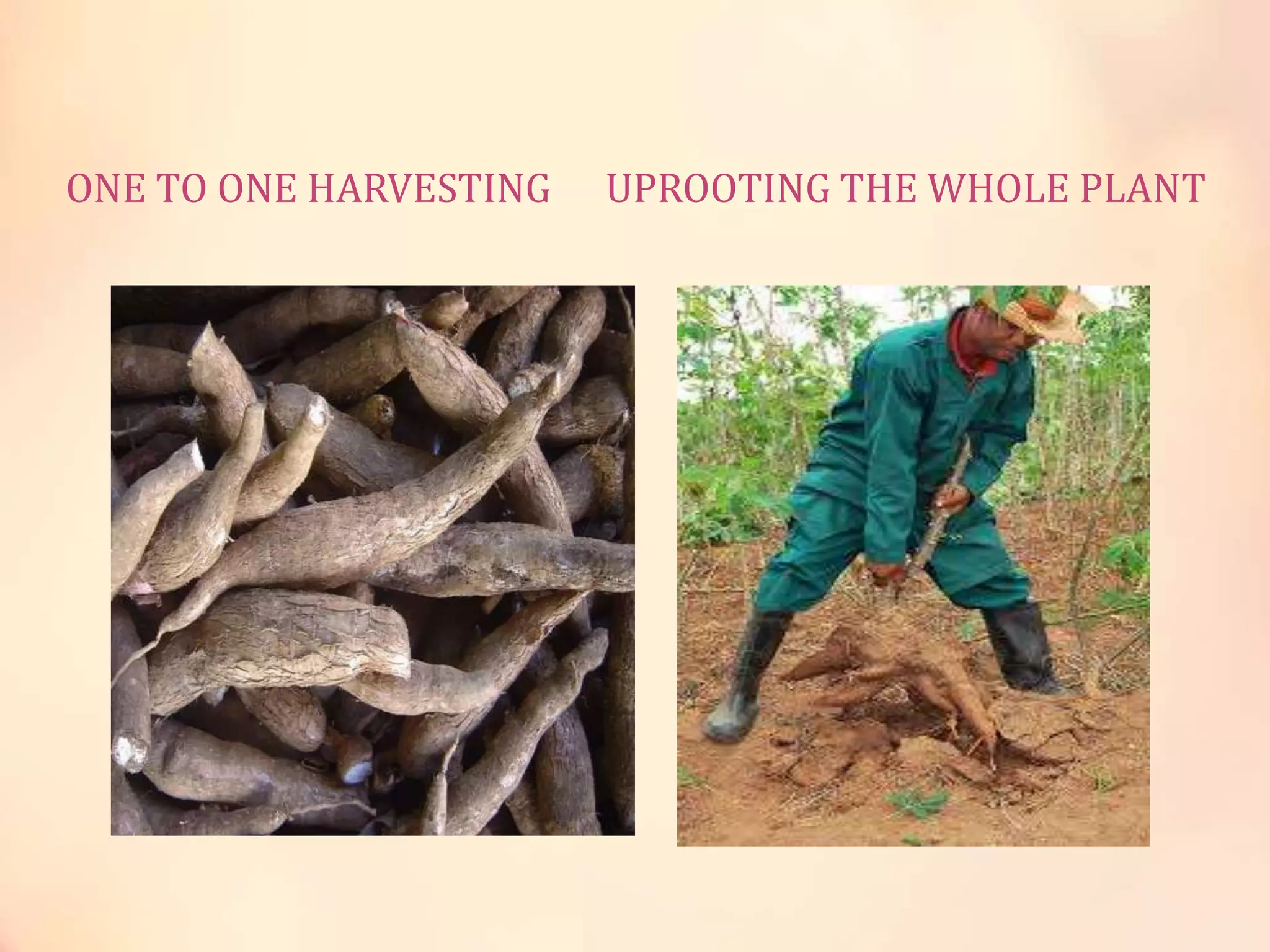
• Cassava harvesting may be done piece-meal (one by one) or can be
by uprooting whole plants. A stick or hoe may be used to remove
the tubers.
ONE TO ONE HARVESTING UPROOTING THE WHOLE PLANT
Post-Harvest Operations
• Some of the Harvested tubers must be delivered to the
processing plant within 48 hours to prevent deterioration.
Roots can be processed into granulated flour, or into high
quality cassava flour which can be used as a substitute for
some of the maize flour for Ugali cooking in Tanzania,
wheat flour in bread and confectionary. In Thailand and
China, root starch goes into food products, plywood, paper
and textiles, and is used as feedstock for production of
sweeteners, fructose, and alcohol and fuel ethanol. Two
recent cassava mutations have starch properties that are
highly valued by industry.
• Fresh cassava roots were stored in straw-lined trenches for
periods of up to 12 months (Booth and Coursey, 1994)
Marketing of Cassava
• Cassava crops after being harvested are commonly to
be consumed in livelihood level but since it cannot be
stored for long time then mostly they are sold as fast
foods or are transported to the nearest marketing
places where there will be assured demand of the
crop. If the small scale farmer wishes to store them for
long time then they are advised to reduce water
contents in them by drying them.
MARKETING PLACES
Referrences
• De Vries, J. and G. Toenniessen (2001) Securing the Harvest.
Biotechnology, Breeding and Seed Systems for African Crops.
CABIPublishing, NewYork.
• James, B., Yaninek, J., Tumanteh, A., Maroya,N., Dixon, A., Salawu, R
Kwarteng,J.(2000) Starting a Cassava Farm: IPM Field Guide for
Extension
• N.M., Kanju, E., Kulembeka, H., Tollano, S.M., Massawe, M.H. &
Masumba, E. 1999.
• Food Security and Crop Diversification in SADC countries: The
Role of Cassava and Sweet Potato. Proceedings of the SARRNET
Scientific Workshop, Lusaka,Zambia, 17-19 August 1998
• MKAMILO G.S. & JEREMIAH S.C. (2005). Current status of cassava
improvement programme in Tanzania African Crop Science
Conference Proceedings, Vol. 7. pp. 1311-1314
• Pheneas Ntawuruhunga; James Legg (May 2007). "New Spread of
Cassava Brown Streak Virus Disease and its Implications for the
Movement of Cassava Germplasm in the East and Central African
Region" (PDF).
• Fokunang, C.N., C.N. Akem, T. Ikotun and A.G.O. Dixon,
2000. Germplasm evaluation of cassava genotypes for
resistance to anthracnose, bacterial blight and mosaic
diseases and their effects on yield. Genet. Resour. Crop
Evol., 47: 63-71.
• IITA
• http://www.isaaa.org/kc/cropbiotechupdate/article/
default.asp?ID=9138

Cassava crop 1

  • 1.
  • 2.
    INTRODUCTION • Cassava (Manihotesculenta ) is considered to be the third most important source of calories in the tropics, after rice and maize. • The crop is grown mostly by low life communities especially women and the crop also is grown almost exclusively by smallholder farmers as the result it is perceived as staple food for poor people. • it is one of the few staple crops that can be produced efficiently on a small scale, with no need for mechanization or purchased inputs, and in marginal areas with poor soils and unpredictable rainfall.
  • 3.
    Introduction Cont…… • Itsproduction has been increasing since year 2000 for about 100 Millions tones which is influenced by great demand from Asia where they demand for cassava. • This Booming demand offers millions of cassava growers in tropical countries the opportunity to intensively produce cassava, earn higher incomes and boost the food supply where it is most needed. But how question on “How local farmers choose to improve productivity” this should be of major concern to policymakers on agriculture sector (FAO, .2013)
  • 4.
    BOTANICAL CLASSFICATION AND CHARACTERISTICS •Botanical classification of Cassava. Kingdom: Plantae Division: Angiospermatophyta Class: Eudiocots Order: Malpighiales Family: Euphorbiaceae Genus: Manihot Species: M. esculenta Scientific name: Manihot esculenta Crantz Common name: Cassava (English name) (IITS., 2011)
  • 5.
    Botanical characteristics ofCassava • The cassava plant is a woody perennial shrub grown as annual, which grows from 1 m to 5 m in height. • Roots: Cassava roots are tuberous, coned shape modified for starch storage covered with papery barks and pink to white homogeneous flesh encased cortex detachable rind, about 1 mm thick. • The flesh ranges from bright to soft yellow
  • 6.
    Botanical characteristics cont….. •There are about more than 100 varieties of cassava with each distinctive color and quality adapted to different environmental conditions. • Cassava tubers are very rich in starch, and contain significant quantities of calcium (50mg/100g), phosphorus (40mg/100 g) and vitamin C (25mg/100 g). However, they are low in protein and other nutrients.
  • 7.
    Botanical characteristics cont….. •Stems: The stem erects and radiates from the tuber and has milky latex. As the plant grows, the main stem usually divides into three branches, each of which then divides in the same way.
  • 8.
    • Leaves: Theleaves are large and palmate (Hand- shaped) and have five to seven lobes borne on a long, slender petiole. The leaves grow only towards the end of the branches. They are dark green above and light green below
  • 9.
    • Flowers andfruit: Male and female flowers are arranged in loose plumes and are found on the same plant meaning the plant is Monoecious ( Protogyny). (FAO, .2013) • Common Varieties in Tanzania are Makutupora, Dodoma, Mkumba and Pwani varieties (released 2012), NDL 90/034, HBL 95/05, Kibaha, Kiroba and Mumba and other varieties are I91/00063, I91/0057, I91/0067, MM96/0876, MM96/3075B, MM96/4619, MM96/4684,MM96/5725,MM96/8233, MM96/8450, SS4, and Kachaga (a local variety showing good resistance toCMD) (Mkamilo,. 2005) & (IITA,.2012)
  • 10.
    • Note: Thehardy and better able to tolerate drought and poor soil conditions than other of many crop species. It is able to be grown extremely poor, acidic soil because of its symbiotic association with the soil fungi called mycorrhizae. • The crop has high productivity on the piece of land due to its ability to fast recover from lost in foliage and/ or damages caused by diseases or pests. • The plant is also unusual and infamous, because both roots and leaves can somewhat be toxic when consumed. The toxic nature is resulted from the Cyanogenic glucosides (glucose + Cyanide) with produce the Hydrogen cyanide (HCN) which is potent toxin and this happens to damaged plant tissues.
  • 11.
    • All ofCassava varieties has the cynogenic glucose and there by one can tell if the cassava is: • Sweet : When the flesh of the crop contain less concentration of the cynogenic glucose hence these types require few processing techniques before consumption. • Bitter : When the flesh of the crop contain high concentration of the cynogenic glucose hence these types require extensive processing techniques to reduce the toxic compound before consumption. These techniques involves Grating, Fermenting and Sun drying, all of these techniques are aimed to damage the plant tissue hence reduce the volatile HCN. This tells the effectiveness of the processing and preparations are the ones determining the toxicity of the cassava foods. (Alves et all,.1998)
  • 12.
    CASSAVA AS ANANNUAL CROP
  • 13.
    • Cassava planthas shallow root system • Limited ability to survive harsh environment • Has fast growth and attain early maturity • Has excessive demand for nutrients • Also cassava has high multiplication rate • Cassava plant are susceptible to pest and disease • Also has short canopy architecture Above factors proves cassava as annual crops
  • 14.
    Cassava Crop GrowthStages Crop stage No. of days Observation Seedling 5-7 10-12 Adventitious roots emerges . First leaves emerges Leaf beginning and root system 30 Leaves starts to expand and +Ve Photosythesis is observed. Fibrous roots starts to grow. Maturity Up to 8 months Cassava roots are said to be matured enough to be harvested.
  • 15.
    Origin and geographicaldistribution • Many studies indicate that cassava has multiple centres of origin; others suggest that the cultivated species originated on the southern edge of the Brazilian Amazon where it is still grown today. • In year 2013 Tanzania was the 12th largest cassava producer in the world and the 6th largest in Africa after Nigeria (top producer in the word), DRC, Ghana, Angola and Mozambique.
  • 16.
    • The maincassava producing areas in Tanzania are the Lake Victoria zone (Mwanza, Mara, Kagera and Shinyanga regions), the Southern zone(Lindi and Mtwara regions and Tunduru district in Ruvuma region), the Eastern zone (Morogoro, Tanga, Coast, Dar es Salaam) and Zanzibar (Pemba and Unguja islands) • (Mkamilo &Jeremiah, .2005).
  • 17.
    ECONOMIC IMPORTANCE OFCASSAVA CROP o Cassava is used as staple food, as source of carbohydrate, crude protein, minerals, and vitamin Example in Tabora- Tanzania, Nigeria, Ghana, China and in Tamil Nandu- India o Also used to produce alcoholic beverage. Alcoholic bevarage made from cassava include Inmpala(Mozambique, Masato (peruvian amazonia) China, Tiquira (Brazil) o Culinary Sweet variety of cassava can be made into flour that is used to make bread, cakes and cookies.
  • 18.
    Economic importance….. • Itprovides employment . • It also acts as the source of Income.
  • 19.
    Production Requirements forCassava: • Climatic requirements: 1) Temperature • Cassava becomes more productive between 150North and 150 South latitudes. Generally, cassava crop requires a warm, humid climate. Temperature as another factor is very important, as at about 10 °C all growth activities stops. The crop is typically grown in places which are frost- free all year round. • The highest tuber production can be expected in the tropical lowlands, below an altitude of 150 m, where temperatures average 25 °C - 29 °C, but some varieties grow at altitudes of up to 1500 m from sea level (FAO, 2006).
  • 20.
    • 2) Water Onceestablished, cassava can grow in places that receive just about 400 mm of average annual rainfall. But assurance for water availability for the crop ensures more productivity of the crop. • . The root yields increased six fold when the quantity of water supplied by supplementary drip irrigation was equal to that of the season’s rainfall. Supplemental irrigation that increased the total water supply by 20 percent almost doubled root yields (FAO, 2013).
  • 21.
    • Edaphic Factors •Cassava crop is able to be grown on a wide - range of soil types but grows best on deep, free draining soils with sufficient fertility levels. It is advised that a farmer should avoid Shallow soils which may results to restriction on tuber expansion. • Cassava needs a sufficiently loose-textured soil to facilitate initial root penetration and to allow for root thickening. Therefore Cassava grows best on light, sandy loams or on loamy sands which are moist, fertile and deep, but it also does well on soils ranging in texture from sands to clays and on soils of relatively low fertility with pH range about 5.5-6.5 • ( University of Pretoria, .2010).
  • 22.
    Crop management planting/sowing •Site selection: For selecting good site for a cassava crop production, one has to look for an area with dense vegetation cover, deep loamy soils with medium soil fertility and good drainage, and flat or gently sloping land; also examine the field history to plan for plant protection measures(James et al., 2000). • Propagation: Cassava is propagated vegetatively using stem cuttings. In Selecting cuttings one has to select them from the middle stem portions, 30cm long with an average of 5–8nodes
  • 23.
    Propagation cont ….. Vegetativepropagule Growth begins
  • 24.
    AGRONOMIC PRACTICES 1) Landpreparation • Ploughing: The method of land preparation depends on soil type and depth of the water table. Practice minimum tillage in sandy soil to conserve soil, organic matter, moisture, and reduce soil erosion. Prepare land to improve soil contact with stem cuttings. In shallow or hard soils, increase topsoil volume per plant for better establishment. Make ridges or mounds to reduce water logging in poorly drained soils (James et al., 2000). . • Planting: Plant cassava at the correct planting time to ensure: Healthy sprouting and Good crop establishment.
  • 25.
    Select good cassavavarieties for planting, look for varieties which Grow fast, Give good yields, Tolerate major diseases and pests, Mature early, Give high root yields (fresh and dry) and which Meet end-users quality characteristics high dry matter, good mealiness, good ground storability and which are well adapted to your area; the variety should also bulk early and be easy to process. Select healthy cassava stem cuttings, choose disease free cassava plants as sources of planting materials; use stem cuttings taken from the middle, brown portions of the stem and free of stem-borne pests and diseases. plant cassava stem cuttings properly consider the type of soil; prepare ridges and mounds in areas where soil gets waterlogged; use minimum tillage in sandy soil; plant cassava stem cuttings vertically in sandy soil; plant cassava stem cuttings at an angle in loamy soil; plant cassava stem cuttings 1 meter apart from each other insole cropping; and in cassava intercrops make sure there is enough space for the plants (James et al., 2000).
  • 26.
    • Spacing: Distancesbetween cassava plants mainly depend on the variety and on the cropping system. • In Pure stands (with no intercropping), a recommended spacing is 1.0 m * 0.9 m. When the crop is intercropped, Interplant with a cover crop of beans or groundnuts at a spacing of 50cm * 20cm. The spacing is recommended to be 1.0 m * 4.0 m. This combination of crops gives maximum yields of both cassava and bean or groundnuts.(James et al., 2000).
  • 27.
    Fertilizer Requirements • Asoil test should always be done to determine fertilizer types and rates but if not done then the following recommendations for fertilizing should be followed: • a) NPK fertilizer with the relative ratio as (12:24:12) is to be applied at the rate of 336 kg/ha at 6 weeks after planting and followed with 16:8:24 at 16 weeks after planting b) Average quantities to be applied should be one full hand (85gm-113gm) of fertilizer per each plant at each application.
  • 28.
    • c) Thefertilizer should be placed about 15cm to 45cm from the base of the stem in drill holes. Drilled holes should be 10cm to 15cm in depth. Placing fertilizer into the drilled holes reduces fertilizer loss through water runoff. d) it was found that fertilizing plants 16 weeks after planting enhances tuber bulking hence increase productivity. (FAO,. 2006).
  • 29.
    Gap filling andPruning • Gap filling to those stem cuttings to the cutting failed to grow between 2 to 3 weeks. Pruning of the plants should be done about 9 months after planting when using high densities or if growth is excessive. • Note that pruning can create wound entries for pests and pathogens, and can spread them from one plot to another by way of the cutting instrument and workers’ clothing. Dip cutting instruments in a detergent solution between plots to destroy bacterial and viral pathogens on the surface.
  • 30.
    Weeding, Pests &Diseases and Their Managements. • Weed control (WEEDING) • Ensure adequate control of weeds pre-emergence by ploughing and harrowing the soil or applying pre- emergence herbicides before planting and post emergence with herbicide applications, inter-row weeders or regular manual weeding intensively in first three months after planting (Vegetative phase of the crop ) until leaves form a canopy and weed growth is suppressed because the leaves canopy will reduce the growth of weeds by shading them. (FAO, 2006)
  • 31.
    Pests control Most ofthe times insect pests are not a huge threat to cassava crop production but still one needs to have a very close attention. The most notable Pests in Cassava include; • The cassava mealybug, Phenacoccus manihoti. • occurs on cassava leaves, shoot tips, petioles, and stems easily said as on growing points of the plant. • Cassava mealybug damage symptoms include shortened internode lengths, compression of terminal leaves together into “bunchy tops”, distortion of stem portions, defoliation, and “candlestick” appearance of shoot tip, this is because they affect the growing points hence leads to stunt growth. The insects survive on cassava stems and leaves and are easily carried to new fields in this way.
  • 32.
    Vertebrates pest ofcassava Red legged sqirrel(Akande 1976) Giant African rat
  • 33.
    Diseases • Cassava MosaicDisease (CMD) • Cassava mosaic disease is caused by a virus which occurs inside cassava stems and this the most feared disease in the cassava production because it leads to the reduction and deformation of leaves structure hence reduce photosynthetic efficiency hence growth. • Symptoms of cassava mosaic disease damage are patches of normal green leaf color mixed with light green and yellow chlorotic areas in a mosaic pattern
  • 34.
    Cassava Anthracnose Disease(CAD) • Cassava anthracnose disease is caused by a fungus which occurs on the surface of cassava stems. • The disease damage symptoms are cankers (“sores”) on the stem and bases of leaf petioles. The disease reduces the sprouting ability of stem cuttings. (Fokunang et al., 2000)
  • 35.
    Cassava Bud Necrosis •Cassava bud necrosis is caused by a fungus which grows on the surface of cassava stems covering the axilliary buds or the “eyes” of stem cuttings. The affected buds die, and the sprouting ability of stem cuttings is reduced. (James et al., 2000)
  • 36.
    Cassava Brown Streakvirus Disease • It was first identified in 1936 in Tanzania, and has spread to other coastal areas of East Africa. • CBSD is characterized by severe chlorosis and necrosis on infected leaves, giving them a yellowish, mottled appearance. • (Ntawuruhunga& Legg,. 2007)
  • 37.
    General Pest andDisease control Select healthy planting material. Treat cuttings with pesticides and fungicides before planting, and the plants during the growth stage when necessary. Rogue and burn diseased plants regularly during the growth season (if it does not compromise the survival of a specific accession). After harvest, destroy discarded stems and roots that have disease symptoms or pest contamination The use of IPM The use of Natural enemies.
  • 38.
    Harvesting • Harvest assoon as the tubers are mature. Optimum time for harvesting varies according to the variety, climate and soil factors. Harvest early maturing varieties between 8–12 months after planting. Harvest full season varieties between 12 and18 months after planting. In cold environments, harvesting can be delayed until 18 and 24 months after planting. If the tubers are left in the ground, the starch content increases with age until, at a certain point, lignifications takes place, causing the tubers to become tough and woody and making it more difficult to prepare them for consumption and other uses. • Yields may also vary depending on variety, soil type and management practices. Average yields are 10 –30 tons/ha. • Cassava harvesting may be done piece-meal (one by one) or can be by uprooting whole plants. A stick or hoe may be used to remove the tubers.
  • 39.
    ONE TO ONEHARVESTING UPROOTING THE WHOLE PLANT
  • 40.
    Post-Harvest Operations • Someof the Harvested tubers must be delivered to the processing plant within 48 hours to prevent deterioration. Roots can be processed into granulated flour, or into high quality cassava flour which can be used as a substitute for some of the maize flour for Ugali cooking in Tanzania, wheat flour in bread and confectionary. In Thailand and China, root starch goes into food products, plywood, paper and textiles, and is used as feedstock for production of sweeteners, fructose, and alcohol and fuel ethanol. Two recent cassava mutations have starch properties that are highly valued by industry. • Fresh cassava roots were stored in straw-lined trenches for periods of up to 12 months (Booth and Coursey, 1994)
  • 42.
    Marketing of Cassava •Cassava crops after being harvested are commonly to be consumed in livelihood level but since it cannot be stored for long time then mostly they are sold as fast foods or are transported to the nearest marketing places where there will be assured demand of the crop. If the small scale farmer wishes to store them for long time then they are advised to reduce water contents in them by drying them.
  • 44.
  • 46.
    Referrences • De Vries,J. and G. Toenniessen (2001) Securing the Harvest. Biotechnology, Breeding and Seed Systems for African Crops. CABIPublishing, NewYork. • James, B., Yaninek, J., Tumanteh, A., Maroya,N., Dixon, A., Salawu, R Kwarteng,J.(2000) Starting a Cassava Farm: IPM Field Guide for Extension • N.M., Kanju, E., Kulembeka, H., Tollano, S.M., Massawe, M.H. & Masumba, E. 1999. • Food Security and Crop Diversification in SADC countries: The Role of Cassava and Sweet Potato. Proceedings of the SARRNET Scientific Workshop, Lusaka,Zambia, 17-19 August 1998 • MKAMILO G.S. & JEREMIAH S.C. (2005). Current status of cassava improvement programme in Tanzania African Crop Science Conference Proceedings, Vol. 7. pp. 1311-1314 • Pheneas Ntawuruhunga; James Legg (May 2007). "New Spread of Cassava Brown Streak Virus Disease and its Implications for the Movement of Cassava Germplasm in the East and Central African Region" (PDF).
  • 47.
    • Fokunang, C.N.,C.N. Akem, T. Ikotun and A.G.O. Dixon, 2000. Germplasm evaluation of cassava genotypes for resistance to anthracnose, bacterial blight and mosaic diseases and their effects on yield. Genet. Resour. Crop Evol., 47: 63-71. • IITA • http://www.isaaa.org/kc/cropbiotechupdate/article/ default.asp?ID=9138