Organic Vegetable
Production
Johnny H. Pasaquian
ATI Region XII
Tantangan, South Cotabato
1. Perform plant
care and
management
1. Water management is implemented according
to plan.
2. Effective control measures are determined on
specific pest and diseases as described under
the “pest, disease and weed management” of
the PNS
3. All missing hills are replanted to maintain the
desired plant population of the area
4. Plant rejuvenation/rationing are maintained
according to PNS.
5. Organic fertilizers are applied in accordance
with fertilization policy of the PNS
LEARNING OUTCOME
Preparing growth media
• Use the ratio of 1:1:1
• One (1) part of ordinary garden soil, one (1) part of
vermicompost and one (1) part of coco coir dust or
carbonized rice hull
• Introduce beneficial microorganisms
Establishing Organic Nursery
Preparing the seedbed
• Clear the area and prepare growth media
• Sterilize plots through sun drying or hot water
treatment
• Introduce beneficial microorganisms
• Provide access to clean and unchlorinated water
• Prepare the seedbeds using indigenous materials
• Seedling trays maybe used or “arorong”
• Strictly record the activities
Establishing Organic Nursery
Preparing the land
• Thorough land preparation by pulverizing soil and
make it free from weeds
• Construct canals and waterways for proper
drainage
• One meter of width of plot (distance depends upon
the crop to be planted)
• Sterilize plots
• Introduce beneficial microorganisms
• Strictly record the activities
Planting Seedlings
Procedures of Planting and Transplanting
• Land Preparation
• Staking
• Establishing distance
• Holing
• Sterilizing
• Basal application
• Spraying concoctions
• Planting
Planting Seedlings
Planting Seedlings
PLANTING
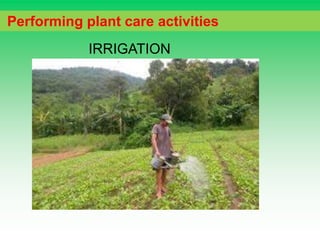
Performing plant care activities
IRRIGATION
General procedures in plant care
• Visit the plants everyday and observe presence of pests and
diseases
• Water the plants every other day preferably in the morning
• Weed the plants when needed by hand weeding
• Spray concoction to make the soil healthy (feed the soil, not
the plant)
• For faster growth, spray IMO & FPJ
• Spray FFJ to make fruits healthy and good taste
• Spray OHN and LABS when there are insect pests and
diseases observed
• Plant insect repellants around the garden
• Practice crop rotation
Performing plant care activities
Organic Control Methods
• Introduction of beneficial microorganisms
• Increase population of natural enemies by planting
alternative host plant for natural enemies
• Use parasitoid
• Maintain sanitation in the field
• Plant sacrificial plant
Performing plant care activities
Improving soil fertility
• Use of organic fertilizer
• Loosen the soil and spray IMO to increase the
growth of beneficial microorganism
• Practice intercropping
• Application of green manure
• Practice crop rotation
• Prevent soil erosion through cover cropping
• Practice fallow period
Performing plant care activities
Applying basal and foliar fertilizer
• Basal fertilizer is applied in the soil by digging holes
or mixing basal fertilizer into the soil of preferred
bed before planting the seedling.
• Foliar fertilizer is applied by spraying into the plant
leaves and body during ambient temperature while
the stomata is open.
Performing plant care activities
8. USE MULCH
• Mulch – a protective covering, usually of organic
matter such as leaves, straw, placed around plants
to prevent the evaporation of moisture and the
growth of weeds.
• For wet and dry season
• For weed control
• As soil protection
• To protect the fruits
• Reduces pests and diseases
• Saves on watering and labor
• Better quality of crops and yields
Rice straw mulch in eggplant
Eggplant
LAND PREPARATION
1.Thorough land preparation by alternate
plowing and harrowing two to three
times depending on the soil type
2.Pulverize the soil
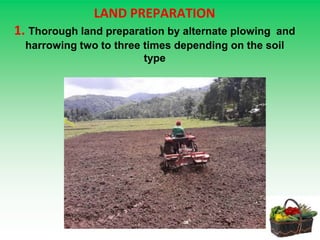
LAND PREPARATION
1. Thorough land preparation by alternate plowing and
harrowing two to three times depending on the soil
type
LAND PREPARATION
2. Pulverize the soil
2. Direct seeding
Pole sitao - plant two to three seeds/hill.
Cover with 2-2.5 cm with pulverized soil. At
10 days after emergence (DAE), thin out
seedling to one plant per hill.
Ampalaya – Break the seed coat lightly and
soak the seeds in water for 24 hours, then
wash. Incubate for 24 – 48 hours until the
radicle appear. Plant the seeds with uniform
germination to have uniform stand of plant
in the field
SEEDLING ESTABLISHMENT
Vigorous seedlings are the foundation of
vigorous plants
- can tolerate certain level of pest
infestation and disease infection
Production of Seedlings
1.Soil medium preparation
- Prepare the soil medium by thoroughly
mixing a 1:1:1 ratio garden soil,
compost, and one of the three:
carbonated rice hull/rice hull/coir
dust/saw dust
2. Sowing of seeds
a. Use of seedling tray
• multi cell plastic trays are available in
different sizes (50 to 140 cells per tray)
• The soil media is filled into the plastic
tray
• Depending on the crop, one to two seeds
are placed into each cell
• Depth of sowing depends on the size of
the seed. As a rule of thumb, it should be
only twice the size of the seed
3. Care of seedlings
•Water the sown seeds once a day
during the first 3 days
•For seedlings sown in seedbox,
prick the seedlings 3-5 days after
germination and transplant to
seedling trays (1 seedling per cell)
Pricking is not done for seeds sown
directly in plastic seedling tray
Hardened seedlings can easily recover from
stress during transplanting
•Seedlings 3-4 week old are ready for
transplanting
CROP DAYS TO
TRANSPLANTING
AFTER SOWING
EGGPLANT 21-30
TOMATO 18-21
PECHAY 10-14
4. Transplanting
•Transplant the seedling during cloudy
days, cool weather or in the afternoon
when the sun is not too hot to avoid
seedling shock.
•Minimize root injuries/disturbance.
•Remove the seedlings from the
seedling tray with the soil medium as
compact as possible.
Lay Out
Planting distance: 0.40 m x 0.50m distance between hills, 2
rows in a plot for eggplant and ampalaya
Planting distance: 0.40 m x 0.50m distance between
hills, 2 rows in a plot for ampalaya
Lay Out
Planting distance of
0.40 m distance
between hills, 2
rows in a plot
Lay Out
Lay Out
Planting Distance: 0.15m x 0.15m between
hills, 5 rows in a plot
CARE AND MAINTENANCE OF THE PLANTS
1. Fertilization
- to provide plants that are lacking in the soil by using
organic fertilizer
- Organic fertilizers include composts and
microbial based fertilizers
- Fertilizers are applied basal (applied before
planting or transplanting)
Characteristics of organic fertilizers
1. Low nutrient content
2. Slow effect
3. Can be dried and stored for a long time
4. Promote good condition of the soil
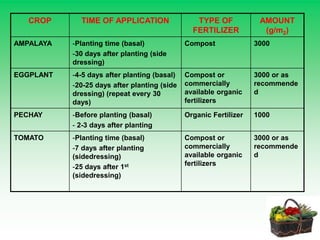
CROP TIME OF APPLICATION TYPE OF
FERTILIZER
AMOUNT
(g/m2)
AMPALAYA -Planting time (basal)
-30 days after planting (side
dressing)
Compost 3000
EGGPLANT -4-5 days after planting (basal)
-20-25 days after planting (side
dressing) (repeat every 30
days)
Compost or
commercially
available organic
fertilizers
3000 or as
recommende
d
PECHAY -Before planting (basal)
- 2-3 days after planting
Organic Fertilizer 1000
TOMATO -Planting time (basal)
-7 days after planting
(sidedressing)
-25 days after 1st
(sidedressing)
Compost or
commercially
available organic
fertilizers
3000 or as
recommende
d
CROP SPECIAL CULTURAL
PRACTICES
TOMATO Single staking (wet
season)
POLE SITAO Trellising (inverted v
type)
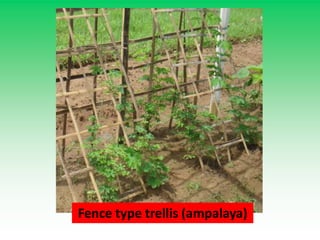
AMPALAYA Trellising (fence
type)
CROP SPECIAL CULTURAL PRACTICES
TOMATO Single staking (wet season)
CROP SPECIAL CULTURAL PRACTICES
POLE SITAO Trellising (inverted v type)
• Trellising – providing support to
climbing plants
1. Ampalaya
• Before the vines creep, construct
vertical, overhead or fence type
trellises.
• Lay-out 2.5 m long and 2 – 2.5 cm
wide ipil-ipil, bamboo or kakawate
poles 2 m apart within rows
2. Pole sitao
• Provide wood or bamboo trellis
measuring two meters for climbing
vines.
• Provide vertical single support trellis
made from either bamboo or wood,
with a height of 2 m.
Fence type trellis (ampalaya)
Overhead type trellis
(ampalaya)
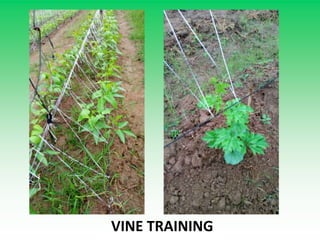
• VINE TRAINING( ampalaya, pole sitao)
-train the vines by spreading them evenly
across the trellis until they reach the top
PRUNING (ampalaya)
• Remove the lower lateral or branches to
facilitate vine growth at the top of the
trellis
VINE TRAINING
PRUNING
Weed Control
1. Remove weeds around the plants
2. Cut-off the weeds in between rows
using a scythe.
MULCHING
-Mulch with rice straw to control weeds
and conserve soil moisture
Weed Control
VEGETABLE-SOA.ppt

VEGETABLE-SOA.ppt

  • 1.
    Organic Vegetable Production Johnny H.Pasaquian ATI Region XII Tantangan, South Cotabato
  • 2.
    1. Perform plant careand management 1. Water management is implemented according to plan. 2. Effective control measures are determined on specific pest and diseases as described under the “pest, disease and weed management” of the PNS 3. All missing hills are replanted to maintain the desired plant population of the area 4. Plant rejuvenation/rationing are maintained according to PNS. 5. Organic fertilizers are applied in accordance with fertilization policy of the PNS LEARNING OUTCOME
  • 3.
    Preparing growth media •Use the ratio of 1:1:1 • One (1) part of ordinary garden soil, one (1) part of vermicompost and one (1) part of coco coir dust or carbonized rice hull • Introduce beneficial microorganisms Establishing Organic Nursery
  • 4.
    Preparing the seedbed •Clear the area and prepare growth media • Sterilize plots through sun drying or hot water treatment • Introduce beneficial microorganisms • Provide access to clean and unchlorinated water • Prepare the seedbeds using indigenous materials • Seedling trays maybe used or “arorong” • Strictly record the activities Establishing Organic Nursery
  • 5.
    Preparing the land •Thorough land preparation by pulverizing soil and make it free from weeds • Construct canals and waterways for proper drainage • One meter of width of plot (distance depends upon the crop to be planted) • Sterilize plots • Introduce beneficial microorganisms • Strictly record the activities Planting Seedlings
  • 6.
    Procedures of Plantingand Transplanting • Land Preparation • Staking • Establishing distance • Holing • Sterilizing • Basal application • Spraying concoctions • Planting Planting Seedlings
  • 7.
  • 8.
    Performing plant careactivities IRRIGATION
  • 9.
    General procedures inplant care • Visit the plants everyday and observe presence of pests and diseases • Water the plants every other day preferably in the morning • Weed the plants when needed by hand weeding • Spray concoction to make the soil healthy (feed the soil, not the plant) • For faster growth, spray IMO & FPJ • Spray FFJ to make fruits healthy and good taste • Spray OHN and LABS when there are insect pests and diseases observed • Plant insect repellants around the garden • Practice crop rotation Performing plant care activities
  • 10.
    Organic Control Methods •Introduction of beneficial microorganisms • Increase population of natural enemies by planting alternative host plant for natural enemies • Use parasitoid • Maintain sanitation in the field • Plant sacrificial plant Performing plant care activities
  • 11.
    Improving soil fertility •Use of organic fertilizer • Loosen the soil and spray IMO to increase the growth of beneficial microorganism • Practice intercropping • Application of green manure • Practice crop rotation • Prevent soil erosion through cover cropping • Practice fallow period Performing plant care activities
  • 12.
    Applying basal andfoliar fertilizer • Basal fertilizer is applied in the soil by digging holes or mixing basal fertilizer into the soil of preferred bed before planting the seedling. • Foliar fertilizer is applied by spraying into the plant leaves and body during ambient temperature while the stomata is open. Performing plant care activities
  • 13.
    8. USE MULCH •Mulch – a protective covering, usually of organic matter such as leaves, straw, placed around plants to prevent the evaporation of moisture and the growth of weeds. • For wet and dry season • For weed control • As soil protection • To protect the fruits • Reduces pests and diseases • Saves on watering and labor • Better quality of crops and yields
  • 14.
    Rice straw mulchin eggplant
  • 15.
  • 16.
    LAND PREPARATION 1.Thorough landpreparation by alternate plowing and harrowing two to three times depending on the soil type 2.Pulverize the soil
  • 17.
    LAND PREPARATION 1. Thoroughland preparation by alternate plowing and harrowing two to three times depending on the soil type
  • 18.
  • 19.
    2. Direct seeding Polesitao - plant two to three seeds/hill. Cover with 2-2.5 cm with pulverized soil. At 10 days after emergence (DAE), thin out seedling to one plant per hill. Ampalaya – Break the seed coat lightly and soak the seeds in water for 24 hours, then wash. Incubate for 24 – 48 hours until the radicle appear. Plant the seeds with uniform germination to have uniform stand of plant in the field
  • 20.
    SEEDLING ESTABLISHMENT Vigorous seedlingsare the foundation of vigorous plants - can tolerate certain level of pest infestation and disease infection Production of Seedlings 1.Soil medium preparation - Prepare the soil medium by thoroughly mixing a 1:1:1 ratio garden soil, compost, and one of the three: carbonated rice hull/rice hull/coir dust/saw dust
  • 21.
    2. Sowing ofseeds a. Use of seedling tray • multi cell plastic trays are available in different sizes (50 to 140 cells per tray) • The soil media is filled into the plastic tray • Depending on the crop, one to two seeds are placed into each cell • Depth of sowing depends on the size of the seed. As a rule of thumb, it should be only twice the size of the seed
  • 22.
    3. Care ofseedlings •Water the sown seeds once a day during the first 3 days •For seedlings sown in seedbox, prick the seedlings 3-5 days after germination and transplant to seedling trays (1 seedling per cell) Pricking is not done for seeds sown directly in plastic seedling tray
  • 23.
    Hardened seedlings caneasily recover from stress during transplanting •Seedlings 3-4 week old are ready for transplanting
  • 24.
    CROP DAYS TO TRANSPLANTING AFTERSOWING EGGPLANT 21-30 TOMATO 18-21 PECHAY 10-14
  • 25.
    4. Transplanting •Transplant theseedling during cloudy days, cool weather or in the afternoon when the sun is not too hot to avoid seedling shock. •Minimize root injuries/disturbance. •Remove the seedlings from the seedling tray with the soil medium as compact as possible.
  • 26.
    Lay Out Planting distance:0.40 m x 0.50m distance between hills, 2 rows in a plot for eggplant and ampalaya
  • 27.
    Planting distance: 0.40m x 0.50m distance between hills, 2 rows in a plot for ampalaya Lay Out
  • 28.
    Planting distance of 0.40m distance between hills, 2 rows in a plot Lay Out
  • 29.
    Lay Out Planting Distance:0.15m x 0.15m between hills, 5 rows in a plot
  • 30.
    CARE AND MAINTENANCEOF THE PLANTS 1. Fertilization - to provide plants that are lacking in the soil by using organic fertilizer - Organic fertilizers include composts and microbial based fertilizers - Fertilizers are applied basal (applied before planting or transplanting)
  • 31.
    Characteristics of organicfertilizers 1. Low nutrient content 2. Slow effect 3. Can be dried and stored for a long time 4. Promote good condition of the soil
  • 32.
    CROP TIME OFAPPLICATION TYPE OF FERTILIZER AMOUNT (g/m2) AMPALAYA -Planting time (basal) -30 days after planting (side dressing) Compost 3000 EGGPLANT -4-5 days after planting (basal) -20-25 days after planting (side dressing) (repeat every 30 days) Compost or commercially available organic fertilizers 3000 or as recommende d PECHAY -Before planting (basal) - 2-3 days after planting Organic Fertilizer 1000 TOMATO -Planting time (basal) -7 days after planting (sidedressing) -25 days after 1st (sidedressing) Compost or commercially available organic fertilizers 3000 or as recommende d
  • 33.
    CROP SPECIAL CULTURAL PRACTICES TOMATOSingle staking (wet season) POLE SITAO Trellising (inverted v type) AMPALAYA Trellising (fence type)
  • 34.
    CROP SPECIAL CULTURALPRACTICES TOMATO Single staking (wet season)
  • 35.
    CROP SPECIAL CULTURALPRACTICES POLE SITAO Trellising (inverted v type)
  • 36.
    • Trellising –providing support to climbing plants 1. Ampalaya • Before the vines creep, construct vertical, overhead or fence type trellises. • Lay-out 2.5 m long and 2 – 2.5 cm wide ipil-ipil, bamboo or kakawate poles 2 m apart within rows
  • 37.
    2. Pole sitao •Provide wood or bamboo trellis measuring two meters for climbing vines. • Provide vertical single support trellis made from either bamboo or wood, with a height of 2 m.
  • 38.
  • 39.
  • 40.
    • VINE TRAINING(ampalaya, pole sitao) -train the vines by spreading them evenly across the trellis until they reach the top PRUNING (ampalaya) • Remove the lower lateral or branches to facilitate vine growth at the top of the trellis
  • 41.
  • 42.
  • 43.
    Weed Control 1. Removeweeds around the plants 2. Cut-off the weeds in between rows using a scythe. MULCHING -Mulch with rice straw to control weeds and conserve soil moisture
  • 44.