1
PROPRIETARY MATERIAL. © The McGraw-Hill Companies, Inc. All rights reserved. No part of this Manual
may be displayed, reproduced or distributed in any form or by any means, without the prior written permission of the
publisher, or used beyond the limited distribution to teachers and educators permitted by McGraw-Hill for their
individual course preparation. If you are a student using this Manual, you are using it without permission.
CHAPTER 2
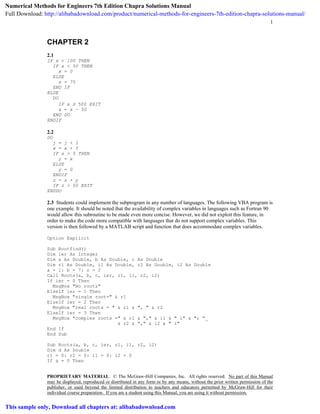
2.1
IF x < 100 THEN
IF x < 50 THEN
x = 0
ELSE
x = 75
END IF
ELSE
DO
IF x  500 EXIT
x = x – 50
END DO
ENDIF
2.2
DO
j = j + 1
x = x + 5
IF x > 5 THEN
y = x
ELSE
y = 0
ENDIF
z = x + y
IF z > 50 EXIT
ENDDO
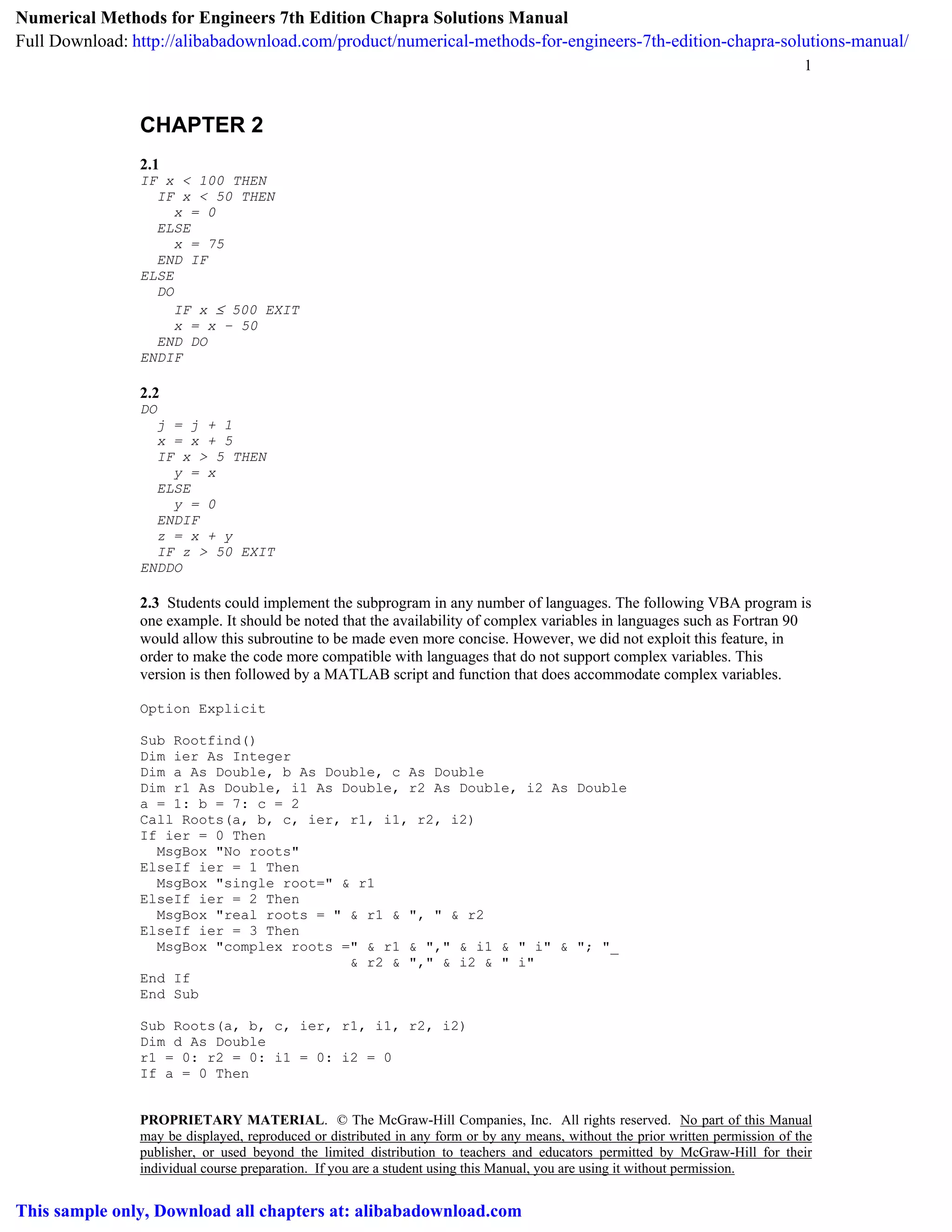
2.3 Students could implement the subprogram in any number of languages. The following VBA program is
one example. It should be noted that the availability of complex variables in languages such as Fortran 90
would allow this subroutine to be made even more concise. However, we did not exploit this feature, in
order to make the code more compatible with languages that do not support complex variables. This
version is then followed by a MATLAB script and function that does accommodate complex variables.
Option Explicit
Sub Rootfind()
Dim ier As Integer
Dim a As Double, b As Double, c As Double
Dim r1 As Double, i1 As Double, r2 As Double, i2 As Double
a = 1: b = 7: c = 2
Call Roots(a, b, c, ier, r1, i1, r2, i2)
If ier = 0 Then
MsgBox "No roots"
ElseIf ier = 1 Then
MsgBox "single root=" & r1
ElseIf ier = 2 Then
MsgBox "real roots = " & r1 & ", " & r2
ElseIf ier = 3 Then
MsgBox "complex roots =" & r1 & "," & i1 & " i" & "; "_
& r2 & "," & i2 & " i"
End If
End Sub
Sub Roots(a, b, c, ier, r1, i1, r2, i2)
Dim d As Double
r1 = 0: r2 = 0: i1 = 0: i2 = 0
If a = 0 Then
Numerical Methods for Engineers 7th Edition Chapra Solutions Manual
Full Download: http://alibabadownload.com/product/numerical-methods-for-engineers-7th-edition-chapra-solutions-manual/
This sample only, Download all chapters at: alibabadownload.com
2
PROPRIETARY MATERIAL. © The McGraw-Hill Companies, Inc. All rights reserved. No part of this Manual
may be displayed, reproduced or distributed in any form or by any means, without the prior written permission of the
publisher, or used beyond the limited distribution to teachers and educators permitted by McGraw-Hill for their
individual course preparation. If you are a student using this Manual, you are using it without permission.
If b <> 0 Then
r1 = -c / b
ier = 1
Else
ier = 0
End If
Else
d = b ^ 2 - 4 * a * c
If (d >= 0) Then
r1 = (-b + Sqr(d)) / (2 * a)
r2 = (-b - Sqr(d)) / (2 * a)
ier = 2
Else
r1 = -b / (2 * a)
r2 = r1
i1 = Sqr(Abs(d)) / (2 * a)
i2 = -i1
ier = 3
End If
End If
End Sub
The answers for the 3 test cases are: (a) 0.2984, 6.702; (b) 0.32; (c) 0.4167 + 1.5789i; 0.4167 
1.5789i.
Several features of this subroutine bear mention:
 The subroutine does not involve input or output. Rather, information is passed in and out via the
arguments. This is often the preferred style, because the I/O is left to the discretion of the programmer
within the calling program.
 Note that a variable is passed (IER) in order to distinguish among the various cases.
MATLAB:
function [r1,r2]=quadroots(a,b,c)
r1 = 0; r2 = 0;
if a == 0
if b ~= 0
r1=-c/b;
else
r1='Trivial solution';
end
else
discr=b^2-4*a*c;
if discr >= 0
r1=(-b+sqrt(discr))/(2*a);
r2=(-b-sqrt(discr))/(2*a);
else
r1 =-b/(2*a); i1=sqrt(abs(discr))/(2*a);
r2=r1-i1*i; r1=r1+i1*i;
end
end
Script:
clc
format compact
disp('(a)'),[r1,r2]=quadroots(1,7,2)
disp('(b)'),[r1,r2]=quadroots(0,-5,1.6)
disp('(c)'),[r1,r2]=quadroots(3,2.5,8)
Output when script is run
3
PROPRIETARY MATERIAL. © The McGraw-Hill Companies, Inc. All rights reserved. No part of this Manual
may be displayed, reproduced or distributed in any form or by any means, without the prior written permission of the
publisher, or used beyond the limited distribution to teachers and educators permitted by McGraw-Hill for their
individual course preparation. If you are a student using this Manual, you are using it without permission.
(a)
r1 =
-0.2984
r2 =
-6.7016
(b)
r1 =
0.3200
r2 =
0
(c)
r1 =
-0.4167 + 1.5789i
r2 =
-0.4167 - 1.5789i
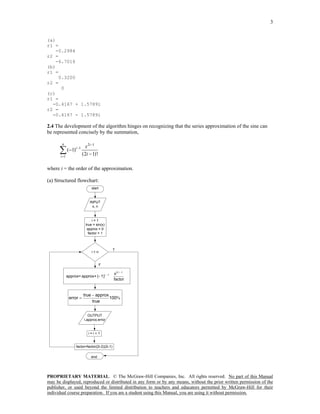
2.4 The development of the algorithm hinges on recognizing that the series approximation of the sine can
be represented concisely by the summation,
2 1
1
1
( 1)
(2 1)!
n i
i
i
x
i





where i = the order of the approximation.
(a) Structured flowchart:
start
INPUT
x, n
i > n
end
i = 1
true = sin(x)
approx = 0
factor = 1
approx approx
x
factor
i
i -
= + -( 1) - 1
2 1
error
true approx
true
100

%
OUTPUT
i,approx,error
i = i + 1
F
T
factor=factor(2i-2)(2i-1)
4
PROPRIETARY MATERIAL. © The McGraw-Hill Companies, Inc. All rights reserved. No part of this Manual
may be displayed, reproduced or distributed in any form or by any means, without the prior written permission of the
publisher, or used beyond the limited distribution to teachers and educators permitted by McGraw-Hill for their
individual course preparation. If you are a student using this Manual, you are using it without permission.
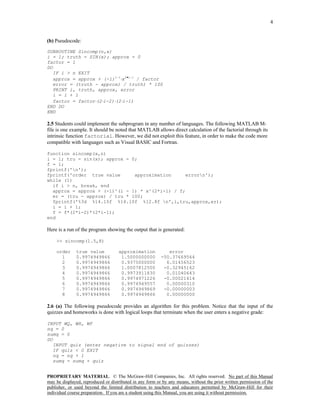
(b) Pseudocode:
SUBROUTINE Sincomp(n,x)
i = 1; truth = SIN(x); approx = 0
factor = 1
DO
IF i > n EXIT
approx = approx + (-1)i-1
x2i-1
/ factor
error = (truth - approx) / truth) * 100
PRINT i, truth, approx, error
i = i + 1
factor = factor(2i-2)(2i-1)
END DO
END
2.5 Students could implement the subprogram in any number of languages. The following MATLAB M-
file is one example. It should be noted that MATLAB allows direct calculation of the factorial through its
intrinsic function factorial. However, we did not exploit this feature, in order to make the code more
compatible with languages such as Visual BASIC and Fortran.
function sincomp(x,n)
i = 1; tru = sin(x); approx = 0;
f = 1;
fprintf('n');
fprintf('order true value approximation errorn');
while (1)
if i > n, break, end
approx = approx + (-1)^(i - 1) * x^(2*i-1) / f;
er = (tru - approx) / tru * 100;
fprintf('%3d %14.10f %14.10f %12.8f n',i,tru,approx,er);
i = i + 1;
f = f*(2*i-2)*(2*i-1);
end
Here is a run of the program showing the output that is generated:
>> sincomp(1.5,8)
order true value approximation error
1 0.9974949866 1.5000000000 -50.37669564
2 0.9974949866 0.9375000000 6.01456523
3 0.9974949866 1.0007812500 -0.32945162
4 0.9974949866 0.9973911830 0.01040643
5 0.9974949866 0.9974971226 -0.00021414
6 0.9974949866 0.9974949557 0.00000310
7 0.9974949866 0.9974949869 -0.00000003
8 0.9974949866 0.9974949866 0.00000000
2.6 (a) The following pseudocode provides an algorithm for this problem. Notice that the input of the
quizzes and homeworks is done with logical loops that terminate when the user enters a negative grade:
INPUT WQ, WH, WF
nq = 0
sumq = 0
DO
INPUT quiz (enter negative to signal end of quizzes)
IF quiz < 0 EXIT
nq = nq + 1
sumq = sumq + quiz
5
PROPRIETARY MATERIAL. © The McGraw-Hill Companies, Inc. All rights reserved. No part of this Manual
may be displayed, reproduced or distributed in any form or by any means, without the prior written permission of the
publisher, or used beyond the limited distribution to teachers and educators permitted by McGraw-Hill for their
individual course preparation. If you are a student using this Manual, you are using it without permission.
END DO
AQ = sumq / nq
nh = 0
sumh = 0
DO
INPUT homework (enter negative to signal end of homeworks)
IF homework < 0 EXIT
nh = nh + 1
sumh = sumh + homework
END DO
AH = sumh / nh
DISPLAY "Is there a final exam (y or n)"
INPUT answer
IF answer = "y" THEN
INPUT FE
AG = (WQ * AQ + WH * AH + WF * FE) / (WQ + WH + WF)
ELSE
AG = (WQ * AQ + WH * AH) / (WQ + WH)
END IF
DISPLAY AG
END
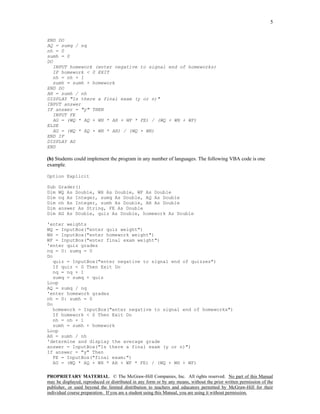
(b) Students could implement the program in any number of languages. The following VBA code is one
example.
Option Explicit
Sub Grader()
Dim WQ As Double, WH As Double, WF As Double
Dim nq As Integer, sumq As Double, AQ As Double
Dim nh As Integer, sumh As Double, AH As Double
Dim answer As String, FE As Double
Dim AG As Double, quiz As Double, homework As Double
'enter weights
WQ = InputBox("enter quiz weight")
WH = InputBox("enter homework weight")
WF = InputBox("enter final exam weight")
'enter quiz grades
nq = 0: sumq = 0
Do
quiz = InputBox("enter negative to signal end of quizzes")
If quiz < 0 Then Exit Do
nq = nq + 1
sumq = sumq + quiz
Loop
AQ = sumq / nq
'enter homework grades
nh = 0: sumh = 0
Do
homework = InputBox("enter negative to signal end of homeworks")
If homework < 0 Then Exit Do
nh = nh + 1
sumh = sumh + homework
Loop
AH = sumh / nh
'determine and display the average grade
answer = InputBox("Is there a final exam (y or n)")
If answer = "y" Then
FE = InputBox("final exam:")
AG = (WQ * AQ + WH * AH + WF * FE) / (WQ + WH + WF)
6
PROPRIETARY MATERIAL. © The McGraw-Hill Companies, Inc. All rights reserved. No part of this Manual
may be displayed, reproduced or distributed in any form or by any means, without the prior written permission of the
publisher, or used beyond the limited distribution to teachers and educators permitted by McGraw-Hill for their
individual course preparation. If you are a student using this Manual, you are using it without permission.
Else
AG = (WQ * AQ + WH * AH) / (WQ + WH)
End If
MsgBox "Average grade = " & AG
End Sub
The results should conform to:
AQ = 442/5 = 88.4
AH = 556/6 = 92.667
without final
30(88.4) 40(92.667)
AG 90.8381
30 40

 

with final
30(88.4) 40(92.667) 30(91)
AG 90.8867
30 40 30
 
 
 
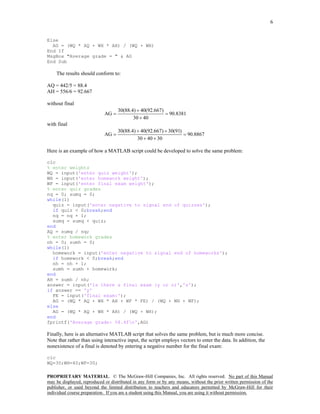
Here is an example of how a MATLAB script could be developed to solve the same problem:
clc
% enter weights
WQ = input('enter quiz weight');
WH = input('enter homework weight');
WF = input('enter final exam weight');
% enter quiz grades
nq = 0; sumq = 0;
while(1)
quiz = input('enter negative to signal end of quizzes');
if quiz < 0;break;end
nq = nq + 1;
sumq = sumq + quiz;
end
AQ = sumq / nq;
% enter homework grades
nh = 0; sumh = 0;
while(1)
homework = input('enter negative to signal end of homeworks');
if homework < 0;break;end
nh = nh + 1;
sumh = sumh + homework;
end
AH = sumh / nh;
answer = input('Is there a final exam (y or n)','s');
if answer == 'y'
FE = input('final exam:');
AG = (WQ * AQ + WH * AH + WF * FE) / (WQ + WH + WF);
else
AG = (WQ * AQ + WH * AH) / (WQ + WH);
end
fprintf('Average grade: %8.4fn',AG)
Finally, here is an alternative MATLAB script that solves the same problem, but is much more concise.
Note that rather than using interactive input, the script employs vectors to enter the data. In addition, the
nonexistence of a final is denoted by entering a negative number for the final exam:
clc
WQ=30;WH=40;WF=30;
7
PROPRIETARY MATERIAL. © The McGraw-Hill Companies, Inc. All rights reserved. No part of this Manual
may be displayed, reproduced or distributed in any form or by any means, without the prior written permission of the
publisher, or used beyond the limited distribution to teachers and educators permitted by McGraw-Hill for their
individual course preparation. If you are a student using this Manual, you are using it without permission.
QG=[98 95 90 60 99];
HG=[98 95 86 100 100 77];
FE=91;
if FE>0
AG=(WQ*mean(QG)+WH*mean(HG)+WF*FE)/(WQ+WH+WF);
else
AG=(WQ*mean(QG)+WH*mean(HG))/(WQ+WH);
end
fprintf('Average grade: %8.4fn',AG)
2.7 (a) Pseudocode:
IF a > 0 THEN
tol = 10–6
x = a/2
DO
y = (x + a/x)/2
e = (y – x)/y
x = y
IF e < tol EXIT
END DO
SquareRoot = x
ELSE
SquareRoot = 0
END IF
(b) Students could implement the function in any number of languages. The following VBA and MATLAB
codes are two possible options.
VBA Function Procedure MATLAB M-File
Option Explicit
Function SquareRoot(a)
Dim x As Double, y As Double
Dim e As Double, tol As Double
If a > 0 Then
tol = 0.000001
x = a / 2
Do
y = (x + a / x) / 2
e = Abs((y - x) / y)
x = y
If e < tol Then Exit Do
Loop
SquareRoot = x
Else
SquareRoot = 0
End If
End Function
function s = SquareRoot(a)
if a > 0
tol = 0.000001;
x = a / 2;
while(1)
y = (x + a / x) / 2;
e = abs((y - x) / y);
x = y;
if e < tol, break, end
end
s = x;
else
s = 0;
end
2.8 A MATLAB M-file can be written to solve this problem as
function futureworth(P, i, n)
nn = 0:n;
F = P*(1+i).^nn;
y = [nn;F];
fprintf('n year future worthn');
fprintf('%5d %14.2fn',y);
This function can be used to evaluate the test case,
8
PROPRIETARY MATERIAL. © The McGraw-Hill Companies, Inc. All rights reserved. No part of this Manual
may be displayed, reproduced or distributed in any form or by any means, without the prior written permission of the
publisher, or used beyond the limited distribution to teachers and educators permitted by McGraw-Hill for their
individual course preparation. If you are a student using this Manual, you are using it without permission.
>> futureworth(100000,0.04,11)
year future worth
0 100000.00
1 104000.00
2 108160.00
3 112486.40
4 116985.86
5 121665.29
6 126531.90
7 131593.18
8 136856.91
9 142331.18
10 148024.43
11 153945.41
2.9 A MATLAB M-file can be written to solve this problem as
function annualpayment(P, i, n)
nn = 1:n;
A = P*i*(1+i).^nn./((1+i).^nn-1);
y = [nn;A];
fprintf('n year annual paymentn');
fprintf('%5d %14.2fn',y);
This function can be used to evaluate the test case,
>> annualpayment(55000,0.066,5)
year annual payment
1 58630.00
2 30251.49
3 20804.86
4 16091.17
5 13270.64
2.10 Students could implement the function in any number of languages. The following VBA and
MATLAB codes are two possible options.
VBA Function Procedure MATLAB M-File
Option Explicit
Function avgtemp(Tm, Tp, ts, te)
Dim pi As Double, w As Double
Dim Temp As Double, t As Double
Dim sum As Double, i As Integer
Dim n As Integer
pi = 4 * Atn(1)
w = 2 * pi / 365
sum = 0
n = 0
t = ts
For i = ts To te
Temp = Tm+(Tp-Tm)*Cos(w*(t-205))
sum = sum + Temp
n = n + 1
t = t + 1
Next i
avgtemp = sum / n
End Function
function Ta = avgtemp(Tm,Tp,ts,te)
w = 2*pi/365;
t = ts:te;
T = Tm + (Tp-Tm)*cos(w*(t-205));
Ta = mean(T);
9
PROPRIETARY MATERIAL. © The McGraw-Hill Companies, Inc. All rights reserved. No part of this Manual
may be displayed, reproduced or distributed in any form or by any means, without the prior written permission of the
publisher, or used beyond the limited distribution to teachers and educators permitted by McGraw-Hill for their
individual course preparation. If you are a student using this Manual, you are using it without permission.
The function can be used to evaluate the test cases. The following show the results for MATLAB,
>> avgtemp(22.1,28.3,0,59)
ans =
16.2148
>> avgtemp(10.7,22.9,180,242)
ans =
22.2491
2.11 The programs are student specific and will be similar to the codes developed for VBA and MATLAB
as outlined in sections 2.4 and 2.5. For example, the following MATLAB script was developed to use the
function from section 2.5 to compute and tabulate the numerical results for the value at t = 12 s, along with
an estimate of the absolute value of the true relative error based on the analytical solution:
clc; format compact
m=68.1; cd=12.5;
ti=0; tf=12.;
vi=0;
vtrue=9.81*m/cd*(1-exp(-cd/m*tf))
dt=[2 1 0.5]';
for i = 1:3
v(i)=euler(dt(i),ti,tf,vi,m,cd);
end
et=abs((vtrue-v)/vtrue*100);
z=[dt v' et']';
fprintf(' dt v(12) et(pct)n')
fprintf('%10.3f %10.3f %10.3fn',z);
Output:
vtrue =
47.5387
dt v(12) et(pct)
2.000 50.010 5.199
1.000 48.756 2.561
0.500 48.142 1.269
The general conclusion is that the error is halved when the step size is halved.
2.12 Students could implement the subprogram in any number of languages. The following VBA/Excel and
MATLAB programs are two examples based on the algorithm outlined in Fig. P2.12.
VBA/Excel MATLAB
Option Explicit
Sub Bubble(n, b)
Dim m As Integer, i As Integer
Dim switch As Boolean, dum As Double
m = n - 1
Do
switch = False
For i = 1 To m
If b(i) > b(i + 1) Then
dum = b(i)
b(i) = b(i + 1)
b(i + 1) = dum
function y = Bubble(x)
n = length(x);
m = n - 1;
b = x;
while(1)
s = 0;
for i = 1:m
if b(i) > b(i + 1)
dum = b(i);
b(i) = b(i + 1);
b(i + 1) = dum;
10
PROPRIETARY MATERIAL. © The McGraw-Hill Companies, Inc. All rights reserved. No part of this Manual
may be displayed, reproduced or distributed in any form or by any means, without the prior written permission of the
publisher, or used beyond the limited distribution to teachers and educators permitted by McGraw-Hill for their
individual course preparation. If you are a student using this Manual, you are using it without permission.
switch = True
End If
Next i
If switch = False Then Exit Do
m = m - 1
Loop
End Sub
s = 1;
end
end
if s == 0, break, end
m = m - 1;
end
y = b;
Notice how the MATLAB length function allows us to omit the length of the vector in the function
argument. Here is an example MATLAB script that invokes the function to sort a vector:
clc
a=[6 3 4 2 1 5 7];
Bubble(a)
ans =
1 2 3 4 5 6 7
2.13 Students could implement the function in any number of languages. The following VBA and
MATLAB codes are two possible options.
VBA Function Procedure MATLAB M-File
Option Explicit
Function Vol(R, d)
Dim V1 As Double, V2 As Double
Dim pi As Double
pi = 4 * Atn(1)
If d < R Then
Vol = pi * d ^ 3 / 3
ElseIf d <= 3 * R Then
V1 = pi * R ^ 3 / 3
V2 = pi * R ^ 2 * (d - R)
Vol = V1 + V2
Else
Vol = "overtop"
End If
End Function
function Vol = tankvolume(R, d)
if d < R
Vol = pi * d ^ 3 / 3;
elseif d <= 3 * R
V1 = pi * R ^ 3 / 3;
V2 = pi * R ^ 2 * (d - R);
Vol = V1 + V2;
else
Vol = 'overtop';
end
The results are:
R d Volume
1 0.5 0.1309
1 1.2 1.675516
1 3 7.330383
1 3.1 overtop
2.14 Here is a flowchart for the algorithm:
11
PROPRIETARY MATERIAL. © The McGraw-Hill Companies, Inc. All rights reserved. No part of this Manual
may be displayed, reproduced or distributed in any form or by any means, without the prior written permission of the
publisher, or used beyond the limited distribution to teachers and educators permitted by McGraw-Hill for their
individual course preparation. If you are a student using this Manual, you are using it without permission.
Function Polar(x, y)
22
yxr 
x < 0
y > 0y > 0
 





 
x
y1
tan
 





 
x
y1
tan  





 
x
y1
tan 
2

 
y < 0
2

 
 
y < 0

 180Polar

180Polar
End Polar
 = 3.141593
T
T
T
T
T
F
F
F
F
x > 0
 





 
x
y1
tan
TF
F
Students could implement the function in any number of languages. The following MATLAB M-file is
one option. Versions in other languages such as Fortran 90, Visual Basic, or C would have a similar
structure.
function polar(x, y)
r = sqrt(x .^ 2 + y .^ 2);
n = length(x);
for i = 1:n
if x(i) > 0
th(i) = atan(y(i) / x(i));
elseif x(i) < 0
if y(i) > 0
th(i) = atan(y(i) / x(i)) + pi;
elseif y(i) < 0
th(i) = atan(y(i) / x(i)) - pi;
else
th(i) = pi;
end
else
if y(i) > 0
th(i) = pi / 2;
elseif y(i) < 0
th(i) = -pi / 2;
else
th(i) = 0;
end
end
th(i) = th(i) * 180 / pi;
end
ou=[x;y;r;th];
12
PROPRIETARY MATERIAL. © The McGraw-Hill Companies, Inc. All rights reserved. No part of this Manual
may be displayed, reproduced or distributed in any form or by any means, without the prior written permission of the
publisher, or used beyond the limited distribution to teachers and educators permitted by McGraw-Hill for their
individual course preparation. If you are a student using this Manual, you are using it without permission.
fprintf('n x y radius anglen');
fprintf('%8.2f %8.2f %10.4f %10.4f n',ou);
This function can be used to evaluate the test cases as in the following script:
clc; format compact
x=[1 1 0 -1 -1 -1 0 1 0];
y=[0 1 1 1 0 -1 -1 -1 0];
polar(x,y)
When the script is run, the resulting output is
x y radius angle
1.00 0.00 1.0000 0.0000
1.00 1.00 1.4142 45.0000
0.00 1.00 1.0000 90.0000
-1.00 1.00 1.4142 135.0000
-1.00 0.00 1.0000 180.0000
-1.00 -1.00 1.4142 -135.0000
0.00 -1.00 1.0000 -90.0000
1.00 -1.00 1.4142 -45.0000
0.00 0.00 0.0000 0.0000
2.15 Students could implement the function in any number of languages. The following VBA and
MATLAB codes are two possible options.
VBA Function Procedure MATLAB M-File
Function grade(s)
If s >= 90 Then
grade = "A"
ElseIf s >= 80 Then
grade = "B"
ElseIf s >= 70 Then
grade = "C"
ElseIf s >= 60 Then
grade = "D"
Else
grade = "F"
End If
End Function
function grade = lettergrade(score)
if score >= 90
grade = 'A';
elseif score >= 80
grade = 'B';
elseif score >= 70
grade = 'C';
elseif score >= 60
grade = 'D';
else
grade = 'F';
end
2.16 Students could implement the functions in any number of languages. The following VBA and
MATLAB codes are two possible options.
VBA Function Procedure MATLAB M-File
(a) Factorial
Function factor(n)
Dim x As Long, i As Integer
x = 1
For i = 1 To n
x = x * i
Next i
factor = x
End Function
(b) Minimum
Function min(x, n)
Dim i As Integer
min = x(1)
function fout = factor(n)
x = 1;
for i = 1:n
x = x * i;
end
fout = x;
function xm = xmin(x)
n = length(x);
xm = x(1);
13
PROPRIETARY MATERIAL. © The McGraw-Hill Companies, Inc. All rights reserved. No part of this Manual
may be displayed, reproduced or distributed in any form or by any means, without the prior written permission of the
publisher, or used beyond the limited distribution to teachers and educators permitted by McGraw-Hill for their
individual course preparation. If you are a student using this Manual, you are using it without permission.
For i = 2 To n
If x(i) < min Then min = x(i)
Next i
End Function
(c) Average
Function mean(x, n)
Dim sum As Double
Dim i As Integer
sum = x(1)
For i = 2 To n
sum = sum + x(i)
Next i
mean = sum / n
End Function
for i = 2:n
if x(i) < xm, xm = x(i); end
end
function xm = xmean(x)
n = length(x);
s = x(1);
for i = 2:n
s = s + x(i);
end
xm = s / n;
2.17 Students could implement the functions in any number of languages. The following VBA and
MATLAB codes are two possible options.
VBA Function Procedure MATLAB M-File
(a) Square root sum of squares
Function SSS(x, n, m)
Dim i As Integer, j As Integer
SSS = 0
For i = 1 To n
For j = 1 To m
SSS = SSS + x(i, j) ^ 2
Next j
Next i
SSS = Sqr(SSS)
End Function
(b) Normalization
Sub normal(x, n, m, y)
Dim i As Integer, j As Integer
Dim max As Double
For i = 1 To n
max = Abs(x(i, 1))
For j = 2 To m
If Abs(x(i, j)) > max Then
max = x(i, j)
End If
Next j
For j = 1 To m
y(i, j) = x(i, j) / max
Next j
Next i
End Sub
function s = SSS(x)
[n,m] = size(x);
s = 0;
for i = 1:n
for j = 1:m
s = s + x(i, j) ^ 2;
end
end
s = sqrt(s);
function y = normal(x)
[n,m] = size(x);
for i = 1:n
mx = abs(x(i, 1));
for j = 2:m
if abs(x(i, j)) > mx
mx = x(i, j);
end
end
for j = 1:m
y(i, j) = x(i, j) / mx;
end
end
Alternate version:
function y = normal(x)
n = size(x);
for i = 1:n
y(i,:) = x(i,:)/max(x(i,:));
end
2.18 The following MATLAB function implements the piecewise function:
function v = vpiece(t)
if t<0
v = 0;
14
PROPRIETARY MATERIAL. © The McGraw-Hill Companies, Inc. All rights reserved. No part of this Manual
may be displayed, reproduced or distributed in any form or by any means, without the prior written permission of the
publisher, or used beyond the limited distribution to teachers and educators permitted by McGraw-Hill for their
individual course preparation. If you are a student using this Manual, you are using it without permission.
elseif t<10
v = 11*t^2 - 5*t;
elseif t<20
v = 1100 - 5*t;
elseif t<30
v = 50*t + 2*(t - 20)^2;
else
v = 1520*exp(-0.2*(t-30));
end
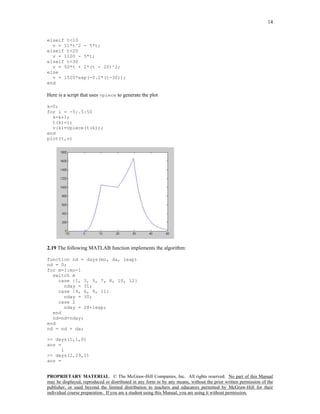
Here is a script that uses vpiece to generate the plot
k=0;
for i = -5:.5:50
k=k+1;
t(k)=i;
v(k)=vpiece(t(k));
end
plot(t,v)
2.19 The following MATLAB function implements the algorithm:
function nd = days(mo, da, leap)
nd = 0;
for m=1:mo-1
switch m
case {1, 3, 5, 7, 8, 10, 12}
nday = 31;
case {4, 6, 9, 11}
nday = 30;
case 2
nday = 28+leap;
end
nd=nd+nday;
end
nd = nd + da;
>> days(1,1,0)
ans =
1
>> days(2,29,1)
ans =
15
PROPRIETARY MATERIAL. © The McGraw-Hill Companies, Inc. All rights reserved. No part of this Manual
may be displayed, reproduced or distributed in any form or by any means, without the prior written permission of the
publisher, or used beyond the limited distribution to teachers and educators permitted by McGraw-Hill for their
individual course preparation. If you are a student using this Manual, you are using it without permission.
60
>> days(3,1,0)
ans =
60
>> days(6,21,0)
ans =
172
>> days(12,31,1)
ans =
366
2.20 The following MATLAB function implements the algorithm:
function nd = days(mo, da, year)
leap = 0;
if year / 4 - fix(year / 4) == 0, leap = 1; end
nd = 0;
for m=1:mo-1
switch m
case {1, 3, 5, 7, 8, 10, 12}
nday = 31;
case {4, 6, 9, 11}
nday = 30;
case 2
nday = 28+leap;
end
nd=nd+nday;
end
nd = nd + da;
>> days(1,1,1999)
ans =
1
>> days(2,29,2000)
ans =
60
>> days(3,1,2001)
ans =
60
>> days(6,21,2002)
ans =
172
>> days(12,31,2004)
ans =
366
2.21 A MATLAB M-file can be written as
function Manning(A)
A(:,5)=sqrt(A(:,2))./A(:,1).*(A(:,3).*A(:,4)./(A(:,3)+2*A(:,4))).^(2/3);
fprintf('n n S B H Un');
fprintf('%8.3f %8.4f %10.2f %10.2f %10.4fn',A');
This function can be run to create the table,
>> A=[.035 .0001 10 2
.020 .0002 8 1
.015 .001 20 1.5
.03 .0007 24 3
.022 .0003 15 2.5];
16
PROPRIETARY MATERIAL. © The McGraw-Hill Companies, Inc. All rights reserved. No part of this Manual
may be displayed, reproduced or distributed in any form or by any means, without the prior written permission of the
publisher, or used beyond the limited distribution to teachers and educators permitted by McGraw-Hill for their
individual course preparation. If you are a student using this Manual, you are using it without permission.
>> Manning(A)
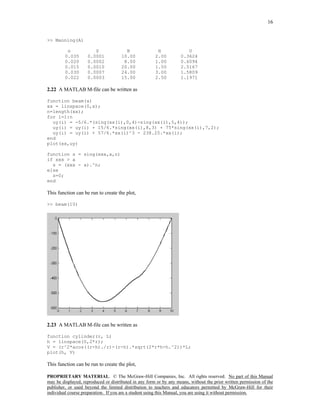
n S B H U
0.035 0.0001 10.00 2.00 0.3624
0.020 0.0002 8.00 1.00 0.6094
0.015 0.0010 20.00 1.50 2.5167
0.030 0.0007 24.00 3.00 1.5809
0.022 0.0003 15.00 2.50 1.1971
2.22 A MATLAB M-file can be written as
function beam(x)
xx = linspace(0,x);
n=length(xx);
for i=1:n
uy(i) = -5/6.*(sing(xx(i),0,4)-sing(xx(i),5,4));
uy(i) = uy(i) + 15/6.*sing(xx(i),8,3) + 75*sing(xx(i),7,2);
uy(i) = uy(i) + 57/6.*xx(i)^3 - 238.25.*xx(i);
end
plot(xx,uy)
function s = sing(xxx,a,n)
if xxx > a
s = (xxx - a).^n;
else
s=0;
end
This function can be run to create the plot,
>> beam(10)
2.23 A MATLAB M-file can be written as
function cylinder(r, L)
h = linspace(0,2*r);
V = (r^2*acos((r-h)./r)-(r-h).*sqrt(2*r*h-h.^2))*L;
plot(h, V)
This function can be run to create the plot,
17
PROPRIETARY MATERIAL. © The McGraw-Hill Companies, Inc. All rights reserved. No part of this Manual
may be displayed, reproduced or distributed in any form or by any means, without the prior written permission of the
publisher, or used beyond the limited distribution to teachers and educators permitted by McGraw-Hill for their
individual course preparation. If you are a student using this Manual, you are using it without permission.
>> cylinder(2,5)
2.24 Before the chute opens (t < 10), Euler’s method can be implemented as
ttvtvttv 





 )(
80
10
8.9)()(
After the chute opens (t  10), the drag coefficient is changed and the implementation becomes
ttvtvttv 





 )(
80
50
8.9)()(
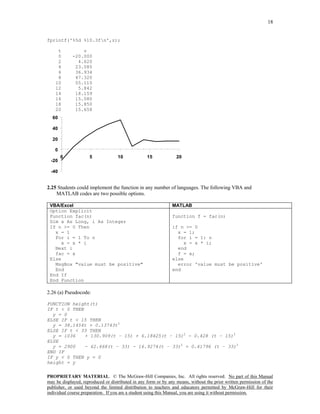
You can implement the subprogram in any number of languages. The following MATLAB M-file is one
example. Notice that the results are inaccurate because the stepsize is too big. A smaller stepsize should be
used to attain adequate accuracy.
function parachute
g = 9.81;
m = 80; c = 10;
ti = 0; tf = 20; dt = 2;
vi = -20;
tc = 10; cc = 50;
np = (tf - ti) / dt;
t = ti; v = vi;
tout(1) = t; vout(1) = v;
for i = 1:np
if t < tc
dvdt = g - c / m * v;
else
dvdt = g - cc / m * v;
end
v = v + dvdt * dt;
t = t + dt;
tout(i+1) = t; vout(i+1) = v;
end
plot(tout,vout)
z=[tout;vout]
fprintf(' t vn');
18
PROPRIETARY MATERIAL. © The McGraw-Hill Companies, Inc. All rights reserved. No part of this Manual
may be displayed, reproduced or distributed in any form or by any means, without the prior written permission of the
publisher, or used beyond the limited distribution to teachers and educators permitted by McGraw-Hill for their
individual course preparation. If you are a student using this Manual, you are using it without permission.
fprintf('%5d %10.3fn',z);
t v
0 -20.000
2 4.620
4 23.085
6 36.934
8 47.320
10 55.110
12 5.842
14 18.159
16 15.080
18 15.850
20 15.658
-40
-20
0
20
40
60
0 5 10 15 20
2.25 Students could implement the function in any number of languages. The following VBA and
MATLAB codes are two possible options.
VBA/Excel MATLAB
Option Explicit
Function fac(n)
Dim x As Long, i As Integer
If n >= 0 Then
x = 1
For i = 1 To n
x = x * i
Next i
fac = x
Else
MsgBox "value must be positive"
End
End If
End Function
function f = fac(n)
if n >= 0
x = 1;
for i = 1: n
x = x * i;
end
f = x;
else
error 'value must be positive'
end
2.26 (a) Pseudocode:
FUNCTION height(t)
IF t < 0 THEN
y = 0
ELSE IF t < 15 THEN
y = 38.1454t + 0.13743t3
ELSE IF t < 33 THEN
y = 1036 + 130.909(t – 15) + 6.18425(t – 15)2
- 0.428 (t – 15)3
ELSE
y = 2900 - 62.468(t – 33) - 16.9274(t – 33)2
+ 0.41796 (t – 33)3
END IF
IF y < 0 THEN y = 0
height = y
19
PROPRIETARY MATERIAL. © The McGraw-Hill Companies, Inc. All rights reserved. No part of this Manual
may be displayed, reproduced or distributed in any form or by any means, without the prior written permission of the
publisher, or used beyond the limited distribution to teachers and educators permitted by McGraw-Hill for their
individual course preparation. If you are a student using this Manual, you are using it without permission.
END
(b) MATLAB:
function y = height(t)
%Function to compute height of rocket from piecewise function
% y = height(t)
% input:
% t = time
% output:
% y = height
if t < 0
y = 0;
elseif t < 15
y = 38.14544*t + 0.137428*t^3;
elseif t < 33
y = 1036 + 130.909*(t - 15) + 6.18425*(t - 15)^2 - 0.428*(t - 15)^3;
else
y = 2900 - 62.468*(t - 33) - 16.9274*(t - 33)^2 + 0.41796*(t - 33)^3;
end
if y < 0, y = 0; end
end
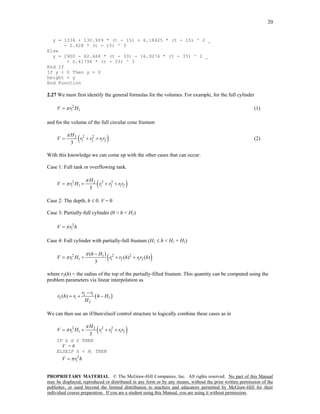
Here is a script that uses the function to generate a plot:
clc,clf
t=[-2:47];
for i=1:length(t)
y(i)=height(t(i));
end
plot(t,y)
-10 0 10 20 30 40 50
0
500
1000
1500
2000
2500
3000
VBA:
Option Explicit
Function height(t)
If t < 0 Then
y = 0
ElseIf t < 15 Then
y = 38.14544 * t + 0.137428 * t ^ 3
ElseIf t < 33 Then
20
PROPRIETARY MATERIAL. © The McGraw-Hill Companies, Inc. All rights reserved. No part of this Manual
may be displayed, reproduced or distributed in any form or by any means, without the prior written permission of the
publisher, or used beyond the limited distribution to teachers and educators permitted by McGraw-Hill for their
individual course preparation. If you are a student using this Manual, you are using it without permission.
y = 1036 + 130.909 * (t - 15) + 6.18425 * (t - 15) ^ 2 _
- 0.428 * (t - 15) ^ 3
Else
y = 2900 - 62.468 * (t - 33) - 16.9274 * (t - 33) ^ 2 _
+ 0.41796 * (t - 33) ^ 3
End If
If y < 0 Then y = 0
height = y
End Function
2.27 We must first identify the general formulas for the volumes. For example, for the full cylinder
2
1 1V r H (1)
and for the volume of the full circular cone frustum
 2 22
1 2 1 2
3
H
V r r r r

   (2)
With this knowledge we can come up with the other cases that can occur:
Case 1: Full tank or overflowing tank.
 2 2 22
1 1 1 2 1 2
3
H
V r H r r r r

   
Case 2: The depth, h  0. V = 0
Case 3: Partially-full cylinder (0 < h < H1)
2
1V r h
Case 4: Full cylinder with partially-full frustum (H1  h < H1 + H2)
 2 2 21
1 1 1 2 1 2
( )
( ) ( )
3
h H
V r H r r h r r h



   
where r2(h) = the radius of the top of the partially-filled frustum. This quantity can be computed using the
problem parameters via linear interpolation as
 2 1
2 1 1
2
( )
r r
r h r h H
H

  
We can then use an if/then/elseif control structure to logically combine these cases as in
 2 2 22
1 1 1 2 1 2
3
H
V r H r r r r

   
IF h  0 THEN
V = 0
ELSEIF h < H1 THEN
2
1V r h
21
PROPRIETARY MATERIAL. © The McGraw-Hill Companies, Inc. All rights reserved. No part of this Manual
may be displayed, reproduced or distributed in any form or by any means, without the prior written permission of the
publisher, or used beyond the limited distribution to teachers and educators permitted by McGraw-Hill for their
individual course preparation. If you are a student using this Manual, you are using it without permission.
ELSEIF h < H1 + H2 THEN
 2 1
2 1 1
2
( )
r r
r h r h H
H

  
 2 2 21
1 1 1 2 1 2
( )
( ) ( )
3
h H
V r H r r h r r h



   
ENDIF
Notice how Eqs. (1) and (2) are used several times, but with different arguments. This suggests that we
should represent them as independent functions that would be called by the main function. We do this in
the following codes.
VBA/Excel.
Option Explicit
Const pi As Double = 3.14159265358979
Function Vol(h, r1, h1, r2, h2)
Dim r2h As Double
Vol = VCyl(r1, h1) + VFus(r1, r2, h2)
If h <= 0 Then
Vol = 0
ElseIf h < h1 Then
Vol = VCyl(r1, h)
ElseIf h < h1 + h2 Then
r2h = r1 + (r2 - r1) / h2 * (h - h1)
Vol = VCyl(r1, h1) + VFus(r1, r2h, h - h1)
End If
End Function
Function VCyl(r, y)
VCyl = pi * r ^ 2 * y
End Function
Function VFus(r1, r2, h2)
VFus = pi * h2 / 3 * (r1 ^ 2 + r2 ^ 2 + r1 * r2)
End Function
22
PROPRIETARY MATERIAL. © The McGraw-Hill Companies, Inc. All rights reserved. No part of this Manual
may be displayed, reproduced or distributed in any form or by any means, without the prior written permission of the
publisher, or used beyond the limited distribution to teachers and educators permitted by McGraw-Hill for their
individual course preparation. If you are a student using this Manual, you are using it without permission.
MATLAB. Here are the functions:
function V=Vol(h, r1, h1, r2, h2)
V = VCyl(r1, h1) + VFus(r1, r2, h2);
if h <= 0
V = 0;
elseif h < h1
V = VCyl(r1, h);
elseif h < h1 + h2
r2h = r1 + (r2 - r1) / h2 * (h - h1);
V = VCyl(r1, h1) + VFus(r1, r2h, h - h1);
end
end
function V=VCyl(r, y)
V = pi * r ^ 2 * y;
end
function V=VFus(r1, r2, h2)
V = pi * h2 / 3 * (r1 ^ 2 + r2 ^ 2 + r1 * r2);
end
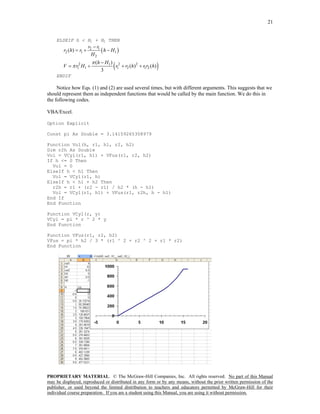
Here is a script that uses the functions to develop a plot of volume versus height:
clc,clf
h=[-1:0.5:16];
r1=4; H1=10; r2=6.5; H2=5;
n=length(h);
vol=zeros(n);
for i=1:n
vol(i)=Vol(h(i),r1, H1, r2, H2);
end
plot(h,vol)
-2 0 2 4 6 8 10 12 14 16
0
100
200
300
400
500
600
700
800
900
1000
Numerical Methods for Engineers 7th Edition Chapra Solutions Manual
Full Download: http://alibabadownload.com/product/numerical-methods-for-engineers-7th-edition-chapra-solutions-manual/
This sample only, Download all chapters at: alibabadownload.com

Numerical Methods for Engineers 7th Edition Chapra Solutions Manual

  • 1.
    1 PROPRIETARY MATERIAL. ©The McGraw-Hill Companies, Inc. All rights reserved. No part of this Manual may be displayed, reproduced or distributed in any form or by any means, without the prior written permission of the publisher, or used beyond the limited distribution to teachers and educators permitted by McGraw-Hill for their individual course preparation. If you are a student using this Manual, you are using it without permission. CHAPTER 2 2.1 IF x < 100 THEN IF x < 50 THEN x = 0 ELSE x = 75 END IF ELSE DO IF x  500 EXIT x = x – 50 END DO ENDIF 2.2 DO j = j + 1 x = x + 5 IF x > 5 THEN y = x ELSE y = 0 ENDIF z = x + y IF z > 50 EXIT ENDDO 2.3 Students could implement the subprogram in any number of languages. The following VBA program is one example. It should be noted that the availability of complex variables in languages such as Fortran 90 would allow this subroutine to be made even more concise. However, we did not exploit this feature, in order to make the code more compatible with languages that do not support complex variables. This version is then followed by a MATLAB script and function that does accommodate complex variables. Option Explicit Sub Rootfind() Dim ier As Integer Dim a As Double, b As Double, c As Double Dim r1 As Double, i1 As Double, r2 As Double, i2 As Double a = 1: b = 7: c = 2 Call Roots(a, b, c, ier, r1, i1, r2, i2) If ier = 0 Then MsgBox "No roots" ElseIf ier = 1 Then MsgBox "single root=" & r1 ElseIf ier = 2 Then MsgBox "real roots = " & r1 & ", " & r2 ElseIf ier = 3 Then MsgBox "complex roots =" & r1 & "," & i1 & " i" & "; "_ & r2 & "," & i2 & " i" End If End Sub Sub Roots(a, b, c, ier, r1, i1, r2, i2) Dim d As Double r1 = 0: r2 = 0: i1 = 0: i2 = 0 If a = 0 Then Numerical Methods for Engineers 7th Edition Chapra Solutions Manual Full Download: http://alibabadownload.com/product/numerical-methods-for-engineers-7th-edition-chapra-solutions-manual/ This sample only, Download all chapters at: alibabadownload.com
  • 2.
    2 PROPRIETARY MATERIAL. ©The McGraw-Hill Companies, Inc. All rights reserved. No part of this Manual may be displayed, reproduced or distributed in any form or by any means, without the prior written permission of the publisher, or used beyond the limited distribution to teachers and educators permitted by McGraw-Hill for their individual course preparation. If you are a student using this Manual, you are using it without permission. If b <> 0 Then r1 = -c / b ier = 1 Else ier = 0 End If Else d = b ^ 2 - 4 * a * c If (d >= 0) Then r1 = (-b + Sqr(d)) / (2 * a) r2 = (-b - Sqr(d)) / (2 * a) ier = 2 Else r1 = -b / (2 * a) r2 = r1 i1 = Sqr(Abs(d)) / (2 * a) i2 = -i1 ier = 3 End If End If End Sub The answers for the 3 test cases are: (a) 0.2984, 6.702; (b) 0.32; (c) 0.4167 + 1.5789i; 0.4167  1.5789i. Several features of this subroutine bear mention:  The subroutine does not involve input or output. Rather, information is passed in and out via the arguments. This is often the preferred style, because the I/O is left to the discretion of the programmer within the calling program.  Note that a variable is passed (IER) in order to distinguish among the various cases. MATLAB: function [r1,r2]=quadroots(a,b,c) r1 = 0; r2 = 0; if a == 0 if b ~= 0 r1=-c/b; else r1='Trivial solution'; end else discr=b^2-4*a*c; if discr >= 0 r1=(-b+sqrt(discr))/(2*a); r2=(-b-sqrt(discr))/(2*a); else r1 =-b/(2*a); i1=sqrt(abs(discr))/(2*a); r2=r1-i1*i; r1=r1+i1*i; end end Script: clc format compact disp('(a)'),[r1,r2]=quadroots(1,7,2) disp('(b)'),[r1,r2]=quadroots(0,-5,1.6) disp('(c)'),[r1,r2]=quadroots(3,2.5,8) Output when script is run
  • 3.
    3 PROPRIETARY MATERIAL. ©The McGraw-Hill Companies, Inc. All rights reserved. No part of this Manual may be displayed, reproduced or distributed in any form or by any means, without the prior written permission of the publisher, or used beyond the limited distribution to teachers and educators permitted by McGraw-Hill for their individual course preparation. If you are a student using this Manual, you are using it without permission. (a) r1 = -0.2984 r2 = -6.7016 (b) r1 = 0.3200 r2 = 0 (c) r1 = -0.4167 + 1.5789i r2 = -0.4167 - 1.5789i 2.4 The development of the algorithm hinges on recognizing that the series approximation of the sine can be represented concisely by the summation, 2 1 1 1 ( 1) (2 1)! n i i i x i      where i = the order of the approximation. (a) Structured flowchart: start INPUT x, n i > n end i = 1 true = sin(x) approx = 0 factor = 1 approx approx x factor i i - = + -( 1) - 1 2 1 error true approx true 100  % OUTPUT i,approx,error i = i + 1 F T factor=factor(2i-2)(2i-1)
  • 4.
    4 PROPRIETARY MATERIAL. ©The McGraw-Hill Companies, Inc. All rights reserved. No part of this Manual may be displayed, reproduced or distributed in any form or by any means, without the prior written permission of the publisher, or used beyond the limited distribution to teachers and educators permitted by McGraw-Hill for their individual course preparation. If you are a student using this Manual, you are using it without permission. (b) Pseudocode: SUBROUTINE Sincomp(n,x) i = 1; truth = SIN(x); approx = 0 factor = 1 DO IF i > n EXIT approx = approx + (-1)i-1 x2i-1 / factor error = (truth - approx) / truth) * 100 PRINT i, truth, approx, error i = i + 1 factor = factor(2i-2)(2i-1) END DO END 2.5 Students could implement the subprogram in any number of languages. The following MATLAB M- file is one example. It should be noted that MATLAB allows direct calculation of the factorial through its intrinsic function factorial. However, we did not exploit this feature, in order to make the code more compatible with languages such as Visual BASIC and Fortran. function sincomp(x,n) i = 1; tru = sin(x); approx = 0; f = 1; fprintf('n'); fprintf('order true value approximation errorn'); while (1) if i > n, break, end approx = approx + (-1)^(i - 1) * x^(2*i-1) / f; er = (tru - approx) / tru * 100; fprintf('%3d %14.10f %14.10f %12.8f n',i,tru,approx,er); i = i + 1; f = f*(2*i-2)*(2*i-1); end Here is a run of the program showing the output that is generated: >> sincomp(1.5,8) order true value approximation error 1 0.9974949866 1.5000000000 -50.37669564 2 0.9974949866 0.9375000000 6.01456523 3 0.9974949866 1.0007812500 -0.32945162 4 0.9974949866 0.9973911830 0.01040643 5 0.9974949866 0.9974971226 -0.00021414 6 0.9974949866 0.9974949557 0.00000310 7 0.9974949866 0.9974949869 -0.00000003 8 0.9974949866 0.9974949866 0.00000000 2.6 (a) The following pseudocode provides an algorithm for this problem. Notice that the input of the quizzes and homeworks is done with logical loops that terminate when the user enters a negative grade: INPUT WQ, WH, WF nq = 0 sumq = 0 DO INPUT quiz (enter negative to signal end of quizzes) IF quiz < 0 EXIT nq = nq + 1 sumq = sumq + quiz
  • 5.
    5 PROPRIETARY MATERIAL. ©The McGraw-Hill Companies, Inc. All rights reserved. No part of this Manual may be displayed, reproduced or distributed in any form or by any means, without the prior written permission of the publisher, or used beyond the limited distribution to teachers and educators permitted by McGraw-Hill for their individual course preparation. If you are a student using this Manual, you are using it without permission. END DO AQ = sumq / nq nh = 0 sumh = 0 DO INPUT homework (enter negative to signal end of homeworks) IF homework < 0 EXIT nh = nh + 1 sumh = sumh + homework END DO AH = sumh / nh DISPLAY "Is there a final exam (y or n)" INPUT answer IF answer = "y" THEN INPUT FE AG = (WQ * AQ + WH * AH + WF * FE) / (WQ + WH + WF) ELSE AG = (WQ * AQ + WH * AH) / (WQ + WH) END IF DISPLAY AG END (b) Students could implement the program in any number of languages. The following VBA code is one example. Option Explicit Sub Grader() Dim WQ As Double, WH As Double, WF As Double Dim nq As Integer, sumq As Double, AQ As Double Dim nh As Integer, sumh As Double, AH As Double Dim answer As String, FE As Double Dim AG As Double, quiz As Double, homework As Double 'enter weights WQ = InputBox("enter quiz weight") WH = InputBox("enter homework weight") WF = InputBox("enter final exam weight") 'enter quiz grades nq = 0: sumq = 0 Do quiz = InputBox("enter negative to signal end of quizzes") If quiz < 0 Then Exit Do nq = nq + 1 sumq = sumq + quiz Loop AQ = sumq / nq 'enter homework grades nh = 0: sumh = 0 Do homework = InputBox("enter negative to signal end of homeworks") If homework < 0 Then Exit Do nh = nh + 1 sumh = sumh + homework Loop AH = sumh / nh 'determine and display the average grade answer = InputBox("Is there a final exam (y or n)") If answer = "y" Then FE = InputBox("final exam:") AG = (WQ * AQ + WH * AH + WF * FE) / (WQ + WH + WF)
  • 6.
    6 PROPRIETARY MATERIAL. ©The McGraw-Hill Companies, Inc. All rights reserved. No part of this Manual may be displayed, reproduced or distributed in any form or by any means, without the prior written permission of the publisher, or used beyond the limited distribution to teachers and educators permitted by McGraw-Hill for their individual course preparation. If you are a student using this Manual, you are using it without permission. Else AG = (WQ * AQ + WH * AH) / (WQ + WH) End If MsgBox "Average grade = " & AG End Sub The results should conform to: AQ = 442/5 = 88.4 AH = 556/6 = 92.667 without final 30(88.4) 40(92.667) AG 90.8381 30 40     with final 30(88.4) 40(92.667) 30(91) AG 90.8867 30 40 30       Here is an example of how a MATLAB script could be developed to solve the same problem: clc % enter weights WQ = input('enter quiz weight'); WH = input('enter homework weight'); WF = input('enter final exam weight'); % enter quiz grades nq = 0; sumq = 0; while(1) quiz = input('enter negative to signal end of quizzes'); if quiz < 0;break;end nq = nq + 1; sumq = sumq + quiz; end AQ = sumq / nq; % enter homework grades nh = 0; sumh = 0; while(1) homework = input('enter negative to signal end of homeworks'); if homework < 0;break;end nh = nh + 1; sumh = sumh + homework; end AH = sumh / nh; answer = input('Is there a final exam (y or n)','s'); if answer == 'y' FE = input('final exam:'); AG = (WQ * AQ + WH * AH + WF * FE) / (WQ + WH + WF); else AG = (WQ * AQ + WH * AH) / (WQ + WH); end fprintf('Average grade: %8.4fn',AG) Finally, here is an alternative MATLAB script that solves the same problem, but is much more concise. Note that rather than using interactive input, the script employs vectors to enter the data. In addition, the nonexistence of a final is denoted by entering a negative number for the final exam: clc WQ=30;WH=40;WF=30;
  • 7.
    7 PROPRIETARY MATERIAL. ©The McGraw-Hill Companies, Inc. All rights reserved. No part of this Manual may be displayed, reproduced or distributed in any form or by any means, without the prior written permission of the publisher, or used beyond the limited distribution to teachers and educators permitted by McGraw-Hill for their individual course preparation. If you are a student using this Manual, you are using it without permission. QG=[98 95 90 60 99]; HG=[98 95 86 100 100 77]; FE=91; if FE>0 AG=(WQ*mean(QG)+WH*mean(HG)+WF*FE)/(WQ+WH+WF); else AG=(WQ*mean(QG)+WH*mean(HG))/(WQ+WH); end fprintf('Average grade: %8.4fn',AG) 2.7 (a) Pseudocode: IF a > 0 THEN tol = 10–6 x = a/2 DO y = (x + a/x)/2 e = (y – x)/y x = y IF e < tol EXIT END DO SquareRoot = x ELSE SquareRoot = 0 END IF (b) Students could implement the function in any number of languages. The following VBA and MATLAB codes are two possible options. VBA Function Procedure MATLAB M-File Option Explicit Function SquareRoot(a) Dim x As Double, y As Double Dim e As Double, tol As Double If a > 0 Then tol = 0.000001 x = a / 2 Do y = (x + a / x) / 2 e = Abs((y - x) / y) x = y If e < tol Then Exit Do Loop SquareRoot = x Else SquareRoot = 0 End If End Function function s = SquareRoot(a) if a > 0 tol = 0.000001; x = a / 2; while(1) y = (x + a / x) / 2; e = abs((y - x) / y); x = y; if e < tol, break, end end s = x; else s = 0; end 2.8 A MATLAB M-file can be written to solve this problem as function futureworth(P, i, n) nn = 0:n; F = P*(1+i).^nn; y = [nn;F]; fprintf('n year future worthn'); fprintf('%5d %14.2fn',y); This function can be used to evaluate the test case,
  • 8.
    8 PROPRIETARY MATERIAL. ©The McGraw-Hill Companies, Inc. All rights reserved. No part of this Manual may be displayed, reproduced or distributed in any form or by any means, without the prior written permission of the publisher, or used beyond the limited distribution to teachers and educators permitted by McGraw-Hill for their individual course preparation. If you are a student using this Manual, you are using it without permission. >> futureworth(100000,0.04,11) year future worth 0 100000.00 1 104000.00 2 108160.00 3 112486.40 4 116985.86 5 121665.29 6 126531.90 7 131593.18 8 136856.91 9 142331.18 10 148024.43 11 153945.41 2.9 A MATLAB M-file can be written to solve this problem as function annualpayment(P, i, n) nn = 1:n; A = P*i*(1+i).^nn./((1+i).^nn-1); y = [nn;A]; fprintf('n year annual paymentn'); fprintf('%5d %14.2fn',y); This function can be used to evaluate the test case, >> annualpayment(55000,0.066,5) year annual payment 1 58630.00 2 30251.49 3 20804.86 4 16091.17 5 13270.64 2.10 Students could implement the function in any number of languages. The following VBA and MATLAB codes are two possible options. VBA Function Procedure MATLAB M-File Option Explicit Function avgtemp(Tm, Tp, ts, te) Dim pi As Double, w As Double Dim Temp As Double, t As Double Dim sum As Double, i As Integer Dim n As Integer pi = 4 * Atn(1) w = 2 * pi / 365 sum = 0 n = 0 t = ts For i = ts To te Temp = Tm+(Tp-Tm)*Cos(w*(t-205)) sum = sum + Temp n = n + 1 t = t + 1 Next i avgtemp = sum / n End Function function Ta = avgtemp(Tm,Tp,ts,te) w = 2*pi/365; t = ts:te; T = Tm + (Tp-Tm)*cos(w*(t-205)); Ta = mean(T);
  • 9.
    9 PROPRIETARY MATERIAL. ©The McGraw-Hill Companies, Inc. All rights reserved. No part of this Manual may be displayed, reproduced or distributed in any form or by any means, without the prior written permission of the publisher, or used beyond the limited distribution to teachers and educators permitted by McGraw-Hill for their individual course preparation. If you are a student using this Manual, you are using it without permission. The function can be used to evaluate the test cases. The following show the results for MATLAB, >> avgtemp(22.1,28.3,0,59) ans = 16.2148 >> avgtemp(10.7,22.9,180,242) ans = 22.2491 2.11 The programs are student specific and will be similar to the codes developed for VBA and MATLAB as outlined in sections 2.4 and 2.5. For example, the following MATLAB script was developed to use the function from section 2.5 to compute and tabulate the numerical results for the value at t = 12 s, along with an estimate of the absolute value of the true relative error based on the analytical solution: clc; format compact m=68.1; cd=12.5; ti=0; tf=12.; vi=0; vtrue=9.81*m/cd*(1-exp(-cd/m*tf)) dt=[2 1 0.5]'; for i = 1:3 v(i)=euler(dt(i),ti,tf,vi,m,cd); end et=abs((vtrue-v)/vtrue*100); z=[dt v' et']'; fprintf(' dt v(12) et(pct)n') fprintf('%10.3f %10.3f %10.3fn',z); Output: vtrue = 47.5387 dt v(12) et(pct) 2.000 50.010 5.199 1.000 48.756 2.561 0.500 48.142 1.269 The general conclusion is that the error is halved when the step size is halved. 2.12 Students could implement the subprogram in any number of languages. The following VBA/Excel and MATLAB programs are two examples based on the algorithm outlined in Fig. P2.12. VBA/Excel MATLAB Option Explicit Sub Bubble(n, b) Dim m As Integer, i As Integer Dim switch As Boolean, dum As Double m = n - 1 Do switch = False For i = 1 To m If b(i) > b(i + 1) Then dum = b(i) b(i) = b(i + 1) b(i + 1) = dum function y = Bubble(x) n = length(x); m = n - 1; b = x; while(1) s = 0; for i = 1:m if b(i) > b(i + 1) dum = b(i); b(i) = b(i + 1); b(i + 1) = dum;
  • 10.
    10 PROPRIETARY MATERIAL. ©The McGraw-Hill Companies, Inc. All rights reserved. No part of this Manual may be displayed, reproduced or distributed in any form or by any means, without the prior written permission of the publisher, or used beyond the limited distribution to teachers and educators permitted by McGraw-Hill for their individual course preparation. If you are a student using this Manual, you are using it without permission. switch = True End If Next i If switch = False Then Exit Do m = m - 1 Loop End Sub s = 1; end end if s == 0, break, end m = m - 1; end y = b; Notice how the MATLAB length function allows us to omit the length of the vector in the function argument. Here is an example MATLAB script that invokes the function to sort a vector: clc a=[6 3 4 2 1 5 7]; Bubble(a) ans = 1 2 3 4 5 6 7 2.13 Students could implement the function in any number of languages. The following VBA and MATLAB codes are two possible options. VBA Function Procedure MATLAB M-File Option Explicit Function Vol(R, d) Dim V1 As Double, V2 As Double Dim pi As Double pi = 4 * Atn(1) If d < R Then Vol = pi * d ^ 3 / 3 ElseIf d <= 3 * R Then V1 = pi * R ^ 3 / 3 V2 = pi * R ^ 2 * (d - R) Vol = V1 + V2 Else Vol = "overtop" End If End Function function Vol = tankvolume(R, d) if d < R Vol = pi * d ^ 3 / 3; elseif d <= 3 * R V1 = pi * R ^ 3 / 3; V2 = pi * R ^ 2 * (d - R); Vol = V1 + V2; else Vol = 'overtop'; end The results are: R d Volume 1 0.5 0.1309 1 1.2 1.675516 1 3 7.330383 1 3.1 overtop 2.14 Here is a flowchart for the algorithm:
  • 11.
    11 PROPRIETARY MATERIAL. ©The McGraw-Hill Companies, Inc. All rights reserved. No part of this Manual may be displayed, reproduced or distributed in any form or by any means, without the prior written permission of the publisher, or used beyond the limited distribution to teachers and educators permitted by McGraw-Hill for their individual course preparation. If you are a student using this Manual, you are using it without permission. Function Polar(x, y) 22 yxr  x < 0 y > 0y > 0          x y1 tan          x y1 tan          x y1 tan  2    y < 0 2      y < 0   180Polar  180Polar End Polar  = 3.141593 T T T T T F F F F x > 0          x y1 tan TF F Students could implement the function in any number of languages. The following MATLAB M-file is one option. Versions in other languages such as Fortran 90, Visual Basic, or C would have a similar structure. function polar(x, y) r = sqrt(x .^ 2 + y .^ 2); n = length(x); for i = 1:n if x(i) > 0 th(i) = atan(y(i) / x(i)); elseif x(i) < 0 if y(i) > 0 th(i) = atan(y(i) / x(i)) + pi; elseif y(i) < 0 th(i) = atan(y(i) / x(i)) - pi; else th(i) = pi; end else if y(i) > 0 th(i) = pi / 2; elseif y(i) < 0 th(i) = -pi / 2; else th(i) = 0; end end th(i) = th(i) * 180 / pi; end ou=[x;y;r;th];
  • 12.
    12 PROPRIETARY MATERIAL. ©The McGraw-Hill Companies, Inc. All rights reserved. No part of this Manual may be displayed, reproduced or distributed in any form or by any means, without the prior written permission of the publisher, or used beyond the limited distribution to teachers and educators permitted by McGraw-Hill for their individual course preparation. If you are a student using this Manual, you are using it without permission. fprintf('n x y radius anglen'); fprintf('%8.2f %8.2f %10.4f %10.4f n',ou); This function can be used to evaluate the test cases as in the following script: clc; format compact x=[1 1 0 -1 -1 -1 0 1 0]; y=[0 1 1 1 0 -1 -1 -1 0]; polar(x,y) When the script is run, the resulting output is x y radius angle 1.00 0.00 1.0000 0.0000 1.00 1.00 1.4142 45.0000 0.00 1.00 1.0000 90.0000 -1.00 1.00 1.4142 135.0000 -1.00 0.00 1.0000 180.0000 -1.00 -1.00 1.4142 -135.0000 0.00 -1.00 1.0000 -90.0000 1.00 -1.00 1.4142 -45.0000 0.00 0.00 0.0000 0.0000 2.15 Students could implement the function in any number of languages. The following VBA and MATLAB codes are two possible options. VBA Function Procedure MATLAB M-File Function grade(s) If s >= 90 Then grade = "A" ElseIf s >= 80 Then grade = "B" ElseIf s >= 70 Then grade = "C" ElseIf s >= 60 Then grade = "D" Else grade = "F" End If End Function function grade = lettergrade(score) if score >= 90 grade = 'A'; elseif score >= 80 grade = 'B'; elseif score >= 70 grade = 'C'; elseif score >= 60 grade = 'D'; else grade = 'F'; end 2.16 Students could implement the functions in any number of languages. The following VBA and MATLAB codes are two possible options. VBA Function Procedure MATLAB M-File (a) Factorial Function factor(n) Dim x As Long, i As Integer x = 1 For i = 1 To n x = x * i Next i factor = x End Function (b) Minimum Function min(x, n) Dim i As Integer min = x(1) function fout = factor(n) x = 1; for i = 1:n x = x * i; end fout = x; function xm = xmin(x) n = length(x); xm = x(1);
  • 13.
    13 PROPRIETARY MATERIAL. ©The McGraw-Hill Companies, Inc. All rights reserved. No part of this Manual may be displayed, reproduced or distributed in any form or by any means, without the prior written permission of the publisher, or used beyond the limited distribution to teachers and educators permitted by McGraw-Hill for their individual course preparation. If you are a student using this Manual, you are using it without permission. For i = 2 To n If x(i) < min Then min = x(i) Next i End Function (c) Average Function mean(x, n) Dim sum As Double Dim i As Integer sum = x(1) For i = 2 To n sum = sum + x(i) Next i mean = sum / n End Function for i = 2:n if x(i) < xm, xm = x(i); end end function xm = xmean(x) n = length(x); s = x(1); for i = 2:n s = s + x(i); end xm = s / n; 2.17 Students could implement the functions in any number of languages. The following VBA and MATLAB codes are two possible options. VBA Function Procedure MATLAB M-File (a) Square root sum of squares Function SSS(x, n, m) Dim i As Integer, j As Integer SSS = 0 For i = 1 To n For j = 1 To m SSS = SSS + x(i, j) ^ 2 Next j Next i SSS = Sqr(SSS) End Function (b) Normalization Sub normal(x, n, m, y) Dim i As Integer, j As Integer Dim max As Double For i = 1 To n max = Abs(x(i, 1)) For j = 2 To m If Abs(x(i, j)) > max Then max = x(i, j) End If Next j For j = 1 To m y(i, j) = x(i, j) / max Next j Next i End Sub function s = SSS(x) [n,m] = size(x); s = 0; for i = 1:n for j = 1:m s = s + x(i, j) ^ 2; end end s = sqrt(s); function y = normal(x) [n,m] = size(x); for i = 1:n mx = abs(x(i, 1)); for j = 2:m if abs(x(i, j)) > mx mx = x(i, j); end end for j = 1:m y(i, j) = x(i, j) / mx; end end Alternate version: function y = normal(x) n = size(x); for i = 1:n y(i,:) = x(i,:)/max(x(i,:)); end 2.18 The following MATLAB function implements the piecewise function: function v = vpiece(t) if t<0 v = 0;
  • 14.
    14 PROPRIETARY MATERIAL. ©The McGraw-Hill Companies, Inc. All rights reserved. No part of this Manual may be displayed, reproduced or distributed in any form or by any means, without the prior written permission of the publisher, or used beyond the limited distribution to teachers and educators permitted by McGraw-Hill for their individual course preparation. If you are a student using this Manual, you are using it without permission. elseif t<10 v = 11*t^2 - 5*t; elseif t<20 v = 1100 - 5*t; elseif t<30 v = 50*t + 2*(t - 20)^2; else v = 1520*exp(-0.2*(t-30)); end Here is a script that uses vpiece to generate the plot k=0; for i = -5:.5:50 k=k+1; t(k)=i; v(k)=vpiece(t(k)); end plot(t,v) 2.19 The following MATLAB function implements the algorithm: function nd = days(mo, da, leap) nd = 0; for m=1:mo-1 switch m case {1, 3, 5, 7, 8, 10, 12} nday = 31; case {4, 6, 9, 11} nday = 30; case 2 nday = 28+leap; end nd=nd+nday; end nd = nd + da; >> days(1,1,0) ans = 1 >> days(2,29,1) ans =
  • 15.
    15 PROPRIETARY MATERIAL. ©The McGraw-Hill Companies, Inc. All rights reserved. No part of this Manual may be displayed, reproduced or distributed in any form or by any means, without the prior written permission of the publisher, or used beyond the limited distribution to teachers and educators permitted by McGraw-Hill for their individual course preparation. If you are a student using this Manual, you are using it without permission. 60 >> days(3,1,0) ans = 60 >> days(6,21,0) ans = 172 >> days(12,31,1) ans = 366 2.20 The following MATLAB function implements the algorithm: function nd = days(mo, da, year) leap = 0; if year / 4 - fix(year / 4) == 0, leap = 1; end nd = 0; for m=1:mo-1 switch m case {1, 3, 5, 7, 8, 10, 12} nday = 31; case {4, 6, 9, 11} nday = 30; case 2 nday = 28+leap; end nd=nd+nday; end nd = nd + da; >> days(1,1,1999) ans = 1 >> days(2,29,2000) ans = 60 >> days(3,1,2001) ans = 60 >> days(6,21,2002) ans = 172 >> days(12,31,2004) ans = 366 2.21 A MATLAB M-file can be written as function Manning(A) A(:,5)=sqrt(A(:,2))./A(:,1).*(A(:,3).*A(:,4)./(A(:,3)+2*A(:,4))).^(2/3); fprintf('n n S B H Un'); fprintf('%8.3f %8.4f %10.2f %10.2f %10.4fn',A'); This function can be run to create the table, >> A=[.035 .0001 10 2 .020 .0002 8 1 .015 .001 20 1.5 .03 .0007 24 3 .022 .0003 15 2.5];
  • 16.
    16 PROPRIETARY MATERIAL. ©The McGraw-Hill Companies, Inc. All rights reserved. No part of this Manual may be displayed, reproduced or distributed in any form or by any means, without the prior written permission of the publisher, or used beyond the limited distribution to teachers and educators permitted by McGraw-Hill for their individual course preparation. If you are a student using this Manual, you are using it without permission. >> Manning(A) n S B H U 0.035 0.0001 10.00 2.00 0.3624 0.020 0.0002 8.00 1.00 0.6094 0.015 0.0010 20.00 1.50 2.5167 0.030 0.0007 24.00 3.00 1.5809 0.022 0.0003 15.00 2.50 1.1971 2.22 A MATLAB M-file can be written as function beam(x) xx = linspace(0,x); n=length(xx); for i=1:n uy(i) = -5/6.*(sing(xx(i),0,4)-sing(xx(i),5,4)); uy(i) = uy(i) + 15/6.*sing(xx(i),8,3) + 75*sing(xx(i),7,2); uy(i) = uy(i) + 57/6.*xx(i)^3 - 238.25.*xx(i); end plot(xx,uy) function s = sing(xxx,a,n) if xxx > a s = (xxx - a).^n; else s=0; end This function can be run to create the plot, >> beam(10) 2.23 A MATLAB M-file can be written as function cylinder(r, L) h = linspace(0,2*r); V = (r^2*acos((r-h)./r)-(r-h).*sqrt(2*r*h-h.^2))*L; plot(h, V) This function can be run to create the plot,
  • 17.
    17 PROPRIETARY MATERIAL. ©The McGraw-Hill Companies, Inc. All rights reserved. No part of this Manual may be displayed, reproduced or distributed in any form or by any means, without the prior written permission of the publisher, or used beyond the limited distribution to teachers and educators permitted by McGraw-Hill for their individual course preparation. If you are a student using this Manual, you are using it without permission. >> cylinder(2,5) 2.24 Before the chute opens (t < 10), Euler’s method can be implemented as ttvtvttv        )( 80 10 8.9)()( After the chute opens (t  10), the drag coefficient is changed and the implementation becomes ttvtvttv        )( 80 50 8.9)()( You can implement the subprogram in any number of languages. The following MATLAB M-file is one example. Notice that the results are inaccurate because the stepsize is too big. A smaller stepsize should be used to attain adequate accuracy. function parachute g = 9.81; m = 80; c = 10; ti = 0; tf = 20; dt = 2; vi = -20; tc = 10; cc = 50; np = (tf - ti) / dt; t = ti; v = vi; tout(1) = t; vout(1) = v; for i = 1:np if t < tc dvdt = g - c / m * v; else dvdt = g - cc / m * v; end v = v + dvdt * dt; t = t + dt; tout(i+1) = t; vout(i+1) = v; end plot(tout,vout) z=[tout;vout] fprintf(' t vn');
  • 18.
    18 PROPRIETARY MATERIAL. ©The McGraw-Hill Companies, Inc. All rights reserved. No part of this Manual may be displayed, reproduced or distributed in any form or by any means, without the prior written permission of the publisher, or used beyond the limited distribution to teachers and educators permitted by McGraw-Hill for their individual course preparation. If you are a student using this Manual, you are using it without permission. fprintf('%5d %10.3fn',z); t v 0 -20.000 2 4.620 4 23.085 6 36.934 8 47.320 10 55.110 12 5.842 14 18.159 16 15.080 18 15.850 20 15.658 -40 -20 0 20 40 60 0 5 10 15 20 2.25 Students could implement the function in any number of languages. The following VBA and MATLAB codes are two possible options. VBA/Excel MATLAB Option Explicit Function fac(n) Dim x As Long, i As Integer If n >= 0 Then x = 1 For i = 1 To n x = x * i Next i fac = x Else MsgBox "value must be positive" End End If End Function function f = fac(n) if n >= 0 x = 1; for i = 1: n x = x * i; end f = x; else error 'value must be positive' end 2.26 (a) Pseudocode: FUNCTION height(t) IF t < 0 THEN y = 0 ELSE IF t < 15 THEN y = 38.1454t + 0.13743t3 ELSE IF t < 33 THEN y = 1036 + 130.909(t – 15) + 6.18425(t – 15)2 - 0.428 (t – 15)3 ELSE y = 2900 - 62.468(t – 33) - 16.9274(t – 33)2 + 0.41796 (t – 33)3 END IF IF y < 0 THEN y = 0 height = y
  • 19.
    19 PROPRIETARY MATERIAL. ©The McGraw-Hill Companies, Inc. All rights reserved. No part of this Manual may be displayed, reproduced or distributed in any form or by any means, without the prior written permission of the publisher, or used beyond the limited distribution to teachers and educators permitted by McGraw-Hill for their individual course preparation. If you are a student using this Manual, you are using it without permission. END (b) MATLAB: function y = height(t) %Function to compute height of rocket from piecewise function % y = height(t) % input: % t = time % output: % y = height if t < 0 y = 0; elseif t < 15 y = 38.14544*t + 0.137428*t^3; elseif t < 33 y = 1036 + 130.909*(t - 15) + 6.18425*(t - 15)^2 - 0.428*(t - 15)^3; else y = 2900 - 62.468*(t - 33) - 16.9274*(t - 33)^2 + 0.41796*(t - 33)^3; end if y < 0, y = 0; end end Here is a script that uses the function to generate a plot: clc,clf t=[-2:47]; for i=1:length(t) y(i)=height(t(i)); end plot(t,y) -10 0 10 20 30 40 50 0 500 1000 1500 2000 2500 3000 VBA: Option Explicit Function height(t) If t < 0 Then y = 0 ElseIf t < 15 Then y = 38.14544 * t + 0.137428 * t ^ 3 ElseIf t < 33 Then
  • 20.
    20 PROPRIETARY MATERIAL. ©The McGraw-Hill Companies, Inc. All rights reserved. No part of this Manual may be displayed, reproduced or distributed in any form or by any means, without the prior written permission of the publisher, or used beyond the limited distribution to teachers and educators permitted by McGraw-Hill for their individual course preparation. If you are a student using this Manual, you are using it without permission. y = 1036 + 130.909 * (t - 15) + 6.18425 * (t - 15) ^ 2 _ - 0.428 * (t - 15) ^ 3 Else y = 2900 - 62.468 * (t - 33) - 16.9274 * (t - 33) ^ 2 _ + 0.41796 * (t - 33) ^ 3 End If If y < 0 Then y = 0 height = y End Function 2.27 We must first identify the general formulas for the volumes. For example, for the full cylinder 2 1 1V r H (1) and for the volume of the full circular cone frustum  2 22 1 2 1 2 3 H V r r r r     (2) With this knowledge we can come up with the other cases that can occur: Case 1: Full tank or overflowing tank.  2 2 22 1 1 1 2 1 2 3 H V r H r r r r      Case 2: The depth, h  0. V = 0 Case 3: Partially-full cylinder (0 < h < H1) 2 1V r h Case 4: Full cylinder with partially-full frustum (H1  h < H1 + H2)  2 2 21 1 1 1 2 1 2 ( ) ( ) ( ) 3 h H V r H r r h r r h        where r2(h) = the radius of the top of the partially-filled frustum. This quantity can be computed using the problem parameters via linear interpolation as  2 1 2 1 1 2 ( ) r r r h r h H H     We can then use an if/then/elseif control structure to logically combine these cases as in  2 2 22 1 1 1 2 1 2 3 H V r H r r r r      IF h  0 THEN V = 0 ELSEIF h < H1 THEN 2 1V r h
  • 21.
    21 PROPRIETARY MATERIAL. ©The McGraw-Hill Companies, Inc. All rights reserved. No part of this Manual may be displayed, reproduced or distributed in any form or by any means, without the prior written permission of the publisher, or used beyond the limited distribution to teachers and educators permitted by McGraw-Hill for their individual course preparation. If you are a student using this Manual, you are using it without permission. ELSEIF h < H1 + H2 THEN  2 1 2 1 1 2 ( ) r r r h r h H H      2 2 21 1 1 1 2 1 2 ( ) ( ) ( ) 3 h H V r H r r h r r h        ENDIF Notice how Eqs. (1) and (2) are used several times, but with different arguments. This suggests that we should represent them as independent functions that would be called by the main function. We do this in the following codes. VBA/Excel. Option Explicit Const pi As Double = 3.14159265358979 Function Vol(h, r1, h1, r2, h2) Dim r2h As Double Vol = VCyl(r1, h1) + VFus(r1, r2, h2) If h <= 0 Then Vol = 0 ElseIf h < h1 Then Vol = VCyl(r1, h) ElseIf h < h1 + h2 Then r2h = r1 + (r2 - r1) / h2 * (h - h1) Vol = VCyl(r1, h1) + VFus(r1, r2h, h - h1) End If End Function Function VCyl(r, y) VCyl = pi * r ^ 2 * y End Function Function VFus(r1, r2, h2) VFus = pi * h2 / 3 * (r1 ^ 2 + r2 ^ 2 + r1 * r2) End Function
  • 22.
    22 PROPRIETARY MATERIAL. ©The McGraw-Hill Companies, Inc. All rights reserved. No part of this Manual may be displayed, reproduced or distributed in any form or by any means, without the prior written permission of the publisher, or used beyond the limited distribution to teachers and educators permitted by McGraw-Hill for their individual course preparation. If you are a student using this Manual, you are using it without permission. MATLAB. Here are the functions: function V=Vol(h, r1, h1, r2, h2) V = VCyl(r1, h1) + VFus(r1, r2, h2); if h <= 0 V = 0; elseif h < h1 V = VCyl(r1, h); elseif h < h1 + h2 r2h = r1 + (r2 - r1) / h2 * (h - h1); V = VCyl(r1, h1) + VFus(r1, r2h, h - h1); end end function V=VCyl(r, y) V = pi * r ^ 2 * y; end function V=VFus(r1, r2, h2) V = pi * h2 / 3 * (r1 ^ 2 + r2 ^ 2 + r1 * r2); end Here is a script that uses the functions to develop a plot of volume versus height: clc,clf h=[-1:0.5:16]; r1=4; H1=10; r2=6.5; H2=5; n=length(h); vol=zeros(n); for i=1:n vol(i)=Vol(h(i),r1, H1, r2, H2); end plot(h,vol) -2 0 2 4 6 8 10 12 14 16 0 100 200 300 400 500 600 700 800 900 1000 Numerical Methods for Engineers 7th Edition Chapra Solutions Manual Full Download: http://alibabadownload.com/product/numerical-methods-for-engineers-7th-edition-chapra-solutions-manual/ This sample only, Download all chapters at: alibabadownload.com