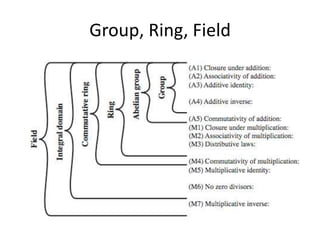
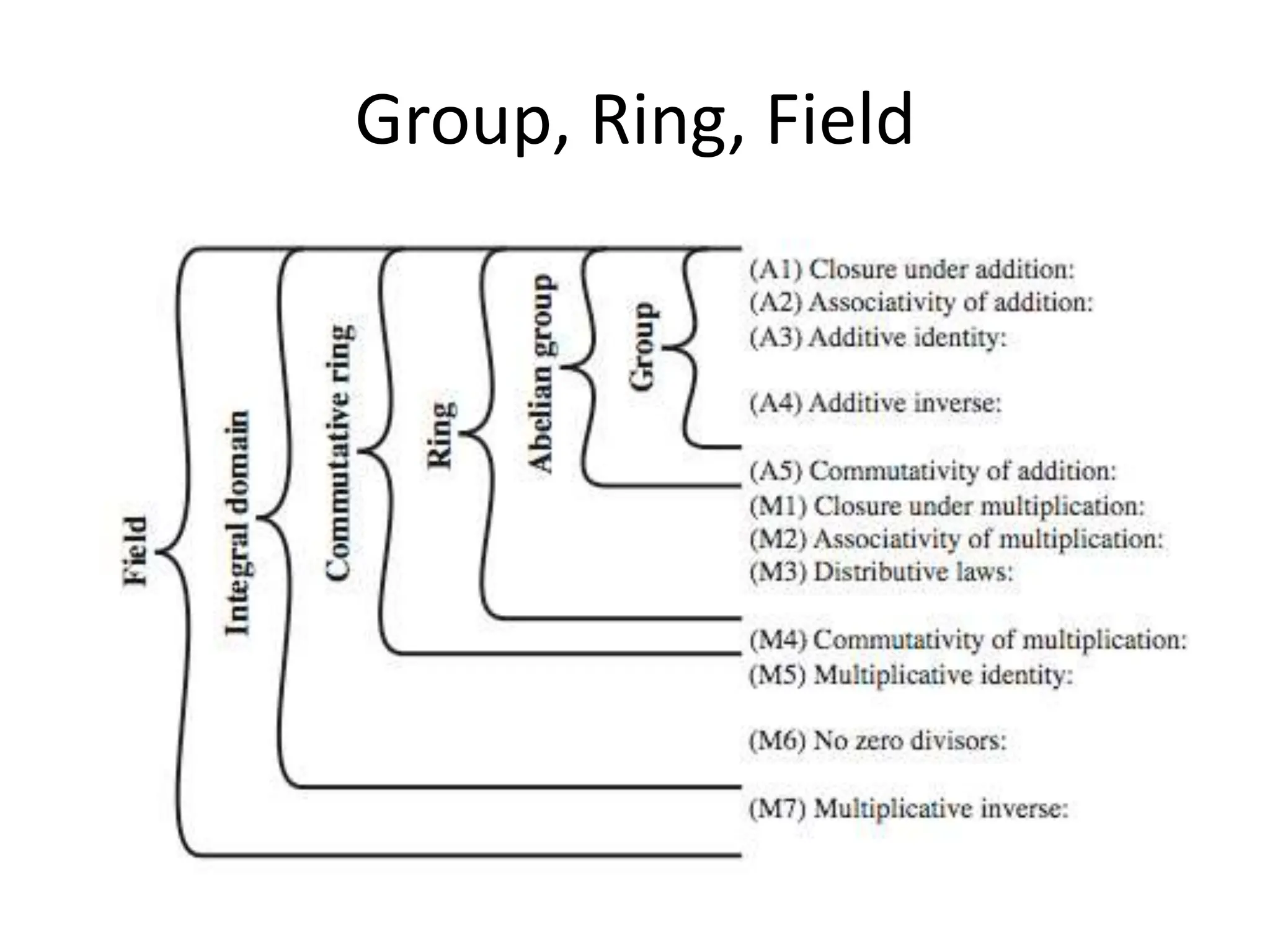
Group, Ring, Field
Finite (Galois) Fields
• finite fields play a key role in cryptography
• can show number of elements in a finite field
must be a power of a prime pn
• known as Galois fields
• denoted GF(pn)
• in particular often use the fields:
– GF(p)
– GF(2n)
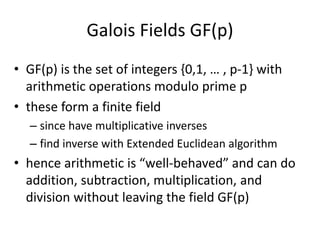
Galois Fields GF(p)
• GF(p) is the set of integers {0,1, … , p-1} with
arithmetic operations modulo prime p
• these form a finite field
– since have multiplicative inverses
– find inverse with Extended Euclidean algorithm
• hence arithmetic is “well-behaved” and can do
addition, subtraction, multiplication, and
division without leaving the field GF(p)
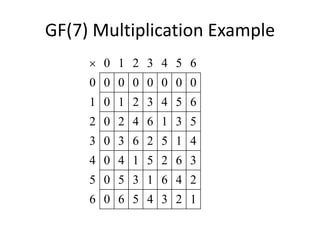
GF(7) Multiplication Example
 0 1 2 3 4 5 6
0 0 0 0 0 0 0 0
1 0 1 2 3 4 5 6
2 0 2 4 6 1 3 5
3 0 3 6 2 5 1 4
4 0 4 1 5 2 6 3
5 0 5 3 1 6 4 2
6 0 6 5 4 3 2 1
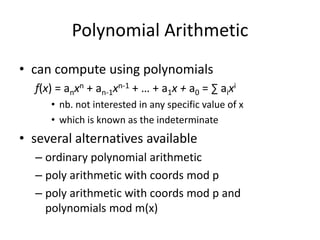
Polynomial Arithmetic
• can compute using polynomials
f(x) = anxn + an-1xn-1 + … + a1x + a0 = ∑ aixi
• nb. not interested in any specific value of x
• which is known as the indeterminate
• several alternatives available
– ordinary polynomial arithmetic
– poly arithmetic with coords mod p
– poly arithmetic with coords mod p and
polynomials mod m(x)
Ordinary Polynomial Arithmetic
• add or subtract corresponding coefficients
• multiply all terms by each other
• eg
let f(x) = x3 + x2 + 2 and g(x) = x2 – x + 1
f(x) + g(x) = x3 + 2x2 – x + 3
f(x) – g(x) = x3 + x + 1
f(x) x g(x) = x5 + 3x2 – 2x + 2
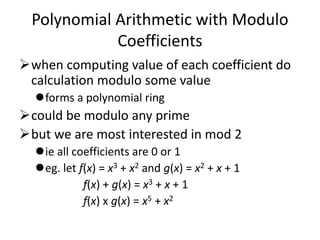
Polynomial Arithmetic with Modulo
Coefficients
when computing value of each coefficient do
calculation modulo some value
forms a polynomial ring
could be modulo any prime
but we are most interested in mod 2
ie all coefficients are 0 or 1
eg. let f(x) = x3 + x2 and g(x) = x2 + x + 1
f(x) + g(x) = x3 + x + 1
f(x) x g(x) = x5 + x2
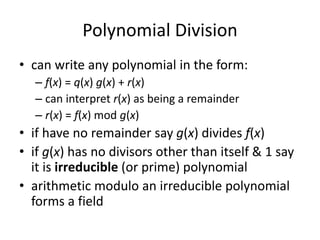
Polynomial Division
• can write any polynomial in the form:
– f(x) = q(x) g(x) + r(x)
– can interpret r(x) as being a remainder
– r(x) = f(x) mod g(x)
• if have no remainder say g(x) divides f(x)
• if g(x) has no divisors other than itself & 1 say
it is irreducible (or prime) polynomial
• arithmetic modulo an irreducible polynomial
forms a field
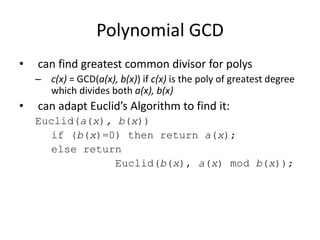
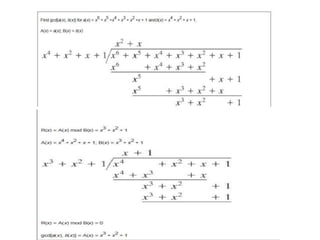
Polynomial GCD
• can find greatest common divisor for polys
– c(x) = GCD(a(x), b(x)) if c(x) is the poly of greatest degree
which divides both a(x), b(x)
• can adapt Euclid’s Algorithm to find it:
Euclid(a(x), b(x))
if (b(x)=0) then return a(x);
else return
Euclid(b(x), a(x) mod b(x));
Problem: Find the GCD of 3x6 + 2x2+x +5 and 6x4 + x3 + 2x +4 in
F7[x]
Solution: Divide
3x6 + 2x2+x +5 by 6x4 + x3 + 2x +4
Q: 4x2+ 4x +4 R: 2x3 +6x2+5x +3
Divide
3x6 + 2x2+x +5 by 2x3 +6x2+5x +3
Q: 3x +2 R: x2+4x+5
Divide 2x3 +6x2+5x +3 by x2+4x+5
Q: 2x +5 R: 3x +6
Divide x2+4x+5 by 3x +6
Q: 5x +3 R: 1
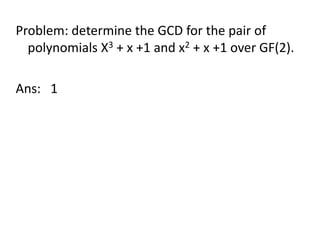
Problem: determine the GCD for the pair of
polynomials X3 + x +1 and x2 + x +1 over GF(2).
Ans: 1

23.ppt

  • 1.
  • 2.
    Finite (Galois) Fields •finite fields play a key role in cryptography • can show number of elements in a finite field must be a power of a prime pn • known as Galois fields • denoted GF(pn) • in particular often use the fields: – GF(p) – GF(2n)
  • 3.
    Galois Fields GF(p) •GF(p) is the set of integers {0,1, … , p-1} with arithmetic operations modulo prime p • these form a finite field – since have multiplicative inverses – find inverse with Extended Euclidean algorithm • hence arithmetic is “well-behaved” and can do addition, subtraction, multiplication, and division without leaving the field GF(p)
  • 4.
    GF(7) Multiplication Example 0 1 2 3 4 5 6 0 0 0 0 0 0 0 0 1 0 1 2 3 4 5 6 2 0 2 4 6 1 3 5 3 0 3 6 2 5 1 4 4 0 4 1 5 2 6 3 5 0 5 3 1 6 4 2 6 0 6 5 4 3 2 1
  • 5.
    Polynomial Arithmetic • cancompute using polynomials f(x) = anxn + an-1xn-1 + … + a1x + a0 = ∑ aixi • nb. not interested in any specific value of x • which is known as the indeterminate • several alternatives available – ordinary polynomial arithmetic – poly arithmetic with coords mod p – poly arithmetic with coords mod p and polynomials mod m(x)
  • 6.
    Ordinary Polynomial Arithmetic •add or subtract corresponding coefficients • multiply all terms by each other • eg let f(x) = x3 + x2 + 2 and g(x) = x2 – x + 1 f(x) + g(x) = x3 + 2x2 – x + 3 f(x) – g(x) = x3 + x + 1 f(x) x g(x) = x5 + 3x2 – 2x + 2
  • 7.
    Polynomial Arithmetic withModulo Coefficients when computing value of each coefficient do calculation modulo some value forms a polynomial ring could be modulo any prime but we are most interested in mod 2 ie all coefficients are 0 or 1 eg. let f(x) = x3 + x2 and g(x) = x2 + x + 1 f(x) + g(x) = x3 + x + 1 f(x) x g(x) = x5 + x2
  • 8.
    Polynomial Division • canwrite any polynomial in the form: – f(x) = q(x) g(x) + r(x) – can interpret r(x) as being a remainder – r(x) = f(x) mod g(x) • if have no remainder say g(x) divides f(x) • if g(x) has no divisors other than itself & 1 say it is irreducible (or prime) polynomial • arithmetic modulo an irreducible polynomial forms a field
  • 9.
    Polynomial GCD • canfind greatest common divisor for polys – c(x) = GCD(a(x), b(x)) if c(x) is the poly of greatest degree which divides both a(x), b(x) • can adapt Euclid’s Algorithm to find it: Euclid(a(x), b(x)) if (b(x)=0) then return a(x); else return Euclid(b(x), a(x) mod b(x));
  • 11.
    Problem: Find theGCD of 3x6 + 2x2+x +5 and 6x4 + x3 + 2x +4 in F7[x] Solution: Divide 3x6 + 2x2+x +5 by 6x4 + x3 + 2x +4 Q: 4x2+ 4x +4 R: 2x3 +6x2+5x +3 Divide 3x6 + 2x2+x +5 by 2x3 +6x2+5x +3 Q: 3x +2 R: x2+4x+5 Divide 2x3 +6x2+5x +3 by x2+4x+5 Q: 2x +5 R: 3x +6 Divide x2+4x+5 by 3x +6 Q: 5x +3 R: 1
  • 12.
    Problem: determine theGCD for the pair of polynomials X3 + x +1 and x2 + x +1 over GF(2). Ans: 1