Coin Change Problem
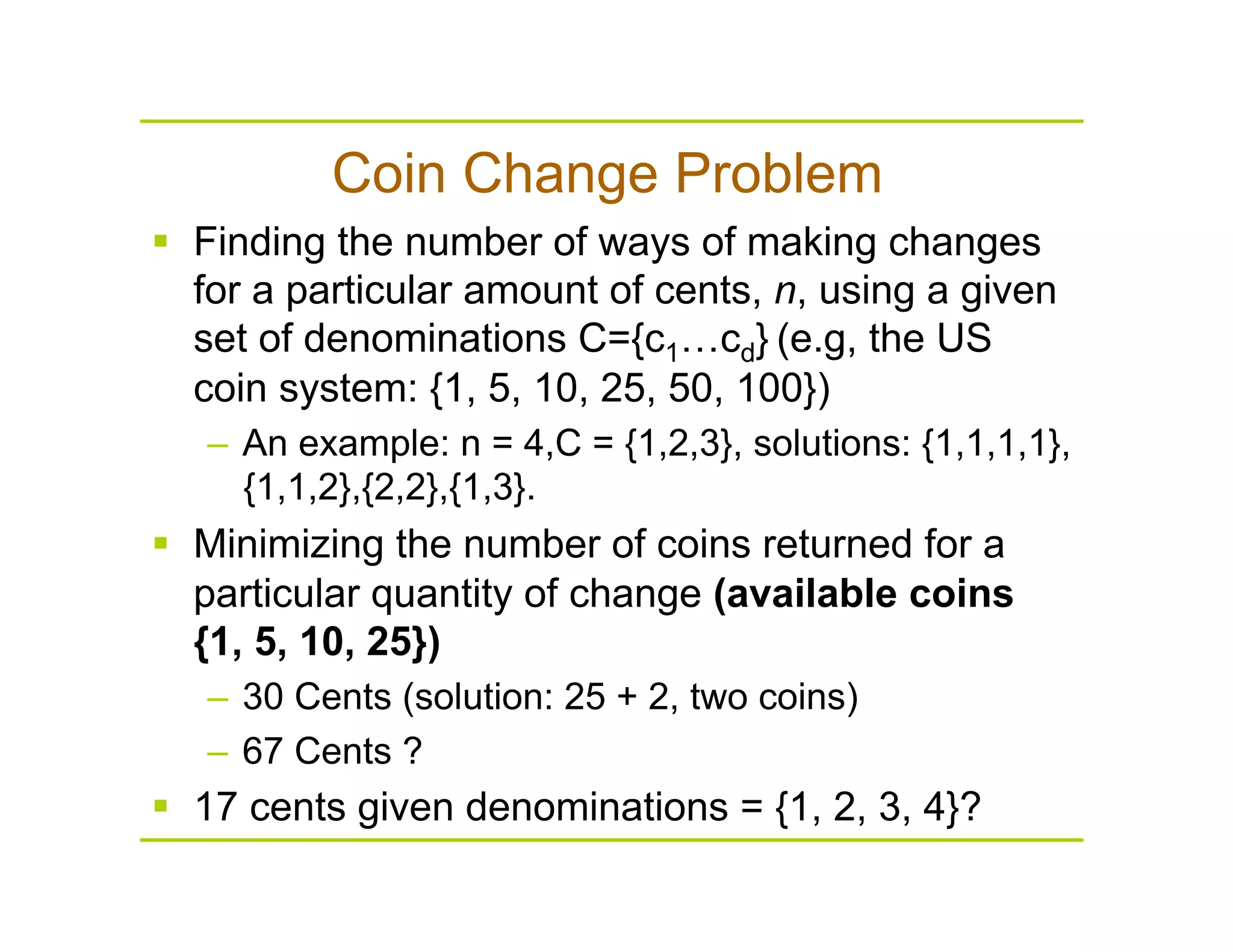
  Finding the number of ways of making changes
for a particular amount of cents, n, using a given
set of denominations C={c1…cd} (e.g, the US
coin system: {1, 5, 10, 25, 50, 100})
–  An example: n = 4,C = {1,2,3}, solutions: {1,1,1,1},
{1,1,2},{2,2},{1,3}.
  Minimizing the number of coins returned for a
particular quantity of change (available coins
{1, 5, 10, 25})
–  30 Cents (solution: 25 + 2, two coins)
–  67 Cents ?
  17 cents given denominations = {1, 2, 3, 4}?
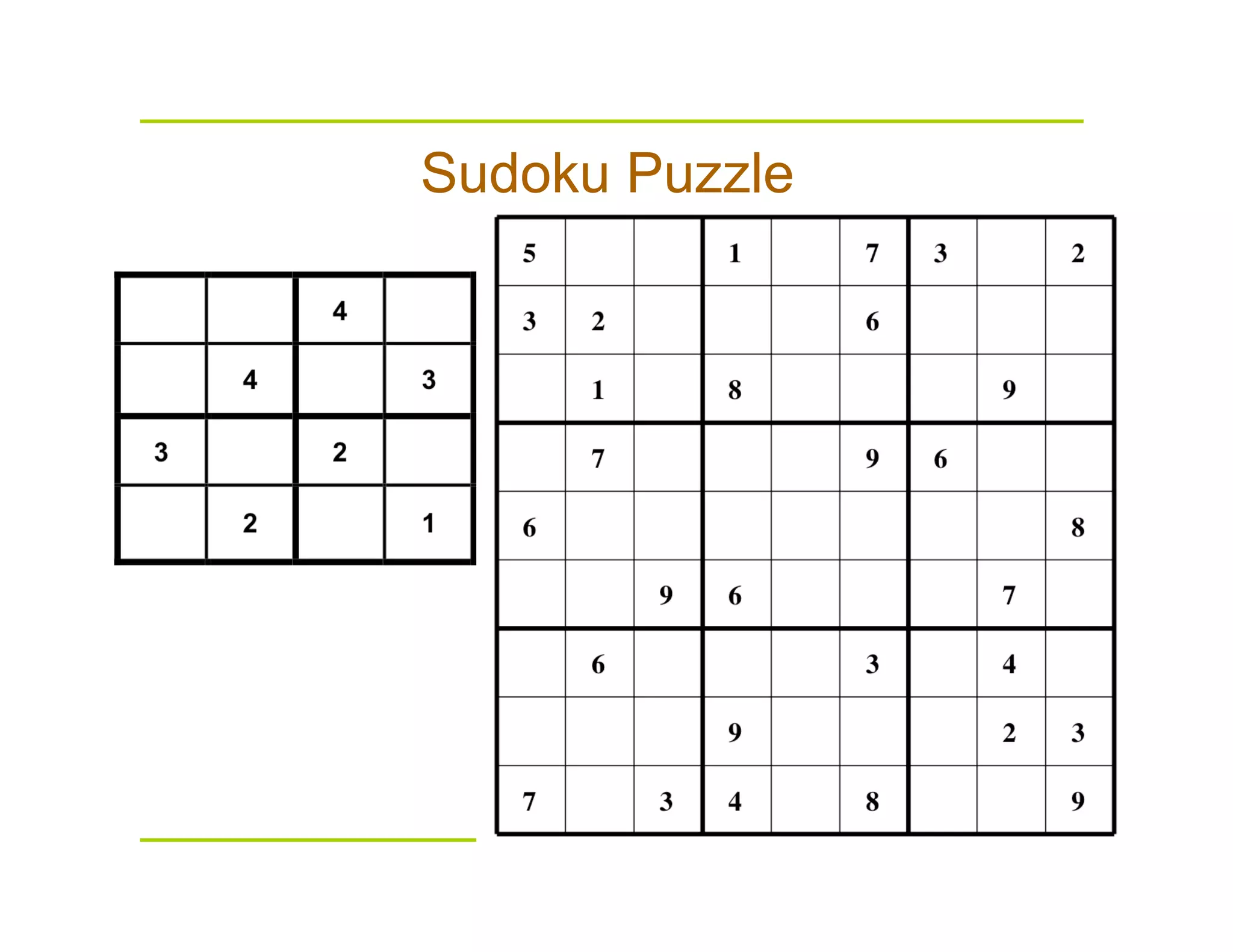
Sudoku Puzzle
Find the Fewest Coins:
Casher’s algorithm
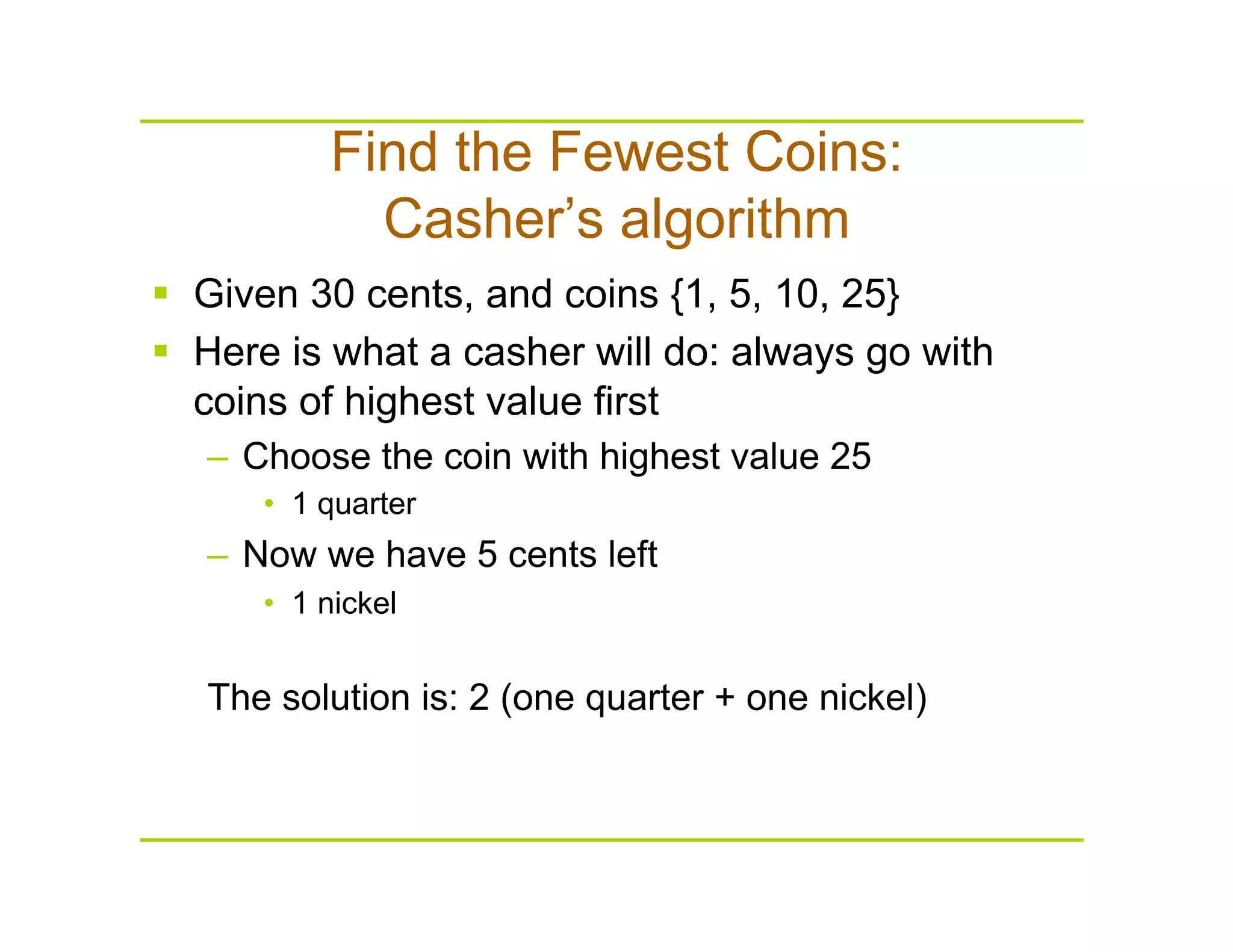
  Given 30 cents, and coins {1, 5, 10, 25}
  Here is what a casher will do: always go with
coins of highest value first
–  Choose the coin with highest value 25
•  1 quarter
–  Now we have 5 cents left
•  1 nickel
The solution is: 2 (one quarter + one nickel)
Greedy Algorithm Does not
Always Give Optimal Solution to
Coin Change Problem
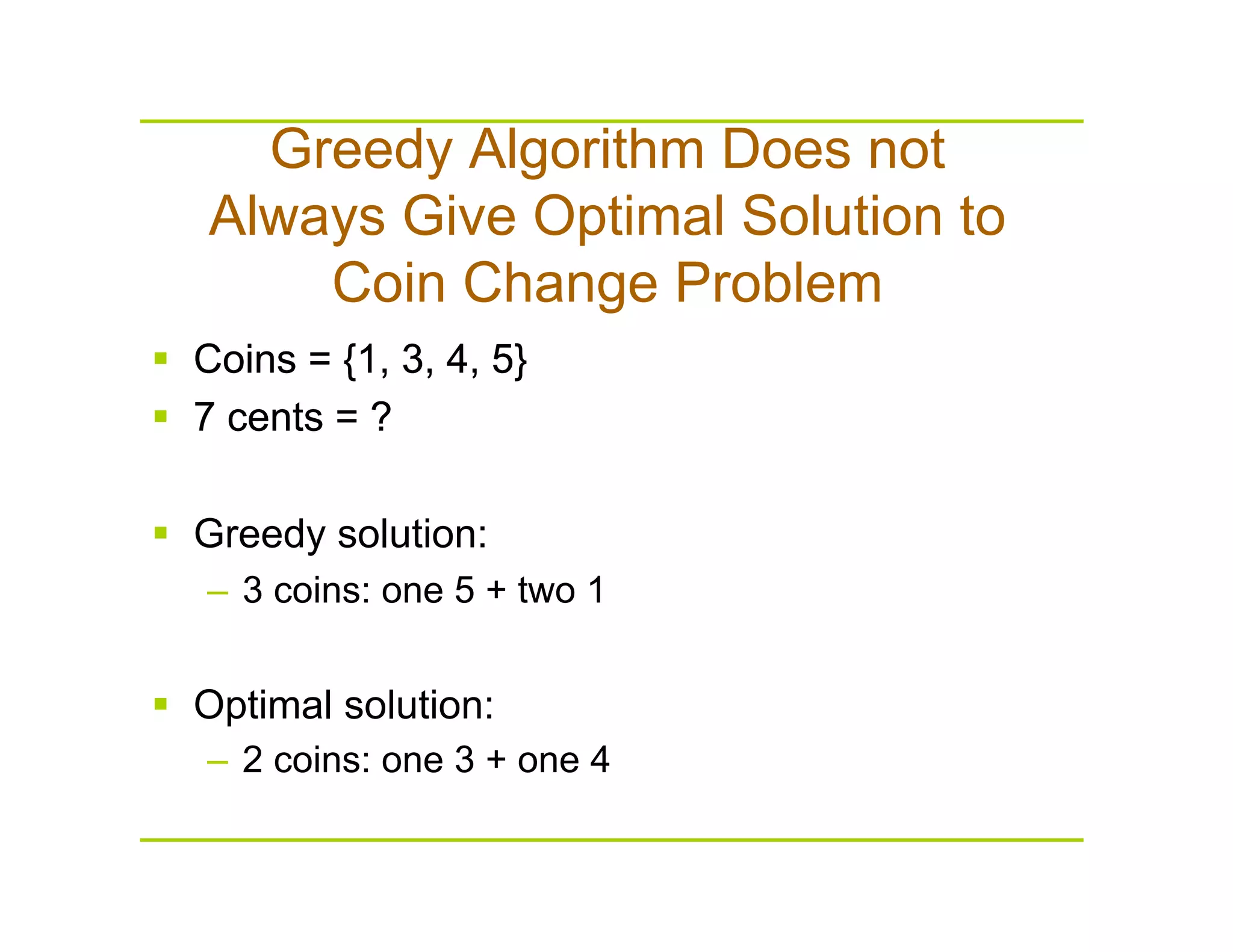
  Coins = {1, 3, 4, 5}
  7 cents = ?
  Coins = {1, 3, 4, 5}
  7 cents = ?
  Greedy solution:
–  3 coins: one 5 + two 1
  Optimal solution:
–  2 coins: one 3 + one 4
Find the Fewest Coins:
Divide and Conquer
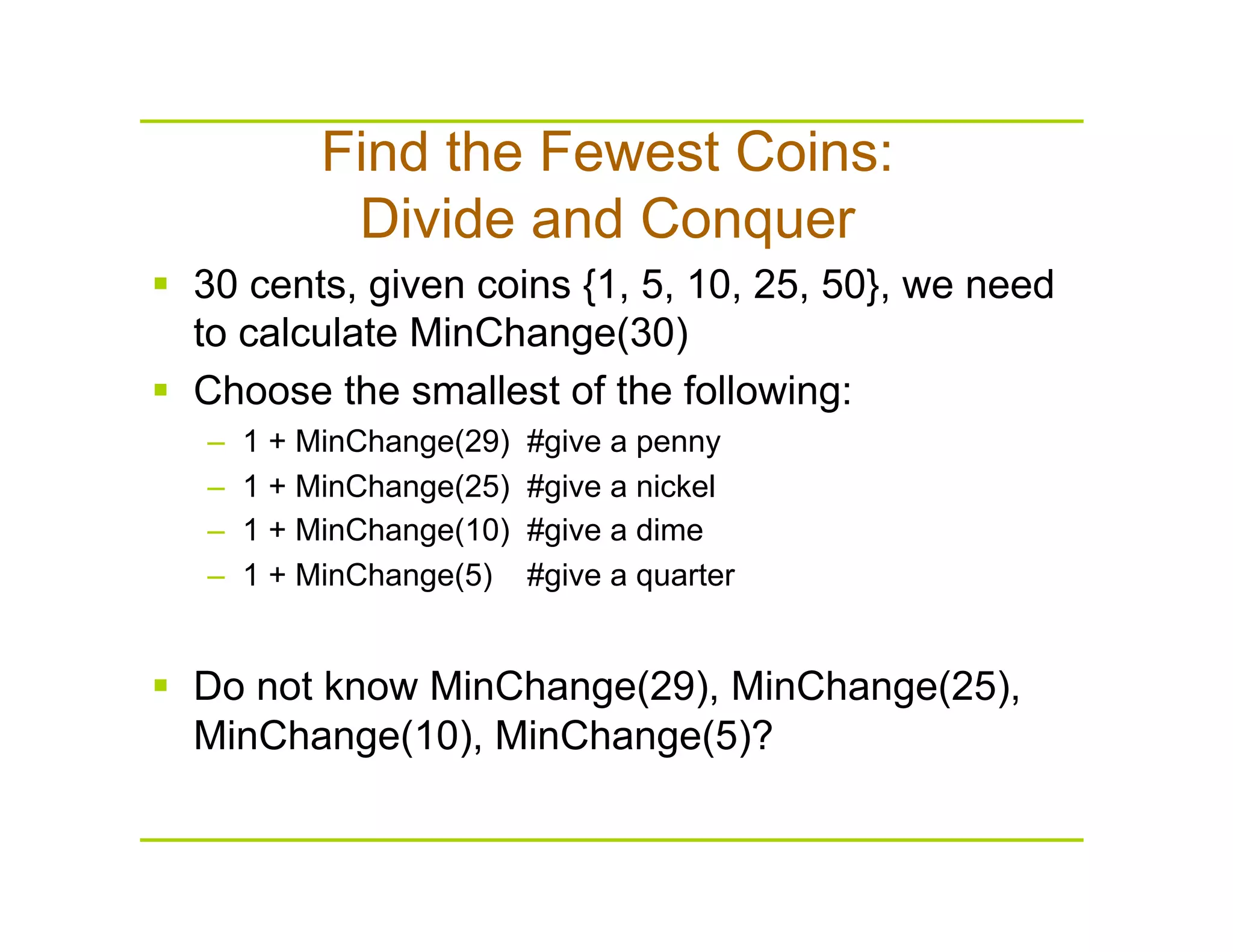
  30 cents, given coins {1, 5, 10, 25, 50}, we need
to calculate MinChange(30)
  Choose the smallest of the following:
–  1 + MinChange(29) #give a penny
–  1 + MinChange(25) #give a nickel
–  1 + MinChange(10) #give a dime
–  1 + MinChange(5) #give a quarter
  Do not know MinChange(29), MinChange(25),
MinChange(10), MinChange(5)?
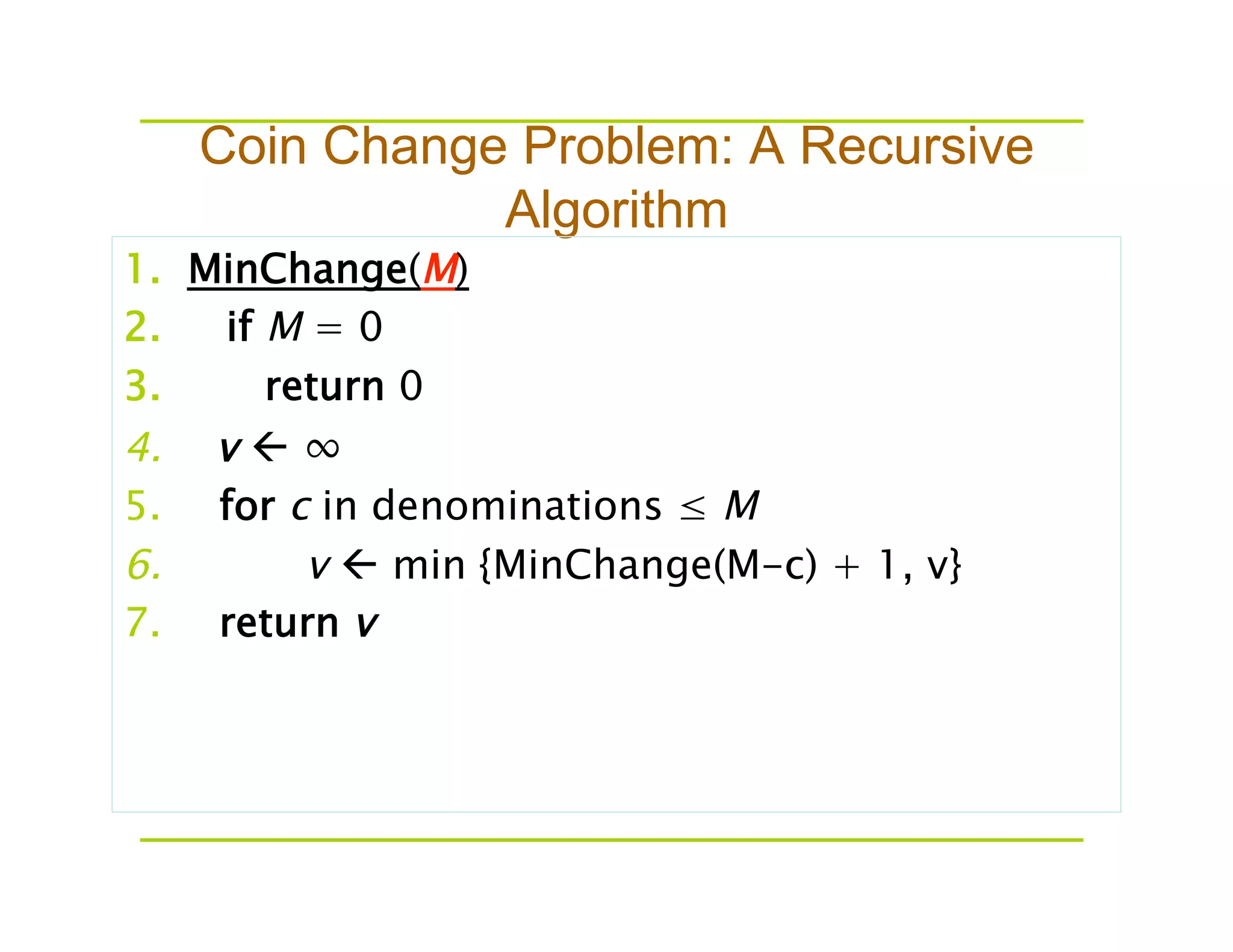
Coin Change Problem: A Recursive
Algorithm
1.  MinChange(M)
2.  if M = 0
3.  return 0
4.  v  ∞
5.  for c in denominations ≤ M
6.  v  min {MinChange(M-c) + 1, v}
7.  return v
Recursive Algorithm Is Not Efficient
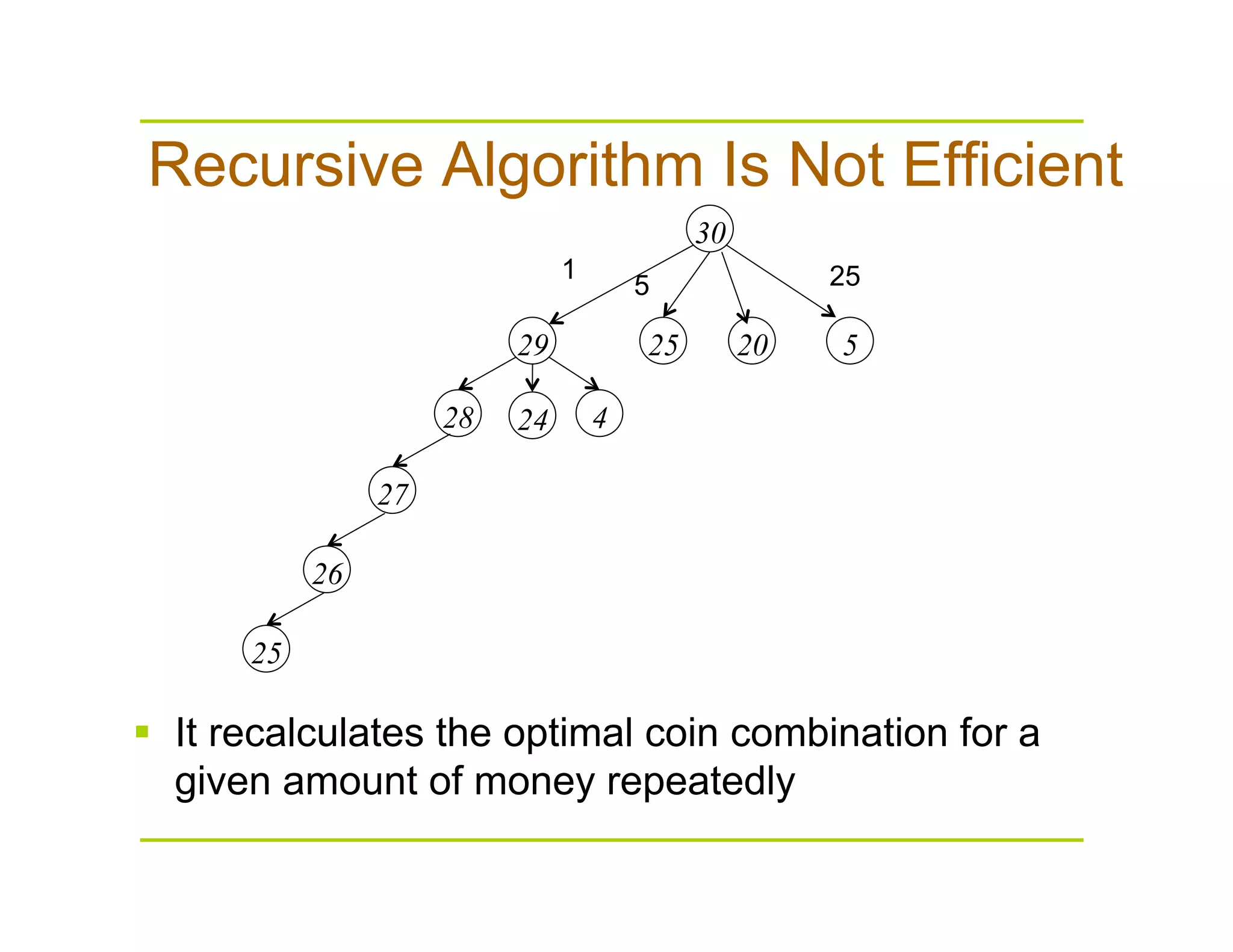
  It recalculates the optimal coin combination for a
given amount of money repeatedly
30
29 25 5
2428 4
1
5 25
27
26
25
20
How to avoid computing the same
function multiple times
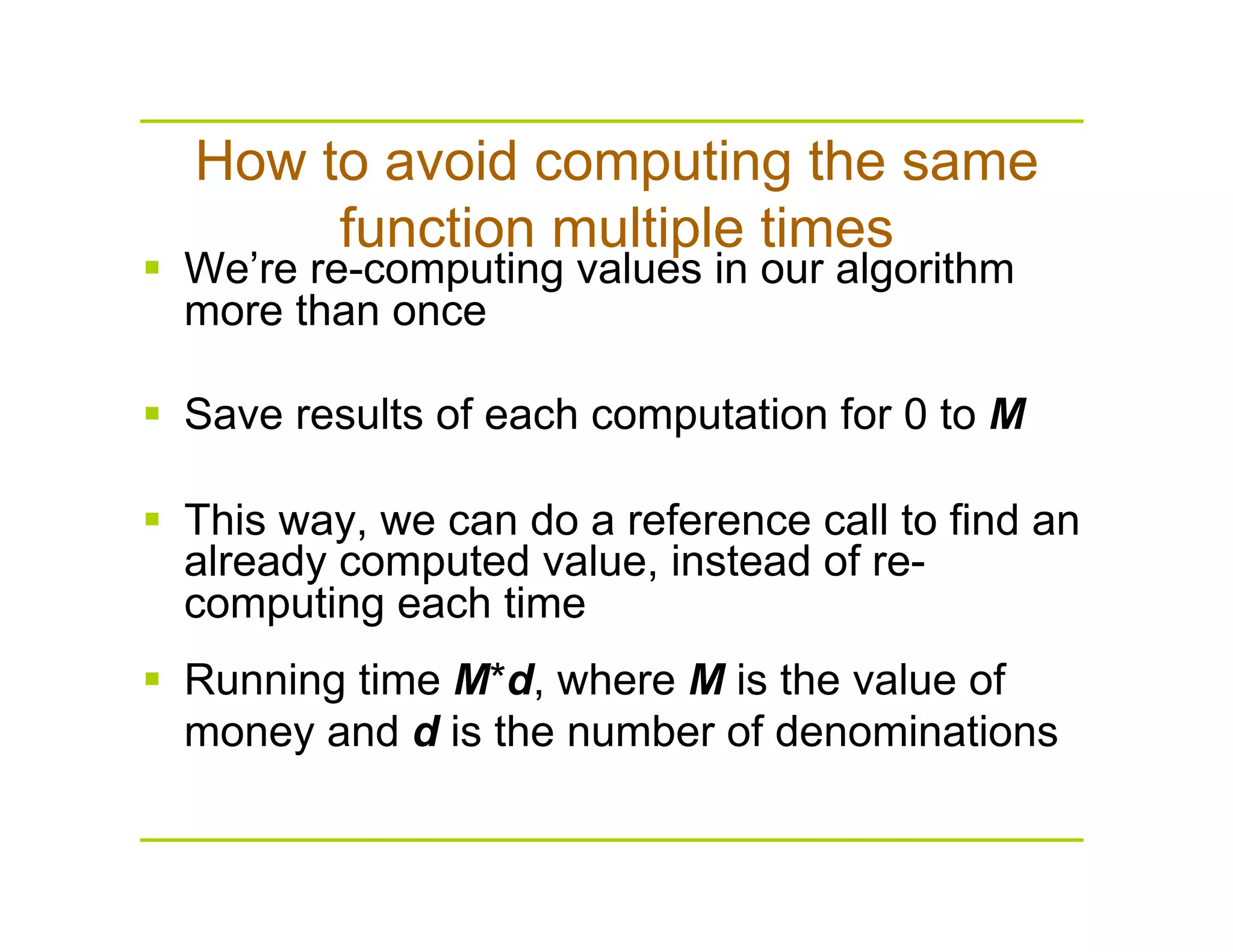
  We’re re-computing values in our algorithm
more than once
  Save results of each computation for 0 to M
  This way, we can do a reference call to find an
already computed value, instead of re-
computing each time
  Running time M*d, where M is the value of
money and d is the number of denominations
Coin Change Problem: Save the
Intermediate Results
1.  MinChange(M)
2.  if minChange[M] not empty
3.  return minChange[M]
4.  if M = 0
5.  return 0
6.  for c in denominations ≤ M
7.  v  min {MinChange(M-c) + 1, v}
8.  minChange[M] = v
9.  return v
The Change Problem: Dynamic
Programming
1.  MinChangeDP(M)
2.  minCoin[0]  0
3.  for m  1 to M
4.  minCoin[m] infinity
5.  for c in denominations ≤ M
6.  if minCoin[m-c] + 1 < minCoin[m]
7.  minCoin[m]minCoin[m-c] + 1
8.  return minCoin[M]
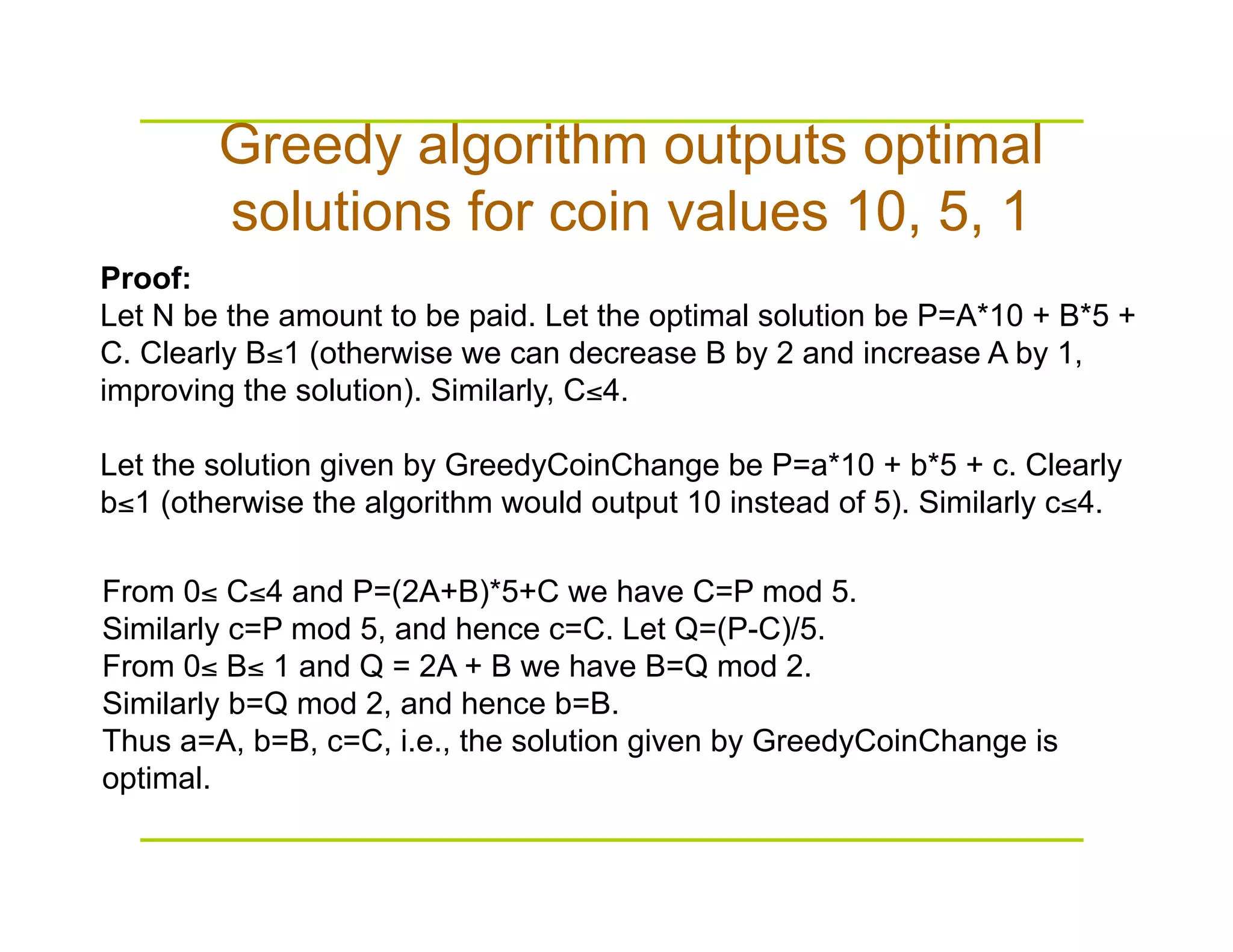
Proof:
Let N be the amount to be paid. Let the optimal solution be P=A*10 + B*5 +
C. Clearly B≤1 (otherwise we can decrease B by 2 and increase A by 1,
improving the solution). Similarly, C≤4.
Let the solution given by GreedyCoinChange be P=a*10 + b*5 + c. Clearly
b≤1 (otherwise the algorithm would output 10 instead of 5). Similarly c≤4.
From 0≤ C≤4 and P=(2A+B)*5+C we have C=P mod 5.
Similarly c=P mod 5, and hence c=C. Let Q=(P-C)/5.
From 0≤ B≤ 1 and Q = 2A + B we have B=Q mod 2.
Similarly b=Q mod 2, and hence b=B.
Thus a=A, b=B, c=C, i.e., the solution given by GreedyCoinChange is
optimal.
Greedy algorithm outputs optimal
solutions for coin values 10, 5, 1

Coin Change Problem

  • 1.
    Coin Change Problem  Finding the number of ways of making changes for a particular amount of cents, n, using a given set of denominations C={c1…cd} (e.g, the US coin system: {1, 5, 10, 25, 50, 100}) –  An example: n = 4,C = {1,2,3}, solutions: {1,1,1,1}, {1,1,2},{2,2},{1,3}.   Minimizing the number of coins returned for a particular quantity of change (available coins {1, 5, 10, 25}) –  30 Cents (solution: 25 + 2, two coins) –  67 Cents ?   17 cents given denominations = {1, 2, 3, 4}?
  • 2.
  • 3.
    Find the FewestCoins: Casher’s algorithm   Given 30 cents, and coins {1, 5, 10, 25}   Here is what a casher will do: always go with coins of highest value first –  Choose the coin with highest value 25 •  1 quarter –  Now we have 5 cents left •  1 nickel The solution is: 2 (one quarter + one nickel)
  • 4.
    Greedy Algorithm Doesnot Always Give Optimal Solution to Coin Change Problem   Coins = {1, 3, 4, 5}   7 cents = ?   Coins = {1, 3, 4, 5}   7 cents = ?   Greedy solution: –  3 coins: one 5 + two 1   Optimal solution: –  2 coins: one 3 + one 4
  • 5.
    Find the FewestCoins: Divide and Conquer   30 cents, given coins {1, 5, 10, 25, 50}, we need to calculate MinChange(30)   Choose the smallest of the following: –  1 + MinChange(29) #give a penny –  1 + MinChange(25) #give a nickel –  1 + MinChange(10) #give a dime –  1 + MinChange(5) #give a quarter   Do not know MinChange(29), MinChange(25), MinChange(10), MinChange(5)?
  • 6.
    Coin Change Problem:A Recursive Algorithm 1.  MinChange(M) 2.  if M = 0 3.  return 0 4.  v  ∞ 5.  for c in denominations ≤ M 6.  v  min {MinChange(M-c) + 1, v} 7.  return v
  • 7.
    Recursive Algorithm IsNot Efficient   It recalculates the optimal coin combination for a given amount of money repeatedly 30 29 25 5 2428 4 1 5 25 27 26 25 20
  • 8.
    How to avoidcomputing the same function multiple times   We’re re-computing values in our algorithm more than once   Save results of each computation for 0 to M   This way, we can do a reference call to find an already computed value, instead of re- computing each time   Running time M*d, where M is the value of money and d is the number of denominations
  • 9.
    Coin Change Problem:Save the Intermediate Results 1.  MinChange(M) 2.  if minChange[M] not empty 3.  return minChange[M] 4.  if M = 0 5.  return 0 6.  for c in denominations ≤ M 7.  v  min {MinChange(M-c) + 1, v} 8.  minChange[M] = v 9.  return v
  • 10.
    The Change Problem:Dynamic Programming 1.  MinChangeDP(M) 2.  minCoin[0]  0 3.  for m  1 to M 4.  minCoin[m] infinity 5.  for c in denominations ≤ M 6.  if minCoin[m-c] + 1 < minCoin[m] 7.  minCoin[m]minCoin[m-c] + 1 8.  return minCoin[M]
  • 11.
    Proof: Let N bethe amount to be paid. Let the optimal solution be P=A*10 + B*5 + C. Clearly B≤1 (otherwise we can decrease B by 2 and increase A by 1, improving the solution). Similarly, C≤4. Let the solution given by GreedyCoinChange be P=a*10 + b*5 + c. Clearly b≤1 (otherwise the algorithm would output 10 instead of 5). Similarly c≤4. From 0≤ C≤4 and P=(2A+B)*5+C we have C=P mod 5. Similarly c=P mod 5, and hence c=C. Let Q=(P-C)/5. From 0≤ B≤ 1 and Q = 2A + B we have B=Q mod 2. Similarly b=Q mod 2, and hence b=B. Thus a=A, b=B, c=C, i.e., the solution given by GreedyCoinChange is optimal. Greedy algorithm outputs optimal solutions for coin values 10, 5, 1