PRESENTED BY:SATYABRATA MONDAL
ROLLNO.:12000123082
DEPARTMENT:COMPUTER SCIENCE & ENGINEERING-2
SEMESTER:3rd
SUBJECT:COMPUTER ORGANISATION
SUBJECT CODE:PC-CS 302
DR.B.C.ROY ENGINEERING COLLEGE
CONTINUOUS ASSIGNMENT-I
TOPIC:NUMBER SYSTEM AND ITS CONVERSION METHODS
2.
Introduction to
Number Systems
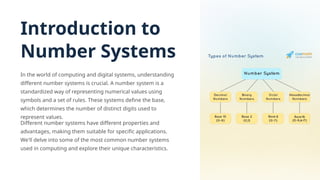
Inthe world of computing and digital systems, understanding
different number systems is crucial. A number system is a
standardized way of representing numerical values using
symbols and a set of rules. These systems define the base,
which determines the number of distinct digits used to
represent values.
Different number systems have different properties and
advantages, making them suitable for specific applications.
We'll delve into some of the most common number systems
used in computing and explore their unique characteristics.
3.
Binary Number System
Thebinary number system is the foundation of modern computing. It
utilizes only two digits, 0 and 1, which represent the absence or presence
of an electrical signal, respectively. This system is incredibly efficient for
representing information in computers, as it simplifies the processing
and storage of data.
1 Base-2
The binary system is based on the power of 2. Each digit position
represents a power of 2, starting from 2^0 (rightmost digit) and
increasing to higher powers.
2 Example
The binary number 10110 represents the decimal value 22. The
rightmost digit (0) is 2^0, the next digit (1) is 2^1, and so on. We
add these values together: (1 * 2^4) + (0 * 2^3) + (1 * 2^2) + (1 *
2^1) + (0 * 2^0) = 16 + 0 + 4 + 2 + 0 = 22.
4.
Decimal Number System
Thedecimal number system is the most familiar to humans, as it's the system we use in everyday life. It has a
base of 10, meaning it uses ten distinct digits: 0, 1, 2, 3, 4, 5, 6, 7, 8, and 9.
Base-10
Each digit position represents a
power of 10, starting from 10^0
(rightmost digit) and increasing
to higher powers.
Example
The decimal number 345
represents the value (3 * 10^2)
+ (4 * 10^1) + (5 * 10^0) = 300 +
40 + 5 = 345.
Applications
Decimal numbers are used
extensively in everyday life,
including finances,
measurements, and scientific
calculations.
5.
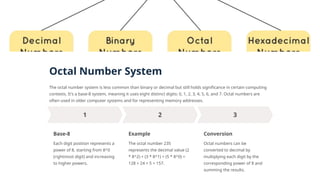
Octal Number System
Theoctal number system is less common than binary or decimal but still holds significance in certain computing
contexts. It's a base-8 system, meaning it uses eight distinct digits: 0, 1, 2, 3, 4, 5, 6, and 7. Octal numbers are
often used in older computer systems and for representing memory addresses.
Base-8
Each digit position represents a
power of 8, starting from 8^0
(rightmost digit) and increasing
to higher powers.
Example
The octal number 235
represents the decimal value (2
* 8^2) + (3 * 8^1) + (5 * 8^0) =
128 + 24 + 5 = 157.
Conversion
Octal numbers can be
converted to decimal by
multiplying each digit by the
corresponding power of 8 and
summing the results.
6.
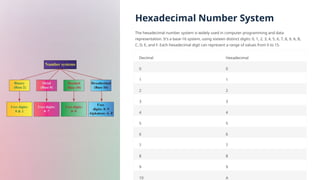
Hexadecimal Number System
Thehexadecimal number system is widely used in computer programming and data
representation. It's a base-16 system, using sixteen distinct digits: 0, 1, 2, 3, 4, 5, 6, 7, 8, 9, A, B,
C, D, E, and F. Each hexadecimal digit can represent a range of values from 0 to 15.
Decimal Hexadecimal
0 0
1 1
2 2
3 3
4 4
5 5
6 6
7 7
8 8
9 9
10 A
7.
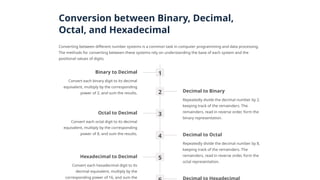
Conversion between Binary,Decimal,
Octal, and Hexadecimal
Converting between different number systems is a common task in computer programming and data processing.
The methods for converting between these systems rely on understanding the base of each system and the
positional values of digits.
1
Binary to Decimal
Convert each binary digit to its decimal
equivalent, multiply by the corresponding
power of 2, and sum the results. 2 Decimal to Binary
Repeatedly divide the decimal number by 2,
keeping track of the remainders. The
remainders, read in reverse order, form the
binary representation.
3
Octal to Decimal
Convert each octal digit to its decimal
equivalent, multiply by the corresponding
power of 8, and sum the results.
4 Decimal to Octal
Repeatedly divide the decimal number by 8,
keeping track of the remainders. The
remainders, read in reverse order, form the
octal representation.
5
Hexadecimal to Decimal
Convert each hexadecimal digit to its
decimal equivalent, multiply by the
corresponding power of 16, and sum the Decimal to Hexadecimal
8.
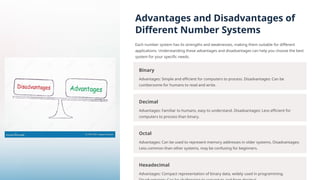
Advantages and Disadvantagesof
Different Number Systems
Each number system has its strengths and weaknesses, making them suitable for different
applications. Understanding these advantages and disadvantages can help you choose the best
system for your specific needs.
Binary
Advantages: Simple and efficient for computers to process. Disadvantages: Can be
cumbersome for humans to read and write.
Decimal
Advantages: Familiar to humans, easy to understand. Disadvantages: Less efficient for
computers to process than binary.
Octal
Advantages: Can be used to represent memory addresses in older systems. Disadvantages:
Less common than other systems, may be confusing for beginners.
Hexadecimal
Advantages: Compact representation of binary data, widely used in programming.
9.
Applications of NumberSystems
Number systems are fundamental to various aspects of computing and technology.
Understanding how they are used can provide a deeper appreciation for the underlying
mechanisms of modern devices.
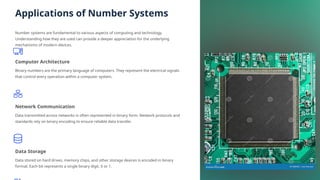
Computer Architecture
Binary numbers are the primary language of computers. They represent the electrical signals
that control every operation within a computer system.
Network Communication
Data transmitted across networks is often represented in binary form. Network protocols and
standards rely on binary encoding to ensure reliable data transfer.
Data Storage
Data stored on hard drives, memory chips, and other storage devices is encoded in binary
format. Each bit represents a single binary digit, 0 or 1.
10.
Importance of Understanding
NumberSystems
Having a solid understanding of number systems is crucial for anyone working in the fields of
computer science, engineering, and related areas. It enables you to:
1 Analyze Computer Behavior
Understand how computers process and store data at a fundamental level.
2 Debug and Optimize Code
Identify and resolve errors in programs that involve data representation and manipulation.
3 Work with Low-Level Systems
Effectively interact with computer hardware and systems that require knowledge of
binary representation.
4 Enhance Problem-Solving Skills
Develop a deeper understanding of digital systems and improve your ability to solve
complex problems.
11.
Conclusion and Summary
Numbersystems are essential tools in the world of
computing, each with its unique characteristics and
advantages. While binary is the primary language of
computers, understanding decimal, octal, and hexadecimal
allows for more efficient communication, data representation,
and program development. By mastering these concepts, you
gain valuable insights into the inner workings of digital
systems and equip yourself with essential knowledge for
success in the field.