NUMBER SYSTEM
1
By:
IMRAN ULLAH GONDAL/ CSE
Number System
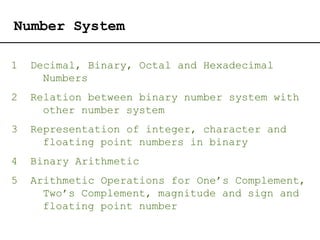
1 Decimal, Binary, Octal and Hexadecimal
Numbers
2 Relation between binary number system with
other number system
3 Representation of integer, character and
floating point numbers in binary
4 Binary Arithmetic
5 Arithmetic Operations for One’s Complement,
Two’s Complement, magnitude and sign and
floating point number
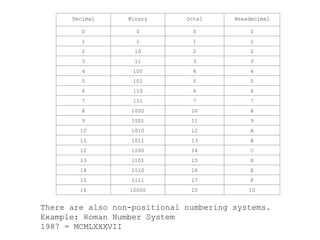
Decimal Binary Octal Hexadecimal
0 0 0 0
1 1 1 1
2 10 2 2
3 11 3 3
4 100 4 4
5 101 5 5
6 110 6 6
7 111 7 7
8 1000 10 8
9 1001 11 9
10 1010 12 A
11 1011 13 B
12 1100 14 C
13 1101 15 D
14 1110 16 E
15 1111 17 F
16 10000 20 10
There are also non-positional numbering systems.
Example: Roman Number System
1987 = MCMLXXXVII
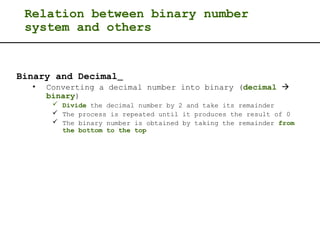
Relation between binary number
system and others
Binary and Decimal
• Converting a decimal number into binary (decimal 
binary)
 Divide the decimal number by 2 and take its remainder
 The process is repeated until it produces the result of 0
 The binary number is obtained by taking the remainder from
the bottom to the top
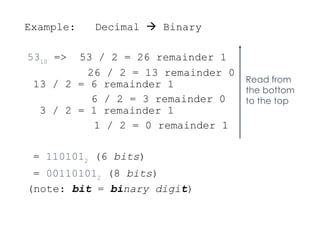
Example: Decimal  Binary
5310
=> 53 / 2 = 26 remainder 1
26 / 2 = 13 remainder 0
13 / 2 = 6 remainder 1
6 / 2 = 3 remainder 0
3 / 2 = 1 remainder 1
1 / 2 = 0 remainder 1
= 1101012
(6 bits)
= 001101012
(8 bits)
(note: bit = binary digit)
Read from
the bottom
to the top
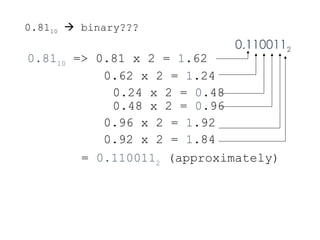
0.8110  binary???
0.8110
=> 0.81 x 2 = 1.62
0.62 x 2 = 1.24
0.24 x 2 = 0.48
0.48 x 2 = 0.96
0.96 x 2 = 1.92
0.92 x 2 = 1.84
= 0.1100112
(approximately)
0.1100112
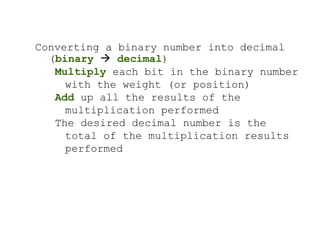
Converting a binary number into decimal
(binary  decimal)
Multiply each bit in the binary number
with the weight (or position)
Add up all the results of the
multiplication performed
The desired decimal number is the
total of the multiplication results
performed
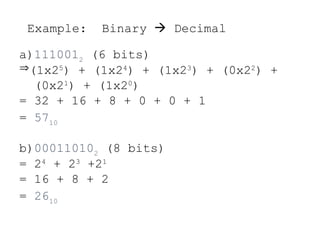
Example: Binary  Decimal
a)1110012
(6 bits)
(1x25
) + (1x24
) + (1x23
) + (0x22
) +
(0x21
) + (1x20
)
= 32 + 16 + 8 + 0 + 0 + 1
= 5710
b)000110102
(8 bits)
= 24
+ 23
+21
= 16 + 8 + 2
= 2610
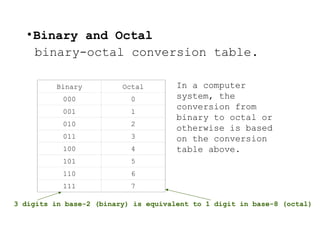
•Binary and Octal
binary-octal conversion table.
Binary Octal
000 0
001 1
010 2
011 3
100 4
101 5
110 6
111 7
In a computer
system, the
conversion from
binary to octal or
otherwise is based
on the conversion
table above.
3 digits in base-2 (binary) is equivalent to 1 digit in base-8 (octal)
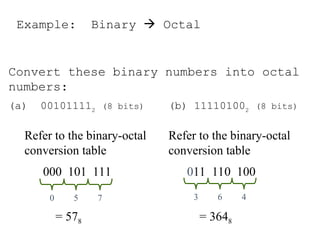
Example: Binary  Octal
Convert these binary numbers into octal
numbers:
(a) 001011112
(8 bits) (b) 111101002
(8 bits)
Refer to the binary-octal
conversion table
000 101 111
= 578
0 5 7
Refer to the binary-octal
conversion table
011 110 100
= 3648
3 6 4
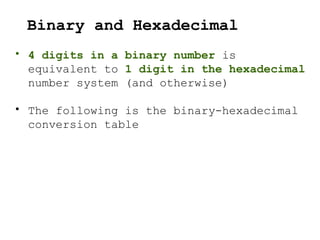
• 4 digits in a binary number is
equivalent to 1 digit in the hexadecimal
number system (and otherwise)
• The following is the binary-hexadecimal
conversion table
Binary and Hexadecimal
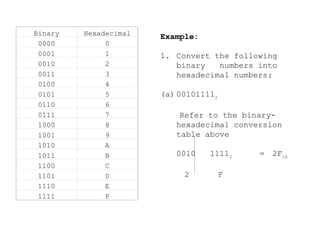
Binary Hexadecimal
0000 0
0001 1
0010 2
0011 3
0100 4
0101 5
0110 6
0111 7
1000 8
1001 9
1010 A
1011 B
1100 C
1101 D
1110 E
1111 F
Example:
1. Convert the following
binary numbers into
hexadecimal numbers:
(a) 001011112
Refer to the binary-
hexadecimal conversion
table above
0010 11112
= 2F16
2 F
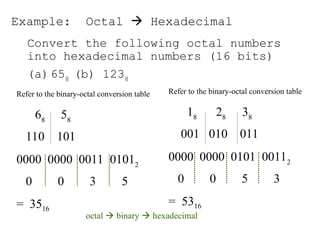
Example: Octal  Hexadecimal
Convert the following octal numbers
into hexadecimal numbers (16 bits)
(a)658
(b) 1238
Refer to the binary-octal conversion table
68
58
110 101
0000 0000 0011 01012
0 0 3 5
= 3516
Refer to the binary-octal conversion table
18
28
38
001 010 011
0000 0000 0101 00112
0 0 5 3
= 5316
octal  binary  hexadecimal
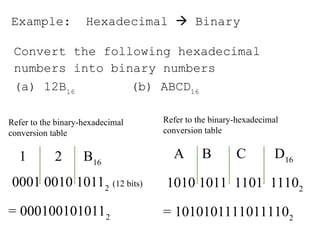
Example: Hexadecimal  Binary
Convert the following hexadecimal
numbers into binary numbers
(a) 12B16
(b) ABCD16
Refer to the binary-hexadecimal
conversion table
1 2 B16
0001 0010 10112
(12 bits)
= 0001001010112
Refer to the binary-hexadecimal
conversion table
A B C D16
1010 1011 1101 11102
= 10101011110111102
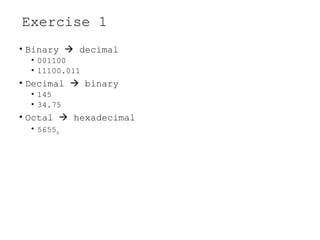
Exercise 1
• Binary  decimal
• 001100
• 11100.011
• Decimal  binary
• 145
• 34.75
• Octal  hexadecimal
• 56558
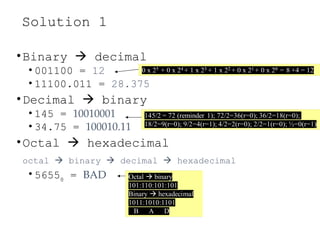
Solution 1
•Binary  decimal
• 001100 = 12
• 11100.011 = 28.375
•Decimal  binary
• 145 = 10010001
• 34.75 = 100010.11
•Octal  hexadecimal
octal  binary  decimal  hexadecimal
• 56558
= BAD
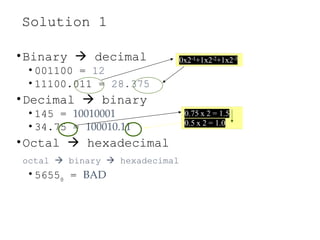
Solution 1
•Binary  decimal
• 001100 = 12
• 11100.011 = 28.375
•Decimal  binary
• 145 = 10010001
• 34.75 = 100010.11
•Octal  hexadecimal
octal  binary  hexadecimal
• 56558
= BAD
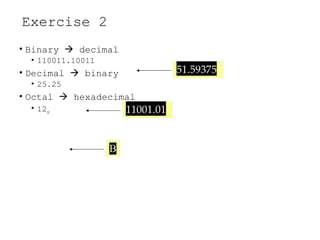
Exercise 2
• Binary  decimal
• 110011.10011
• Decimal  binary
• 25.25
• Octal  hexadecimal
• 128
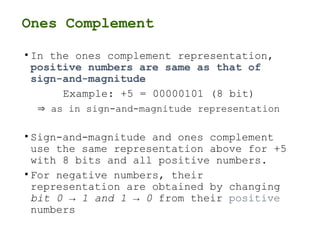
Ones Complement
• In the ones complement representation,
positive numbers are same as that of
sign-and-magnitude
Example: +5 = 00000101 (8 bit)
 as in sign-and-magnitude representation
• Sign-and-magnitude and ones complement
use the same representation above for +5
with 8 bits and all positive numbers.
• For negative numbers, their
representation are obtained by changing
bit 0 → 1 and 1 → 0 from their positive
numbers
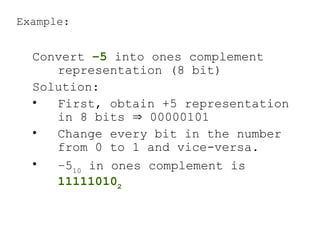
Example:
Convert –5 into ones complement
representation (8 bit)
Solution:
• First, obtain +5 representation
in 8 bits  00000101
• Change every bit in the number
from 0 to 1 and vice-versa.
• –510
in ones complement is
111110102
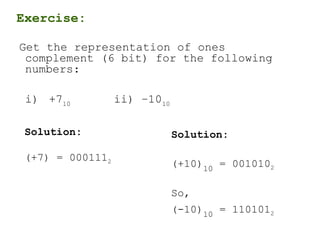
Exercise:
Get the representation of ones
complement (6 bit) for the following
numbers:
i) +710
ii) –1010
Solution:
(+7) = 0001112
Solution:
(+10)10
= 0010102
So,
(-10)10
= 1101012
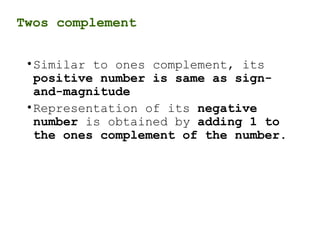
Twos complement
•Similar to ones complement, its
positive number is same as sign-
and-magnitude
•Representation of its negative
number is obtained by adding 1 to
the ones complement of the number.
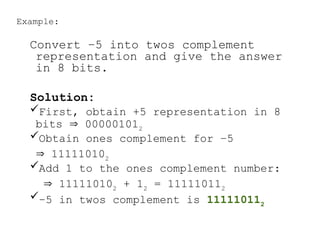
Example:
Convert –5 into twos complement
representation and give the answer
in 8 bits.
Solution:
First, obtain +5 representation in 8
bits  000001012
Obtain ones complement for –5
 111110102
Add 1 to the ones complement number:
 111110102
+ 12
= 111110112
–5 in twos complement is 111110112
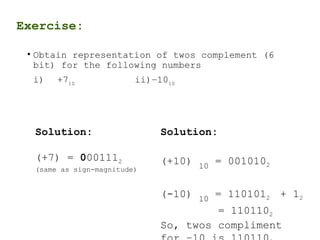
Exercise:
• Obtain representation of twos complement (6
bit) for the following numbers
i) +710
ii)–1010
Solution:
(+7) = 0001112
(same as sign-magnitude)
Solution:
(+10) 10
= 0010102
(-10) 10
= 1101012 + 12
= 1101102
So, twos compliment
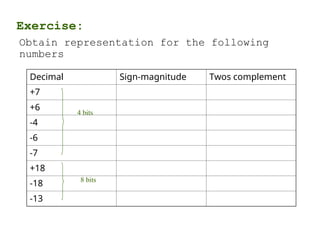
Exercise:
Obtain representation for the following
numbers
Decimal Sign-magnitude Twos complement
+7
+6
-4
-6
-7
+18
-18
-13
4 bits
8 bits
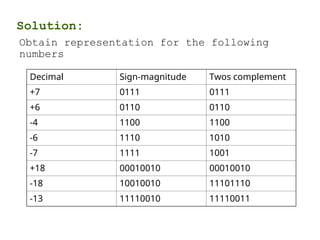
Solution:
Obtain representation for the following
numbers
Decimal Sign-magnitude Twos complement
+7 0111 0111
+6 0110 0110
-4 1100 1100
-6 1110 1010
-7 1111 1001
+18 00010010 00010010
-18 10010010 11101110
-13 11110010 11110011
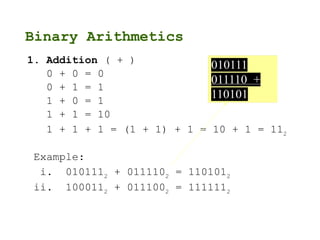
Binary Arithmetics
1. Addition ( + )
0 + 0 = 0
0 + 1 = 1
1 + 0 = 1
1 + 1 = 10
1 + 1 + 1 = (1 + 1) + 1 = 10 + 1 = 112
Example:
i. 0101112
+ 0111102
= 1101012
ii. 1000112
+ 0111002
= 1111112
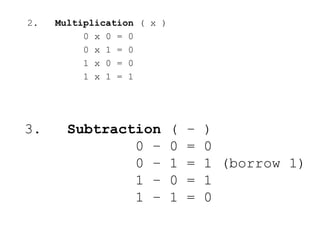
2. Multiplication ( x )
0 x 0 = 0
0 x 1 = 0
1 x 0 = 0
1 x 1 = 1
3. Subtraction ( – )
0 – 0 = 0
0 – 1 = 1 (borrow 1)
1 – 0 = 1
1 – 1 = 0
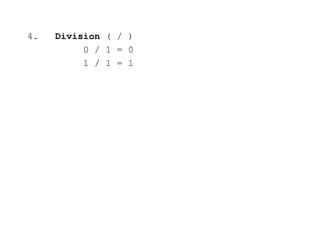
4. Division ( / )
0 / 1 = 0
1 / 1 = 1

Number_Systems in Digital Logic Design CS-151

  • 1.
  • 2.
    Number System 1 Decimal,Binary, Octal and Hexadecimal Numbers 2 Relation between binary number system with other number system 3 Representation of integer, character and floating point numbers in binary 4 Binary Arithmetic 5 Arithmetic Operations for One’s Complement, Two’s Complement, magnitude and sign and floating point number
  • 3.
    Decimal Binary OctalHexadecimal 0 0 0 0 1 1 1 1 2 10 2 2 3 11 3 3 4 100 4 4 5 101 5 5 6 110 6 6 7 111 7 7 8 1000 10 8 9 1001 11 9 10 1010 12 A 11 1011 13 B 12 1100 14 C 13 1101 15 D 14 1110 16 E 15 1111 17 F 16 10000 20 10 There are also non-positional numbering systems. Example: Roman Number System 1987 = MCMLXXXVII
  • 4.
    Relation between binarynumber system and others Binary and Decimal • Converting a decimal number into binary (decimal  binary)  Divide the decimal number by 2 and take its remainder  The process is repeated until it produces the result of 0  The binary number is obtained by taking the remainder from the bottom to the top
  • 5.
    Example: Decimal Binary 5310 => 53 / 2 = 26 remainder 1 26 / 2 = 13 remainder 0 13 / 2 = 6 remainder 1 6 / 2 = 3 remainder 0 3 / 2 = 1 remainder 1 1 / 2 = 0 remainder 1 = 1101012 (6 bits) = 001101012 (8 bits) (note: bit = binary digit) Read from the bottom to the top
  • 6.
    0.8110  binary??? 0.8110 =>0.81 x 2 = 1.62 0.62 x 2 = 1.24 0.24 x 2 = 0.48 0.48 x 2 = 0.96 0.96 x 2 = 1.92 0.92 x 2 = 1.84 = 0.1100112 (approximately) 0.1100112
  • 7.
    Converting a binarynumber into decimal (binary  decimal) Multiply each bit in the binary number with the weight (or position) Add up all the results of the multiplication performed The desired decimal number is the total of the multiplication results performed
  • 8.
    Example: Binary Decimal a)1110012 (6 bits) (1x25 ) + (1x24 ) + (1x23 ) + (0x22 ) + (0x21 ) + (1x20 ) = 32 + 16 + 8 + 0 + 0 + 1 = 5710 b)000110102 (8 bits) = 24 + 23 +21 = 16 + 8 + 2 = 2610
  • 9.
    •Binary and Octal binary-octalconversion table. Binary Octal 000 0 001 1 010 2 011 3 100 4 101 5 110 6 111 7 In a computer system, the conversion from binary to octal or otherwise is based on the conversion table above. 3 digits in base-2 (binary) is equivalent to 1 digit in base-8 (octal)
  • 10.
    Example: Binary Octal Convert these binary numbers into octal numbers: (a) 001011112 (8 bits) (b) 111101002 (8 bits) Refer to the binary-octal conversion table 000 101 111 = 578 0 5 7 Refer to the binary-octal conversion table 011 110 100 = 3648 3 6 4
  • 11.
    • 4 digitsin a binary number is equivalent to 1 digit in the hexadecimal number system (and otherwise) • The following is the binary-hexadecimal conversion table Binary and Hexadecimal
  • 12.
    Binary Hexadecimal 0000 0 00011 0010 2 0011 3 0100 4 0101 5 0110 6 0111 7 1000 8 1001 9 1010 A 1011 B 1100 C 1101 D 1110 E 1111 F Example: 1. Convert the following binary numbers into hexadecimal numbers: (a) 001011112 Refer to the binary- hexadecimal conversion table above 0010 11112 = 2F16 2 F
  • 13.
    Example: Octal Hexadecimal Convert the following octal numbers into hexadecimal numbers (16 bits) (a)658 (b) 1238 Refer to the binary-octal conversion table 68 58 110 101 0000 0000 0011 01012 0 0 3 5 = 3516 Refer to the binary-octal conversion table 18 28 38 001 010 011 0000 0000 0101 00112 0 0 5 3 = 5316 octal  binary  hexadecimal
  • 14.
    Example: Hexadecimal Binary Convert the following hexadecimal numbers into binary numbers (a) 12B16 (b) ABCD16 Refer to the binary-hexadecimal conversion table 1 2 B16 0001 0010 10112 (12 bits) = 0001001010112 Refer to the binary-hexadecimal conversion table A B C D16 1010 1011 1101 11102 = 10101011110111102
  • 15.
    Exercise 1 • Binary decimal • 001100 • 11100.011 • Decimal  binary • 145 • 34.75 • Octal  hexadecimal • 56558
  • 16.
    Solution 1 •Binary decimal • 001100 = 12 • 11100.011 = 28.375 •Decimal  binary • 145 = 10010001 • 34.75 = 100010.11 •Octal  hexadecimal octal  binary  decimal  hexadecimal • 56558 = BAD
  • 17.
    Solution 1 •Binary decimal • 001100 = 12 • 11100.011 = 28.375 •Decimal  binary • 145 = 10010001 • 34.75 = 100010.11 •Octal  hexadecimal octal  binary  hexadecimal • 56558 = BAD
  • 18.
    Exercise 2 • Binary decimal • 110011.10011 • Decimal  binary • 25.25 • Octal  hexadecimal • 128
  • 19.
    Ones Complement • Inthe ones complement representation, positive numbers are same as that of sign-and-magnitude Example: +5 = 00000101 (8 bit)  as in sign-and-magnitude representation • Sign-and-magnitude and ones complement use the same representation above for +5 with 8 bits and all positive numbers. • For negative numbers, their representation are obtained by changing bit 0 → 1 and 1 → 0 from their positive numbers
  • 20.
    Example: Convert –5 intoones complement representation (8 bit) Solution: • First, obtain +5 representation in 8 bits  00000101 • Change every bit in the number from 0 to 1 and vice-versa. • –510 in ones complement is 111110102
  • 21.
    Exercise: Get the representationof ones complement (6 bit) for the following numbers: i) +710 ii) –1010 Solution: (+7) = 0001112 Solution: (+10)10 = 0010102 So, (-10)10 = 1101012
  • 22.
    Twos complement •Similar toones complement, its positive number is same as sign- and-magnitude •Representation of its negative number is obtained by adding 1 to the ones complement of the number.
  • 23.
    Example: Convert –5 intotwos complement representation and give the answer in 8 bits. Solution: First, obtain +5 representation in 8 bits  000001012 Obtain ones complement for –5  111110102 Add 1 to the ones complement number:  111110102 + 12 = 111110112 –5 in twos complement is 111110112
  • 24.
    Exercise: • Obtain representationof twos complement (6 bit) for the following numbers i) +710 ii)–1010 Solution: (+7) = 0001112 (same as sign-magnitude) Solution: (+10) 10 = 0010102 (-10) 10 = 1101012 + 12 = 1101102 So, twos compliment
  • 25.
    Exercise: Obtain representation forthe following numbers Decimal Sign-magnitude Twos complement +7 +6 -4 -6 -7 +18 -18 -13 4 bits 8 bits
  • 26.
    Solution: Obtain representation forthe following numbers Decimal Sign-magnitude Twos complement +7 0111 0111 +6 0110 0110 -4 1100 1100 -6 1110 1010 -7 1111 1001 +18 00010010 00010010 -18 10010010 11101110 -13 11110010 11110011
  • 27.
    Binary Arithmetics 1. Addition( + ) 0 + 0 = 0 0 + 1 = 1 1 + 0 = 1 1 + 1 = 10 1 + 1 + 1 = (1 + 1) + 1 = 10 + 1 = 112 Example: i. 0101112 + 0111102 = 1101012 ii. 1000112 + 0111002 = 1111112
  • 28.
    2. Multiplication (x ) 0 x 0 = 0 0 x 1 = 0 1 x 0 = 0 1 x 1 = 1 3. Subtraction ( – ) 0 – 0 = 0 0 – 1 = 1 (borrow 1) 1 – 0 = 1 1 – 1 = 0
  • 29.
    4. Division (/ ) 0 / 1 = 0 1 / 1 = 1