Null-hypothesis for a Split-Plot One- 
Way Analysis of Variance (ANOVA) 
Conceptual Explanation
With hypothesis testing we are setting up a null-hypothesis 
–
With hypothesis testing we are setting up a null-hypothesis 
– the probability that there is no 
effect or relationship –
With hypothesis testing we are setting up a null-hypothesis 
– the probability that there is no 
effect or relationship – and then we collect 
evidence that leads us to either accept or reject 
that null hypothesis.
As you may recall, a One-Way Split-Plot ANOVA 
is like a Factorial ANOVA except that instead of 
having two independent variables (e.g., age and 
gender) you have at least one independent 
variable with two or more levels that are 
independent of one another (e.g., gender – 
male and female) and another independent 
variable with two or more levels that are 
repeated (e.g., pre-post test).
As you may recall, a One-Way Split-Plot ANOVA 
is like a Factorial ANOVA except that instead of 
having two independent variables (e.g., age and 
gender) you have at least one independent 
variable with two or more levels that are 
independent of one another (e.g., gender – 
male and female) and another independent 
variable with two or more levels that are 
repeated (e.g., pre-post test).
Here is a template for writing a null-hypothesis 
for a Split-Plot ANOVA.
Here is a template for writing a null-hypothesis 
for a Split-Plot ANOVA. 
There is no statistically significant effect for 
[Insert independent main effect]
Here is a template for writing a null-hypothesis 
for a Split-Plot ANOVA. 
There is no statistically significant effect for 
[Insert independent main effect] 
There is no statistically significant effect for 
[Insert repeated main effect]
Here is a template for writing a null-hypothesis 
for a Split-Plot ANOVA. 
There is no statistically significant effect for 
[Insert independent main effect] 
There is no statistically significant effect for 
[Insert repeated main effect] 
There is no statistically significant interaction 
effect between [Insert independent main effect]
Here is a template for writing a null-hypothesis 
for a Split-Plot ANOVA. 
There is no statistically significant effect for 
[Insert independent main effect] 
There is no statistically significant effect for 
[Insert repeated main effect] 
There is no statistically significant interaction 
effect between [Insert independent main effect] 
and [Insert repeated main effect]
Example #1
Problem:
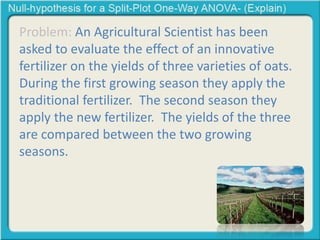
Problem: An Agricultural Scientist has been 
asked to evaluate the effect of an innovative 
fertilizer on the yields of three varieties of oats. 
During the first growing season they apply the 
traditional fertilizer. The second season they 
apply the new fertilizer. The yields of the three 
are compared between the two growing 
seasons.
Template:
Template: 
There is no statistically significant effect for 
[Insert independent main effect]
Template: 
There is no statistically significant effect for 
[Insert independent main effect] 
There is no statistically significant effect for 
[Insert repeated main effect]
Template: 
There is no statistically significant effect for 
[Insert independent main effect] 
There is no statistically significant effect for 
[Insert repeated main effect] 
There is no statistically significant interaction 
effect between [Insert independent main effect]
Template: 
There is no statistically significant effect for 
[Insert independent main effect] 
There is no statistically significant effect for 
[Insert repeated main effect] 
There is no statistically significant interaction 
effect between [Insert independent main effect] 
and [Insert repeated main effect]
Null-hypothesis:
Null-hypothesis: 
There is no statistically significant effect for oat 
type.
Null-hypothesis: 
There is no statistically significant effect for oat 
type. 
There is no statistically significant effect for 
growing year.
Null-hypothesis: 
There is no statistically significant effect for oat 
type. 
There is no statistically significant effect for 
growing year. 
There is no statistically significant interaction 
effect between oat type and growing year.
Example #2
Problem:
Problem: A pastor of a congregation wants to 
know the effect of an new type of sermon on 
parishioner religious behavior. His plan is to 
give his morning congregation the new type of 
sermon and his evening congregation (the 
control group) a traditional sermon. Prior to 
commencing the two sermon types, he sends a 
self-report survey to parishioners to assess their 
religious behavior. Three months later he sends 
out the same survey and compares the results.
Template:
Template: 
There is no statistically significant effect for 
[Insert independent main effect]
Template: 
There is no statistically significant effect for 
[Insert independent main effect] 
There is no statistically significant effect for 
[Insert repeated main effect]
Template: 
There is no statistically significant effect for 
[Insert independent main effect] 
There is no statistically significant effect for 
[Insert repeated main effect] 
There is no statistically significant interaction 
effect between [Insert independent main effect]
Template: 
There is no statistically significant effect for 
[Insert independent main effect] 
There is no statistically significant effect for 
[Insert repeated main effect] 
There is no statistically significant interaction 
effect between [Insert independent main effect] 
and [Insert repeated main effect]
Null-hypothesis:
Null-hypothesis: 
There is no statistically significant effect for 
sermon type.
Null-hypothesis: 
There is no statistically significant effect for 
sermon type. 
There is no statistically significant effect for time 
of survey administration.
Null-hypothesis: 
There is no statistically significant effect for 
sermon type. 
There is no statistically significant effect for time 
of survey administration. 
There is no statistically significant interaction 
effect between sermon type
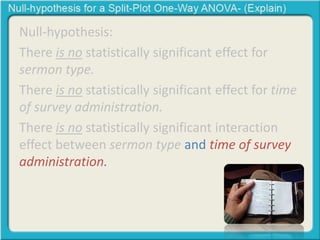
Null-hypothesis: 
There is no statistically significant effect for 
sermon type. 
There is no statistically significant effect for time 
of survey administration. 
There is no statistically significant interaction 
effect between sermon type and time of survey 
administration.

Null hypothesis for split-plot ANOVA

  • 1.
    Null-hypothesis for aSplit-Plot One- Way Analysis of Variance (ANOVA) Conceptual Explanation
  • 2.
    With hypothesis testingwe are setting up a null-hypothesis –
  • 3.
    With hypothesis testingwe are setting up a null-hypothesis – the probability that there is no effect or relationship –
  • 4.
    With hypothesis testingwe are setting up a null-hypothesis – the probability that there is no effect or relationship – and then we collect evidence that leads us to either accept or reject that null hypothesis.
  • 5.
    As you mayrecall, a One-Way Split-Plot ANOVA is like a Factorial ANOVA except that instead of having two independent variables (e.g., age and gender) you have at least one independent variable with two or more levels that are independent of one another (e.g., gender – male and female) and another independent variable with two or more levels that are repeated (e.g., pre-post test).
  • 6.
    As you mayrecall, a One-Way Split-Plot ANOVA is like a Factorial ANOVA except that instead of having two independent variables (e.g., age and gender) you have at least one independent variable with two or more levels that are independent of one another (e.g., gender – male and female) and another independent variable with two or more levels that are repeated (e.g., pre-post test).
  • 7.
    Here is atemplate for writing a null-hypothesis for a Split-Plot ANOVA.
  • 8.
    Here is atemplate for writing a null-hypothesis for a Split-Plot ANOVA. There is no statistically significant effect for [Insert independent main effect]
  • 9.
    Here is atemplate for writing a null-hypothesis for a Split-Plot ANOVA. There is no statistically significant effect for [Insert independent main effect] There is no statistically significant effect for [Insert repeated main effect]
  • 10.
    Here is atemplate for writing a null-hypothesis for a Split-Plot ANOVA. There is no statistically significant effect for [Insert independent main effect] There is no statistically significant effect for [Insert repeated main effect] There is no statistically significant interaction effect between [Insert independent main effect]
  • 11.
    Here is atemplate for writing a null-hypothesis for a Split-Plot ANOVA. There is no statistically significant effect for [Insert independent main effect] There is no statistically significant effect for [Insert repeated main effect] There is no statistically significant interaction effect between [Insert independent main effect] and [Insert repeated main effect]
  • 12.
  • 13.
  • 14.
    Problem: An AgriculturalScientist has been asked to evaluate the effect of an innovative fertilizer on the yields of three varieties of oats. During the first growing season they apply the traditional fertilizer. The second season they apply the new fertilizer. The yields of the three are compared between the two growing seasons.
  • 15.
  • 16.
    Template: There isno statistically significant effect for [Insert independent main effect]
  • 17.
    Template: There isno statistically significant effect for [Insert independent main effect] There is no statistically significant effect for [Insert repeated main effect]
  • 18.
    Template: There isno statistically significant effect for [Insert independent main effect] There is no statistically significant effect for [Insert repeated main effect] There is no statistically significant interaction effect between [Insert independent main effect]
  • 19.
    Template: There isno statistically significant effect for [Insert independent main effect] There is no statistically significant effect for [Insert repeated main effect] There is no statistically significant interaction effect between [Insert independent main effect] and [Insert repeated main effect]
  • 20.
  • 21.
    Null-hypothesis: There isno statistically significant effect for oat type.
  • 22.
    Null-hypothesis: There isno statistically significant effect for oat type. There is no statistically significant effect for growing year.
  • 23.
    Null-hypothesis: There isno statistically significant effect for oat type. There is no statistically significant effect for growing year. There is no statistically significant interaction effect between oat type and growing year.
  • 24.
  • 25.
  • 26.
    Problem: A pastorof a congregation wants to know the effect of an new type of sermon on parishioner religious behavior. His plan is to give his morning congregation the new type of sermon and his evening congregation (the control group) a traditional sermon. Prior to commencing the two sermon types, he sends a self-report survey to parishioners to assess their religious behavior. Three months later he sends out the same survey and compares the results.
  • 27.
  • 28.
    Template: There isno statistically significant effect for [Insert independent main effect]
  • 29.
    Template: There isno statistically significant effect for [Insert independent main effect] There is no statistically significant effect for [Insert repeated main effect]
  • 30.
    Template: There isno statistically significant effect for [Insert independent main effect] There is no statistically significant effect for [Insert repeated main effect] There is no statistically significant interaction effect between [Insert independent main effect]
  • 31.
    Template: There isno statistically significant effect for [Insert independent main effect] There is no statistically significant effect for [Insert repeated main effect] There is no statistically significant interaction effect between [Insert independent main effect] and [Insert repeated main effect]
  • 32.
  • 33.
    Null-hypothesis: There isno statistically significant effect for sermon type.
  • 34.
    Null-hypothesis: There isno statistically significant effect for sermon type. There is no statistically significant effect for time of survey administration.
  • 35.
    Null-hypothesis: There isno statistically significant effect for sermon type. There is no statistically significant effect for time of survey administration. There is no statistically significant interaction effect between sermon type
  • 36.
    Null-hypothesis: There isno statistically significant effect for sermon type. There is no statistically significant effect for time of survey administration. There is no statistically significant interaction effect between sermon type and time of survey administration.