Sub: Experimental Designs
Akash Sahoo
M.Sc. Agronomy
Department of Agronomy
Treatment :
Various objects of comparison in a comparative
experiments are termed as treatment.
Treatment is what we want to compare in the
experiment.
Block :
In agricultural experiment most of the time we
divided the whole experimental field into relatively
homogeneous sub group.
Within the block – Homogeneous
Between the block - Heterogeneous
Experimental Unit :
• It is the smallest part of the experimental area to
which we apply the treatment.
• Experimental unit is the physical unit that receives a
particular treatment. for example: a plot in the field.
Principle of Design of Experiment :
There are three principle-
Replication:
Replication is the repeated application of treatment
in different blocks.
• Replication reduce experimental error.
• It reduces the variability of the experimental result
• In RBD block and replication is equal.
Randomization :
Randomization is the random application of
treatment in the experimental unit. In a randomized
experimental design objects or individuals are
randomly assigned to an experimental group.
• To reduce the biasness.
• Randomization ensures that each individuals will
have equal chance of being assigned to any
experimental unit.
Local Control :
Local control is the techniques of the experimental
error.
• To reduce the error by suitably modifying the
allocation of treatment to the experimental unit
• It is not used in CRD.
ANOVA (Analysis of Variance) :
It is a powerful statistical tool for test of
significance. The test of significance based on t-
distribution is an adequate procedure only for
testing the significance of difference between two
sample mean.
• Basic purpose of ANOVA is to test the
homogeneity of several means.
Assumption involving in ANOVA :
1.The effects are additive in nature
2. The observations are independent
3.The variable concerned must be normally
distributed
A C B D C
C D A C D
B E D B
• 5 Treatment : A,B,C,D and E
• A Repeated 2 times
• B Repeated 3 times Total 14 treatment
• C Repeated 4 times
• D Repeated 4 times
• E Repeated 1 Time
CRD
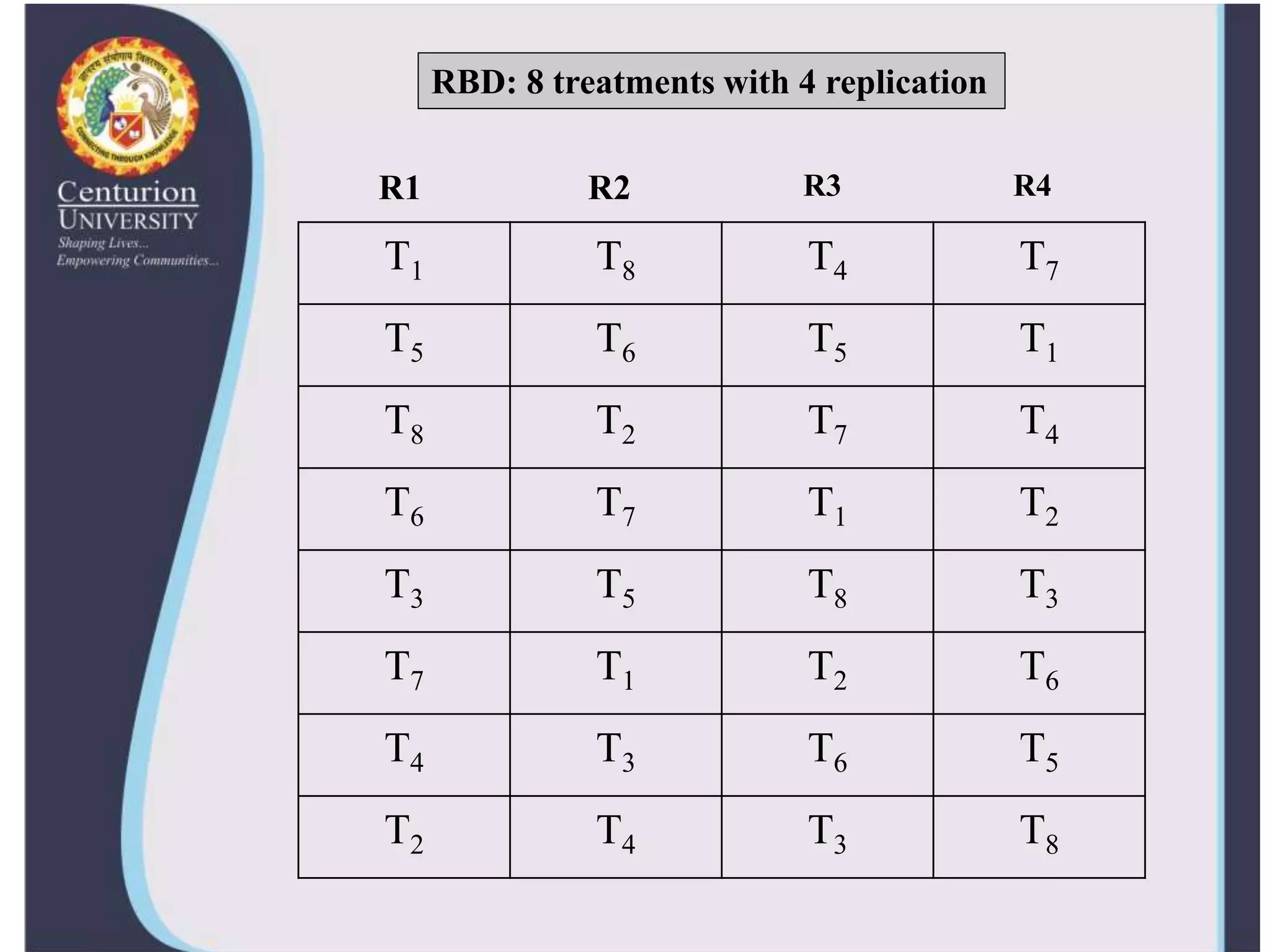
T1 T8 T4 T7
T5 T6 T5 T1
T8 T2 T7 T4
T6 T7 T1 T2
T3 T5 T8 T3
T7 T1 T2 T6
T4 T3 T6 T5
T2 T4 T3 T8
RBD: 8 treatments with 4 replication
R1 R2 R4
R3
• In ANOVA model, t-test is used for testing
two population mean.
• F-test is used for test the population
variences.
Level of Significance :
Probability of rejecting null hypothesis when it is
true is called level of significance.
This probability are generally taken as 0.001,
0.05, 0.01 or 0.1%, 1%, 5% etc. these are called
level of significance.
Region of Rejection :
Let x1,x2,x3,…xn are the n number
of point, say x̂ are present in the N-
dimensional sample space(ω). If any point
falls not in the sample space then it is called
region of rejecton.
Experimental Error :
A variation in response due to some
extraneous factor (inherent different among
the experimental unit ,error associated
during measurement etc.) is known as
experimental error.
Uniformity trial :
In experiments particularly in field
experiment in order to have an idea about
the condition of the proposed experimental
area a trial known as uniformity trial.
A short duration crop is grown under
uniform condition by dividing the whole
area into smallest unit to determine shape
and size, no. of plot in a block.
At the time of harvesting the entire
field divided into smallest unit of same size
and shape and the produced from each unit
recorded separately
Symmetrical factorial experiment :
A factorial experiment is symmetrical if the
number of levels for all the factors are same.
Example : a two factor factorial experiment
with five varieties and five different doses of
nitrogen is symmetrical factorial experiments.
Asymmetrical factorial experiment :
A factorial experiment is asymmetrical if the
number of levels for all factors are different.
Example : a two factor factorial experiment with
five varieties and any doses of nitrogen (but not
equals to five) is an asymmetrical factorial
experiment.
Subject CRD RBD LSD
Advantages • Number of replication may be
varied from treatment to
treatment.
• CRD provide maximum number
of degrees of freedom for the
estimation of experimental error.
• Increases the precision of
the experiment.
• Any replication can be
included in RBD.
• The statistical analysis is
simple and easy.
• Experimental error is
small for LSD compared
to CRD and RBD.
• LSD is more efficient
than CRD, RBD.
Limitations • CRD is less accurate than
other design.
• RBD may not be
suitable large number
of treatment.
• It is a versatile design.
• Layout is not as simple
as CRD, RBD.
• It requires mainly
square shaped plot .
Comparisons • Completely homogeneous
• All the treatment are completely
randomized in the experimental
units.
• Heterogeneous
• All the treatments are
randomize each block are
separately.
• Heterogeneous
• Randomization takes
place under the restriction
gap. Each treatment occur
once and only in each row
and each column.
Uses of CRD in Agriculture :
• CRD is applicable when the experimental material
is homogeneous. Example : homogeneous soil
condition in the field.
• Usually in the field , the soil will be
heterogeneous. Thus CRD is not preferable in field
conditions.
Uses of RBD in Agriculture :
• Number of replication is same for all treatment.
• Missing plots are easily estimated.
Formula
CRD :
SE(m) = √(MSE/ri)
SE(d) = √(2MSE/r)
RBD :
SE(m) = √(MSE/r)
SE(d) = √2 x S.E(m)
LSD :
CD = SE(d).t
Thank You

Experimental design.pptx

  • 1.
    Sub: Experimental Designs AkashSahoo M.Sc. Agronomy Department of Agronomy
  • 2.
    Treatment : Various objectsof comparison in a comparative experiments are termed as treatment. Treatment is what we want to compare in the experiment. Block : In agricultural experiment most of the time we divided the whole experimental field into relatively homogeneous sub group. Within the block – Homogeneous Between the block - Heterogeneous
  • 3.
    Experimental Unit : •It is the smallest part of the experimental area to which we apply the treatment. • Experimental unit is the physical unit that receives a particular treatment. for example: a plot in the field. Principle of Design of Experiment : There are three principle- Replication: Replication is the repeated application of treatment in different blocks. • Replication reduce experimental error. • It reduces the variability of the experimental result • In RBD block and replication is equal.
  • 4.
    Randomization : Randomization isthe random application of treatment in the experimental unit. In a randomized experimental design objects or individuals are randomly assigned to an experimental group. • To reduce the biasness. • Randomization ensures that each individuals will have equal chance of being assigned to any experimental unit. Local Control : Local control is the techniques of the experimental error. • To reduce the error by suitably modifying the allocation of treatment to the experimental unit • It is not used in CRD.
  • 5.
    ANOVA (Analysis ofVariance) : It is a powerful statistical tool for test of significance. The test of significance based on t- distribution is an adequate procedure only for testing the significance of difference between two sample mean. • Basic purpose of ANOVA is to test the homogeneity of several means. Assumption involving in ANOVA : 1.The effects are additive in nature 2. The observations are independent 3.The variable concerned must be normally distributed
  • 6.
    A C BD C C D A C D B E D B • 5 Treatment : A,B,C,D and E • A Repeated 2 times • B Repeated 3 times Total 14 treatment • C Repeated 4 times • D Repeated 4 times • E Repeated 1 Time CRD
  • 7.
    T1 T8 T4T7 T5 T6 T5 T1 T8 T2 T7 T4 T6 T7 T1 T2 T3 T5 T8 T3 T7 T1 T2 T6 T4 T3 T6 T5 T2 T4 T3 T8 RBD: 8 treatments with 4 replication R1 R2 R4 R3
  • 8.
    • In ANOVAmodel, t-test is used for testing two population mean. • F-test is used for test the population variences. Level of Significance : Probability of rejecting null hypothesis when it is true is called level of significance. This probability are generally taken as 0.001, 0.05, 0.01 or 0.1%, 1%, 5% etc. these are called level of significance.
  • 9.
    Region of Rejection: Let x1,x2,x3,…xn are the n number of point, say x̂ are present in the N- dimensional sample space(ω). If any point falls not in the sample space then it is called region of rejecton. Experimental Error : A variation in response due to some extraneous factor (inherent different among the experimental unit ,error associated during measurement etc.) is known as experimental error.
  • 10.
    Uniformity trial : Inexperiments particularly in field experiment in order to have an idea about the condition of the proposed experimental area a trial known as uniformity trial. A short duration crop is grown under uniform condition by dividing the whole area into smallest unit to determine shape and size, no. of plot in a block. At the time of harvesting the entire field divided into smallest unit of same size and shape and the produced from each unit recorded separately
  • 11.
    Symmetrical factorial experiment: A factorial experiment is symmetrical if the number of levels for all the factors are same. Example : a two factor factorial experiment with five varieties and five different doses of nitrogen is symmetrical factorial experiments. Asymmetrical factorial experiment : A factorial experiment is asymmetrical if the number of levels for all factors are different. Example : a two factor factorial experiment with five varieties and any doses of nitrogen (but not equals to five) is an asymmetrical factorial experiment.
  • 12.
    Subject CRD RBDLSD Advantages • Number of replication may be varied from treatment to treatment. • CRD provide maximum number of degrees of freedom for the estimation of experimental error. • Increases the precision of the experiment. • Any replication can be included in RBD. • The statistical analysis is simple and easy. • Experimental error is small for LSD compared to CRD and RBD. • LSD is more efficient than CRD, RBD. Limitations • CRD is less accurate than other design. • RBD may not be suitable large number of treatment. • It is a versatile design. • Layout is not as simple as CRD, RBD. • It requires mainly square shaped plot . Comparisons • Completely homogeneous • All the treatment are completely randomized in the experimental units. • Heterogeneous • All the treatments are randomize each block are separately. • Heterogeneous • Randomization takes place under the restriction gap. Each treatment occur once and only in each row and each column.
  • 13.
    Uses of CRDin Agriculture : • CRD is applicable when the experimental material is homogeneous. Example : homogeneous soil condition in the field. • Usually in the field , the soil will be heterogeneous. Thus CRD is not preferable in field conditions. Uses of RBD in Agriculture : • Number of replication is same for all treatment. • Missing plots are easily estimated.
  • 14.
    Formula CRD : SE(m) =√(MSE/ri) SE(d) = √(2MSE/r) RBD : SE(m) = √(MSE/r) SE(d) = √2 x S.E(m) LSD : CD = SE(d).t
  • 15.