Bangalore university
Dept.of microbiology and biotechnology
Topic:DNA fingerprinting, nucleic acid
hybridization, rRNA sequence
Submitted to:
Dr.DC Mohan sir
Dept.of MB and BT.
Presented by:
Shivakumar k
1st Msc
Biotechnology
Contents
1. DNA fingerprinting:
-structure of DNA
-definition for DNA fingerprinting
-History
-steps involved in DNA fingerprinting
- Applications
2. Nucleic acid hybridization
-introduction
-Definition
-principle
-Methodology
-Types of nucleic acid hybridization
3. rRNA sequence
-Introduction
-16s rRNA
-sequence method
-phyylogeenetic tree of life base 16s rRNA sequence
Structure of DNA
• DNA is act as genetic material in all most all living organisms
I,e it carries the genetic information from one generation to
the next generation (parents –children’s)
• Structurally the DNA is made up of two polynucleotide chains
that forms a double helix like structure
• DNA is a polymer of repeating unit called nucleotide.each
nucleotide composed of phosphate group,deoxyribose sugar
and nitrogenous base.
• The base sequences of one strand is always complementary
to sequence of the other strand.
• The chemical structure of everyone DNA is same the only
difference between people is the order of the base pair
Definition
A technique used especially for idenfication of individuals by extracting and
identifying the base pair pattern of the DNA.
This technique is also know as DNA typing ,genetic fingerprinting ,DNA
profiling
Steps involved in DNA fingerprinting
1. Isolation of DNA
2. Polymerase chain reaction (PCR)
3. Cutting of DNA
4. Separation of DNA fragments by gel electrophoresis
5. Denaturation of the DNA
6. Blotting(transfer of DNA to solid membrane)
7. Probing
8. Detection(DNA fingerprinting)
1. Isolation of the DNA
This is the first step in DNA fingerprinting
The cell are brokendown to release the DNA
If only small amount of the DNA is available It can be amplified using PCR
2.Polymerase chain
reaction (PCR) • This is the process of invitro
amplification of specific DNA
sequences to million folds
• It was invested by kary mulls in 1983
• PCR involved following steps
1.Denaturation
2.Annealing
3.Extension
Mechanism of PCR
1. Denaturation: During this process,
the double helical arrangement of the
sample DNA (template DNA) is denatured
at a temperature of about 94°C- 95°C.
The two strands get separated out
2. Annealing: In this step, the primers,
which are the sequences of DNA added to
the reaction mixture anneal with the
complementary (similar or matching)
sequences in the template DNA. This
occurs at different temperatures
3. Extension: This is the final stage of
the PCR cycle, occurs at 72°C when the
enzyme Polymerase added to the reaction
mixture, make the primers extend along
the length of the DNA strand.
3.Cutting of DNA
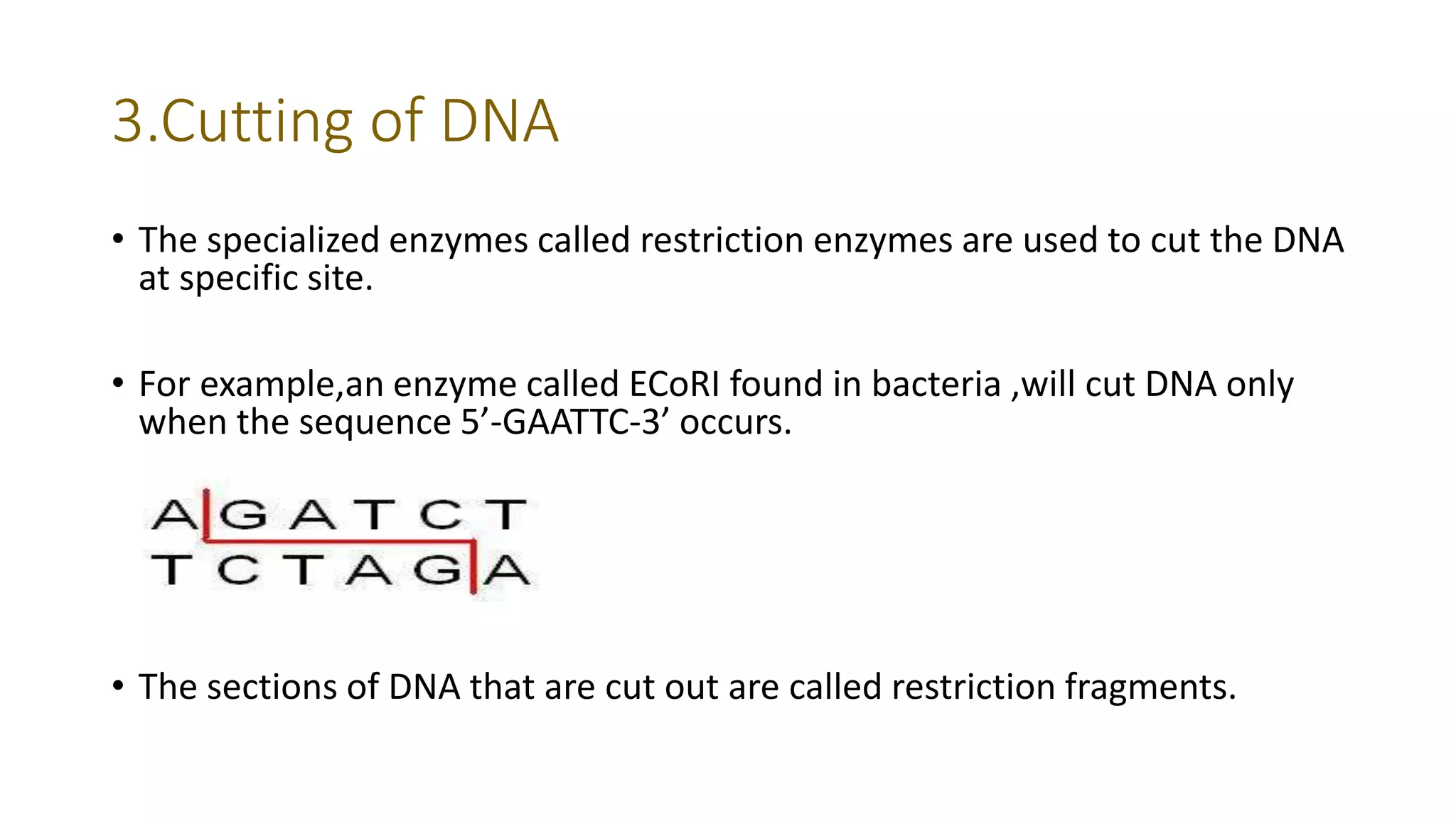
• The specialized enzymes called restriction enzymes are used to cut the DNA
at specific site.
• For example,an enzyme called ECoRI found in bacteria ,will cut DNA only
when the sequence 5’-GAATTC-3’ occurs.
• The sections of DNA that are cut out are called restriction fragments.
4.Separation of DNA fragments by gel electrophoresis
• The process by which the size Separation,size
fractionation is done is called gel electrophoresis
• The DNA is poured in to a gel, such as agarose,and
an electric charge is applied to the gel,with the
positive charge at the bottom and the negative
charge at the top.
• Because DNA has a slightly negative charged,the
pieces of DNA will be attracted toward the bottom
of the gel.
• The small pieces of DNA will able to move more
quickly and thus further towards the bottom than
the larger pieces.
• The different sized pieces of DNA will therefore be
separated according to their size,with the small
pieces towards the bottom and the Large pieces
towards the top.
5.Denaturation of double stranded DNA
• Denaturation is the process of
splitting of double stranded DNA
in to single strand
• This can be done either by
heating or by chemically treating
the DNA in the gel
6.Blotting
The process of transferring of DNA from gel to the solid
membrane ( Nitrocellulose paper or nylon paper)
Blot is made permanent by drying at 80 degree c for 2hrs or
subjected it to uv-rays
The area unoccupied by target DNA is blocked with buffer,this
prevents empty sites from being bound by probes during
hybridization.
7.Probing
• Probe is a small piece of DNA used to find another piece of DNA
• They are short and single stranded,it may be purified mRNA,cDNA
,synthetic oligonucleotide.it must be labelled to visualize.
• Usually It is a radioactive copy of DNA .
• Adding radioactive probes to the Nitrocellulose paper the probe binds to
the complementary DNA on the membrane.
• The membrane is placed in hybridization buffer at 42 degree c for 4-8 hrs.
• Excess of probes that is non-specially bound is washed.
8.Detention (fingerprinting)
• Auto radiograph is taken by exposing
Nitrocellulose paper to x-ray film.
• Dark bands shows the position of DNA
sequence hybridize with probe.
• The resulting band pattern is then compared
with known pattern.
• If the band positions are same in two bands
then the organism is identical, if the bands
are at different positions then the organism
is not identical. ( they are belonging to
different species)
Application of DNA fingerprinting
• To identify criminals:
Where fingerprints are not available but biological specimens are available like
blood or semen stains,hair or items of clothing at the scene of the crime then these
items may be valuable sources of DNA of the criminal.
• Paternity testing:
Testing paternity sample requires the collection of cells and comparison of DNA
fingerprintings from and between children and potential parents.
• Diagnosis and developing curves for inherited disorders:
DNA fingerprinting is used to diagnose inherited disorders in both parental and
newborn babies in hospitals around the work.
These disorders may include hemophilia,Alzheimer’s, sickle cell
anemia,thalassemia,cystic fibrosis etc.
• DNA fingerprinting is also used for the idenfication of microorganisms like
bacteria.
Nucleic acid hybridization
Introduction:
• Nucleic acids are the Large complex biological molecules present in the nuclei of cells of all living organisms
• They are responsible for hereditary characters
• Basically their are two types of nucleic acids are their namely DNA and RNA.
• Dna is acts as genetic material in almost all living organisms, but RNA is acts as genetic material in some of
the viruses and play an major role in protein synthesis.
• The DNA will produce the RNA molecule during transcription process.
• If a double stranded molecule of DNA is subjected to heat,the complementary strand’s will be separate.The
hydrogen bonds between the bases break .
• If single strand’s are when slowly they will reunite to form a double stranded molecule identical to the
original double strand.
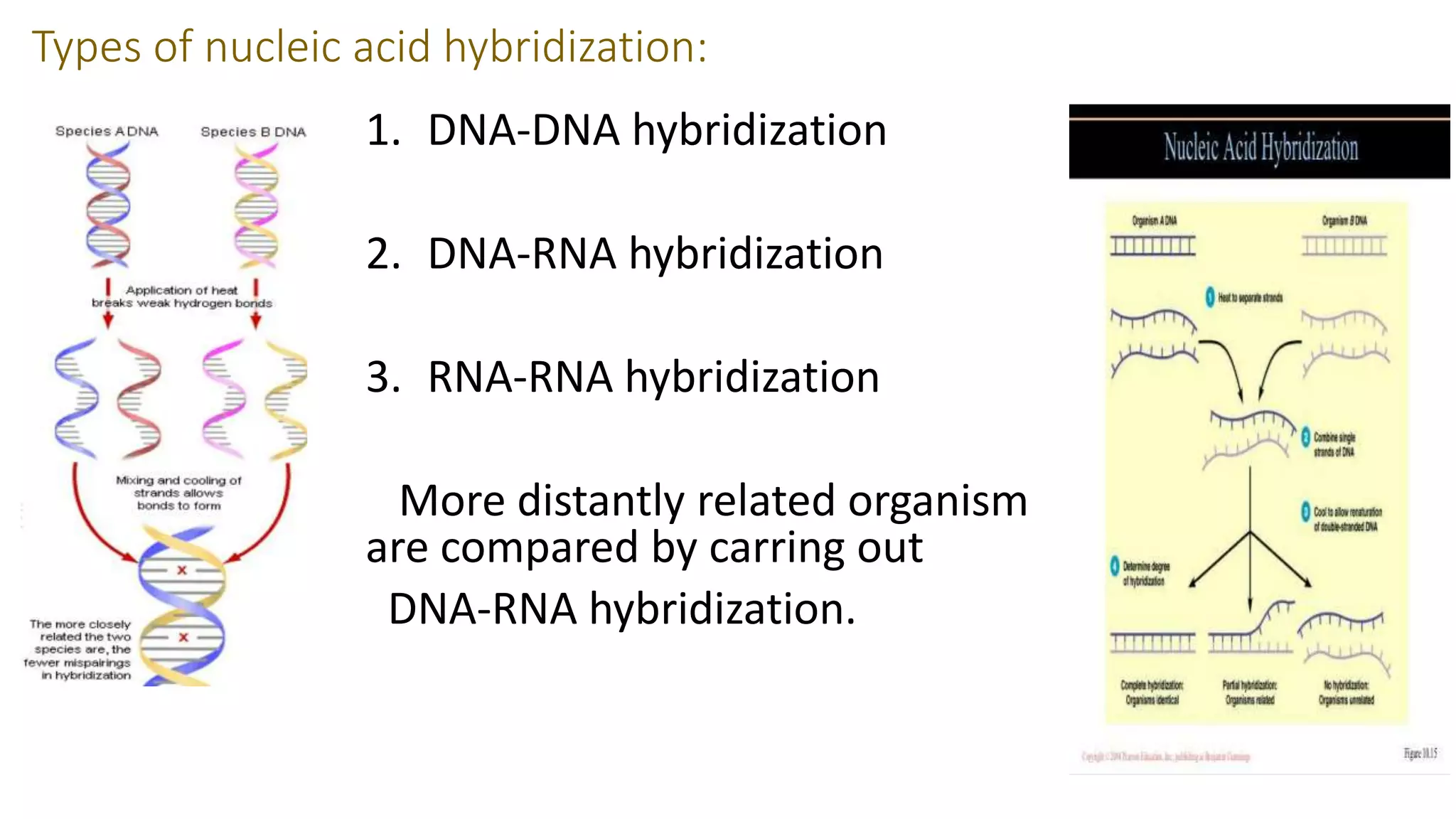
• When this technique is applied to separate DNA strands from two different organisms, it is possible to
determine the extent of similarity between the base sequence of the two organisms. This method is know as
nucleic acid hybridization.
• The procedure measures the ability of DNA strands from one organism to hybridize with DNA strands of
another organism ,the greater the degree of hybridization the greater the degree of relatedness.
Definition and principle of nucleic acid Hybridization
Definition:
The process of mating of two different organisms or species to create a
new organism called hybrid.
Here the process of forming a double stranded nucleic acid from joining
two complementary single strands of DNA or RNA.
Principle:
The technique of nucleic acid hybridization is established and developed
on the basis of denaturation and renaturation of nucleic acids.
Hydrogen bonds in double stranded nucleic acid can be disrupted by
some physiochemical elements and two strands of nucleic acids are
separated in to single strands .
Methodology of nucleic acid hybridization:
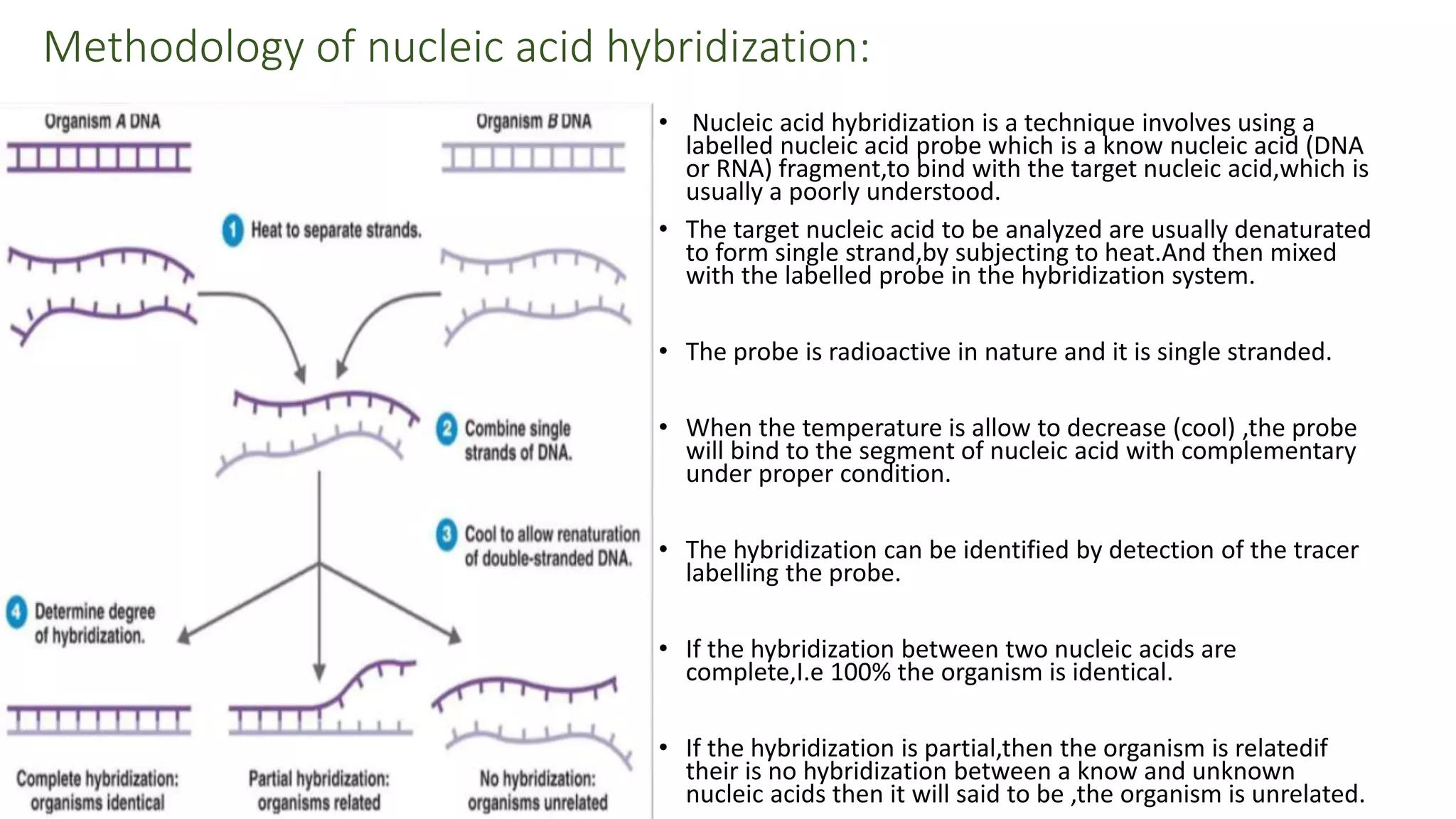
• Nucleic acid hybridization is a technique involves using a
labelled nucleic acid probe which is a know nucleic acid (DNA
or RNA) fragment,to bind with the target nucleic acid,which is
usually a poorly understood.
• The target nucleic acid to be analyzed are usually denaturated
to form single strand,by subjecting to heat.And then mixed
with the labelled probe in the hybridization system.
• The probe is radioactive in nature and it is single stranded.
• When the temperature is allow to decrease (cool) ,the probe
will bind to the segment of nucleic acid with complementary
under proper condition.
• The hybridization can be identified by detection of the tracer
labelling the probe.
• If the hybridization between two nucleic acids are
complete,I.e 100% the organism is identical.
• If the hybridization is partial,then the organism is relatedif
their is no hybridization between a know and unknown
nucleic acids then it will said to be ,the organism is unrelated.
Types of nucleic acid hybridization:
1. DNA-DNA hybridization
2. DNA-RNA hybridization
3. RNA-RNA hybridization
More distantly related organism
are compared by carring out
DNA-RNA hybridization.
rRNA sequence
Introduction:
• Basically there are three types of RNAs are present,namely transferring
RNA(tRNA),messager RNA (mRNA), and ribosomal RNA (rRNA)
• Among these rRNA is most predominant type present in maximum
amount.
• The main function of RNA is the synthesis of proteins during translation.
• The ribosomes are mainly constructed with two ingredients ,rRNA and
ribosomal proteins .
• The prokaryotes contains 70s type of ribosomes,whereas eukaryotes
contains 80s ribosomes.
• In prokaryotes like bacterial and archeal cells,the 70s ribosome is made up
of two subunit namely smaller 30s and larger 50s subunit.
• The 50s subunit composed of 23s rRNA ,5s rRNA and 31proteins,whereas
30s subunit composed of 16s rRNA molecule and 21 proteins.
• The eukaryotic 80s ribosomes are also made up two subunit,larger 60s
and smaller 40s subunits.The larger 60s subunit composed of 40
proteins,5s rRNA, 28s rRNA,5.8s rRNA ,whereas smaller 40s subunit is
composed of 30 proteins and 18s rRNA molecule.
• Among these the 16s rRNA genes are typically used for sequence
comparisons in prokaryotes. The counter part in eukaryotes is the 18s
rRNA.
• rRNA sequence is currently being used to determine the phylogenetic
relationship among organisms.
• There are several advantages to using rRNA .
-first ,all cells contain ribosomes.
-second,rRNA genes have undergone few changes over time so all
members of a domain,phylum and in some cases,a genus ,have the same
signature sequence in their rRNA.
-The rRNA used most often is a component of the smaller portion of
ribosomes.
-A third advantage of rRNA sequencing is that cells don’t have to be
cultured in the laboratory.
16s rRNA
• 16s rRNA is present in the 30s subunit of the prokaryotic ribosomes, and the genes for
the 16s rRNA contains about 1,500 nucleotides(2,000 eukaryotes) that can be easily
and quickly sequenced.
• The 16s rRNA sequence that is unique to individual organism at strain level is after
referred as signature sequence.
• 16s rRNA sequence is highly conserved through the evolutionary history, I,e wherever
the evolution takes place very little change will occur in 16s rRNA sequence.
• The signature sequence or highly conserved regions present in 16s rRNA are
complementary similar in same species but different in different species.
• Because of signature sequence in 16s rRNA and conserved nature this 16s rRNA is
used for the rRNA sequencing for bacterial identification.
Sequence methodology
• Isoation of DNA from the organism (bacteria)
• After isolation ,using PCR ,amplify the genes
encoding 16s rRNA using RNA primers from
genomic DNA .
• Once the amplification done,the amplified
fragments are subsequently cut with one or more
restriction enzymes and separate by
electrophoresis.
• The resulting band patterns can then be
compared ,then the rRNA genes in the amplified
fragments can be sequenced by ‘Sanger method’
to determine evolutionary relationship between
organisms.
Phylogenetic tree of life base 16S rRNA sequences
References
• Microbiology
prescott,harleg and kien‘s
Seventh edition
• Brock biology of microorganisms
Tenth edition
Michealt,madigan,john M,Martinko
Jack parker
• Microbiogy,4th edition,Simon Baker
caroline Griffiths,Jane nicklin.
• Introductory microbiology
D.Balachandar,R Thamizh vendan.
• Microbiology
seventh edition
Jalquelyn G,Black
• Microbiology
Michael J,pelczar,JR,E.C.s Chan,
Noel R,krieg
nucleic acid sequencing methods(DNA finger printing,nucleic acid hybridization,rRNA sequencing)

nucleic acid sequencing methods(DNA finger printing,nucleic acid hybridization,rRNA sequencing)

  • 1.
    Bangalore university Dept.of microbiologyand biotechnology Topic:DNA fingerprinting, nucleic acid hybridization, rRNA sequence Submitted to: Dr.DC Mohan sir Dept.of MB and BT. Presented by: Shivakumar k 1st Msc Biotechnology
  • 2.
    Contents 1. DNA fingerprinting: -structureof DNA -definition for DNA fingerprinting -History -steps involved in DNA fingerprinting - Applications 2. Nucleic acid hybridization -introduction -Definition -principle -Methodology -Types of nucleic acid hybridization 3. rRNA sequence -Introduction -16s rRNA -sequence method -phyylogeenetic tree of life base 16s rRNA sequence
  • 4.
    Structure of DNA •DNA is act as genetic material in all most all living organisms I,e it carries the genetic information from one generation to the next generation (parents –children’s) • Structurally the DNA is made up of two polynucleotide chains that forms a double helix like structure • DNA is a polymer of repeating unit called nucleotide.each nucleotide composed of phosphate group,deoxyribose sugar and nitrogenous base. • The base sequences of one strand is always complementary to sequence of the other strand. • The chemical structure of everyone DNA is same the only difference between people is the order of the base pair
  • 5.
    Definition A technique usedespecially for idenfication of individuals by extracting and identifying the base pair pattern of the DNA. This technique is also know as DNA typing ,genetic fingerprinting ,DNA profiling
  • 7.
    Steps involved inDNA fingerprinting 1. Isolation of DNA 2. Polymerase chain reaction (PCR) 3. Cutting of DNA 4. Separation of DNA fragments by gel electrophoresis 5. Denaturation of the DNA 6. Blotting(transfer of DNA to solid membrane) 7. Probing 8. Detection(DNA fingerprinting)
  • 9.
    1. Isolation ofthe DNA This is the first step in DNA fingerprinting The cell are brokendown to release the DNA If only small amount of the DNA is available It can be amplified using PCR
  • 10.
    2.Polymerase chain reaction (PCR)• This is the process of invitro amplification of specific DNA sequences to million folds • It was invested by kary mulls in 1983 • PCR involved following steps 1.Denaturation 2.Annealing 3.Extension
  • 11.
    Mechanism of PCR 1.Denaturation: During this process, the double helical arrangement of the sample DNA (template DNA) is denatured at a temperature of about 94°C- 95°C. The two strands get separated out 2. Annealing: In this step, the primers, which are the sequences of DNA added to the reaction mixture anneal with the complementary (similar or matching) sequences in the template DNA. This occurs at different temperatures 3. Extension: This is the final stage of the PCR cycle, occurs at 72°C when the enzyme Polymerase added to the reaction mixture, make the primers extend along the length of the DNA strand.
  • 12.
    3.Cutting of DNA •The specialized enzymes called restriction enzymes are used to cut the DNA at specific site. • For example,an enzyme called ECoRI found in bacteria ,will cut DNA only when the sequence 5’-GAATTC-3’ occurs. • The sections of DNA that are cut out are called restriction fragments.
  • 13.
    4.Separation of DNAfragments by gel electrophoresis • The process by which the size Separation,size fractionation is done is called gel electrophoresis • The DNA is poured in to a gel, such as agarose,and an electric charge is applied to the gel,with the positive charge at the bottom and the negative charge at the top. • Because DNA has a slightly negative charged,the pieces of DNA will be attracted toward the bottom of the gel. • The small pieces of DNA will able to move more quickly and thus further towards the bottom than the larger pieces. • The different sized pieces of DNA will therefore be separated according to their size,with the small pieces towards the bottom and the Large pieces towards the top.
  • 14.
    5.Denaturation of doublestranded DNA • Denaturation is the process of splitting of double stranded DNA in to single strand • This can be done either by heating or by chemically treating the DNA in the gel
  • 15.
    6.Blotting The process oftransferring of DNA from gel to the solid membrane ( Nitrocellulose paper or nylon paper) Blot is made permanent by drying at 80 degree c for 2hrs or subjected it to uv-rays The area unoccupied by target DNA is blocked with buffer,this prevents empty sites from being bound by probes during hybridization.
  • 16.
    7.Probing • Probe isa small piece of DNA used to find another piece of DNA • They are short and single stranded,it may be purified mRNA,cDNA ,synthetic oligonucleotide.it must be labelled to visualize. • Usually It is a radioactive copy of DNA . • Adding radioactive probes to the Nitrocellulose paper the probe binds to the complementary DNA on the membrane. • The membrane is placed in hybridization buffer at 42 degree c for 4-8 hrs. • Excess of probes that is non-specially bound is washed.
  • 17.
    8.Detention (fingerprinting) • Autoradiograph is taken by exposing Nitrocellulose paper to x-ray film. • Dark bands shows the position of DNA sequence hybridize with probe. • The resulting band pattern is then compared with known pattern. • If the band positions are same in two bands then the organism is identical, if the bands are at different positions then the organism is not identical. ( they are belonging to different species)
  • 18.
    Application of DNAfingerprinting • To identify criminals: Where fingerprints are not available but biological specimens are available like blood or semen stains,hair or items of clothing at the scene of the crime then these items may be valuable sources of DNA of the criminal. • Paternity testing: Testing paternity sample requires the collection of cells and comparison of DNA fingerprintings from and between children and potential parents. • Diagnosis and developing curves for inherited disorders: DNA fingerprinting is used to diagnose inherited disorders in both parental and newborn babies in hospitals around the work. These disorders may include hemophilia,Alzheimer’s, sickle cell anemia,thalassemia,cystic fibrosis etc. • DNA fingerprinting is also used for the idenfication of microorganisms like bacteria.
  • 19.
    Nucleic acid hybridization Introduction: •Nucleic acids are the Large complex biological molecules present in the nuclei of cells of all living organisms • They are responsible for hereditary characters • Basically their are two types of nucleic acids are their namely DNA and RNA. • Dna is acts as genetic material in almost all living organisms, but RNA is acts as genetic material in some of the viruses and play an major role in protein synthesis. • The DNA will produce the RNA molecule during transcription process. • If a double stranded molecule of DNA is subjected to heat,the complementary strand’s will be separate.The hydrogen bonds between the bases break . • If single strand’s are when slowly they will reunite to form a double stranded molecule identical to the original double strand. • When this technique is applied to separate DNA strands from two different organisms, it is possible to determine the extent of similarity between the base sequence of the two organisms. This method is know as nucleic acid hybridization. • The procedure measures the ability of DNA strands from one organism to hybridize with DNA strands of another organism ,the greater the degree of hybridization the greater the degree of relatedness.
  • 20.
    Definition and principleof nucleic acid Hybridization Definition: The process of mating of two different organisms or species to create a new organism called hybrid. Here the process of forming a double stranded nucleic acid from joining two complementary single strands of DNA or RNA. Principle: The technique of nucleic acid hybridization is established and developed on the basis of denaturation and renaturation of nucleic acids. Hydrogen bonds in double stranded nucleic acid can be disrupted by some physiochemical elements and two strands of nucleic acids are separated in to single strands .
  • 21.
    Methodology of nucleicacid hybridization: • Nucleic acid hybridization is a technique involves using a labelled nucleic acid probe which is a know nucleic acid (DNA or RNA) fragment,to bind with the target nucleic acid,which is usually a poorly understood. • The target nucleic acid to be analyzed are usually denaturated to form single strand,by subjecting to heat.And then mixed with the labelled probe in the hybridization system. • The probe is radioactive in nature and it is single stranded. • When the temperature is allow to decrease (cool) ,the probe will bind to the segment of nucleic acid with complementary under proper condition. • The hybridization can be identified by detection of the tracer labelling the probe. • If the hybridization between two nucleic acids are complete,I.e 100% the organism is identical. • If the hybridization is partial,then the organism is relatedif their is no hybridization between a know and unknown nucleic acids then it will said to be ,the organism is unrelated.
  • 22.
    Types of nucleicacid hybridization: 1. DNA-DNA hybridization 2. DNA-RNA hybridization 3. RNA-RNA hybridization More distantly related organism are compared by carring out DNA-RNA hybridization.
  • 23.
    rRNA sequence Introduction: • Basicallythere are three types of RNAs are present,namely transferring RNA(tRNA),messager RNA (mRNA), and ribosomal RNA (rRNA) • Among these rRNA is most predominant type present in maximum amount. • The main function of RNA is the synthesis of proteins during translation. • The ribosomes are mainly constructed with two ingredients ,rRNA and ribosomal proteins . • The prokaryotes contains 70s type of ribosomes,whereas eukaryotes contains 80s ribosomes. • In prokaryotes like bacterial and archeal cells,the 70s ribosome is made up of two subunit namely smaller 30s and larger 50s subunit. • The 50s subunit composed of 23s rRNA ,5s rRNA and 31proteins,whereas 30s subunit composed of 16s rRNA molecule and 21 proteins. • The eukaryotic 80s ribosomes are also made up two subunit,larger 60s and smaller 40s subunits.The larger 60s subunit composed of 40 proteins,5s rRNA, 28s rRNA,5.8s rRNA ,whereas smaller 40s subunit is composed of 30 proteins and 18s rRNA molecule. • Among these the 16s rRNA genes are typically used for sequence comparisons in prokaryotes. The counter part in eukaryotes is the 18s rRNA.
  • 24.
    • rRNA sequenceis currently being used to determine the phylogenetic relationship among organisms. • There are several advantages to using rRNA . -first ,all cells contain ribosomes. -second,rRNA genes have undergone few changes over time so all members of a domain,phylum and in some cases,a genus ,have the same signature sequence in their rRNA. -The rRNA used most often is a component of the smaller portion of ribosomes. -A third advantage of rRNA sequencing is that cells don’t have to be cultured in the laboratory.
  • 25.
    16s rRNA • 16srRNA is present in the 30s subunit of the prokaryotic ribosomes, and the genes for the 16s rRNA contains about 1,500 nucleotides(2,000 eukaryotes) that can be easily and quickly sequenced. • The 16s rRNA sequence that is unique to individual organism at strain level is after referred as signature sequence. • 16s rRNA sequence is highly conserved through the evolutionary history, I,e wherever the evolution takes place very little change will occur in 16s rRNA sequence. • The signature sequence or highly conserved regions present in 16s rRNA are complementary similar in same species but different in different species. • Because of signature sequence in 16s rRNA and conserved nature this 16s rRNA is used for the rRNA sequencing for bacterial identification.
  • 26.
    Sequence methodology • Isoationof DNA from the organism (bacteria) • After isolation ,using PCR ,amplify the genes encoding 16s rRNA using RNA primers from genomic DNA . • Once the amplification done,the amplified fragments are subsequently cut with one or more restriction enzymes and separate by electrophoresis. • The resulting band patterns can then be compared ,then the rRNA genes in the amplified fragments can be sequenced by ‘Sanger method’ to determine evolutionary relationship between organisms.
  • 27.
    Phylogenetic tree oflife base 16S rRNA sequences
  • 28.
    References • Microbiology prescott,harleg andkien‘s Seventh edition • Brock biology of microorganisms Tenth edition Michealt,madigan,john M,Martinko Jack parker • Microbiogy,4th edition,Simon Baker caroline Griffiths,Jane nicklin. • Introductory microbiology D.Balachandar,R Thamizh vendan. • Microbiology seventh edition Jalquelyn G,Black • Microbiology Michael J,pelczar,JR,E.C.s Chan, Noel R,krieg