
Nuclear power
plant
Contents:
 Introduction
 Fuels
 Working
 Power generation
 controls
1
Introduction:
 Why we need nuclear power plants, even
though there are many ways for
producing energy?
 The following pictures will explains that,
2
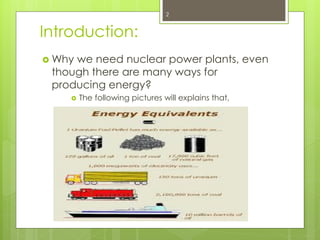
Explanation for diagram:
The picture explains that,
 1 uranium pellet produces energy as,
 120 gallons of oil,
 1 ton of coal,
 17000 cubic feet of natural gas.
 1000 megawatts of electricity is produced by,
 150 tons of uranium,
 2100000 tons of coal,
 10 million barrels of oil.
Reference:
1 US Gallon=3.78 liters or 231 cub. Inch.
1 UK Gallon=4.54 liters or 277.42 cub. Inch.
3
How could we get this level of
demand for energy ?
 Because in past decades there is not
much industries and all.
 But now ,there are many industries.
 So ,energy is needed in more amount.
 Therefore the nuclear power plants came
Into light.
4
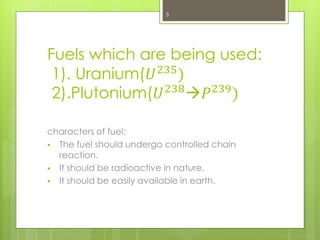
Fuels which are being used:
1). Uranium(𝑈235
)
2).Plutonium(𝑈238
𝑃239
)
characters of fuel:
 The fuel should undergo controlled chain
reaction.
 It should be radioactive in nature.
 It should be easily available in earth.
5
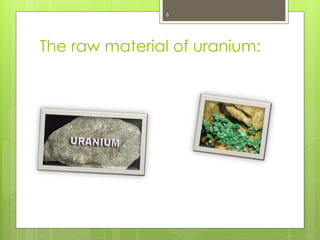
The raw material of uranium:
6
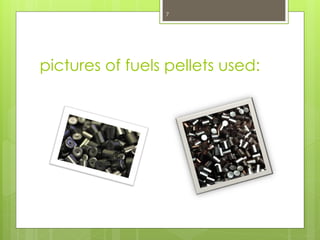
pictures of fuels pellets used:
7
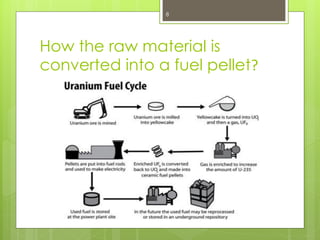
How the raw material is
converted into a fuel pellet?
8
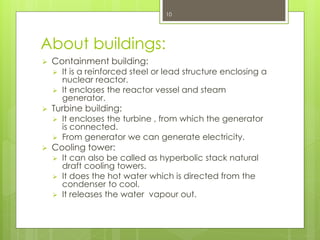
Buildings in plant:
 There are many buildings in the nuclear
power plant.
 The main buildings are,
 Containment building,
 Turbine building,
 Cooling towers.
9
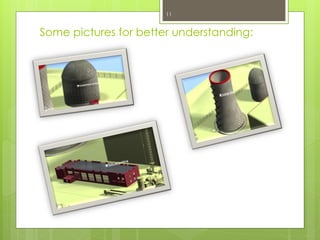
About buildings:
 Containment building:
 It is a reinforced steel or lead structure enclosing a
nuclear reactor.
 It encloses the reactor vessel and steam
generator.
 Turbine building:
 It encloses the turbine , from which the generator
is connected.
 From generator we can generate electricity.
 Cooling tower:
 It can also be called as hyperbolic stack natural
draft cooling towers.
 It does the hot water which is directed from the
condenser to cool.
 It releases the water vapour out.
10
Some pictures for better understanding:
11
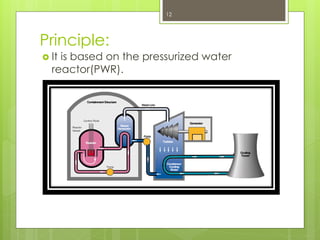
Principle:
 It is based on the pressurized water
reactor(PWR).
12
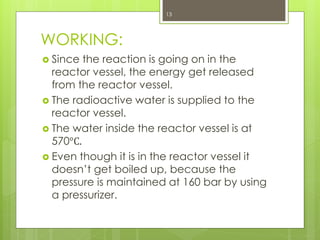
WORKING:
 Since the reaction is going on in the
reactor vessel, the energy get released
from the reactor vessel.
 The radioactive water is supplied to the
reactor vessel.
 The water inside the reactor vessel is at
570°C.
 Even though it is in the reactor vessel it
doesn’t get boiled up, because the
pressure is maintained at 160 bar by using
a pressurizer.
13
14
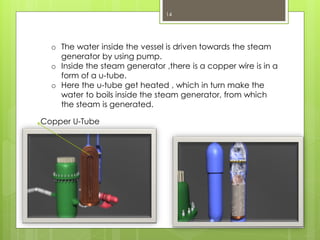
o The water inside the vessel is driven towards the steam
generator by using pump.
o Inside the steam generator ,there is a copper wire is in a
form of a u-tube.
o Here the u-tube get heated , which in turn make the
water to boils inside the steam generator, from which
the steam is generated.
Copper U-Tube
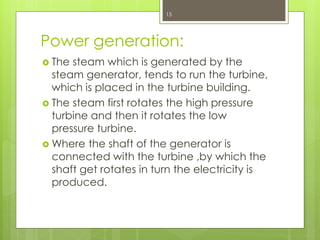
Power generation:
 The steam which is generated by the
steam generator, tends to run the turbine,
which is placed in the turbine building.
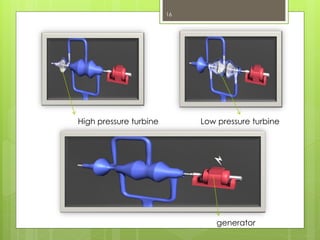
 The steam first rotates the high pressure
turbine and then it rotates the low
pressure turbine.
 Where the shaft of the generator is
connected with the turbine ,by which the
shaft get rotates in turn the electricity is
produced.
15
16
High pressure turbine Low pressure turbine
generator
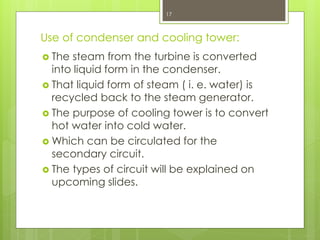
Use of condenser and cooling tower:
 The steam from the turbine is converted
into liquid form in the condenser.
 That liquid form of steam ( i. e. water) is
recycled back to the steam generator.
 The purpose of cooling tower is to convert
hot water into cold water.
 Which can be circulated for the
secondary circuit.
 The types of circuit will be explained on
upcoming slides.
17
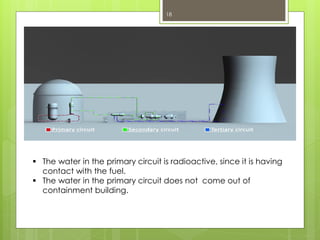
18
 The water in the primary circuit is radioactive, since it is having
contact with the fuel.
 The water in the primary circuit does not come out of
containment building.
19
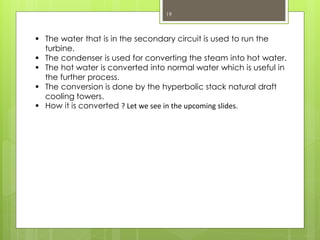
 The water that is in the secondary circuit is used to run the
turbine.
 The condenser is used for converting the steam into hot water.
 The hot water is converted into normal water which is useful in
the further process.
 The conversion is done by the hyperbolic stack natural draft
cooling towers.
 How it is converted ? Let we see in the upcoming slides.
20
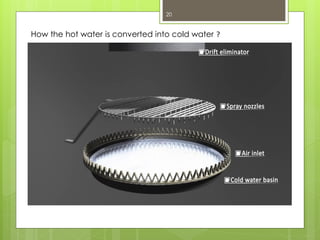
How the hot water is converted into cold water ?
21
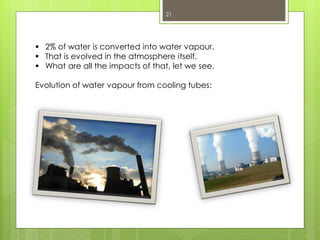
 2% of water is converted into water vapour.
 That is evolved in the atmosphere itself.
 What are all the impacts of that, let we see.
Evolution of water vapour from cooling tubes:
Impacts:
 Before seeing impacts ,we want to see the
overview about nuclear power plants.
 Overview:
 The use of nuclear power as a source of domestic
energy has increased significantly over the past
decade and is expected to continue to do so in the
years to come.
 However, the use of this form of energy does not
come without a unique set of consequences.
 These can range from environmental impact, altering
to a great extent the balance in the flora and fauna
of a region, to causing social problems to do with
social consensus and risk perceptions of people living
in the vicinity of such a plant.
 The upcoming slide discusses some of the down-sides
nuclear power generation is credited for
22
23
Heat Rejection:
 As is with the case of thermal power plants (based on
fossil fuels), nuclear power plants require some means
by which they can expel heat as part of their
condenser system.
 The amount of heat varies from the different
components used in the plant but on an average
about 60 to 70% of thermal energy from the nuclear
fuel is rejected out of the plant.
 Some plants use cooling towers while some use a
large body of water, such as an artificial lake or a
natural body of water such as a lake or a river.
 It also adversely affects the aquatic life of the
ecosystem into which heat is rejected.
 In some cases, the heat rejected into water bodies
can cause fluctuations in flow rates of rivers and
anomalies in sea level.
 One particular research done showed an average
rise in sea level of about 3mm/yr of the Northeast
coast of US.
24
Gaseous Emissions:
 The gaseous emissions from a nuclear power plant can be of
different forms and intensities.
 Nuclear power plants use diesel generators as a means for
back-up electric power in case of emergencies.
 Most are also required to run and test these systems once
every month to ensure their working.
 As such, they release greenhouses gases into the atmosphere.
These gases primarily consist of carbon dioxide, carbon
monoxide, nitrous oxides and sulfur dioxides.
 Apart from greenhouse gases, exhaust gases from buildings
containing radioactive processes is radioactive in nature.
 In addition, in plants with boiling water reactors, the air ejector
exhaust is radioactive as well.
 Such exhausts are passed through delay pipes, storage tanks
and hydrogen recombines before release into the environment
to ensure that radiation levels are in accordance to regulations.
 Radioactive exhaust from nuclear power plants is also known
to cause skin problems of several kinds.
25
Environmental Impact:
 Perhaps the impact which is easiest to notice is the effect on the
environment, particularly in terms of flora and fauna.
 To start with, the setting up of a nuclear plant requires a large
area, preferably situated near a natural water body.
 This is usually accompanied with clearing of forests which
disturbs the natural habitat of several creatures and gradually
upsets the ecological balance of the region.
 Apart from this, studies have shown that due to the heat
rejected into the water bodies, there have been significant
drops in the populations of several species of fish in certain
regions of US.
 Another significant effect is the increased amount of sulfur
dioxide in the air which causes acid rain to form which then
leads to contamination of surface water bodies of the region,
reduction of productivity of the soil, and has several other
negative effects on the region's vegetation and human health.
26
Social Impact:
 Setting up a nuclear power plant in any region does not come
without concerns and criticism from a wide variety of people.
 People in such regions fear the threat of being exposed to
unusual levels of radiation.
 The natural water sources in such places are also doubted to
contain plant emissions especially if the plant uses the body of
water as a heat sink.
 In addition, during the post 9-11 era, there has also been an
increased concern over reactor safety and integrity.
 As such, a lot of effort has to go into convincing the people
living around the plant that it is securely designed with several
safety measures.
 Among other impacts that it can have on the region, plant
commissioning in a region causes impairment of aesthetic,
recreational and natural conservation values and also
significantly lowers the value of the surrounding property.
27
In addition with these impacts the evolution of water vapour
that makes a major problem , how?
 Because there is amount which is to be present in the ambience.
 i.e. maximally 4% has to present , if not means it will leads to
global warming and leads to climate changes.
Another problem is elimination of waste:
 Some radioactive waste will remain undecomposed for millions of
years.
 This also a another major problem.
THE END
DONE BY,
ABDULLAH
ABISHEK
(PSG COLLEGE OF TECHNOLOGY)
28

Nuclear power plant

  • 1.
    Nuclear power plant Contents:  Introduction Fuels  Working  Power generation  controls 1
  • 2.
    Introduction:  Why weneed nuclear power plants, even though there are many ways for producing energy?  The following pictures will explains that, 2
  • 3.
    Explanation for diagram: Thepicture explains that,  1 uranium pellet produces energy as,  120 gallons of oil,  1 ton of coal,  17000 cubic feet of natural gas.  1000 megawatts of electricity is produced by,  150 tons of uranium,  2100000 tons of coal,  10 million barrels of oil. Reference: 1 US Gallon=3.78 liters or 231 cub. Inch. 1 UK Gallon=4.54 liters or 277.42 cub. Inch. 3
  • 4.
    How could weget this level of demand for energy ?  Because in past decades there is not much industries and all.  But now ,there are many industries.  So ,energy is needed in more amount.  Therefore the nuclear power plants came Into light. 4
  • 5.
    Fuels which arebeing used: 1). Uranium(𝑈235 ) 2).Plutonium(𝑈238 𝑃239 ) characters of fuel:  The fuel should undergo controlled chain reaction.  It should be radioactive in nature.  It should be easily available in earth. 5
  • 6.
    The raw materialof uranium: 6
  • 7.
    pictures of fuelspellets used: 7
  • 8.
    How the rawmaterial is converted into a fuel pellet? 8
  • 9.
    Buildings in plant: There are many buildings in the nuclear power plant.  The main buildings are,  Containment building,  Turbine building,  Cooling towers. 9
  • 10.
    About buildings:  Containmentbuilding:  It is a reinforced steel or lead structure enclosing a nuclear reactor.  It encloses the reactor vessel and steam generator.  Turbine building:  It encloses the turbine , from which the generator is connected.  From generator we can generate electricity.  Cooling tower:  It can also be called as hyperbolic stack natural draft cooling towers.  It does the hot water which is directed from the condenser to cool.  It releases the water vapour out. 10
  • 11.
    Some pictures forbetter understanding: 11
  • 12.
    Principle:  It isbased on the pressurized water reactor(PWR). 12
  • 13.
    WORKING:  Since thereaction is going on in the reactor vessel, the energy get released from the reactor vessel.  The radioactive water is supplied to the reactor vessel.  The water inside the reactor vessel is at 570°C.  Even though it is in the reactor vessel it doesn’t get boiled up, because the pressure is maintained at 160 bar by using a pressurizer. 13
  • 14.
    14 o The waterinside the vessel is driven towards the steam generator by using pump. o Inside the steam generator ,there is a copper wire is in a form of a u-tube. o Here the u-tube get heated , which in turn make the water to boils inside the steam generator, from which the steam is generated. Copper U-Tube
  • 15.
    Power generation:  Thesteam which is generated by the steam generator, tends to run the turbine, which is placed in the turbine building.  The steam first rotates the high pressure turbine and then it rotates the low pressure turbine.  Where the shaft of the generator is connected with the turbine ,by which the shaft get rotates in turn the electricity is produced. 15
  • 16.
    16 High pressure turbineLow pressure turbine generator
  • 17.
    Use of condenserand cooling tower:  The steam from the turbine is converted into liquid form in the condenser.  That liquid form of steam ( i. e. water) is recycled back to the steam generator.  The purpose of cooling tower is to convert hot water into cold water.  Which can be circulated for the secondary circuit.  The types of circuit will be explained on upcoming slides. 17
  • 18.
    18  The waterin the primary circuit is radioactive, since it is having contact with the fuel.  The water in the primary circuit does not come out of containment building.
  • 19.
    19  The waterthat is in the secondary circuit is used to run the turbine.  The condenser is used for converting the steam into hot water.  The hot water is converted into normal water which is useful in the further process.  The conversion is done by the hyperbolic stack natural draft cooling towers.  How it is converted ? Let we see in the upcoming slides.
  • 20.
    20 How the hotwater is converted into cold water ?
  • 21.
    21  2% ofwater is converted into water vapour.  That is evolved in the atmosphere itself.  What are all the impacts of that, let we see. Evolution of water vapour from cooling tubes:
  • 22.
    Impacts:  Before seeingimpacts ,we want to see the overview about nuclear power plants.  Overview:  The use of nuclear power as a source of domestic energy has increased significantly over the past decade and is expected to continue to do so in the years to come.  However, the use of this form of energy does not come without a unique set of consequences.  These can range from environmental impact, altering to a great extent the balance in the flora and fauna of a region, to causing social problems to do with social consensus and risk perceptions of people living in the vicinity of such a plant.  The upcoming slide discusses some of the down-sides nuclear power generation is credited for 22
  • 23.
    23 Heat Rejection:  Asis with the case of thermal power plants (based on fossil fuels), nuclear power plants require some means by which they can expel heat as part of their condenser system.  The amount of heat varies from the different components used in the plant but on an average about 60 to 70% of thermal energy from the nuclear fuel is rejected out of the plant.  Some plants use cooling towers while some use a large body of water, such as an artificial lake or a natural body of water such as a lake or a river.  It also adversely affects the aquatic life of the ecosystem into which heat is rejected.  In some cases, the heat rejected into water bodies can cause fluctuations in flow rates of rivers and anomalies in sea level.  One particular research done showed an average rise in sea level of about 3mm/yr of the Northeast coast of US.
  • 24.
    24 Gaseous Emissions:  Thegaseous emissions from a nuclear power plant can be of different forms and intensities.  Nuclear power plants use diesel generators as a means for back-up electric power in case of emergencies.  Most are also required to run and test these systems once every month to ensure their working.  As such, they release greenhouses gases into the atmosphere. These gases primarily consist of carbon dioxide, carbon monoxide, nitrous oxides and sulfur dioxides.  Apart from greenhouse gases, exhaust gases from buildings containing radioactive processes is radioactive in nature.  In addition, in plants with boiling water reactors, the air ejector exhaust is radioactive as well.  Such exhausts are passed through delay pipes, storage tanks and hydrogen recombines before release into the environment to ensure that radiation levels are in accordance to regulations.  Radioactive exhaust from nuclear power plants is also known to cause skin problems of several kinds.
  • 25.
    25 Environmental Impact:  Perhapsthe impact which is easiest to notice is the effect on the environment, particularly in terms of flora and fauna.  To start with, the setting up of a nuclear plant requires a large area, preferably situated near a natural water body.  This is usually accompanied with clearing of forests which disturbs the natural habitat of several creatures and gradually upsets the ecological balance of the region.  Apart from this, studies have shown that due to the heat rejected into the water bodies, there have been significant drops in the populations of several species of fish in certain regions of US.  Another significant effect is the increased amount of sulfur dioxide in the air which causes acid rain to form which then leads to contamination of surface water bodies of the region, reduction of productivity of the soil, and has several other negative effects on the region's vegetation and human health.
  • 26.
    26 Social Impact:  Settingup a nuclear power plant in any region does not come without concerns and criticism from a wide variety of people.  People in such regions fear the threat of being exposed to unusual levels of radiation.  The natural water sources in such places are also doubted to contain plant emissions especially if the plant uses the body of water as a heat sink.  In addition, during the post 9-11 era, there has also been an increased concern over reactor safety and integrity.  As such, a lot of effort has to go into convincing the people living around the plant that it is securely designed with several safety measures.  Among other impacts that it can have on the region, plant commissioning in a region causes impairment of aesthetic, recreational and natural conservation values and also significantly lowers the value of the surrounding property.
  • 27.
    27 In addition withthese impacts the evolution of water vapour that makes a major problem , how?  Because there is amount which is to be present in the ambience.  i.e. maximally 4% has to present , if not means it will leads to global warming and leads to climate changes. Another problem is elimination of waste:  Some radioactive waste will remain undecomposed for millions of years.  This also a another major problem.
  • 28.
    THE END DONE BY, ABDULLAH ABISHEK (PSGCOLLEGE OF TECHNOLOGY) 28